لماذا أصبح مركز اختبار التقنيات الزراعية متطلباً تجارياً


A modern tractor, sprayer, harvester, implement, or agricultural robot is no longer only a mechanical product. It may contain several electronic control units, an operator terminal, GNSS and RTK positioning, cameras, LiDAR, radar, local wireless communication, cellular connectivity, cloud services, mobile applications, and integrations with a Farm Management System.
The individual components can pass their own tests while the complete agricultural workflow still fails. A variable-rate prescription may be calculated correctly but rejected by the terminal. A sensor may produce valid readings but use a unit that the cloud platform interprets incorrectly. An over-the-air update may install successfully but leave the machine unable to reconnect to the implement.
An تكنولوجيا الزراعة Test Centre can help with that, serving as a good direction for the business. That’s why, in this article, we explore what an AgriTech Test Centre is, the failure modes it should target, the problems it can prevent, and the benefits it can bring. We also explain how this approach must cover interoperability and adapt to support AI-enabled agricultural machinery.
مركز اختبار AgriTech لتلبية احتياجات القطاع ومخاطره
توضح بيانات Eurostat الرسمية اتجاه هذا التحول التقني. In 2023, around 18% of EU farms with utilised agricultural area applied at least one precision farming technology or practice. About 11% of EU farms used farm management information systems, while about 7% used agricultural robots. In the same dataset, around 43% of EU farms reported internet access.
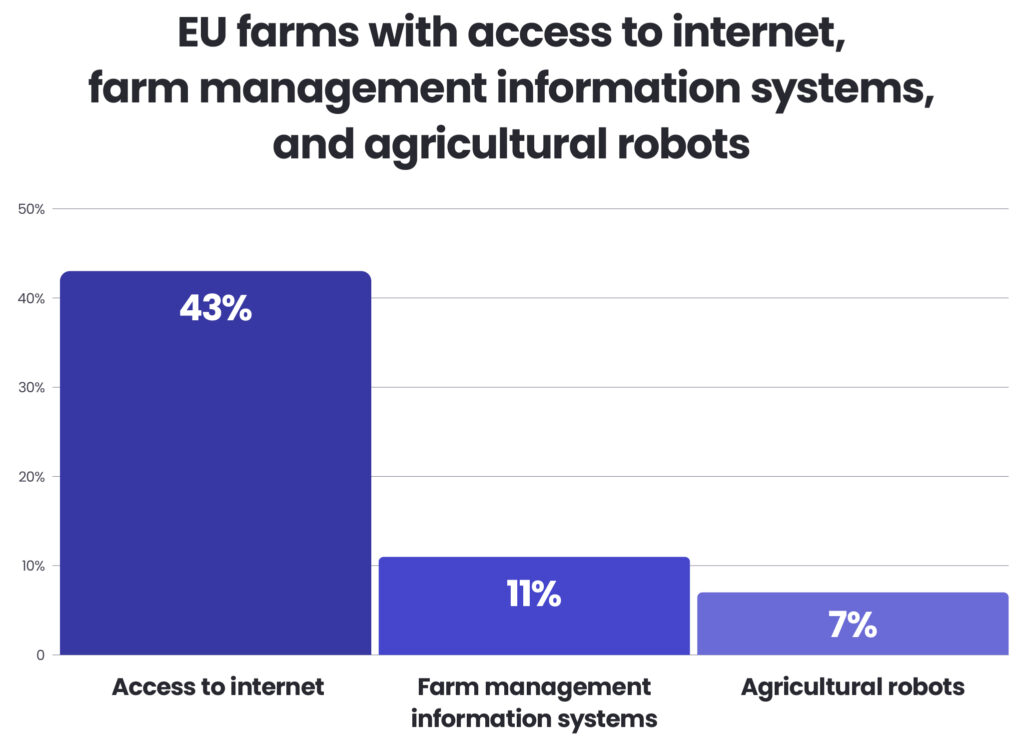
المصدر: يوروستات – مقال: 43% من مزارع الاتحاد الأوروبي لديها إمكانية الوصول إلى الإنترنت
This matters for product validation. Digital agriculture has not yet reached every holding, but the systems already deployed increasingly combine machinery, software, connectivity, and data-driven workflows. One software release can therefore affect many machines and time-critical field operations.
يعالج مركز اختبار AgriTech المخصص خمسة مخاطر تجارية في وقت مبكر:
- مخاطر الإصدار الموسمي: قد لا يكون العيب المكتشف أثناء البذر أو الرش أو الحصاد قابلًا للتكرار في ظل نفس الظروف في عام آخر.
- مخاطر التكوين: قد يحتاج التنفيذ الواحد إلى العمل مع عدة علامات تجارية للجرارات، وأجيال من المحطات الطرفية، وأجهزة استقبال GNSS، وفروع برمجية.
- مخاطر التكامل: قد يمتد سير العمل عبر البرمجيات المدمجة، أو CAN أو ISOBUS، أو التليماتية، أو واجهات برمجة التطبيقات السحابية، أو تطبيقات الهاتف المحمول، أو برمجيات المزارع.
- مخاطر السلامة: يجب أن تتصرف وظائف الإدراك والتحكم والاتصال والوظائف الاحتياطية بشكل متوقع حول الأشخاص والمحاصيل والحيوانات والآلات الأخرى.
- مخاطر الخدمة: تُعدّ حالات الفشل الميدانية مكلفة في التشخيص عندما لا تستطيع المؤسسة إعادة إنتاج إعدادات العميل في بيئة مُتحكَّم بها.
لا يقتصر الغرض من مركز الاختبار على توظيف المزيد من المختبِرين فحسب؛ بل يهدف إلى جعل الأدلة قابلة للتكرار، والإعدادات قابلة للتحكم، وقرارات الإصدار قابلة للقياس.
من يستفيد من مركز اختبار التقنيات الزراعية، وما المشكلات التي يحلها
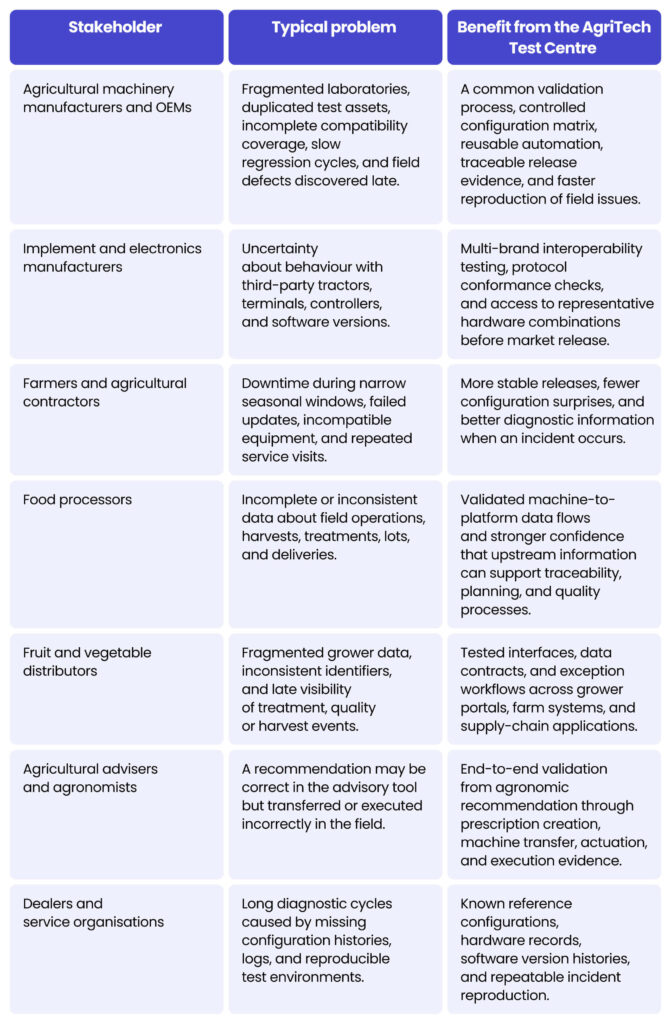
An AgriTech Test Centre is usually funded and operated by a machinery manufacturer, technology provider, or engineering partner. However, its benefits extend across the agricultural and food supply chain. The value differs by stakeholder.
الجدول 1. المشكلات والفوائد حسب مجموعة أصحاب المصلحة
ما هو مركز اختبار AgriTech المخصص؟
A dedicated AgriTech Test Centre is a managed testing ecosystem that combines people, laboratories, hardware, simulation, automation, governance, and field validation. It supports the complete product rather than one application or electronic component in isolation.
“Dedicated” doesn’t have to mean that every engineer and device belongs exclusively to one manufacturer or sits in one building. It means that the organisation has controlled capacity, defined responsibilities, managed configurations, repeatable processes, and agreed release criteria.
يتضمن مركز الاختبار الناضج عادةً:
- اختبار البرمجيات المدمجة ووحدات التحكم الإلكترونية؛
- بيئات البرمجيات في الحلقة والعتاد في الحلقة؛
- محاكاة الاتصالات عبر CAN وISOBUS والإيثرنت والاتصالات التسلسلية؛
- محاكاة GNSS وRTK والمستشعرات والاتصال؛
- اختبار قابلية التشغيل البيني بين الجرار والطرفية والمعدات المرفقة؛
- اختبار تكامل السحابة وAPI والجوال ونظام إدارة المزرعة؛
- التحقق من التحديثات اللاسلكية وإمكانية التراجع؛
- التحقق من السلامة الوظيفية والأمن السيبراني؛
- تشخيص العتاد وإصلاحه وإدارة التكوين؛
- حملات الآلات الحقيقية والتحمل والميدان؛
- لوحات معلومات الإصدار وحوكمة الجودة.
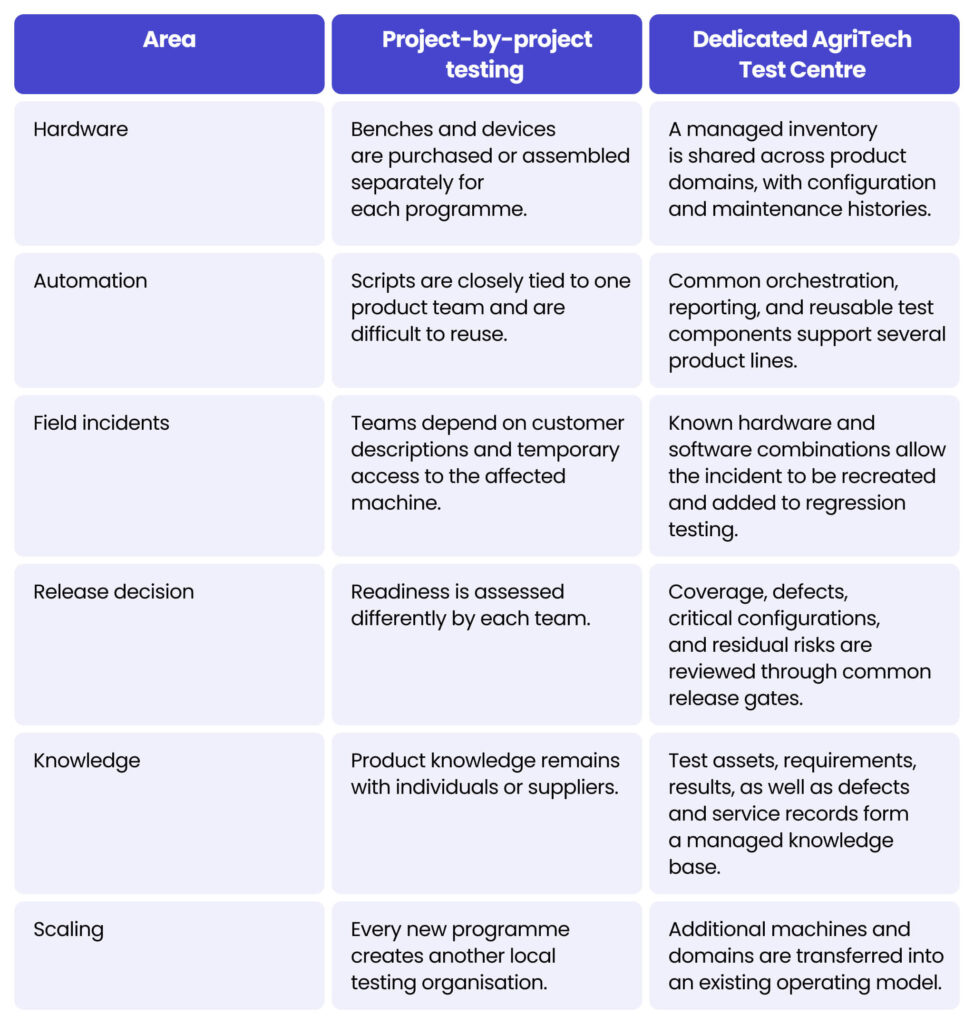
الجدول 2. الاختبار مشروعاً بمشروع مقارنة بمركز اختبار مخصص
عشرة أنماط فشل عالية الأولوية يجب أن يستهدفها مركز اختبار AgriTech
The exact risk ranking depends on the machine, its intended use, and its Operational Design Domain (ODD). That’s why the following list is not a universal safety classification; It is a practical engineering priority list for connected and software-defined agricultural products.
يجب ربط كل نمط فشل بسيناريو قابل للتكرار، والسلوك المتوقع، ومتطلبات الأدلة، ومعيار الإصدار.
1. عدم التوافق بين الجرار والطرفية والمعدات الملحقة
تتصل الأجهزة ماديًا لكنها تعرض وظائف مدعومة مختلفة، أو مجموعات كائنات مختلفة، أو قدرات مختلفة لوحدات التحكم في المهام، أو تفسيرات برمجية مختلفة.
2. انحراف إصدار البرمجيات
يتحقق المختبر من تركيبة واحدة من البرامج الثابتة، بينما يشغّل الوكلاء أو العملاء تركيبة أخرى بخيارات أو تصحيحات أو إعدادات إقليمية مختلفة.
3. تحديث OTA متقطع أو جزئي
يُقاطَع التحديث بسبب انقطاع التيار الكهربائي أو فشل الاتصال، أو تُكمل وحدات التحكم الإلكترونية المختلفة التحديث في أوقات مختلفة.
4. فقدان الاتصال الخلوي أو السحابي
تواصل الآلة العملية ولكنها تفشل في تخزين البيانات مؤقتًا أو مزامنتها أو تسويتها بشكل صحيح عند عودة الاتصال.
5. تدهور GNSS أو RTK
تنخفض دقة تحديد المواقع بالقرب من الأشجار أو المباني أو المنحدرات أو عند ضعف تغطية التصحيح، لكن منطق التحكم لا يدخل في وضع متدهور مناسب.
6. تلوّث المستشعر أو خطأ المعايرة
الغبار أو الطين أو الماء أو الاهتزاز أو درجة الحرارة أو الحركة الميكانيكية تغيّر مخرجات المستشعر دون إحداث عطل واضح في الأجهزة.
7. التحويل غير الصحيح للوحدات أو الإحداثيات أو تنسيق البيانات
يتم تفسير قيمة صالحة بوحدة خاطئة، أو نظام إحداثيات خاطئ، أو دقة عشرية خاطئة، أو مرجع حدود حقل خاطئ.
8. عدم التوافق بين عقد السحابة والآلة
يتم قبول وصفة طبية أو مهمة أو تكوين من قبل خدمة واحدة ولكن يتم رفضه أو تفسيره بشكل مختلف من قبل مكون آخر.
9. سلوك احتياطي غير آمن أو غير واضح
يكتشف النظام عدم اليقين لكنه يستمر، أو يتوقف متأخراً جداً، أو يقدم للمشغل معلومات غير كافية للتدخل.
10. عيب موسمي غير قابل لإعادة الإنتاج
يعتمد الفشل على مرحلة المحصول، أو حالة تربة محددة، أو نمط طقس معين، أو مستوى إضاءة، أو تسلسل تشغيلي غير متاح عندما يحقق المهندسون في المشكلة.
These risks rarely belong to one engineering discipline. They cross embedded software, electronics, control, connectivity, cloud architecture, data management, user experience, and field operations. This is the main reason a system-level Test Centre produces more value than several disconnected component test teams.
من المختبر إلى الميدان: نموذج التحقق رباعي الطبقات
A laboratory cannot eliminate field testing, and field testing cannot replace a controlled laboratory. The effective model uses several validation layers, each designed to detect a different class of defects.
ينقل التسلسل حالات الفشل المكلفة والصعبة التكرار إلى مرحلة أبكر. ثم يتم التقاط الأدلة الواقعية وإعادة استخدامها لتعزيز الاختبار الارتدادي المخبري المستقبلي.
الجدول 3. أربع طبقات للتحقق من صحة الآلات الزراعية
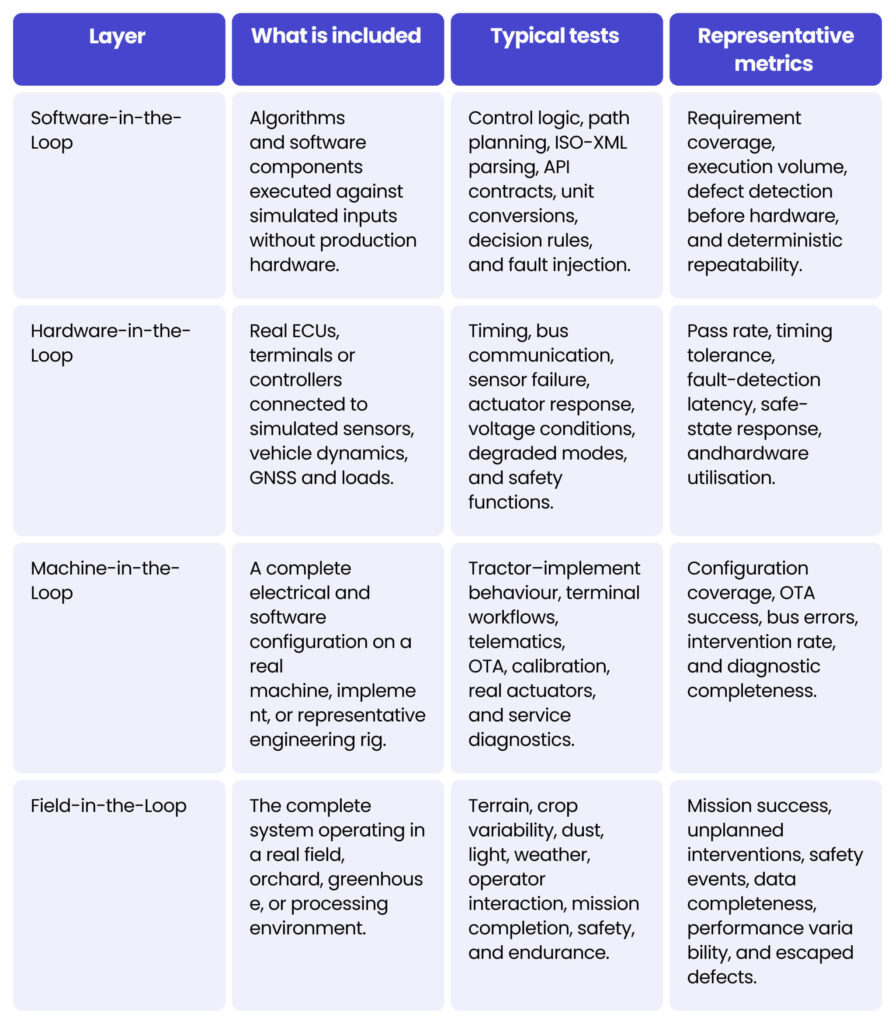
Field-in-the-Loop should also create reusable laboratory assets. Logs, images, sensor streams, GNSS traces, and communication events collected during field campaigns can be replayed against later software versions. A rare field failure then becomes a permanent regression test rather than a one-off engineering anecdote.
لماذا تُعد قابلية التشغيل البيني مشكلة اختبار على مستوى النظام
ISO 11783، المعروف باسم ISOBUS, defines communication between agricultural tractors, implements, and related software applications. The standard creates a common foundation, but the Agricultural Industry Electronics Foundation (AEF) notes that implementation still leaves room for interpretation and different supported functionalities. Therefore, compatibility depends on the functions shared by the complete tractor–terminal–implement combination, not on the presence of an ISOBUS connector alone. [3]
يُظهر حجم اختبارات التشغيل البيني الصناعي سبب الحاجة إلى قدرة دائمة. في ملتقى AEF Plugfest الأوروبي 2024، أجرى أكثر من 350 مشاركاً أكثر من 3,000 اختبار شملت خوادم وعملاء ISOBUS من مصنّعين مختلفين في ثلاثة أيام.
Even a modest internal compatibility matrix grows quickly. Five tractor configurations, four terminals, six implements, and three active software branches already create 360 possible combinations. This is before adding GNSS receivers, optional functions, countries, languages, mobile applications, FMS versions, and connectivity conditions.
لهذا السبب ينبغي لمركز اختبار التقنيات الزراعية أن يختبر قابلية التشغيل البيني على عدة مستويات:
- المستوى المادي ومستوى الشبكة: الموصلات، والطاقة، وحركة CAN، والمطالبة بالعنوان، واستقرار الاتصال.
- المستوى الوظيفي: وظائف ISOBUS المدعومة، وسلوك وحدة التحكم في المهام، والتحكم في الأقسام، والتحكم في المعدل المتغير، وإدارة المعدات الزراعية (Tractor Implement Management).
- مستوى البيانات: ISO-XML، وحدود الحقول، وخرائط الوصفات، وسجلات الآلات، والمعرفات، والوحدات، وأنظمة الإحداثيات.
- مستوى التطبيق: الأجهزة الطرفية، وتطبيقات الجوال، والبوابات الإلكترونية، ومنصات FMS، وأدوات الخدمة.
- مستوى السحابة: واجهات برمجة التطبيقات، وقوائم انتظار الرسائل، ومخططات الأحداث، والمزامنة المتأخرة، ومعالجة التكرارات.
- المستوى الزراعي: ما إذا كان الإجراء الذي نفذته الآلة في النهاية يطابق التوصية والمنتج المسموح به والجرعة والمنطقة المستهدفة.
The last category is important for advisory applications. A plant protection product search engine, including a localised version of it, may return the correct product and legal parameters. The complete workflow still needs tests confirming that the recommendation is transferred to the FMS, converted into the correct task, applied to the intended field area, and recorded without changing the dose, unit, or product identifier.
اختبار الآلات الزراعية ذاتية القيادة والمزودة بالذكاء الاصطناعي
Autonomous machinery increases the validation burden because expected behaviour cannot be defined only as a simple input and output. The system must perceive an uncertain environment, estimate risk, select an action, control the machine, and monitor whether the result remains safe.
A مراجعة منهجية أجراها Aby وIssa صنّفت الأبحاث on the safety of automated agricultural machinery into three main areas: environmental perception, risk assessment and mitigation, and human factors and ergonomics. The review concluded that safe operation is central to commercial deployment and highlighted the value of reliable software environments for testing automated machinery functions.
الـ توفّر سلسلة ISO 18497 إطاراً على مستوى النظام للسلامة من الآلات الزراعية عالية الأتمتة. تغطي متطلباتها ومبادئ التحقق منها الإدراك والحماية والتحكم والإشراف والتحقق من الوظائف المتعلقة بالسلامة.
الجمع بين ODD ومركز اختبار AgriTech للتحقق من صحة الأنظمة القائمة على الذكاء الاصطناعي
Testing must be linked to the machine’s Operational Design Domain (ODD). An Operational Design Domain is the set of conditions in which an automated function is intended to operate. It may specify crop type, terrain, slope, speed, weather, light, connectivity, supervision, field boundaries, and permitted proximity to people.
بالنسبة لنظام زراعي مدعوم بالذكاء الاصطناعي، يجب أن يتضمن برنامج التحقق على الأقل:
- مجموعات بيانات تمثيلية وصعبة، بما في ذلك الإضاءة الضعيفة والحجب والغبار وظروف المحاصيل غير المعتادة؛
- تحليل النتائج السلبية الكاذبة والإيجابية الكاذبة للأجسام ذات الصلة بالسلامة؛
- زمن الكشف والتحكم تحت أقصى حمل معالجة؛
- سلوك دمج المستشعرات عندما يصبح أحد المصادر متدهورًا أو غير متاح؛
- استجابة الإيقاف الآمن والرجوع إلى الوضع السابق؛
- مراقبة انحراف البيانات عبر المحاصيل والمواسم والدول وإصدارات الأجهزة؛
- تنبيهات المشغل، وآليات التدخل، والإشراف عن بُعد؛
- التتبع من المخاطر ومتطلبات السلامة إلى أدلة الاختبار.
Simulation makes rare and dangerous scenarios repeatable. Hardware-in-the-Loop confirms that the production electronics react correctly. Then, field trials verify that the models, assumptions, and physical machine remain valid in the intended environment.
دراسة حالة: التحقق من نظام بيئي للزراعة الدقيقة ذات الحلقة المغلقة على نطاق واسع
سياق الأعمال
Agri solutions needed to connect automatic steering and navigation systems with the FarmCloud Farm Management System. The objective was a closed-loop precision farming workflow in which agronomic intelligence could create a variable-rate prescription, transfer it to a field terminal, record machine tracks, and return operational telemetry to the platform.
The published project involved GPS, mobile applications, Microsoft Azure, ISO-XML, IoT and APIs. It required a scalable, cloud-native integration layer able to support continuous telemetry and large device fleets during the agricultural season.
الجدول 4. نطاق المشروع المنشور ومؤشرات الأداء
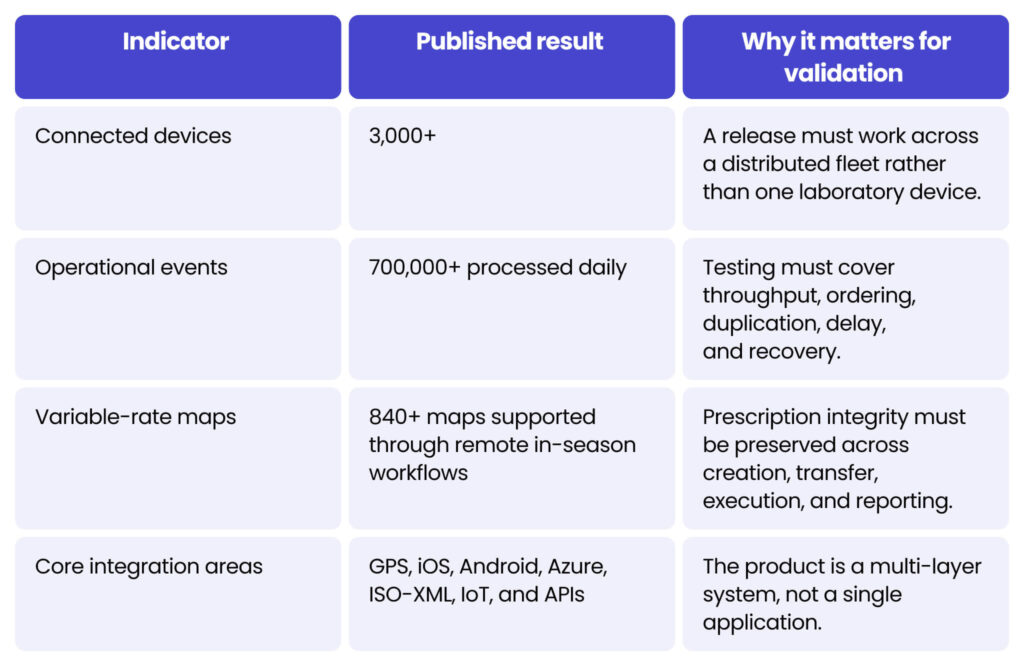
تأتي أرقام المشاريع هذه من محفظة Spyrosoft للمشاريع الزراعية.
ما يضيفه نهج مركز الاختبار
The case study above presents an integration architecture and execution layer. However, it does not state that the project was contracted as a complex Managed Test Centre. The validation design below is therefore an engineering interpretation of how the same system could be industrialised through a dedicated AgriTech Test Centre.
سيقسّم مركز اختبار مناسب سير العمل إلى ستة مجالات اختبار قابلة للتكرار:
- التحقق من الوصفات الطبية. تحقق من الهندسة الميدانية، وأنظمة الإحداثيات، والوحدات، وحدود الجرعة، ومعرفات المنتجات، وبنية ISO-XML قبل النقل.
- توافق الأجهزة الطرفية والأجهزة. نفّذ نفس الوصفة على أطراف التوجيه وأجهزة التحكم وإصدارات البرمجيات التمثيلية.
- الاتصال وسلوك وضع عدم الاتصال. إدخال التأخير والانقطاع والرسائل المكررة والمزامنة المتقطعة.
- إدارة التحديثات عن بعد والتكوين. اختبر النشر التدريجي، وانقطاع الطاقة، والتراجع، والتبعيات غير المتوافقة، وإعداد تقارير حالة الأسطول.
- تسوية البيانات التليمترية. قارن العمليات المخططة ومسارات الآلات وسجلات التطبيق الفعلية وأحداث السحابة.
- الانحدار الموسمي. أعد تشغيل بيانات إنتاج تمثيلية قبل كل إصدار رئيسي واحتفظ بعيوب الميدان الحرجة كاختبارات دائمة.
This approach would make the system measurable at the level that matters to the user: not whether an API responded, but whether the intended field operation reached the correct machine, was executed correctly, and produced reliable evidence.
معيار قطاعي شامل: ما يمكن أن يحققه مركز اختبار مُصنَّع
Agricultural machinery is not identical to automotive. It does, however, share several engineering characteristics: distributed electronic control units, embedded software, communication buses, telematics, safety requirements, hardware variants, and continuous software releases.
Spyrosoft’s automotive OEM Test Centre provides a useful operating-model benchmark. It consolidated domain verification and integration testing across distributed teams, unified processes and infrastructure, and expanded test automation. The following data are evidence of the model’s scalability, not a guaranteed result for every agricultural programme.
الجدول 5. معيار مركز اختبار السيارات ومدى ملاءمته للتقنيات الزراعية
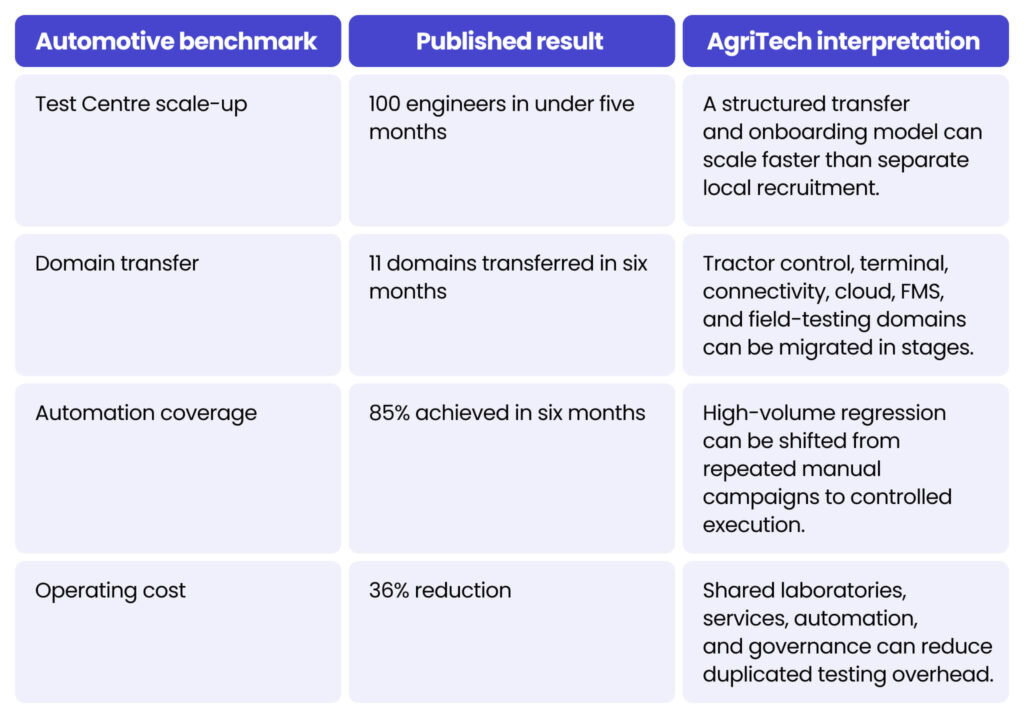
شمل المشروع توحيد العمليات، وتوحيد البنية التحتية، ومنصات الاختبار الموزعة، وإدارة الأجهزة، والتشخيصات، ولوحات المعلومات التشغيلية، وتتبع جاهزية الإصدار.
The relevant lesson is not that agriculture should copy automotive documentation word for word. It is that software-defined machinery eventually needs testing to become a managed production capability rather than an activity repeated independently by every development team.
ما الذي ينبغي أن يقيسه مركز اختبار AgriTech
The number of executed test cases alone should not judge a Test Centre for AgriTech. A large suite can still provide little confidence if it covers the wrong configurations, contains unstable tests, or cannot reproduce field defects.
ينبغي تحديد الأهداف بعد فترة خط أساس. تعتمد القيمة الصحيحة على مخاطر المنتج وتكرار الإصدار وأسطول الأجهزة المثبّتة وتوافر الأجهزة وتكلفة الفشل الميداني.
الجدول 6. المقاييس الموصى بها لمركز اختبار التقنيات الزراعية
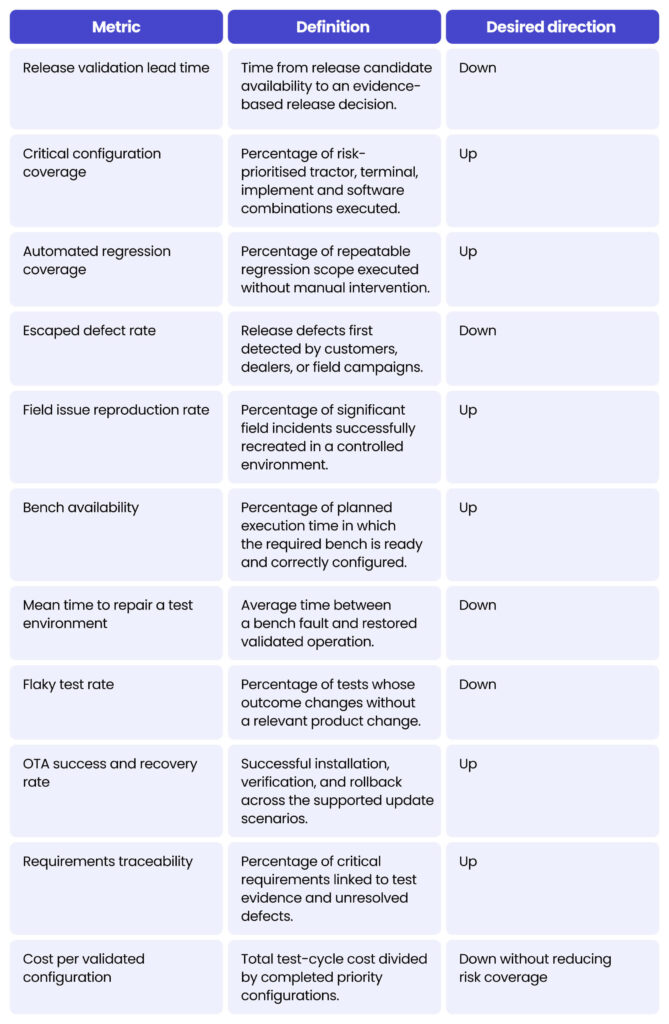
Management should review these metrics together. Faster execution is not an improvement if configuration coverage falls. Higher automation is not useful if flaky tests prevent teams from trusting the result.
تعرّف على كيفية بناء مركز اختبار AgriTech في ثماني خطوات
اقرأ المزيد
خلاصة القول
Agricultural machinery is becoming a software-defined system of systems. Tractors, implements, terminals, sensors, autonomous functions, cloud platforms, and Farm Management Systems now participate in the same operational workflow. Testing these elements separately does not provide sufficient evidence that the complete product will behave correctly in the field.
A dedicated AgriTech Test Centre creates a continuous validation chain from simulation and Hardware-in-the-Loop to complete machines and field trials. It manages hardware, configurations, automation, requirements, defects, release evidence and field-data replay through one operating model.
The strongest starting point is not a large laboratory investment. It is one high-risk workflow with a measurable business impact. Examples include transferring a variable-rate prescription to an implement, completing an OTA update before a seasonal operation, or proving that an autonomous machine enters a safe state when perception becomes uncertain.
So, if you are interested in building a dedicated AgriTech Test Centre with an experienced engineering team, contact us via the form below, and let’s see how we can support your agricultural business.
مصادر مختارة
- Eurostat (2026)، "43% من مزارع الاتحاد الأوروبي لديها إمكانية الوصول إلى الإنترنت"، بالإبلاغ عن بيانات عام 2023 حول الرقمنة الزراعية والزراعة الدقيقة. مقال إحصائي من يوروستات
- Aby, G. R. and Issa, S. F. (2023), “Safety of Automated Agricultural Machineries: A Systematic Literature Review”, Safety, 9(1), 13. منشور علمي مفتوح الوصول
- Agricultural Industry Electronics Foundation (AEF) (2024), European Plugfest 2024 review: over 350 participants and over 3,000 interoperability tests involving ISOBUS servers and clients from multiple manufacturers.
- سلسلة ISO 18497الآلات الزراعية والجرارات – سلامة الآلات شبه الآلية وشبه المستقلة والمستقلة.
الأسئلة الشائعة
No testing process can guarantee that a failure will never occur. A Test Centre reduces the risk by validating the update on representative hardware, testing interrupted installation and rollback, and checking critical machine–implement configurations before fleet deployment.
No. Laboratory testing is used to reproduce conditions, inject faults, and execute regression quickly. Field testing remains necessary to validate the complete machine in real crops, terrain, weather, dust, light, and operator conditions.
They create a risk-based configuration matrix covering tractors, terminals, implements, supported functions, and software versions. Automated protocol and functional tests are combined with representative physical connections and selected multi-brand field trials.
Yes. End-to-end tests can compare the planned operation, machine execution, telemetry, harvest or delivery event, and the final record in the processor’s platform. The test should also cover missing, delayed, and duplicate data.
The distributor needs tested data contracts, common identifiers, validation rules, and visible exception handling. An AgriTech Test Centre can verify integrations against representative grower systems and detect where information is lost, changed, or duplicated.
Yes. The test can start with the recommendation and prescription map, follow its conversion and transfer to the terminal, monitor implement actuation, and compare the completed operation with the original plan.
Yes. A plant protection product search engine, including a localised one, can be tested for data accuracy, filtering, units, and rules, followed by end-to-end tests of recommendation, prescription, machine transfer, and treatment recording.
Start with a workflow that crosses several system boundaries and has a high seasonal, safety or service impact. Good examples are an OTA update, a variable-rate prescription, a safety fallback, or a recurring multi-brand compatibility incident.


arrow_circle_rightاتصل بنا
لنتحدث عن كيفية مساعدتك في مركز اختبار AgriTech الخاص بك

arrow_circle_right مقالاتنا


