جواز المنتج الرقمي في قطاع الأغذية الزراعية وكيفية معالجة الفجوة المعمارية


Large food processors do not need another isolated compliance tool. They need a traceability architecture that connects supplier, batch, quality, production, warehouse, and logistics data across existing systems. A digital product passport in agri-food is an approach that helps frame that challenge: one product or batch record, fed by many operational systems, governed by clear data ownership, and designed for audits, recalls, EUDR, sustainability reporting, and future AI use cases.
لماذا نستخدم جواز المنتج الرقمي في قطاع الأغذية الزراعية؟
A digital product passport (DPP) approach can help food processors design one operational record for a batch, product, or supplier relationship. Food and feed are excluded from the direct scope of the EU Ecodesign for Sustainable Products Regulation, but the DPP architecture pattern is still relevant for agri-food traceability.
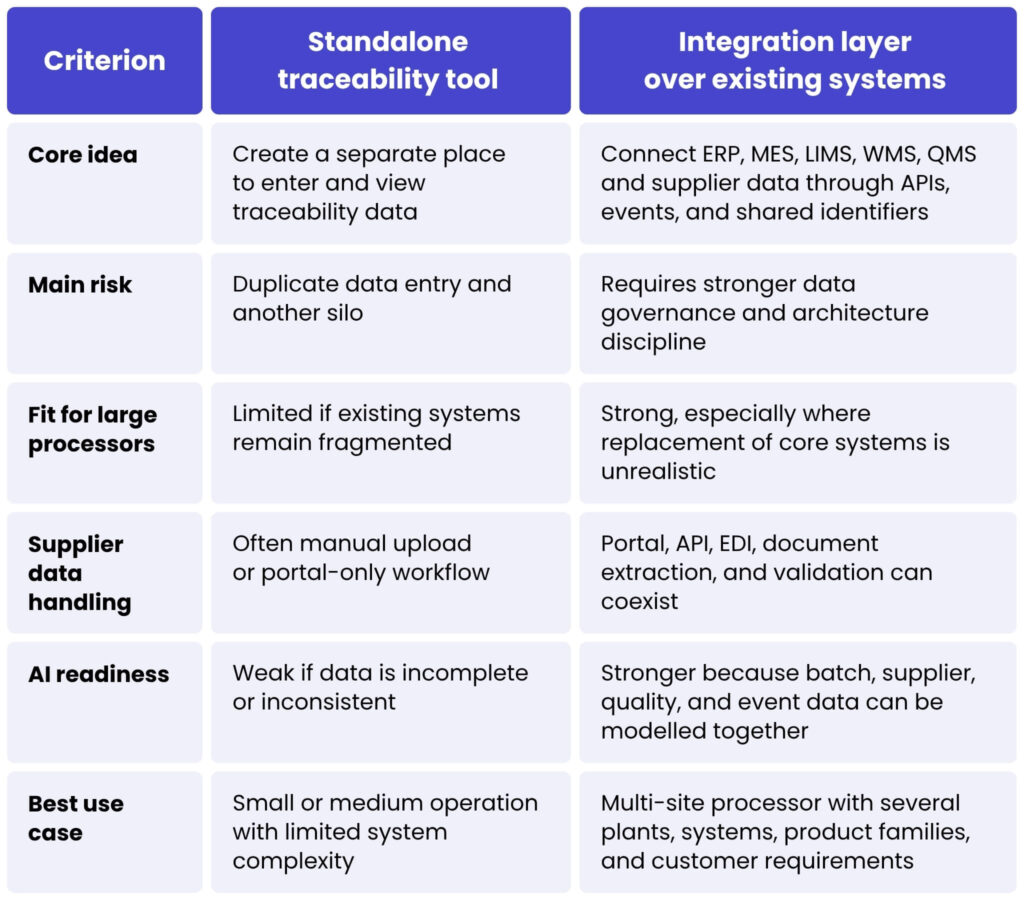
The strongest business case is not replacing ERP, MES, LIMS, WMS, or QMS. It is building an integration layer above them. And only after that integration, you can implement AI solutions. That’s because predictive analytics needs clean batch identifiers, supplier records, quality results, event histories and exception data.
بعد ذلك، تتمثل الخطوة العملية التالية في تقييم بنية التتبع، والتي تشمل الأنظمة والبيانات الرئيسية وسير عمل الموردين والواجهات ومسارات التدقيق والأمان.
جواز المنتج الرقمي في قطاع الأغذية الزراعية: هل هو منظم؟
A digital product passport is a structured digital record that links a physical product, batch, or item to verified data regarding its origin, composition, handling, compliance status, and lifecycle.
في قطاع الأغذية الزراعية، يحتاج هذا التعريف إلى تحفظ مهم واحد. بموجب اللائحة (EU) 2024/1781، يُعد جواز المنتج الرقمي الأوروبي جزءًا من لائحة التصميم البيئي للمنتجات المستدامة (ESPR)، و الأغذية والأعلاف خارج نطاق هذا التنظيم بشكل صريح. However, the definition is still useful because ESPR describes a digital product passport as a product-specific data set accessible electronically through a data carrier, with technical requirements around unique identifiers, open standards, machine readability, interoperability, and controlled access rights.
That distinction matters in boardrooms and in quality departments. A frozen fruit processor, dairy group, meat company, or ingredients manufacturer should not claim that an ESPR Digital Product Passport is legally required for food products unless a specific future rule says so. But the architectural pattern behind the DPP is highly relevant: a product or batch needs a trustworthy digital record that can be read by quality teams, procurement, auditors, customers, regulators, and eventually AI systems.
The argument of this article is direct. Large food processors should not start with another standalone traceability application. They should build a controlled integration layer over the systems they already use.
لماذا أصبحت إمكانية التتبع مشكلة معمارية؟
A recall rarely starts with a clean diagram. It begins with a failed lab result, a customer complaint, a supplier alert, or a phone call from quality. Then the same question lands on several desks at once: where did this material go?
That is precisely the moment when traceability stops being a documentation exercise and becomes an architecture problem. It is no longer a question of whether the data exists; It is whether the business can quickly connect it, trust it, and reuse it across recalls, audits, customer requests, and analytics.
اطّلع على كيفية التعامل مع البيانات المجزأة في شركة كبيرة لتصنيع الأغذية
اقرأ المزيد
لم تصمم معظم شركات تصنيع الأغذية الكبرى بيئة تكنولوجيا المعلومات الخاصة بها كنظام تشغيلي متصل واحد.
- نظام تخطيط موارد المؤسسات (ERP) يدير المشتريات والتمويل والمخزون.
- نظام تنفيذ التصنيع (MES) تتعامل مع أحداث الإنتاج.
- نظام إدارة معلومات المختبر (LIMS) يخزّن نتائج الاختبارات.
- نظام إدارة المستودعات (WMS) يدير حركات المخزون.
- نظام إدارة الجودة (QMS) يتتبع حالات عدم المطابقة والشكاوى والإجراءات التصحيحية.
ثم تأتي بوابات الموردين، ورسائل البريد الإلكتروني، وشهادات PDF، ومستندات النقل، وسجلات سلسلة التبريد، وسجلات جسر الوزن، وعمليات مسح الباركود، وجداول البيانات، وتصديرات البيانات المُعدّة لعملاء محددين.
لكل نظام غرضه الخاص. وقليل منها يتشارك الرؤية ذاتها تجاه الدفعة.
الاتحاد الأوروبي بشأن التتبع في الأغذية الزراعية
تؤطر إرشادات القانون العام للأغذية الصادرة عن المفوضية الأوروبية إمكانية التتبع as the ability to trace and follow food, feed, and ingredients through all stages of production, processing, and distribution. It also links traceability to product withdrawal, consumer information, and the ability to identify suppliers and customers when food or feed is faulty.
In practice, legal traceability is only the baseline. Commercial traceability now reaches further. Retailers, export customers, certification bodies, and sustainability teams ask for proof of origin, chain of custody, pesticide records, microbiological tests, packaging data, storage conditions, carbon inputs, EUDR references, and supplier declarations.
Manual work cannot scale with that demand. A quality team can still prepare an audit pack by downloading files from five systems and asking suppliers for missing certificates. It will just be slow, fragile, and difficult to repeat.
ماذا ينبغي أن يعني جواز المنتج الرقمي في الزراعة وتجهيز الأغذية؟
For a food processor, the useful question is not: „Do we need an official DPP?” The better question is: „Can we create one reliable digital record for the evidence that follows a product or batch through our business?”
A digital product passport in agri-food should mean a passport-like data layer that connects product, batch, supplier, and process history across existing operational systems. It should not be treated as a single monolithic system or a marketing label placed on a QR code. The true value sits behind the label, in the governed data model.
A useful agri-food passport record is usually not created at one level only. Some data belong to the supplier, and some to the crop, herd, farm, field, or facility. While other data belong to the delivery, the production batch, or the finished product or dispatch unit.
وهذا يخلق تحدياً متعدد المستويات في البيانات. يحتاج المعالج إلى الإجابة عن أسئلة مثل:
- أي مورد قام بتوريد هذه المادة الخام؟
- أي مزرعة أو قطعة أرض أو منشأة أو موقع معتمد مرتبط بهذا التسليم؟
- ما الشهادات والإقرارات وفحوصات المخاطر التي كانت سارية في تاريخ التسليم؟
- أي دفعة إنتاج استخدمت المادة؟
- ما نتائج LIMS التي أفرجت عن الدفعة أو حظرتها أو قيّدتها؟
- ما هي المنتجات النهائية أو المنصات أو الشحنات التي تلقت مواد من تلك الدفعة؟
- أي العملاء تلقوا مخزوناً متأثراً؟
- ما السجلات التي تثبت أن العملية اتبعت المتطلبات الداخلية والخارجية؟
لا تحتاج طبقة تشبه جواز السفر إلى استبدال الأنظمة القائمة. بل ينبغي أن تشير إليها، وتزامن بيانات مختارة، وتحكم المعرّفات، وتحافظ على سجل أحداث قابل للتدقيق.
وهذا قريب من منطق بنية جواز السفر الرقمي للمنتج الأوروبي (DPP)، حتى وإن كانت الأغذية والأعلاف مستثناة من لائحة ESPR. تتطلب المادة 10 من لائحة ESPR ربط بيانات جواز المنتج الرقمي (DPP) عبر حامل بيانات إلى معرّف منتج فريد ودائم، قائم على معايير مفتوحة ومصمم ليكون قابلاً للقراءة آلياً ومنظماً وقابلاً للبحث والنقل دون الارتباط بمورّد بعينه.
For agri-food, the same principle can be adapted to batch-level traceability. The identifier may be a batch ID, delivery ID, GS1 Global Trade Item Number (GTIN), Serial Shipping Container Code (SSCC), pallet ID, supplier ID, farm ID, or facility ID. يجب أن تجعل البنية هذه المعرّفات متسقة. وبدون هذا الاتساق، حتى لوحة المعلومات الجيدة المظهر تصبح مجرد زينة.
لماذا لا تكفي ERP وMES وLIMS وWMS وQMS بمفردها؟
Walk into any large food processing plant, and you will find an impressive tech stack. ERP tracks purchasing and inventory, MES watches production, LIMS holds lab results, WMS follows stock, and QMS records non-conformities. The data is there. The problem is that these systems often do not speak the same language when a crisis hits.
عادةً ما تحسّن كل منصة وظيفة واحدة، وليس أدلة المنتج من البداية إلى النهاية.
- يعرف نظام ERP ما تم شراؤه.
- يعرف MES ما تم إنتاجه.
- يعرف LIMS ما تم اختباره.
- يعرف WMS أين تم نقل البضائع.
- يعرف نظام إدارة الجودة ما الذي حدث من خطأ.
وتتطلب قابلية التتبع أن تعمل جميعها معًا.
تعرّف على المزيد حول تكامل أنظمة معالجة الأغذية في الممارسة العملية
اقرأ المزيد
A typical processor can answer isolated questions quickly. Procurement can find the supplier invoice. Production can find the line run. The lab can find the test result. The warehouse can track pallet movements. But the bigger issue is the complete chain.
If a pesticide residue result fails for a raw material delivery, the business must know which production batches consumed it, whether any finished goods were released, where they are stored, which customers received them, and whether similar supplier lots are still in the warehouse. If that logic depends on spreadsheets and personal knowledge, the organisation is exposed.
الخطر ليس تنظيميًا فحسب، بل تشغيليًا أيضًا
التقرير السنوي لشبكة التنبيه والتعاون لعام 2025 الصادر عن المفوضية الأوروبية recorded 10 490 ACN notifications in 2025, up 11% compared with 2024, with RASFF notifications rising by 2%. That level of alert activity shows why processors need fast, structured and auditable traceability rather than manual incident reconstruction.
A standalone dashboard will not fix this. A dashboard can only show useful data after the integration problem has been solved. The harder work is defining identifiers, events, ownership, data quality rules, integrations, exception handling, and audit trails.
الجدول 1. أداة التتبع المستقلة مقابل طبقة التكامل
ما البيانات التي يجب أن تحتوي عليها طبقة التتبع الشبيهة بجواز السفر؟
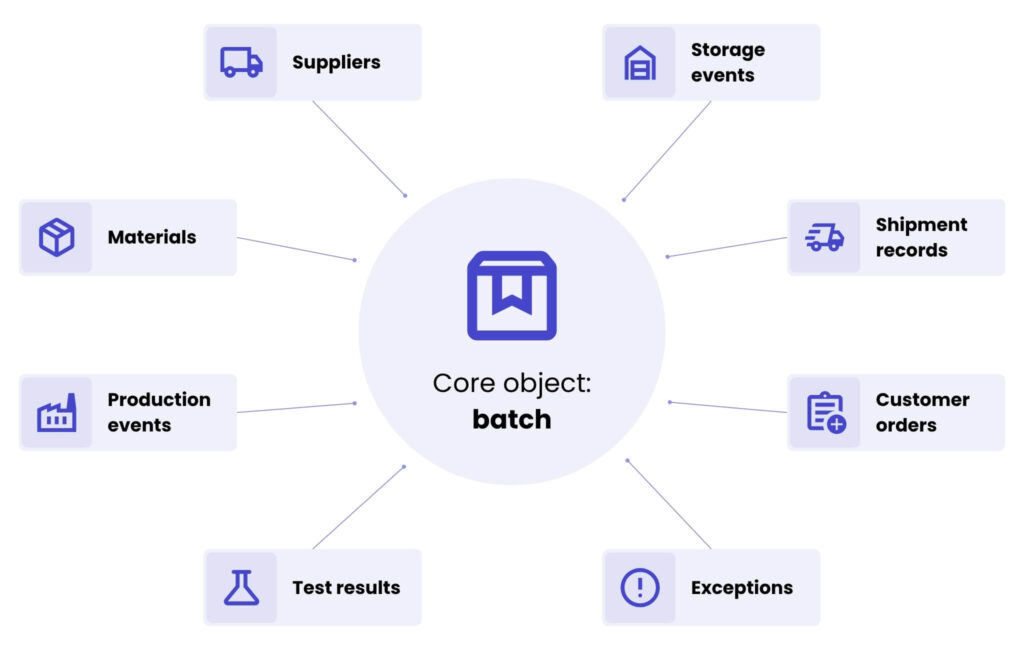
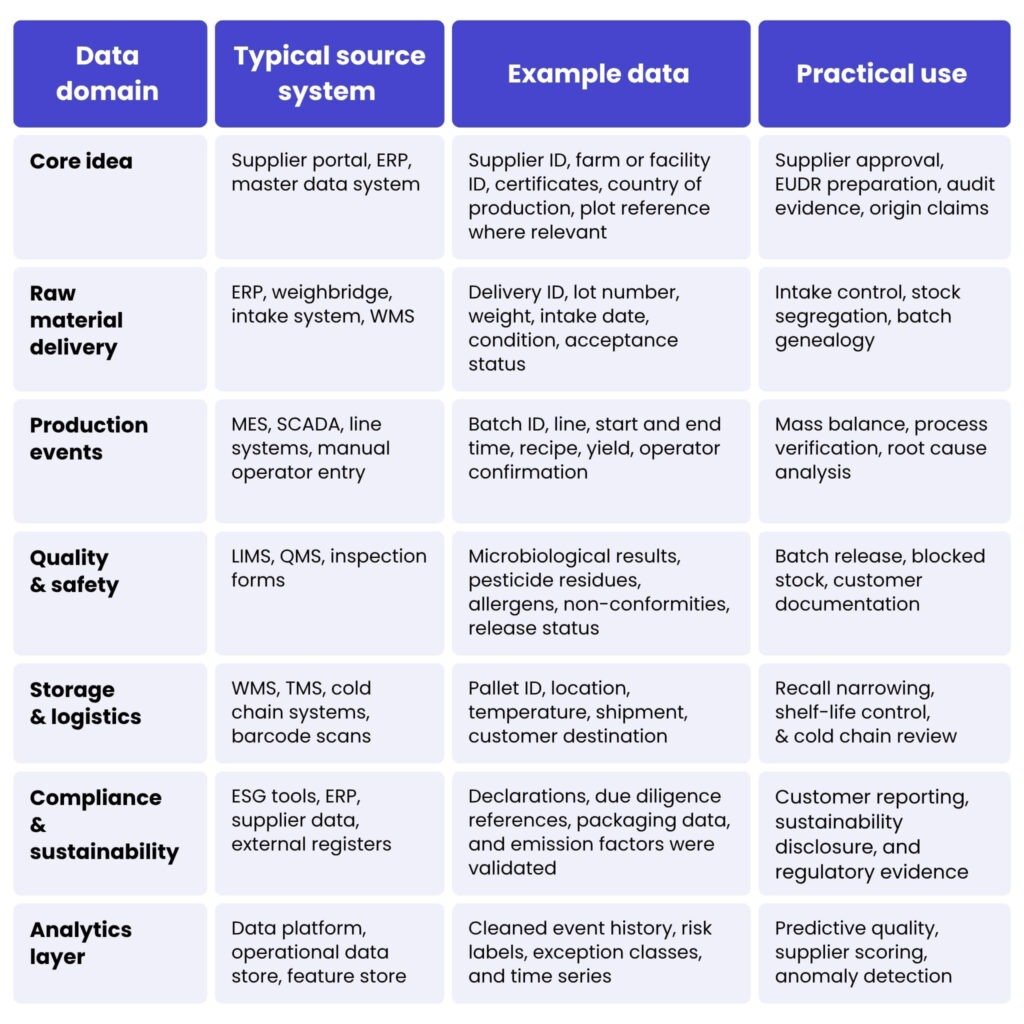
Start with the questions people ask under pressure. Which lots are affected? Which customers received them? Which supplier documents were valid? Which lab result released the batch? The data model should be built around those questions, not around every field available in every system.
A passport-like traceability layer should contain only data that improves recall speed, auditability, supplier control, quality decisions, compliance evidence, or analytics. It should not become a dumping ground for every field in every system. More data is not automatically better; Better-linked data is.
الكائن الأساسي للتتبع
For agricultural raw materials, origin data matters. Depending on commodity and risk profile, this can include farm or plot identifiers, country of production, harvest date, agronomic records, certification status, crop protection declarations, fertiliser documentation, irrigation or water records, animal health records, welfare records, or geolocation.
قواعد الاتحاد الأوروبي بشأن إزالة الغابات يوضح كيف أصبحت بيانات المنشأ تشغيلية. يغطي EUDR سلعًا مثل الماشية والكاكاو والقهوة وزيت النخيل والمطاط وفول الصويا والأخشاب، بالإضافة إلى منتجات مشتقة معينة. From 30 December 2026, large and medium operators must comply with the main obligations. Micro and small operators have until 30 June 2027, with specific rules for those already covered by the EU Timber Regulation.
For food processors in affected categories, the traceability record must connect supply chain evidence with commercial and production flows. It is not enough for procurement to hold a supplier declaration while production holds batch usage in a separate system. The two records need a reliable relationship – that relationship is the architecture.
الجدول 2. المجالات الأساسية للبيانات لطبقة جوازات المنتجات الرقمية (DPPs) في قطاع الأغذية الزراعية
كيف ينبغي تصميم بنية التكامل لجواز المنتج الرقمي في قطاع الأغذية الزراعية؟
Good traceability architecture usually begins with an uncomfortable discovery workshop. Someone draws the official process on a whiteboard, and then quality, production, and warehouse teams explain how the process really works at 6:00 a.m. during intake, when a truck is waiting, a sample is delayed, and the ERP record is not yet complete.
هنا يجب أن يبدأ التصميم، وليس في عرض توضيحي من مورّد.
The integration architecture should work as a controlled operational data layer above existing systems. Its job is to connect ERP, MES, LIMS, WMS, QMS, and supplier workflows through shared identifiers, APIs, event streams, and governance rules, while keeping each source system responsible for the data it genuinely owns.
1. الخيار التصميمي الأول هو نموذج البيانات الأساسي.
That model defines how the business describes suppliers, facilities, raw material lots, production batches, finished goods, pallets, shipments, test results, exceptions, and documents. Without it, every integration becomes a local translation exercise.
2. الخيار التصميمي الثاني هو نموذج الأحداث.
Food processing is a sequence of events: received, sampled, tested, approved, consumed, mixed, cooked, packed, stored, blocked, released, shipped, returned, or recalled. Modelling these events is more useful than building a static database of disconnected records.
GS1’s Electronic Product Code Information Services (EPCIS) is relevant here because it supports traceability and supply chain visibility by recording what happened, when, where, why, and to which object. It is not the only possible standard, but it is a useful reference when designing event-based traceability across organisational boundaries.
3. الخيار التصميمي الثالث هو أسلوب التكامل.
Older systems may need scheduled extracts, database views, message queues, or file exchange. Newer systems can use REST APIs, webhooks, event streaming, or managed integration platforms. Supplier workflows may require a portal, electronic data interchange (EDI), document upload, optical character recognition (OCR) for certificates, or direct API exchange for larger suppliers.
In a real-world factory, strict academic IT models rarely survive contact with the shop floor. A food processing company does not need every system to be modern before it can improve traceability. It needs stable interfaces, known data owners, data quality checks, and a target model that prevents every new integration from becoming a special case.
4. الخيار التصميمي الرابع هو التحكم في الوصول.
Quality, procurement, production, logistics, auditors, and customers do not need the same view. A supplier may be able to update certificates and delivery declarations, but not internal test results; A customer may receive product documentation, but not commercial supplier terms; A regulator may need controlled evidence during an incident.
This is where the concept of the digital product passport in agri-food is useful again. ESPR stresses access rights, interoperability, security, privacy, authentication, reliability, and integrity as part of the DPP’s technical design. Those principles translate well into agri-food architecture, even when the legal instrument is different.
ما الدور الذي ينبغي أن تلعبه البرمجيات الوسيطة وواجهات برمجة التطبيقات وبوابات الموردين؟
In most plants, the problem is not the absence of software. It is the number of hand-offs in agri-food companies. Data moves from a supplier email to a spreadsheet, from the spreadsheet to ERP, from ERP to a production plan, from production to the lab, and finally into an audit pack prepared by someone who knows which folder to trust.
يجب أن تقلل البرمجيات الوسيطة وواجهات برمجة التطبيقات وبوابات الموردين من عمليات التسليم هذه.
- البرمجيات الوسيطة تربط التطبيقات الداخلية.
- واجهات برمجة التطبيقات (APIs) تتيح خدمات بيانات خاضعة للتحكم.
- تجمع بوابات الموردين معلومات منظمة من الشركاء الذين لا يمكنهم التكامل المباشر.
معًا، تشكّل هذه العناصر النسيج التشغيلي للتتبع على مستوى الدفعات.
استخدام البرمجيات الوسيطة في جوازات السفر الرقمية للمنتجات (DPPs) في قطاع الأغذية الزراعية
لا ينبغي التعامل مع البرمجيات الوسيطة كمُوصِّل سحري. إنها تحتاج إلى قواعد:
- أي نظام يملك سجل المورد؟
- أي نظام يملك إنشاء الدفعات؟
- ما النظام الذي يمكنه تغيير حالة الإصدار؟
- أي حدث يفوز إذا اختلف MES و ERP؟
- كيف يتم تمثيل عمليات التسليم المرفوضة؟
- من يمكنه تجاوز دفعة محظورة؟
هذه قرارات تجارية قبل أن تكون قرارات تقنية.
واجهات برمجة التطبيقات (APIs) المطبقة بشكل صحيح لجواز السفر الرقمي للمنتج في مجال الأغذية الزراعية
APIs should be designed around durable business objects, not only around current system screens. Useful API domains include supplier onboarding, certificate status, delivery notification, lot creation, sample registration, quality release, batch genealogy, stock status, shipment confirmation, and recall query.
تبسيط بوابات الموردين لتحسين قابلية الاستخدام
Supplier portals should be simple enough for seasonal and smaller suppliers. The best portal is often not the richest one. It is the one that suppliers actually use, with clear validation, document expiry alerts, field-level guidance, and a visible status of what has been accepted or rejected.
Large suppliers may prefer APIs or EDI. Smaller suppliers may need web forms. Some documents will still arrive as PDFs. The integration layer must accept this mixed reality without losing data governance.
يجب أن تجمع بوابة الموردين الجيدة:
- هوية المورد وسجلات المنشآت،
- نطاق المنتج والمواد المعتمد،
- الشهادات وتواريخ انتهاء صلاحيتها،
- إقرارات التسليم،
- المصدر أو الموقع الجغرافي حيثما كان ذلك مناسباً،
- إقرارات المواد المسببة للحساسية والملوثات،
- EUDR أو أدلة خاصة بالعميل حيثما ينطبق ذلك،
- ردود الإجراءات التصحيحية،
- أدوار التواصل الخاصة بالحوادث العاجلة.
Data quality controls matter here. A portal that accepts any free text will simply digitise chaos. The system should validate mandatory fields, dates, units, certificate versions, supplier approval status, and links between delivery lots and purchase orders.
At Spyrosoft, when we analyse data flows for agri-food clients, we often see the same weak point: the portal, API, or middleware is technically present, but there is no agreed ownership model for supplier master data, certificate status, and batch identifiers. Once ownership is clarified, integration work becomes much less political, and much more engineering driven.
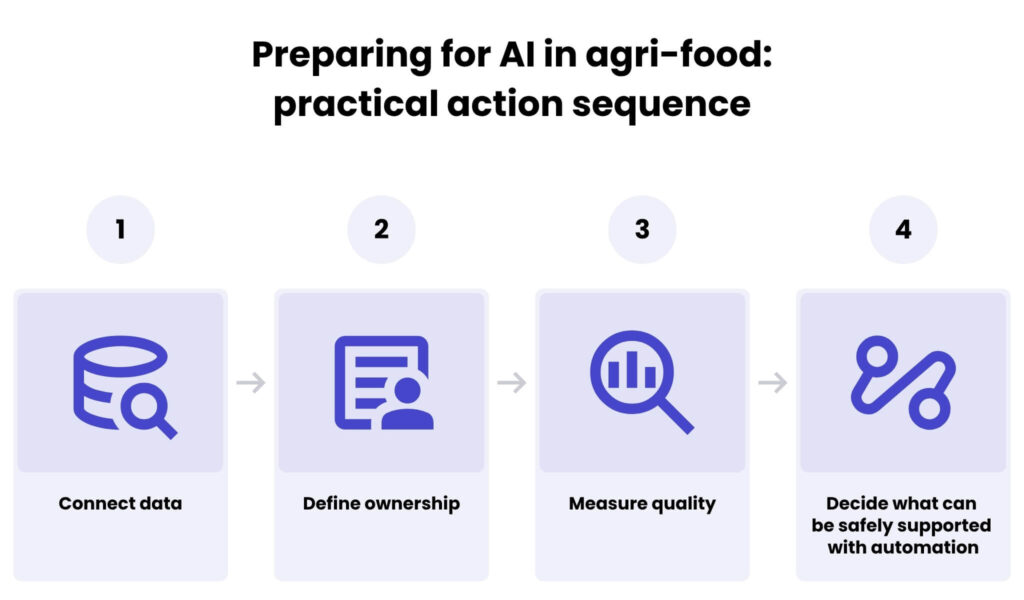
كيف يهيئ جواز المنتج الرقمي في قطاع الأغذية الزراعية المؤسسة للذكاء الاصطناعي؟
AI projects fail quietly when the training data cannot explain the operation. A model may receive thousands of rows, but if supplier IDs are inconsistent, lab samples are not linked to production batches, and complaint records use free text, the model is learning from noise.
A passport-like traceability architecture prepares the organisation for AI by creating structured, connected, and governed data that models real operational relationships. Predictive analytics needs supplier history, delivery timing, origin, crop year, temperature events, line history, test results, previous deviations, storage duration, complaint patterns, and release decisions.
يجب أن يبدأ الذكاء الاصطناعي في معالجة الأغذية بحالات استخدام تستفيد من بيانات التتبع المتصلة. تشمل الأمثلة:
- كشف الشذوذ في نتائج الجودة،
- تقييم مخاطر الموردين،
- التنبؤ بالشهادات المتأخرة،
- تحديد حالات عدم المطابقة المتكررة،
- تجميع الشكاوى،
- تحليل السبب الجذري،
- التنبؤ بمخاطر مدة الصلاحية،
- إعطاء أولوية تلقائية للدفعات للمراجعة.
None of these use cases works well on isolated spreadsheets. The model needs features. It also needs trustworthy labels: released, blocked, reworked, complained, returned, downgraded, or recalled. A traceability layer makes those features discoverable. It also gives data scientists and engineers a clearer boundary between operational truth and analytical transformation.
AI introduces governance risks. A model may identify correlations that are commercially useful but operationally misleading. For example, it may associate a supplier with higher rejection risk because that supplier delivers during a riskier weather window, not because its practices are worse. Human review remains essential.
الفضاء الأوروبي المشترك للبيانات الزراعية initiative reflects the same wider market direction. The European Commission describes agricultural data spaces as a way to support trustworthy pooling and sharing of agricultural data between private stakeholders and public authorities, while the AgriDataSpace preparatory action focused on secure, trusted, transparent and responsible data sharing for agriculture.
ما هي مؤشرات الأداء الرئيسية التي يجب أن تتابعها شركات تصنيع الأغذية؟
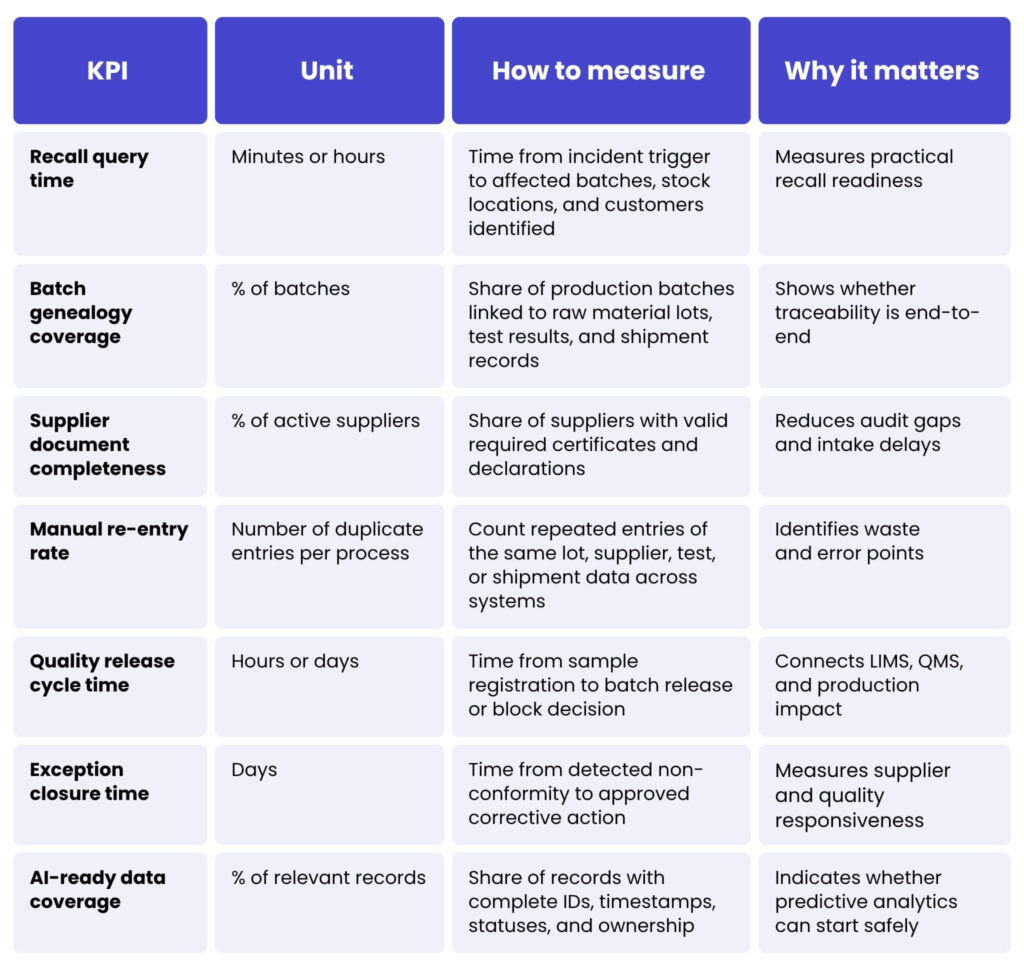
A senior manager will not fund „better data” for long. The case becomes stronger when the discussion moves to recall query time, audit preparation effort, supplier document completeness, and the percentage of batches with full genealogy.
Food processors should track KPIs that measure traceability speed, evidence completeness, supplier data quality, exception handling, batch genealogy coverage, and automation. These KPIs are more useful than vague digital maturity scores because they show whether the organisation can answer operational questions faster and with less manual work.
A processor should not start with 50 metrics. It should start with the few that expose the weakest links. The most valuable metrics usually sit between functions, not inside a single department.
For example, quality release cycle time is not only a laboratory metric. It depends on sampling, LIMS, production planning, ERP stock status, and warehouse decisions. Recall query time is even more cross-functional because it tests whether supplier, production, quality, warehouse, and customer shipment records are actually connected.
الجدول 3. إطار مؤشرات الأداء الرئيسية (KPI) لطبقة التتبع المتكاملة
خطوة بخطوة: كيف تبني بنية تتبع مماثلة لجواز المنتج الرقمي في قطاع الأغذية الزراعية؟
The safest starting point is usually one product family, not the whole company. Pick a product where traceability matters commercially, where supplier data is uneven, and where quality, production, and warehouse records already create friction.
ينبغي بناء بنية تتبّع شبيهة بجواز السفر على مراحل:
الخطوة 1: رسم خريطة رحلة التتبع الحالية
Start with a real product family and follow the data from supplier approval to customer shipment. Capture systems, spreadsheets, manual forms, emails, labels, scans, approvals, exceptions, and reporting outputs. The map should show where data is created, copied, corrected, and lost.
الخطوة 2: تحديد الأسئلة الجوهرية
Do not integrate everything. Define questions the business must answer, such as: which suppliers are linked to this batch, which test results released it, where is the affected stock, which customers received it, which certificates were valid, and which records prove compliance?
الخطوة 3: تصميم نموذج البيانات الأساسي
Create common definitions for supplier, facility, raw material lot, production batch, finished good, pallet, shipment, test result, non-conformity, and document. Decide which system owns each object. This is the backbone.
الخطوة 4: تثبيت المعرّفات
Standardise batch IDs, supplier IDs, facility IDs, lot IDs, and pallet IDs. Decide how legacy identifiers will be mapped. Where GS1 identifiers are already used, align with them rather than inventing parallel keys.
الخطوة 5: ربط الأنظمة ذات الأولوية
Start with ERP, MES, LIMS, and WMS because they usually carry the core batch, production, quality, and stock relationships. Add QMS, supplier workflows, transport, and cold chain data once the backbone is in place.
الخطوة 6: بناء سير عمل بيانات الموردين
صنّف الموردين حسب النضج الرقمي. استخدم واجهات API أو EDI للشركاء الأكبر حجماً، وسير عمل البوابات لمعظم الموردين، واستخراج المستندات المُتحكَّم به لملفات PDF المتبقية. تحقق من صحة البيانات عند الإدخال.
الخطوة 7: إنشاء مسارات التدقيق وقواعد الوصول
Every critical change should have a user, timestamp, source system, and reason. Access should be role-based. Customer-facing records, internal quality records, and supplier-only records should not be mixed.
الخطوة 8: القياس قبل الأتمتة
حدّد خطوط الأساس لزمن استعلام الاستدعاء، واكتمال مستندات الموردين، وتغطية نسب الدُفعات، ومعدل الإدخال اليدوي المتكرر. ثم قم بالأتمتة حيث تُظهر الأدلة وجود عوائق.
الخطوة 9: إعداد التحليلات والذكاء الاصطناعي
Once the event history is reliable, build analytical data sets for supplier risk, quality anomalies, complaint trends, and predictive release support. Keep model outputs explainable for quality teams.
عادةً ما يؤدي تخطي الخطوات الأولى إلى إنشاء منصة هشة أخرى.
قائمة تحقق لتقييم جاهزية جوازات المنتج الرقمي في قطاع الأغذية الزراعية
Before selecting technology, ask whether the organisation can describe its traceability reality without relying on one person who „knows where everything is”. If the answer is no, the first phase should be discovery, not procurement.
A food processor is ready to start a passport-like traceability initiative when it can name the systems, data owners, identifiers, risks, and business questions that matter most. The checklist below can be used in a discovery workshop before selecting technology or estimating implementation effort.
- هل يمكننا تحديد نظام السجلات للمورد والمواد والدفعة ونتيجة الاختبار والمخزون وبيانات الشحن؟
- هل تستخدم أنظمة ERP وMES وLIMS وWMS وQMS معرّفات دفعات أو حصص متوافقة؟
- هل يمكننا التتبع من المنتج النهائي إلى تسليم المواد الخام دون إعادة بناء يدوية لجداول البيانات؟
- هل يمكننا التتبع من تسليم المواد الخام إلى جميع المنتجات النهائية والعملاء المتأثرين؟
- هل تحتوي شهادات الموردين على بيانات وصفية منظمة وتواريخ انتهاء وحالة اعتماد؟
- هل نعرف أي الموردين يمكنهم تبادل البيانات عبر API أو EDI أو البوابة الإلكترونية أو تحميل المستندات؟
- هل يمكن لفرق الجودة معرفة الدفعات المحظورة أو المفرج عنها أو المعاد تصنيعها أو الخاضعة للتحقيق؟
- هل لدينا سجل تدقيق للتغييرات اليدوية على بيانات التتبع الحيوية؟
- هل يمكننا فصل عروض البيانات الداخلية والموجهة للموردين والموجهة للعملاء والموجهة للجهات التنظيمية؟
- هل نعرف أي أدلة مطلوبة وفقًا للائحة EUDR، أو الاستدامة، أو الخاصة بالعميل حسب عائلة المنتج؟
- هل يمكن لتقنية المعلومات دعم التكامل الآمن بين تقنية التشغيل وأنظمة المصنع ومنصات المؤسسة؟
- هل لدينا بيانات تاريخية نظيفة كافية لتدريب أو التحقق من صحة حالة استخدام AI دون خلق ثقة زائفة؟
الإجابة الضعيفة على قائمة التحقق هذه ليست فشلاً. إنها دليل مفيد – تخبر الشركة من أين تبدأ.
حالة استخدام: تتبّع متكامل للصناعات الزراعية والغذائية لمصنّع فواكه مجمّدة في وسط بولندا
حالة الاستخدام هذه سيناريو مركب يستند إلى افتراضات تشغيلية واقعية لمعالج أغذية متعدد المواقع. ولا يُقدَّم كتنفيذ مُسمّى من Spyrosoft.
A frozen fruit processor operates two plants in central Poland and buys soft fruit from approximately 80 active seasonal suppliers. The company sells private-label products to retail and food-service customers in several European markets. Its operational landscape includes one ERP instance, separate WMS configurations at each plant, one LIMS, line-level production records exported from MES terminals, and supplier certificates stored across email folders and shared drives.
The commercial pressure is familiar. Customers ask for faster evidence packs, including supplier approval, residue testing, batch genealogy, cold storage history, and dispatch records. The quality team can produce the evidence, but the process depends on experienced staff who know where files are stored and which spreadsheets contain the latest supplier status. That knowledge is valuable, but it can also present a risk.
يختار المعالج عائلة منتجات واحدة للموجة الأولى من التكامل: منتجات الفراولة المجمدة المعبأة للبيع بالتجزئة. ويشمل النطاق:
- إعداد الموردين،
- استلام المواد الخام،
- نسب دفعات الإنتاج،
- حالة الإفراج في نظام LIMS،
- حركات المستودعات،
- سجلات الشحنات الصادرة.
نتائج مرحلة الاستكشاف
The first discovery phase identifies four main weaknesses. Supplier certificates have inconsistent names and expiry dates. Intake lot numbers are not always identical across ERP and warehouse records. LIMS results are linked to sample numbers, but not always to business-facing batch IDs. Shipment records can identify customers, yet the link back to raw material lots requires manual reconstruction.
تُدخل البنية المستهدفة طبقة تتبّع محورية قائمة على الدفعات.
- يظل نظام ERP المصدر المعتمد لأوامر الشراء والبيانات الرئيسية للموردين.
- يظل LIMS المصدر لنتائج الاختبارات.
- يظل نظام إدارة المستودعات (WMS) المصدر المعتمد لحركات المخزون.
- تخزّن طبقة التكامل العلاقات بين دفعات تسليم الموردين، ودفعات الإنتاج، وحالات الجودة، ومعرّفات المنصات، وشحنات العملاء.
التغيير في سير عمل الموردين
Suppliers receive a portal workflow for certificate upload, declaration submission, and contact updates. The portal validates expiry dates and mandatory fields before a supplier can be treated as fully approved for the product family. Larger suppliers can submit delivery declarations through structured files instead of manual entry.
The initial KPI baseline is deliberately operational. Recall query time is measured from a simulated incident trigger to a complete list of affected finished goods, stock locations, and customers. Supplier document completeness is measured as the percentage of active suppliers with valid required documents before intake. Batch genealogy coverage is measured as the share of batches linked to raw material lots, LIMS results, and outbound shipments.
سير عمل قابل للتكرار لجوازات المنتجات الرقمية (DPPs) في قطاع الأغذية الزراعية
After the pilot design is stabilised, the processor can use the same model for raspberries and blackcurrants. It does not need to rebuild the architecture for each product family. It needs to extend product-specific fields, supplier requirements, and test profiles.
The main limitation is supplier variation. Some seasonal suppliers have low digital maturity and still rely on phone calls and scanned forms. The project therefore keeps a controlled manual route, but it ensures that the processor, not the supplier’s document format, controls the final data model.
الدرس عملي: the processor does not gain traceability from a new screen. It gains traceability from consistent identifiers, event relationships, validated supplier data, and controlled interfaces between systems.
اكتشف كيف يمكن لـ Spyrosoft المساعدة في تتبع المنتجات الزراعية والغذائية
اعرف المزيد
ما المخاطر والقيود الرئيسية لنهج جواز السفر الرقمي للمنتج؟
The most common failure is not technical; it is organisational. A company buys an integration platform, then discovers that no one owns the supplier master record, nobody wants to standardise batch naming, and every plant has a different exception process.
المخاطر الرئيسية هي:
- بيانات رئيسية ضعيفة،
- ملكية غير واضحة،
- عبء الموردين،
- إدارة التغيير الضعيفة،
- ثغرات الأمن السيبراني،
- المبالغة في وعود الذكاء الاصطناعي.
A passport-like traceability layer can improve visibility, but it cannot fix broken processes unless the organisation agrees on who owns data, who approves exceptions, and how evidence is maintained.
- البيانات الرئيسية – If supplier names, facility records, materials, and batch IDs are inconsistent, integrations will carry inconsistencies faster. Cleaning master data is not glamorous work, but it is a necessary one.
- عبء الموردين – If a processor asks every supplier for too much data too quickly, adoption will suffer. Supplier workflows should be risk-based. A high-risk commodity, export customer, or regulated origin claim may justify detailed data. A low-risk packaging supplier may not require the same depth.
- الأمن السيبراني – Integrating plant systems, cloud platforms, and supplier access expands the attack surface. Architecture must cover identity and access management, network segmentation, logging, secrets management, encryption, vulnerability management, and incident response.
- التفسير القانوني – A software architecture can support compliance, but it does not create compliance by itself. Regulatory teams still need to define obligations, approve evidence models, and review product-specific claims.
- مخاطر الذكاء الاصطناعي – Predictive models trained on incomplete data can produce confident but misleading outputs. In quality and safety workflows, AI should assist prioritisation and analysis before it influences release decisions.
من يستفيد من جواز المنتج الرقمي في قطاع الأغذية الزراعية؟
Different teams ask for traceability in different words. Management talks about risk and customer confidence; Quality teams talk about evidence; IT talks about interfaces, and procurement talks about supplier status. The same architecture can serve all of them, provided the design starts from operational decisions rather than generic data collection.
- الإدارة العليا benefits because the business gains a clearer view of operational risk, audit readiness, and customer evidence capability. The decision after reading this article should be to sponsor an architecture assessment, not to buy a point tool after a demo.
- فرق الجودة وسلامة الأغذية benefit because evidence becomes easier to find, compare, and reuse. Their technical knowledge remains central, but less time is spent chasing documents, reconciling lot numbers, and preparing repetitive audit packs.
- قادة تكنولوجيا المعلومات والتكنولوجيا التشغيلية benefit because the integration layer gives them a structured way to modernise without destabilising factory operations. They can replace brittle file transfers and ad hoc database extracts with governed interfaces, event models, and monitored data flows.
- فرق المشتريات benefit because supplier approval becomes more visible. They can see missing certificates, expiring documents, delivery declarations, and supplier response times before issues reach intake or customer audits.
- الموردون benefit when the workflow is designed well. A clear portal or API reduces duplicate requests, unclear email chains, and last-minute document chasing. Poorly designed supplier portals do the opposite, so usability is not a side issue.
- المهندسون الزراعيون والزراعة المستشارون benefit when field-level evidence can travel into the processor’s operational data model. Crop protection records, harvest data, farm declarations, and certification evidence become more useful when they connect to the batch and customer record.
- شركات الآلات وإنترنت الأشياء والتقنيات الزراعية benefit when their data can be fed into trusted operational records. Machine telemetry, temperature logs, storage conditions, and processing events become more valuable when they are tied to product and batch history.
كيف يمكن لـ Spyrosoft دعمك في مجال جوازات المنتجات الرقمية (DPPs) للأغذية الزراعية؟
In our experience working with agri-food clients, the most useful first conversation is rarely about technology selection. It is about the path of one batch: where the data starts, where it is copied, where it loses meaning, and who is expected to trust it during an audit or incident.
تستطيع Spyrosoft دعم كبار مصنعي الأغذية من خلال تصميم وبناء بنية التكامل behind passport-like traceability. The work is not about selling a closed traceability product. It is about mapping the client’s operational landscape, defining the data model, and engineering the software layer that connects existing systems.
يمكن أن يبدأ الارتباط النموذجي بتقييم التتبع المعماري وبنية البيانات. ويتضمن ذلك:
- رسم خرائط النظام،
- مراجعة نسب الدفعات،
- تحليل ملكية البيانات،
- مراجعة سير عمل الموردين،
- جرد التكامل،
- خط الأساس لمؤشرات الأداء الرئيسية وتقييم المخاطر.
From there, we can help design the target architecture. That may include middleware, APIs, event-driven integration, cloud data platforms, operational data stores, supplier portals, document workflows, and identity management or role-based access.
Implementation work can cover backend services, frontend portals, data pipelines, IoT ingestion, integration with ERP, MES, LIMS, WMS and QMS, data validation rules, dashboards, audit trails, and analytics-ready datasets.
The strongest fit is where the processor already has valuable systems but cannot make them work together. In that situation, replacing everything is expensive, slow, and risky, so integration is usually the more realistic path.
جواز المنتج الرقمي في قطاع الأغذية الزراعية – ملخص لقيمته
A digital product passport approach is valuable for agri-food only when it is treated as architecture, not as a label. Food and feed are outside ESPR, but processors still face rising demands for connected, auditable, and reusable product evidence.
السؤال الصحيح ليس: أي أداة تتبع يجب أن نشتري؛ بل هو: كيف نربط الأنظمة التي تحتفظ بالفعل بحقيقتنا التشغيلية؟
For large food processing companies, the answer is a governed integration layer. It should connect ERP, MES, LIMS, WMS, QMS, supplier workflows, and logistics records around shared identifiers and event history. Once that foundation exists, the organisation can respond faster to audits, narrow recalls more precisely, improve supplier control, and prepare data for AI implementation.
لضمان معالجة جانب التكامل في أنشطتك الزراعية الغذائية، تواصل مع خبراء التقنية الزراعية واكتشف كيف يمكننا مساعدة أعمالك.
الأسئلة الشائعة
No, not under the current ESPR framework. Regulation (EU) 2024/1781 explicitly excludes food and feed from its scope. Food processors should therefore avoid claiming that ESPR DPP is mandatory for food. The useful idea is architectural: create a passport-like record that links batch, supplier, quality, production, and logistics data.
Ordinary traceability often proves one step back and one step forward. A passport-like architecture goes further by linking internal batch genealogy, supplier evidence, laboratory results, warehouse events, customer shipments, and compliance documents. It makes traceability operational rather than purely documentary.
Usually not. For large processors, replacing all core systems is rarely the best first move. The better approach is to define a common data model and integration layer that connects the systems already running procurement, production, laboratory, warehouse, and quality workflows.
A supplier portal collects structured supplier data, certificates, declarations, and delivery evidence. It is useful when suppliers cannot integrate directly through APIs or EDI. The portal should validate mandatory fields, expiry dates, and approval status; otherwise, it becomes another place where inconsistent data enters the business.
Yes, for relevant commodities and derived products. EUDR requires affected operators to prove that products are deforestation-free and produced legally. A traceability layer can connect supplier origin data, due diligence references, purchase records, batch usage, and customer shipments. Legal teams still need to define the exact evidence model.
AI should be added after the processor has reliable identifiers, event histories, supplier records, quality results, and exception data. Early AI pilots can support anomaly detection, supplier risk scoring, or complaint clustering. AI should not replace quality judgement in safety-critical release decisions.
The first step is an assessment of the traceability architecture. Select one product family, map the current data journey, identify system owners, measure recall query time, and define the target data model. This creates a grounded scope before technology decisions are made.
The timeline depends on system complexity, supplier workflows, master data quality and integration constraints. A focused discovery and architecture phase can usually define scope faster than a broad transformation programme. Full rollout across several plants and product families should be phased rather than treated as one big deployment.
The most common failure points are unclear data ownership, inconsistent batch identifiers, overcomplicated supplier workflows, weak integration monitoring, and unrealistic AI promises. A strong architecture handles exceptions, legacy systems, and manual fallbacks instead of pretending they do not exist.


arrow_circle_rightاتصل بنا
لنناقش كيف يمكننا مساعدتك في بيانات معالجة الأغذية

arrow_circle_right مقالاتنا


