من ERP إلى عمليات جاهزة للذكاء الاصطناعي: تكامل أنظمة معالجة الأغذية في الممارسة العملية


Most food processors do not lack software. They already run enterprise resource planning (ERP), manufacturing execution systems (MES), warehouse management systems (WMS) and quality applications, often alongside plant historians, spreadsheets and supplier-facing tools. The difficulty is that these applications do not share responsibility, identifiers, or event data consistently. Food processing system integration addresses that gap without forcing a risky enterprise-wide replacement. It creates a governed route through which production, quality, warehouse, supplier, sustainability, and AI use cases can use the same operational facts.
تكامل أنظمة معالجة الأغذية هو نهج معماري يربط التطبيقات التشغيلية وتطبيقات المؤسسة مع الحفاظ على الأنظمة التي لا تزال تؤدي مهامها بشكل جيد.
لماذا يُعد استبدال نظام تخطيط موارد المؤسسات (ERP) عادةً نقطة انطلاق خاطئة؟
ERP replacement is usually the wrong starting point because the operational gap sits between systems, not solely inside the ERP. A modern ERP can improve finance, procurement, and planning, yet it will not automatically absorb plant-floor execution, laboratory workflows, warehouse events, supplier evidence or equipment telemetry. Replacing it before defining data ownership can reproduce the same integration problems on a newer platform.
- An ERP مصمم لإدارة معاملات المؤسسات.
- A MES يسجل ما حدث أثناء الإنتاج.
- A LIMS يدير العينات والطرق ونتائج الاختبارات المعتمدة.
- A MES يتتبع المخزون والمواقع ووحدات المناولة.
- A نظام إدارة الجودة (QMS) يدير الانحرافات والإجراءات التصحيحية والوقائية والتدقيقات والإجراءات الخاضعة للرقابة.
كل تطبيق موجود لأن مجالاً تشغيلياً مختلفاً يحتاج إلى سلوك متخصص.
The architectural error is asking one system to become the master of everything. When ERP or MES platforms take on responsibilities outside their intended domains, customisations accumulate, ownership and inherited responsibilities are unclear, and upgrades become difficult. The result is not a simplification. It is a larger monolith with unclear boundaries.
A better first step is to establish which system is authoritative for each object and event. The integration layer then distributes validated information to the systems that need it, without creating competing masters. This follows the practical direction outlined in Spyrosoft’s earlier analysis of لماذا تفقد مصانع الأغذية الكبيرة السيطرة على البيانات التشغيلية: ربط ما يعمل، ورقمنة الواجهات المفقودة، واستبدال ما لا يمكن جعله آمنًا أو قابلًا للدعم أو مناسبًا للغرض فقط.
There are valid reasons to replace a core system. Replacement becomes sensible when the vendor has ended support, cybersecurity exposure cannot be mitigated, data cannot be extracted reliably, the platform cannot handle the operating model, or the cost of maintaining customisations exceeds the cost and risk of migration. Integration should not be used to preserve a structurally unsafe system.
The position should be explicit: buy a new core platform only after proving that architecture, process ownership and interface design cannot solve the priority business problem. Otherwise, a replacement programme may take years, while traceability, quality, and reporting teams continue to work around the same gaps.
اكتشف كيف يمكن لنهج جواز المنتج الرقمي في قطاع الأغذية الزراعية أن يساعد في سد الفجوة المعمارية
اقرأ المزيد
كيف تبدو بنية تكامل سليمة لنظام معالجة الأغذية؟
A sound food processing system integration architecture separates transaction ownership, data exchange, analytical storage and user-facing workflows. It does not create another master system by accident. Instead, it gives every application a defined role, translates data through governed contracts and records the lineage required to explain where each operational fact came from.
A practical data architecture for food manufacturers normally has six layers. Source applications execute business processes. The integration plane moves commands and events. A canonical data and identity layer resolves meaning across systems. An operational data platform stores harmonised history for reporting and AI. User applications support decisions and external collaboration. Security, observability, and governance apply across every layer.
This structure aligns with the intent of ISA-95 and IEC 62264, the international framework for integrating enterprise and manufacturing control systems. The standard separates business planning and logistics from manufacturing operations management and defines the information exchanged across that boundary. It is useful because it gives IT, operations, and automation teams a common vocabulary before technology choices begin.
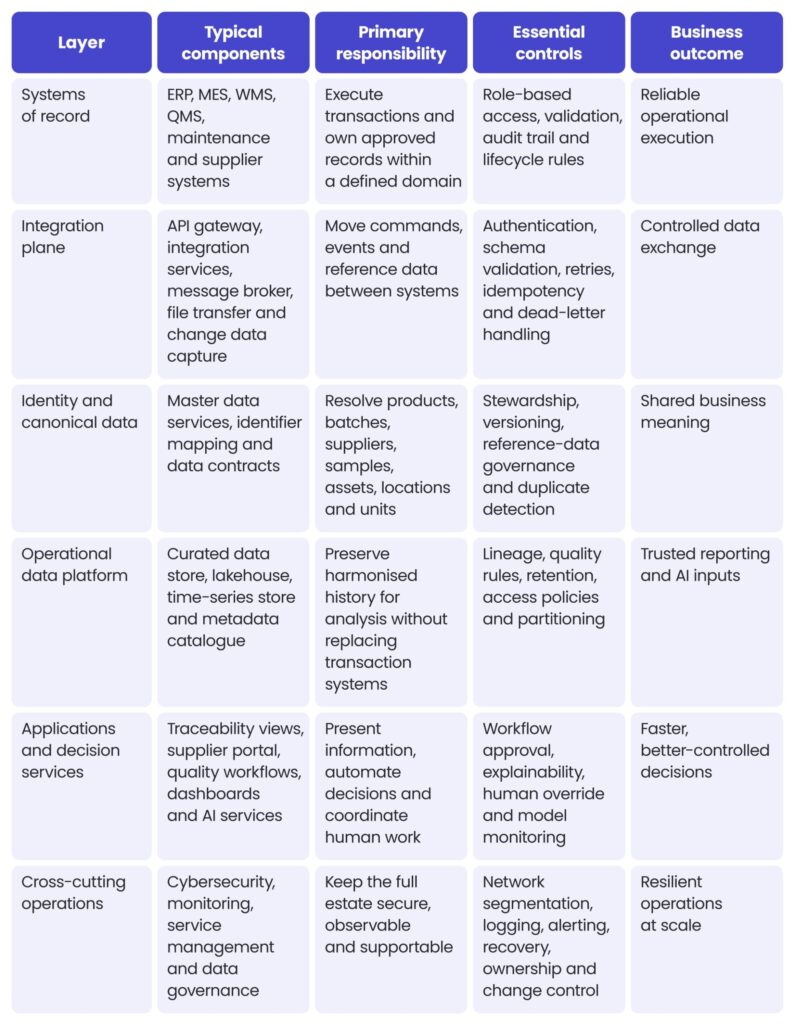
The integration plane should be independent enough to survive changes in individual applications. If the MES is upgraded, downstream consumers should not all require redesign. If a second plant uses a different LIMS, the canonical contract should absorb local variation. This is why data contracts matter as much as middleware products.
A canonical model is not a requirement to place every record in one database. It is an agreed representation used during exchange. For example, each plant may retain its local production order number, while the integration layer maps it to a group-wide production order identifier and records the relationship. The same principle applies to supplier codes, product versions, sample numbers and packaging handling units.
The architecture can be on-premises, cloud-based or hybrid. Plant-critical functions should not depend on an external service if loss of connectivity would stop safe production. Central analytics, cross-site reporting, and model training are often suitable for cloud infrastructure, while local gateways, plant integration services, and buffering protect continuity. The boundary should reflect latency, safety, resilience, and support requirements rather than a blanket cloud policy.
أي نمط تكامل يناسب كل تدفق تشغيلي؟
The right food processing system integration pattern depends on the business consequence of delay, the source system’s capabilities, and the volume of change. APIs suit direct queries and commands. Events suit changes that several consumers must observe. Batch exchange remains appropriate for large, non-urgent data sets. Robotic process automation should be a controlled exception where no stable interface exists.
Use a synchronous API when one system needs an immediate answer, such as checking whether a batch has been released before allocation. Set a strict timeout and define what happens if the dependency is unavailable. Production should not wait indefinitely for a remote service.
Use event-driven architecture for state changes such as “goods received”, “sample collected”, “test approved”, “batch consumed”, “pallet created” or “shipment dispatched”. Producers publish facts once; authorised consumers respond independently. Message ordering, duplicate handling and replay behaviour must be designed before launch.
Managed batch exchange works well for nightly reference-data synchronisation, large historical extracts or external partners without API support. Files still need schemas, checksums, encryption, acknowledgement, quarantine, and support ownership. “Send a CSV” is not an integration design unless error handling is defined.
Change data capture can expose updates from a legacy database when the application has no usable API, but it should not bypass business semantics carelessly. A changed row does not always equal an approved business event. The food processing architecture integration may need rules that translate low-level changes into meaningful, validated events.
At the plant level, Open Platform Communications Unified Architecture (OPC UA) can provide secure, platform-independent information exchange across industrial devices and systems. Message Queuing Telemetry Transport (MQTT) is useful for lightweight publish-and-subscribe telemetry, especially where gateways buffer data or network quality varies. Neither protocol replaces a business data model.
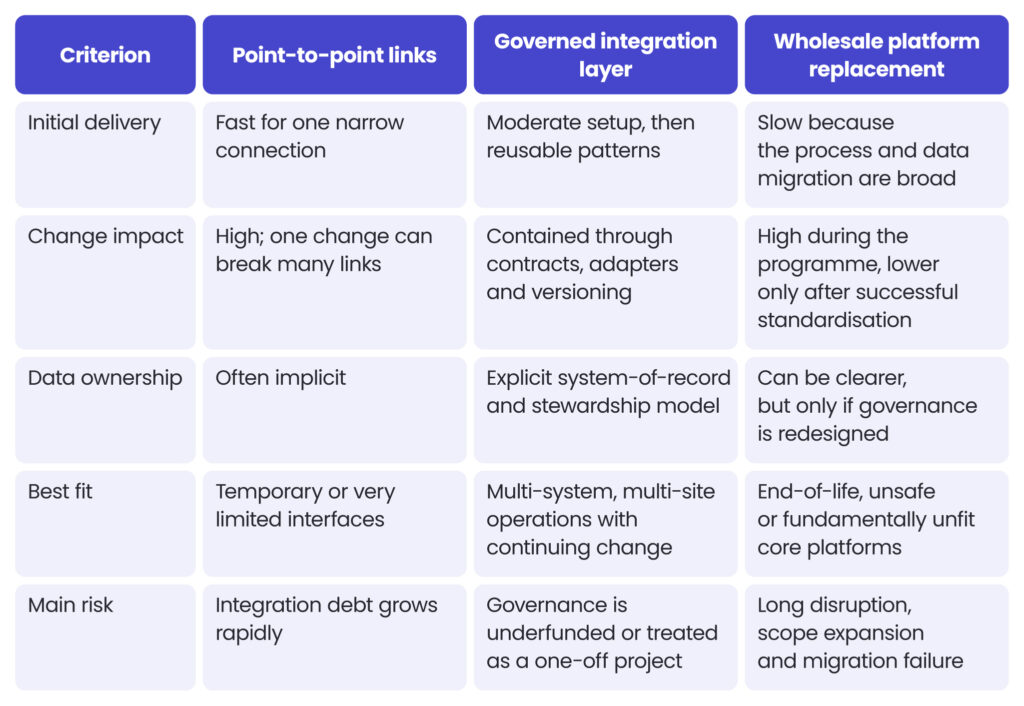
The most durable pattern combines API-led access with event-driven operations. An API gateway protects and governs direct services. A broker distributes state changes. Integration services translate system-specific payloads into canonical contracts. A catalogue records ownership, versions, dependencies and service-level objectives.
Observability is mandatory. Teams need a single view of message failures, processing latency, schema errors, queue depth and replay status. An integration that fails silently is worse than a manual process because users assume the data is current.
كيف تصبح قابلية التتبع منتجاً بياناتياً بدلاً من مجرد إجراء تدقيقي؟
Traceability becomes a data product when every relevant movement and transformation creates a structured, searchable event linked to stable identities. The organisation can then reconstruct product history continuously, not assemble it only during a mock recall or customer audit. The traceability view is generated from operational events rather than maintained as a separate spreadsheet.
المادة 18 من اللائحة (EC) رقم 178/2002 requires food and feed businesses to identify who supplied them and the businesses to which products were supplied. Many processors need deeper internal genealogy to meet customer requirements, certification schemes and risk management objectives. The architecture should distinguish the legal minimum from the operational capability the business chooses to build.
يجب أن يجيب حدث التتبع على خمسة أسئلة:
- ما الكائن أو الكمية التي كانت معنية؟
- متى وقع الحدث، ومتى تم تسجيله؟
- أين حدث ذلك، بما في ذلك الموقع أو الخط أو السفينة أو منطقة المستودع أو الموقع الخارجي؟
- لماذا حدث ذلك، مثل تحويل الاستلام أو الحجز أو الإفراج أو إعادة العمل أو الإرسال؟
- أي عملية أو مستخدم أو آلة أو معاملة تجارية توفر الدليل؟
خدمات معلومات المنتج الإلكتروني (EPCIS) والمفردات التجارية الأساسية (CBV) من GS1 provide a standard way to express and exchange visibility events across enterprises. Food processors do not have to adopt every GS1 element to benefit from the model. The important principle is to represent objects, locations, business steps, dispositions, and transformations consistently.
يجب أن يدعم تتبع سلالة الدفعات الاستعلامات الأمامية والخلفية
A backward query starts with a finished product or shipment and identifies ingredients, packaging, production orders, laboratory approvals and suppliers. A forward query starts with an incoming lot or packaging batch and identifies all affected intermediates, finished products, locations, and customer dispatches.
Splits, merges, and rework need first-class treatment. A raw material lot may be divided across several production runs. Multiple lots may enter a blend. Rework may re-enter a later batch. If the system records only the final product code and date, the genealogy will appear complete until a real investigation exposes missing relationships.
تعزيز إمكانية التتبع لتكامل أنظمة معالجة الأغذية
Food traceability software should sit above reliable execution events. A dashboard cannot repair missing material-usage records, inconsistent timestamps, or unlinked rework. Integration improves food supply chain visibility only when the underlying events are captured at the source and validated against shared identities.
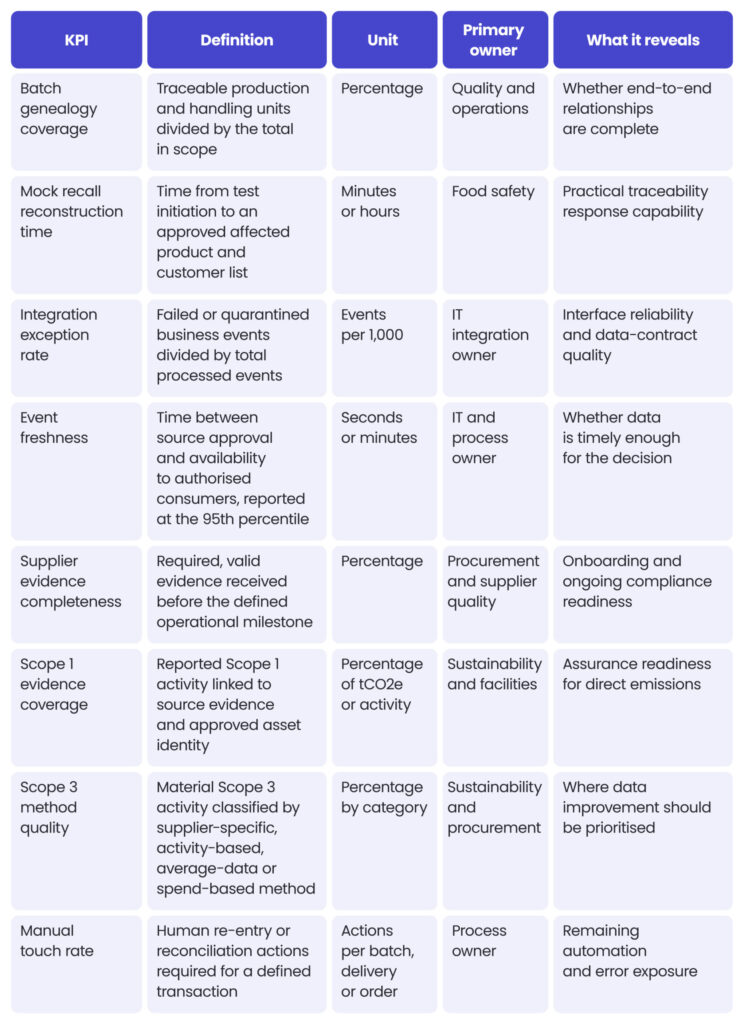
Useful traceability KPIs include genealogy coverage, time to reconstruct a mock recall, percentage of handling units linked to a production batch, event latency, unresolved mapping exceptions, and the quantity difference between issued, consumed, produced and dispatched material. These measures reveal where the chain is weak before an incident occurs.
كيف يمكن للبنية نفسها أن تدعم الإبلاغ عن النطاق 1 والنطاق 3؟
The same architecture for food processing system integration can support Scope 1 and Scope 3 reporting by turning energy, fuel, refrigerant, procurement, logistics, packaging, waste, and supplier records into governed activity data with traceable calculation methods. The reporting output is produced from versioned evidence, rather than assembled each year from disconnected spreadsheets and email attachments.
يغطي النطاق 1 الانبعاثات المباشرة لغازات الدفيئة من المصادر المملوكة أو الخاضعة لسيطرة المنظمة المُبلِّغة.
تشمل السجلات ذات الصلة:
- احتراق الوقود الثابت
- مركبات مملوكة للشركة
- تسرب غاز التبريد
- انبعاثات العمليات، حيثما ينطبق ذلك
غالبًا ما توجد الأدلة المصدرية في أنظمة المرافق وسجلات الصيانة وأنظمة الأسطول والفواتير وقراءات العدادات وسجلات المصانع.
يغطي النطاق 3 الانبعاثات غير المباشرة الأخرى في سلسلة القيمة عبر فئات بروتوكول غازات الدفيئة الـ 15.
غالبًا ما تتضمن فئات المواد الخاصة بالمعالج:
- السلع والخدمات المشتراة،
- الأنشطة المتعلقة بالوقود والطاقة غير المدرجة في النطاق 1 أو 2،
- النقل upstream وdownstream، والنفايات المتولدة في العمليات،
- السلع الرأسمالية والمعالجة،
- استخدام المنتجات المباعة حيثما كان ذلك مناسبًا.
يجب تقييم الأهمية النسبية وحدود إعداد التقارير لكل مؤسسة على حدة.
يجب أن ينشئ هيكل البيانات سجلاً لنشاط الانبعاثات يتضمن هذه الحقول على الأقل:
- نوع النشاط وفئة الإبلاغ؛
- الكمية والوحدة؛
- تاريخ النشاط وفترة التقرير؛
- علاقة المنشأة أو الأصل أو المورّد أو المنتج أو الدفعة أو الشحنة؛
- النظام المصدر ومرجع الأدلة الأصلي؛
- طريقة الحساب؛
- معرّف عامل الانبعاث، المصدر، الموقع الجغرافي، السنة والإصدار؛
- منطق التحويل والأطنان الناتجة من مكافئ ثاني أكسيد الكربون (tCO2e)؛
- حالة جودة البيانات، وملاحظة عدم اليقين، والمسؤول المختص؛
- سجل الموافقات وإعادة البيانات.
Keep activity data separate from emission factors. A logistics record may remain valid while the factor or method changes. If the factor is overwritten inside a spreadsheet, the organisation cannot reproduce a prior report. Versioning allows recalculation while preserving the evidence and method used in the published period.
Scope 1 needs strong asset and meter identity. A gas invoice should map to the correct site, meter, and period. A refrigerant top-up should link to an equipment asset, refrigerant type, quantity, service event, and technician record. Missing asset relationships create avoidable manual reconciliation during assurance.
Scope 3 needs a staged data-quality strategy. Supplier-specific activity or product data may provide better precision, but only when boundaries, units, and methodology are comparable. Secondary data, such as spend-based or average-data methods, can provide an initial inventory where primary data is unavailable. The system should record which method was used and support a planned move towards higher-quality activity data for material categories.
تحديثات على قواعد الإبلاغ عن الاستدامة في الاتحاد الأوروبي
تغيرت متطلبات إعداد تقارير الاستدامة الأوروبية جوهرياً في عام 2026. التوجيه (الاتحاد الأوروبي) 2026/470 narrowed the CSRD scope to undertakings with more than 1,000 employees and net annual turnover above EUR 450 million, subject to national transposition. At the time of writing in June 2026, the revised European Sustainability Reporting Standards (ESRS) were still in the Commission’s adoption process. Organisations should verify the applicable national rules and final standards before publication.
The operational case remains even for companies outside the mandatory CSRD scope. Retail customers, lenders, investors, and larger value chain partners may request emissions evidence. A processor that can retrieve activity data, source documents, and calculation lineage can respond with less manual effort and lower risk of inconsistent answers.
معيار سلسلة القيمة المؤسسية (النطاق 3) من بروتوكول غازات الدفيئة يوفر الإطار المعترف به للفئات الـ 15 وحدود الحساب. وتقوم المفوضية الأوروبية توضيح عام 2026 بشأن سقف سلسلة القيمة في توجيه CSRD يوضح كيف ينبغي تقييد طلبات المعلومات الموجهة إلى شركاء سلسلة القيمة الأصغر لأغراض توجيه CSRD.
ما الذي يجعل البيانات التشغيلية جاهزة فعليًا للذكاء الاصطناعي؟
Operational data is AI-ready when it is reliable enough to support a defined decision, not merely available in a data lake. Models need stable identities, timestamps, provenance, labels, context, and feedback. The organisation also needs controls for access, versioning, monitoring, and human intervention once a model influences production or quality work.
ابنِ قرار التكامل الخاص بك على تقييم مخاطر الجودة
Predicting quality risk before release requires different data from forecasting demand or detecting equipment anomalies. The use case should define the prediction horizon, action owner, acceptable delay, costs of false positives and false negatives, and the fallback when the model is unavailable.
يعتمد الذكاء الاصطناعي في معالجة الأغذية عادةً على عدة مجالات:
- خصائص المواد الواردة، وسجل الموردين، والعوامل الموسمية؛
- معايير العملية، والإنذارات، ووقت التوقف، وظروف الخط؛
- نتائج المختبر وقرارات الجودة؛
- الإنتاجية، والهدر، والمخلفات، وإعادة العمل؛
- سجلات الصيانة واتجاهات المستشعرات؛
- وقت البقاء في المستودع ودرجة الحرارة وظروف الإرسال؛
- الشكاوى والمرتجعات ومواصفات المنتج؛
- بيانات الطاقة والمياه ودورات التنظيف.
Those sources become useful only after identities and time are reconciled. A laboratory result must link to the correct sample and batch. A sensor value must identify the asset, engineering unit, calibration state, and timestamp quality. A complaint must map to the product and production context that existed when the item was made.
Data leakage is a frequent hidden defect. A model trained to predict a failed quality release may accidentally use a field that is populated only after the laboratory decision. It will appear accurate in development and fail in live use. Feature availability must therefore be tested at the actual decision time.
جودة البيانات في تكامل أنظمة معالجة الأغذية المرتبطة بالذكاء الاصطناعي
Ground truth also matters. If operators record defect reasons inconsistently, the model will learn the recording behaviour rather than the production process. A short data-definition and labelling programme may create more value than an immediate algorithm competition.
Model operations need version control, validation, deployment approval, monitoring, and rollback. Teams should track prediction quality, data drift, missing features, intervention frequency, and downstream outcomes. A model that is accurate on average may still be unsafe in a rare allergen, temperature, or contamination scenarios, so high-consequence decisions need explicit rules and qualified human review.
إرشادات NIST AI RMF
The NIST Artificial Intelligence Risk Management Framework emphasises validity, reliability, transparency, security, and data provenance. ISO/IEC 42001:2023 provides a management-system approach for organisations that develop, provide, or use AI. These frameworks are useful even when a specific use case is not classified as high risk under legislation, because they force ownership and lifecycle controls into the programme.
محضر الطعام ليس جاهزاً للذكاء الاصطناعي لمجرد أنه اشترى منصة تحليلات. يصبح جاهزاً عندما تستطيع الشركة أن تشرح:
- ما البيانات التي دعمت قرارًا؟
- أي إصدار من النموذج تم تشغيله؟
- ماذا يعني الناتج؟
- من قام بمراجعته؟
- ماذا حدث بعد ذلك؟
كيف ينبغي أن يبدو برنامج التنفيذ؟
The implementation programme for food processing system integrations should begin with one business-critical vertical slice and create reusable architecture around it. The aim is to prove ownership, event capture, exception handling, and operational value across real systems. A broad “connect everything” initiative creates activity but often postpones the first usable outcome.
الخطوة 1. اختر قرارًا وحدد النتيجة التشغيلية
Choose a use case with measurable operational pain, clear ownership, and data crossing several systems. Good candidates include batch release, mock recall, incoming-material approval, supplier onboarding, or production-yield analysis. Define the decision, users, current lead time, failure modes, and target service level.
الخطوة 2. رسم خريطة التدفق الحالي على مستوى الحدث
Document where each fact originates, who approves it, how it moves, and where manual re-entry occurs. Include spreadsheets, emails, printed forms and informal calls. System diagrams alone rarely capture the real process.
The output should include a source-to-consumer map, a system-of-record matrix, an identifier inventory, an interface catalogue, and an exception list. Interview plant users during live work where possible. The workaround used on a night shift may not appear in a standard operating procedure.
الخطوة 3. تحديد الهويات والملكية وعقود البيانات
Agree on enterprise identities for batch, material, product version, supplier, sample, asset, location, handling unit, order, and shipment. Define mandatory fields, units, status values, timestamps, and correction behaviour. Assign a business data owner and a technical service owner to every contract.
لا تؤجل الحوكمة. الواجهة المبنية قبل الاتفاق على المسؤولية ستُرسّخ افتراضات محلية يصبح إزالتها مكلفة.
الخطوة 4. إنشاء أساس تكامل نظام معالجة الأغذية
Deploy the minimum reusable components: authentication, API management, messaging, schema validation, secrets management, observability, deployment pipelines, and secure connectivity. Select technology that fits support skills and plant constraints. Product selection should follow architecture, not replace it.
Network boundaries need specific attention. Plant systems, enterprise applications, remote suppliers, and cloud services should not share unrestricted trust. Security controls should include least privilege, certificate or key rotation, logging, segmentation, backup, restore testing, and incident ownership.
الخطوة 5. تسليم شريحة عمودية واحدة من البداية إلى النهاية
Connect the chosen flow from the source event to the user decision. For batch release, this might include the MES production-complete event, LIMS result approval, QMS hold status, ERP stock state, and WMS allocation control. Build the operational view and exception workflow at the same time.
Run parallel validation against the current process. Reconcile differences until the new flow is trusted. Acceptance should test late messages, duplicate events, amended results, network interruption, clock errors, rework, and partial system outage, not only the happy path.
الخطوة 6. توسيع نطاق الموردين
Introduce the supplier portal or machine-to-machine channel only for data required by the use case. Begin with a representative supplier group that includes at least one partner with limited digital capabilities. Measure completion, support demand, rejection reasons, and time to approval.
إنشاء نموذج تشغيلي واضح:
- المشتريات تمتلك المشاركة؛
- تتولى جودة الموردين مسؤولية قبول البيانات؛
- قسم تقنية المعلومات مسؤول عن التوافر والوصول؛
- حوكمة البيانات تملك التعريفات.
بدون هذا الفصل، تتحول البوابة إلى مكتب دعم تقني لاتخاذ القرارات التجارية.
الخطوة 7. بناء الطبقة التحليلية وطبقة الذكاء الاصطناعي
Replicate governed events and reference data into the operational data platform. Add quality checks, lineage, metadata, and retention. Create features only after the source contracts are stable enough to reproduce historical states.
Pilot one decision-support model with a human-in-the-loop workflow. Compare the model against a defined baseline, record interventions, and monitor outcomes. A production model needs an owner, validation evidence, a release process, and retirement criteria.
الخطوة 8. التوسع وفق النمط، لا وفق المشروع المخصص
Turn successful interfaces into templates for new plants, lines, laboratories, and suppliers. Reuse identity rules, event schemas, security controls, dashboards, and support procedures. Allow local adapters where systems differ, but keep canonical meaning consistent.
يجب أن يستمر التمويل التشغيلي بعد التسليم. تتطلب خدمات التكامل:
- المراقبة،
- تجديد الشهادات،
- إدارة تغييرات المخطط،
- تخطيط السعة،
- التعافي من الكوارث،
- تنسيق الموردين.
تعامل مع طبقة التكامل كمنتج له خارطة طريق، وليس كتركيب مكتمل.
لأغراض التخطيط، يمكن تحديد مرحلة استكشاف مركزة وبناء الهندسة المستهدفة بإطار زمني من 8 إلى 12 أسبوعًا, depending on the number of sites and access to operational experts. The output should be a prioritised roadmap, not just a slide deck. It should identify the first vertical slice, system dependencies, data risks, security constraints, delivery team, and acceptance measures.
ما هي مؤشرات الأداء الرئيسية التي تثبت نجاح تكامل نظام معالجة الأغذية
Integration is working when business decisions become faster, more complete, and more reproducible without increasing operational risk. Technical uptime alone is insufficient. The measurement set should combine data quality, process lead time, traceability performance, exception volume, user effort, and evidence coverage.
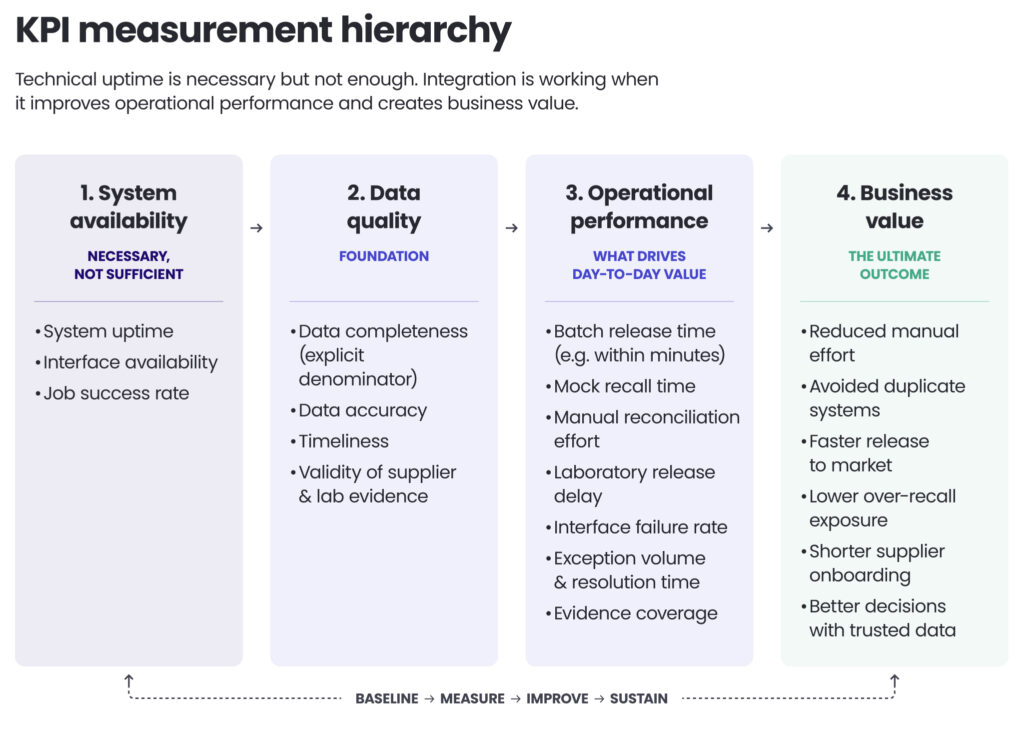
ابدأ بوضع خط أساس قبل تغيير سير العمل. وإلا فقد يقدم البرنامج تقنية جديدة دون إثبات حدوث تغيير تشغيلي.
Use service-level objectives where timeliness matters. A batch-release event may need to be available within minutes, while a monthly sustainability ledger can tolerate overnight processing. Reporting the 95th percentile is more informative than a simple average because it reveals slow or stuck events.
Data completeness should be measured against an explicit denominator. “Most suppliers submitted documents” is not a KPI. “Valid certificates received before first delivery for suppliers and materials requiring certification” is measurable because the population and deadline are known.
Quality measures need an exception workflow. A lower automated pass rate can be acceptable if the system correctly quarantines ambiguous records. The goal is not to hide exceptions; it is to identify, route, and resolve them before they contaminate downstream decisions.
Financial value can be estimated from reduced manual effort, avoided duplicate systems, faster release, lower over-recall exposure, and shorter onboarding. Revenue uplift should not be claimed unless the causal link is measured. For a consideration-stage business case, operational evidence is more credible than an aggressive return-on-investment headline.
من يستفيد، وما القرار الذي يجب أن يتخذه كل فريق؟
Different leaders experience the same food processing architecture integration through different decisions. The programme succeeds when each group owns an outcome, a data set, and a change in working practice rather than treating integration as an IT-only initiative.
مديرو العمليات ومديرو المصانع
The main problem is delayed or inconsistent decisions across production, quality, and warehouse teams. Integrated events show whether material is available, whether a batch has been released, and where work is blocked. Operations should prioritise the vertical slice with the highest downtime, spoilage, release, or manual-coordination impact and define the service level needed at the plant.
They should start collecting actual event timestamps, reason codes, line states, material-consumption confirmations, yield, scrap, rework, and manual intervention. These data support better decisions on scheduling, bottlenecks, changeovers, and exception ownership.
مدراء تقنية المعلومات ومهندسو المؤسسات
The main problem is integration debt across legacy, vendor, and plant-specific systems. A governed integration plane reduces direct dependencies and creates reusable contracts. The CIO should decide which capabilities must be strategic internal products, which can be managed services, and which legacy applications require containment or replacement.
Key data include interface inventory, dependency maps, failure rates, support effort, version lifecycles, security exposure, and total change cost. The architecture decision should balance plant continuity, standardisation, vendor constraints, and long-term ownership.
قادة الجودة وسلامة الأغذية
The main problem is proving batch status, genealogy, and evidence under time pressure. Integrated traceability links production, laboratory, holds, supplier documents, and dispatch without local reconciliation. Quality leaders should define release rules, recall query requirements, evidence retention, and the exceptions that require qualified human approval.
They should collect sample-to-batch relationships, method versions, result approval history, hold reasons, deviation links, certificate validity, and mock-recall performance. Better data supports release, containment, root-cause analysis, and audit preparation.
قادة الاستدامة والمالية
The main problem is reproducing the Scope 1 and Scope 3 figures from the source evidence and the approved methodology. An emissions activity ledger separates operational activity from factor versions and calculation outputs. Sustainability leaders should prioritise material categories, define method hierarchies, and agree which supplier requests are necessary and proportionate.
They should collect quantities, units, dates, facilities, assets, suppliers, products, shipments, factors, uncertainty, and evidence references. Better lineage supports internal review, assurance and consistent responses to customers or lenders.
فرق المشتريات وجودة الموردين
The main problem is incomplete, late, or incomparable supplier information. A supplier interface gives each request a purpose, deadline, validation rule, and approval owner. Procurement should segment suppliers by risk and digital capability rather than impose one channel on everyone.
They should collect onboarding duration, rejection reasons, expired evidence, response time, data method, and support demand. These measures support supplier development, sourcing decisions, and realistic service design.
قادة البيانات والذكاء الاصطناعي
The main problem is producing reproducible features from operational systems that change independently. The food processing integration architecture provides stable identities, historical states, and lineage. Data leaders should select use cases with clear decisions and feedback rather than building a broad feature store before business ownership exists.
They should collect label definitions, feature availability time, model version, prediction, confidence, human action, and realised outcome. Those records support validation, drift monitoring, and responsible model improvement.
الأخطاء الشائعة التي يجب تجنّبها أثناء تكامل نظام معالجة الأغذية
Food processors should avoid treating integration as a sequence of isolated interfaces. The most damaging mistakes create hidden dependencies, unclear ownership, or attractive dashboards built on weak operational records. Correcting them early is less expensive than debugging them during a recall, audit, or seasonal peak.
- البدء بشراء المنصة. لا يمكن لعرض توضيحي للمنتج أن يحدد أي نظام ينبغي أن يتولى مسؤولية الدفعة أو العينة أو اعتماد المورد. حدد نموذج التشغيل أولاً.
- ربط كل تطبيق مباشرة بكل تطبيق آخر. تحقق الروابط من نقطة إلى نقطة مكاسب محلية سريعة، ثم تجعل التغيير بطيئًا ومحفوفًا بالمخاطر.
- استخدام حقول النصوص كمعرّفات. أسماء المنتجات وأسماء الموردين وأرقام الدفعات النصية الحرة ليست مفاتيح مستقرة.
- جعل كل تدفق في الوقت الفعلي. تضيف البنية في الوقت الفعلي تكلفة واعتمادًا تشغيليًا. استخدمها فقط عندما يبرر زمن استجابة القرار ذلك.
- نسخ البيانات منخفضة الجودة بشكل أسرع. يجب أن يتحقق التكامل من الاستثناءات ويحجرها ويحدد مسؤوليتها بدلاً من نشرها.
- التعامل مع بوابة الموردين كمساحة لتخزين المستندات. تحتاج الأدلة إلى سياق وصلاحية وسير عمل ووجهة معتمدة.
- بناء الذكاء الاصطناعي قبل توفر بيانات التغذية الراجعة. لا يمكن للنموذج أن يتعلم نتيجة موثوقة إذا كانت جودة القرارات ورموز الأسباب غير متسقة.
- الكتابة فوق عوامل أو طرق الانبعاثات. يجب أن تكون أرقام الاستدامة قابلة للتكرار خلال فترة التقرير وقابلة للاسترداد عند تغيّر الأساليب.
- تجاهل أنماط أعطال المصنع. يجب اختبار فقدان الاتصال والتخزين المؤقت المحلي والرجوع اليدوي والاستعادة.
- إنهاء التمويل عند الإطلاق التشغيلي. تستمر الواجهات والشهادات والمخططات والنماذج والموردون في التغير.
قائمة التحقق من جاهزية التكامل
Use this checklist before commissioning middleware or food processing software development. A “no” answer does not stop the programme, but it identifies work that belongs in discovery or the first delivery phase.
الأعمال والعمليات
- تحديد قرار الأولوية ومالك العملية المسؤول بشكل واضح.
- المهلة الزمنية الحالية وأنماط الفشل والجهد اليدوي لها خط أساس.
- تتقاطع الشريحة الرأسية الأولى مع أنظمة حقيقية وتنتهي بقرار يتخذه المستخدم.
- تتم توثيق معالجة الاستثناءات والآلية الاحتياطية اليدوية.
- يتوفر ممثلون عن المصنع والجودة والمشتريات والاستدامة وتقنية المعلومات للتصميم والاختبار.
البيانات والملكية
- يتم تعريف أنظمة السجلات للكائنات التجارية الرئيسية.
- يتم جرد معرفات الدفعات والمواد وإصدارات المنتجات والموردين والعينات والأصول والمواقع ووحدات المناولة.
- الوحدات وقيم الحالة والطوابع الزمنية وقواعد التصحيح موثّقة.
- يتم تعيين مالكي البيانات ومالكي الخدمات التقنية.
- قواعد الاحتفاظ والأدلة والتتبع المطلوبة معروفة.
- يتم ربط النطاق 1 ومصادر أنشطة النطاق 3 الجوهرية بالأدلة وطرق الحساب.
التكنولوجيا والأمن
- تمتلك الأنظمة المصدرية واجهات برمجة تطبيقات موثقة، أو إمكانية الوصول إلى قواعد البيانات، أو تصدير الملفات، أو غيرها من الواجهات الممكنة.
- تتمتع سير العمل الحيوية للمصنع بتصميم استمرارية لفقدان الشبكة أو الخدمة.
- للمصادقة والأسرار والشهادات وحسابات الخدمة جهات مالكة لدورة حياتها.
- تم تحديد الحدود الشبكية بين التكنولوجيا التشغيلية وتكنولوجيا المعلومات المؤسسية والموردين وخدمات السحابة.
- تشمل المراقبة زمن الاستجابة والإخفاقات وعمق قائمة الانتظار وأخطاء المخططات وإعادة التشغيل.
- تم اختبار سيناريوهات النسخ الاحتياطي والاستعادة والكوارث أو جدولتها.
التبني والعمليات
- تعكس قنوات الموردين مستويات مختلفة من القدرات الرقمية.
- يمكن للمستخدمين رؤية حداثة البيانات وحالة التحقق وملكية الاستثناءات.
- يستمر دعم الخدمة والتحكم في التغييرات وملكية الإصدارات بعد الإطلاق.
- تشمل تقارير مؤشرات الأداء الرئيسية النتائج التجارية، وليس التوافر التقني فقط.
- تشمل خارطة الطريق إيقاف الجداول المكررة والواجهات والحلول المؤقتة المحلية.
كيف يمكن لـ Spyrosoft دعم تكامل أنظمة معالجة الأغذية؟
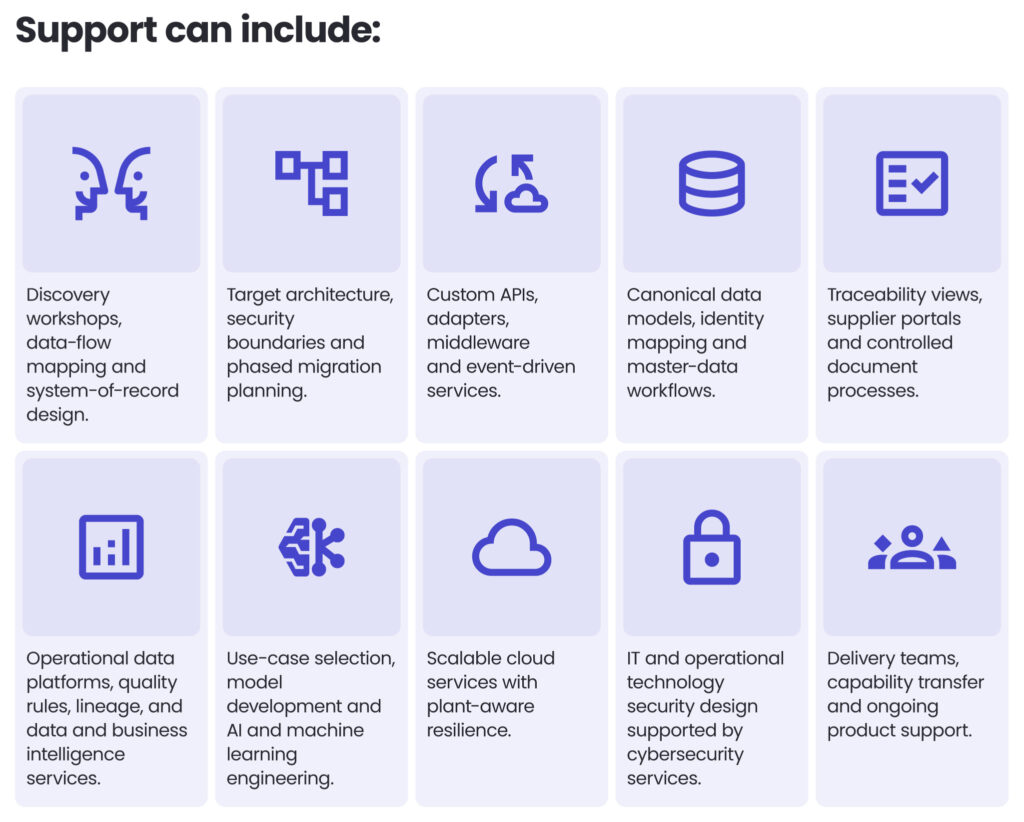
يمكن لـ Spyrosoft دعم مصنّعي الأغذية من خلال الجمع بين هندسة التكامل والهندسة المخصصة، منصات البيانات وذكاء الأعمال, السحابة, الاتصال الصناعي, الأمن السيبراني، و الخبرة في الذكاء الاصطناعي and governance in a single delivery model. The role is not to impose a closed suite. It is to design the target operating architecture, build the missing software, and help internal teams run it safely.
An agri-food software provider should understand the boundary between enterprise systems, plant operations, and external suppliers. It should also be able to work with the constraints of existing vendors, seasonal operations, controlled quality processes, and mixed IT and operational technology environments. Spyrosoft’s خبرة في مجال AgriTech يجمع بين هذه المنظورات المجالية والهندسية.
The first engagement should produce decisions. A useful architecture assessment identifies the priority business slice, systems, and owners involved, current data risks, target integration patterns, security constraints, supplier implications, Scope 1 and Scope 3 data needs, delivery backlog, and acceptance KPIs.
The output should also state what not to build. Some interfaces can remain controlled batch exchanges. Some local systems should be retired. Some AI ideas should wait until labels improve. A credible partner both narrows the programme and delivers it.
تكامل أنظمة معالجة الأغذية: الخلاصة، والخطوة العملية التالية
Food processors do not become AI-ready by replacing every application or copying all data into one platform. They become ready by defining ownership, connecting operational events, preserving lineage, and governing the way data is corrected, shared, and used. ERP, MES, LIMS, WMS, and QMS can remain in place when their responsibilities are clear, and their interfaces are supportable.
The same food processing system integration foundation can serve several priorities: batch genealogy, release control, supplier collaboration, Scope 1 and Scope 3 evidence, analytical reporting, and AI. That reuse is the core business case. It reduces duplicated work and makes future changes less dependent on individual systems or spreadsheets.
The next step is an integration architecture assessment centred on one business-critical flow. As Spyrosoft, we can map your current process, define the target data contracts, and identify a first vertical slice that delivers an operational result, all while building reusable foundations for the wider programme. Contact us via the form below and see what we can do for you.
مصادر ومعايير مختارة
- اللائحة (EC) رقم 178/2002، المادة 18، متطلبات التتبع في قانون الغذاء العام، EUR-Lex.
- ISA-95 وIEC 62264، معايير تكامل أنظمة التحكم في المؤسسات.
- GS1 وEPCIS ومفردات الأعمال الأساسية 2.0.
- بروتوكول غازات الدفيئة، معيار المحاسبة والإبلاغ لسلسلة القيمة المؤسسية (النطاق 3).
- اللائحة المفوضة (EU) 2023/2772، معيار ESRS E1-6 بشأن إجمالي انبعاثات الغازات الدفيئة من النطاق 1 والنطاق 2 والنطاق 3.
- التوجيه (EU) 2026/470 وإرشادات المفوضية الأوروبية الصادرة في 6 مايو 2026 بشأن سقف سلسلة القيمة في CSRD.
- مؤسسة OPC، البنية الموحدة لـ OPC الجزء 1؛ OASIS، MQTT الإصدار 5.0.
- NIST، إطار إدارة مخاطر الذكاء الاصطناعي 1.0.
- ISO/IEC 42001:2023، أنظمة إدارة الذكاء الاصطناعي.
الأسئلة الشائعة
Usually not. The first task is to define which system owns each business object and event, then connect those systems through governed interfaces. ERP replacement is justified when the platform is unsupported, unsafe, unable to expose required data, or unable to support the operating model. Otherwise, integration normally delivers earlier value with lower migration risk.
There is no single duration because site count, vendor access, data quality, and process scope vary. For planning purposes, a focused discovery can be time-boxed to 8–12 weeks, followed by a vertical-slice delivery. The useful planning unit is a business flow, such as release-to-dispatch or incoming-material approval, rather than a promise to connect every system at once.
The organisation should own an enterprise batch identity, while individual systems may retain local identifiers where technical constraints require them. A governed mapping links ERP, MES, LIMS, WMS, and supplier references. The crucial control is that every split, merge, transformation, and rework event preserves the relationship between enterprise and local identities.
No. A data lake provides storage, not reliable meaning. AI requires stable identities, event time, source lineage, labels, feature availability at decision time, quality controls and feedback on outcomes. The analytical platform should consume governed operational events and reference data. It should not become a substitute for correcting weak source processes.
It should collect only the information needed for the defined procurement, quality, traceability, or sustainability decisions. Typical items include onboarding data, certificates, specifications, delivery information, corrective actions, and selected emissions activity data. Requirements should vary by supplier and material risk. Every submission needs validation, versioning, status, and an internal approval owner.
Often yes. Options include vendor APIs, OPC UA, MQTT gateways, database views, change data capture, and controlled file exchange. The decision depends on supportability, latency, and security. A legacy adapter should translate data into a stable contract and isolate the old system. Integration is not appropriate if the source is unsafe or cannot produce reliable records.
Store operational activity separately from emission factors and calculation outputs. Scope 1 records should link fuel, refrigerant, and controlled-asset activity to source evidence. Scope 3 records should link procurement, supplier, transport, packaging, and waste activities to a category, method, and factor version. This structure supports recalculation, assurance, and method improvement.
Use least-privilege service identities, encryption, certificate and secret rotation, network segmentation, schema validation, logging, monitoring, backup and tested recovery. Plant-critical flows need local continuity and clear fallback. Remote supplier or cloud access should never create unrestricted routes into operational technology. Security ownership must continue after the initial implementation.
Choose replacement when the core system is beyond support, presents an unmanageable security risk, cannot support required processes or interfaces, or costs more to contain than to migrate. The decision should include data migration, plant continuity, validation, training, and decommissioning. Replacement should solve a demonstrated structural problem, not serve as a substitute for governance.


arrow_circle_rightاتصل بنا
لنناقش كيف يمكننا مساعدتك في مشاريعك الزراعية التقنية

arrow_circle_right مقالات أخرى


