الذكاء الاصطناعي الطرفي في الزراعة: تصميم أنظمة تعمل دون اتصال بالشبكة


Rural connectivity has improved, but it is still too inconsistent to support cloud-dependent agricultural software as the default operating model. In practice, field operations, machinery workflows, sensor systems, and time-critical alerts must continue to work during network loss, weak signal, or high-latency conditions.
لهذا السبب فإن الذكاء الاصطناعي الطرفي في الزراعة ليس ترقية ميزة. إنه متطلب تصميم أنظمة يقدم مساهمة ملموسة فيتحويل الزراعة وممارسات الزراعة المستدامة. Teams building precision agriculture platforms, connected machinery, and agronomic decision tools need offline-first architectures, local inference, resilient synchronisation, and deterministic fallbacks if they want their software to perform under real-world farm conditions.
لماذا يعد العمل دون اتصال أولاً أمراً مهماً في الزراعة المستدامة؟
Agriculture is not a regular software environment. Fields are large, weather conditions are changeable, assets are mobile, infrastructure is uneven, and many workflows happen outside stable network coverage. Even in places where 5G rollout has progressed, rural quality still lags urban quality. عبر دول منظمة التعاون الاقتصادي والتنمية، في نهاية عام 2024، شهد المستخدمون في المدن سرعات تنزيل عبر الهاتف المحمول أعلى بنسبة 37.2% من المستخدمين في المناطق الريفية، وبلغ متوسط سرعة التنزيل لشبكة 5G حوالي 222.6 ميغابت في الثانية في المدن مقابل 173.5 ميغابت في الثانية في المناطق الريفية.
The gap is not only about average speed. It is also about consistency, latency, signal dropouts, roaming behaviour, and the operational reality in which many farming operations and tasks happen at the edge of coverage, inside steel machinery cabins, in orchards, in remote plots, or across mixed topography. تقييم تغطية النطاق العريض لعام 2024 من المفوضية الأوروبية يتتبع بشكل صريح التوفر في المناطق الريفية بشكل منفصل لأن جودة التغطية ونشرها لا يزالان غير متكافئين جغرافياً.
FAO has also highlighted a broader structural issue: digital exclusion in rural areas grows as services are digitalised and offline alternatives are removed. That principle applies directly to agricultural software and digital technologies. If a spray log, disease alert, irrigation rule, or machine instruction only works online, then the system has been designed against smart farming rather than with it in mind.
ما المشكلات التي تحلها الحوسبة الطرفية للزراعة الدقيقة؟
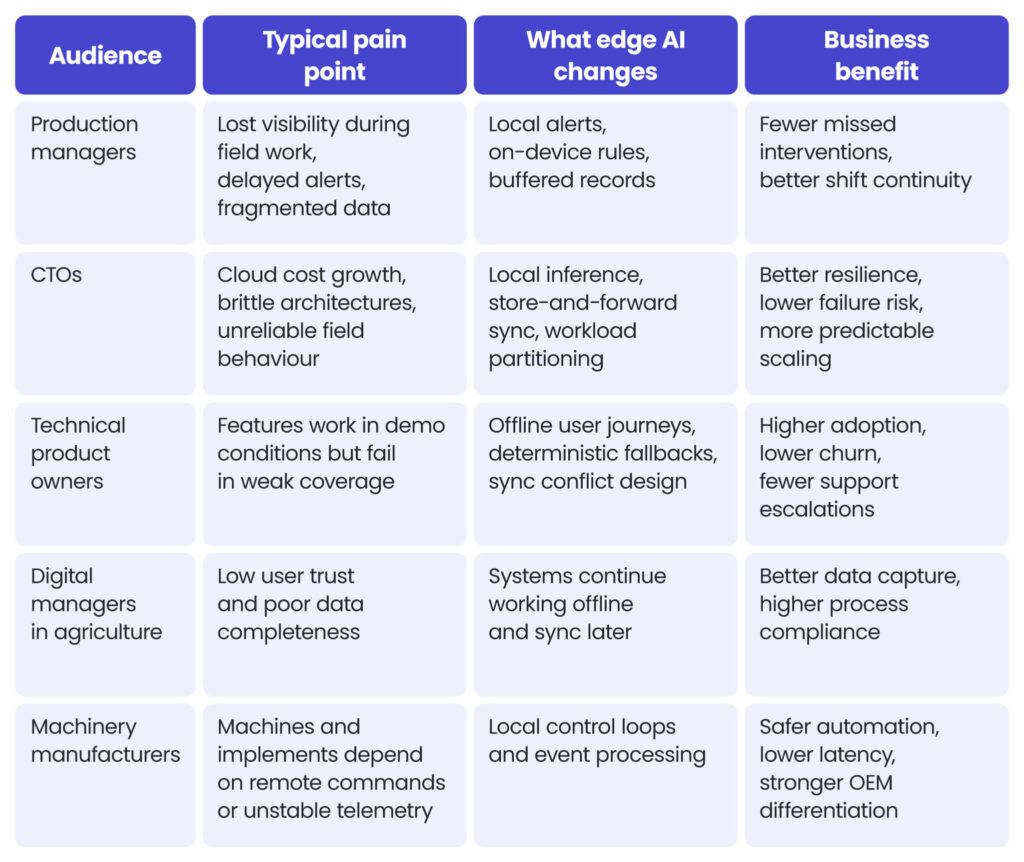
Edge computing addresses one of the most persistent constraints in agricultural digital technologies and systems: the gap between how software is designed in connected environments and how it must actually perform in the field, where latency, limited bandwidth, and unstable connectivity are part of everyday operations.
لماذا يُعد هذا أمرًا مهمًا تجاريًا فيما يتعلق بتحويل الزراعة؟
For software buyers in the agricultural sector, reliability is often valued above algorithmic sophistication. A model with slightly lower laboratory accuracy but strong local execution, good fallback logic, and robust synchronisation can create more operational value than a more complex cloud-dependent system. That trade-off is consistent with current edge computing research in agriculture, which emphasises latency reduction, bandwidth efficiency, and distributed decision-making close to machinery, sensors, and crops.
تعرّف على سبب كون البرمجيات عائقًا محتملاً للزراعة الذاتية وكيفية التعامل مع هذه المشكلة
اقرأ المزيد
السحابة أولاً مقابل الحوسبة الطرفية أولاً في الأنظمة الزراعية
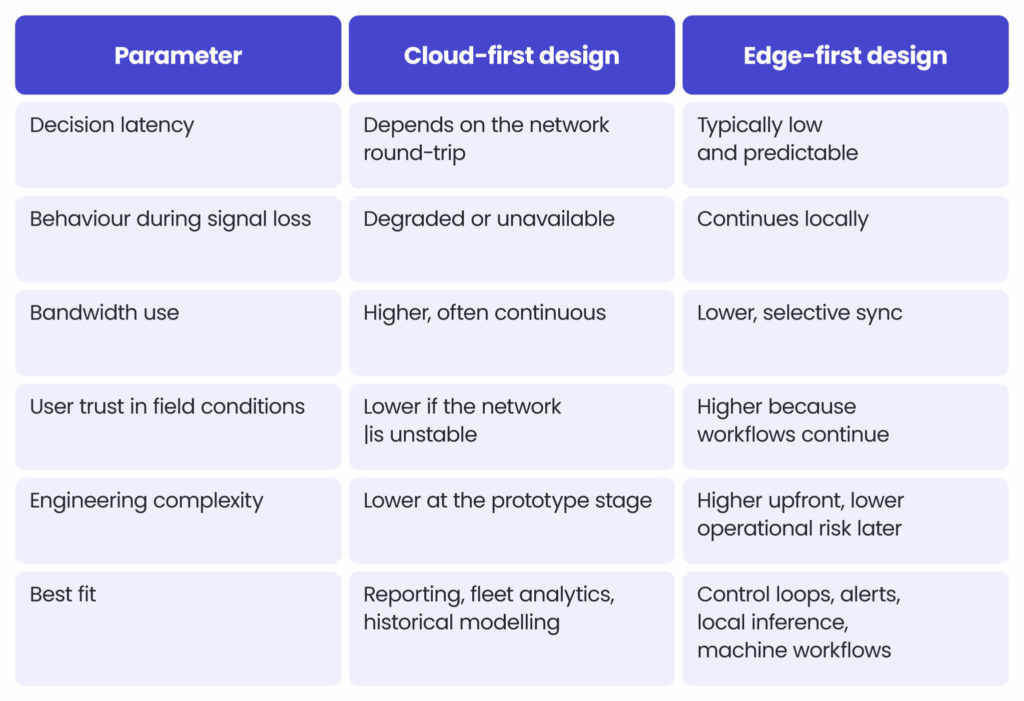
Cloud platforms in smart farming still matter. It is the right place for fleet-wide reporting, model retraining, cross-farm benchmarking, traceability, planning, and long-term analytics. The mistake is assuming it should sit on the critical path of every field decision.
مقارنة خيارات البنية المعمارية
The comparison below provides a simple way to understand how cloud-first and edge-first architectures differ in day-to-day operations, particularly in environments where connectivity, response time, and system continuity have a direct impact on performance in the field.
حيث يجب أن تظل السحابة محورية في الزراعة الذكية
Cloud infrastructure remains essential in agricultural systems, but its main role is not to play a critical part in every operational decision. Its real value lies in scale, coordination, governance, and the ability to combine data across machines, users, farms, and seasons. Wherever the task depends on a broad system view, shared standards, long-term storage, or central control, the cloud should remain the primary layer.
لا تزال السحابة الموطن الأمثل لـ:
- تدريب النماذج وحوكمة الإصدارات،
- توحيد البيانات على مستوى الأسطول،
- التقارير التنظيمية،
- تكامل أنظمة تخطيط موارد المؤسسات (ERP) وإدارة علاقات العملاء (CRM) وسلسلة التوريد،
- تحليل الاتجاهات التاريخية ومعالجة البيانات عبر المواسم والمزارع.
حيث ينبغي أن يكون الذكاء الاصطناعي والحوسبة الطرفية هو الخيار الافتراضي
Edge computing should be the default for functions that must work in real time, close to the machine, sensor, or operator, and without assuming stable connectivity. In modern agriculture and farming operations and environments, many of the most important workflows happen in the field, under weak signal, variable latency, or complete network loss. Wherever the task depends on immediacy, local context, operational continuity, and resilience, the edge should own the execution.
ما يجب أن تتولاه الحوسبة الطرفية:
- استيعاب المستشعرات وتصفيتها،
- كشف الأحداث،
- التوصيات والإنذارات المحلية،
- دعم القرار من جانب الآلة،
- منطق الاحتياطي في حالات الطوارئ،
- سير عمل المشغّل دون اتصال،
- التخزين المؤقت والإرسال بالتخزين والتمرير.
المبادئ الهندسية وراء الذكاء الاصطناعي الطرفي القوي في الزراعة
نقل منطق القرار بالقرب من الحدث
If a frost alarm depends on a round trip to the cloud, it is already too late in many scenarios. Local thresholding, local feature extraction, and local inference reduce risk. Recent research in agricultural edge systems repeatedly frames this as a practical response to bandwidth constraints, lower response efficiency, and resource-sensitive deployment environments.
صمّم للمزامنة، وليس للاتصال الدائم
The right mental model is not “a connected device”. It is “an autonomous local node that synchronises when possible”. This changes how teams design message queues, timestamps, retry logic, idempotency, conflict resolution, and audit trails.
افصل بين الزمن الحقيقي الصارم والزمن الحقيقي المرن
لا يمكن لقاعدة تتعلق بسلامة الآلات أو التشغيل أن تنتظر نفس خط المعالجة الذي يحدّث لوحة المعلومات. تحتاج الفرق إلى فئات صريحة من القرارات:
- قرارات محلية فورية،
- قرارات محلية مع تأكيد سحابي لاحق،
- قرارات السحابة تُدفع بشكل غير متزامن،
- التحليلات التاريخية فقط.
حسّن النماذج للنشر، وليس فقط لدقة المعايير القياسية
Agricultural edge AI often succeeds with smaller models, compressed models, quantised inference, or hybrid rule-plus-model pipelines. A recent 2025 smart agriculture framework showed that lightweight edge-optimised models can achieve 88% weather classification accuracy and 93% crop classification accuracy on resource-constrained hardware, while still supporting real-time local actuation logic.
تعامل مع التخزين المحلي كمكوّن أساسي من الدرجة الأولى
تحتاج الأنظمة التي تعمل دون اتصال أولاً إلى تخزين محلي متين، وليس ذاكرة تخزين مؤقت تُستخدم كفكرة لاحقة. ويشمل ذلك:
- سجلات الأحداث المحلية،
- إجراءات المشغل،
- مخازن مؤقتة للقياس عن بُعد،
- إصدارات النموذج،
- لقطات الإعدادات،
- حالة المزامنة وبيانات التدقيق الوصفية.
كيفية تصميم سير عمل زراعي يعمل دون اتصال أولاً
فيما يلي تسلسل تنفيذ عملي لفرق المنتج والهندسة التي ترغب في بناء أنظمة زراعة دقيقة موثوقة.
الخطوة 1. تحديد القرارات التي يجب أن تصمد أمام انقطاع الشبكة
List all workflows and mark which ones fail if the cloud is unavailable. In most agricultural systems, these include alerts, machine-side recommendations, offline field records, sensor-triggered actions, and operator task confirmation.
الخطوة 2. تحديد ما يعمل محليًا
لكل سير عمل حرج، حدد:
- المدخلات المحلية،
- المعالجة المحلية،
- المخرجات المحلية،
- مخرجات احتياطية في حال عدم توفر النموذج،
- ما يجب مزامنته لاحقًا.
الخطوة 3. تقليل حجم البيانات المرسلة وتكرار المزامنة
Do not send raw streams when summarised events will do. Send features, flags, compressed histories, and priority deltas where possible. This reduces bandwidth pressure and preserves battery life.
الخطوة 4. تصميم معالجة التعارضات قبل النشر
Offline data capture creates merge events. Two operators may edit the same task. A machine may complete work before the cloud plan updates. The product needs clear rules for precedence, reconciliation, and auditability.
الخطوة 5. إنشاء حالة مزامنة مرئية للمشغل
يجب أن يعرف المستخدمون ما إذا كان الإجراء:
- محفوظ محلياً،
- في انتظار المزامنة،
- متزامنة،
- مرفوض،
- تم استبداله بنسخة أحدث.
وهذا ليس مجرد تفصيل تقني، بل يؤثر مباشرة على الثقة.
الخطوة 6. القياس المرجعي في ظروف ريفية واقعية
اختبار تحت:
- شبكة 4G ضعيفة،
- تغطية متقطعة،
- فترات الانقطاع الطويلة،
- قيود البطاريات،
- إعادة تشغيل البوابة،
- تأخر مزامنة الساعة،
- تلف جزئي في البيانات.
حالة الاستخدام: مراقبة الصقيع والأمراض في البساتين مع منطق قرار محلي
السياق
This is an illustrative engineering case based on a realistic orchard deployment pattern rather than a published single-customer reference. It combines common requirements seen in fruit production: frost alerts, leaf wetness monitoring, local weather capture, disease-risk scoring, and delayed synchronisation to a central platform.
السيناريو
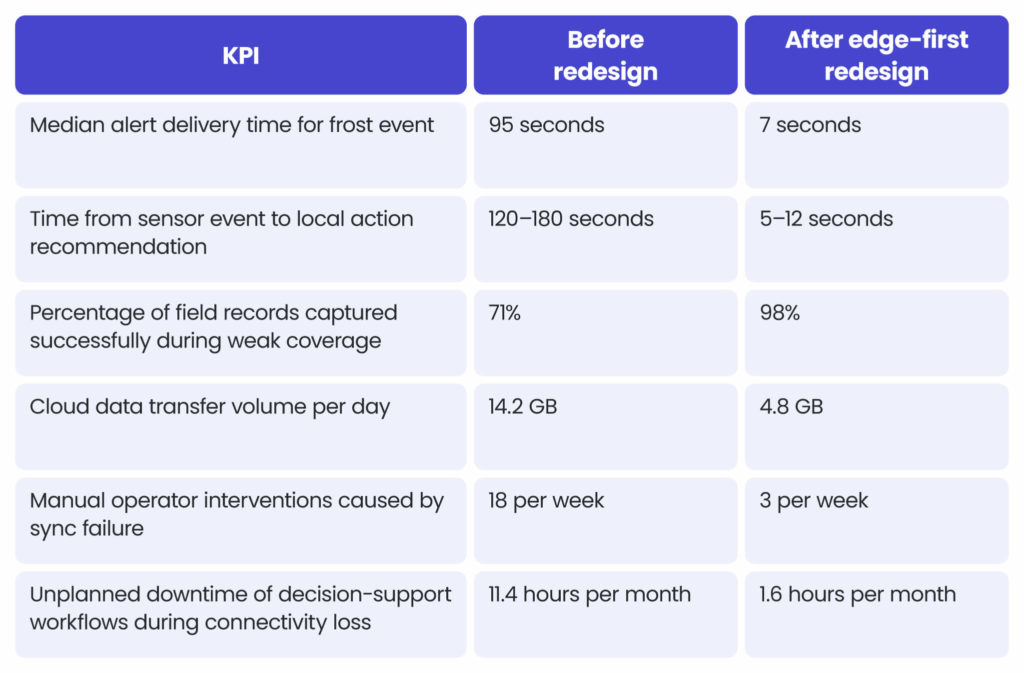
A 120-hectare orchard group operates across 9 separate blocks with mixed connectivity. The previous cloud-first setup relied on central processing for alerts and risk calculations. During spring nights, connectivity instability led to delayed alerts and incomplete field logs.
مؤشرات التشغيل المستهدفة
البنية المستخدمة
- بوابة محلية لكل قطعة في البستان،
- محرك قواعد محلي لعتبات الصقيع والأمراض،
- نموذج مدمج على الجهاز لتقييم الأحداث،
- بيانات القياس عن بُعد المخزنة مؤقتاً مع نقل التخزين وإعادة التوجيه،
- السحابة المركزية فقط للتحليلات التاريخية والتقارير الموسمية وتحديثات النماذج.
لماذا تحسّنت النتائج؟
The main gain does not come from “better AI” alone. It comes from moving the decision path to the edge, reducing round-trip transmissions, and sending events instead of continuous raw traffic. This aligns with broader research on edge-enabled agriculture, which consistently reports latency and bandwidth as major constraints in cloud-dependent designs.
ملاحظة المعيار المرجعي
These figures should be treated as a representative delivery benchmark for architecture planning, not as a universal outcome. Real numbers depend on sensor density, topography, network quality, event frequency, and device class.
الأخطاء الشائعة في أنظمة ومشاريع الذكاء الاصطناعي الطرفي في الزراعة
سبعة أخطاء تبطئ التبني:
- التعامل مع وضع عدم الاتصال كميزة في تطبيق الجوال بدلاً من كونه قراراً معمارياً – يؤدي هذا عادةً إلى مزامنة معطلة، والتقاط جزئي للبيانات، وسلوك غير متسق.
- دفع تدفقات البيانات الخام من أجهزة الاستشعار إلى السحابة بشكل افتراضي – وهو نهج مكلف وهش وغالبًا ما يكون غير ضروري.
- استخدام نماذج كبيرة تناسب لوحة العرض التجريبي ولكن ليس جهاز الإنتاج – فالأجهزة الزراعية لديها قيود حرارية وطاقة وذاكرة.
- تجاهل انحراف الطوابع الزمنية ومشكلات الترتيب – في الأنظمة الميدانية الموزعة، جودة الوقت مهمة.
- بناء التنبيهات دون إمكانية التوضيح أو التفسير المحلي – يحتاج المشغلون إلى معرفة سبب إصدار النظام لتحذير ما.
- خلط منطق السلامة مع سير العمل التجاري العام – لا ينبغي أن تشترك هذه في نفس سلسلة التبعيات.
- تخطي اختبار ظروف الميدان – النظام الذي يُختبر فقط على شبكة Wi-Fi مكتبية مستقرة ليس جاهزًا للإنتاج في مجال الزراعة.
قائمة تحقق للفرق التي تخطط لتطبيق الذكاء الاصطناعي الطرفي في الزراعة
قائمة التحقق الفنية
- حدد سير العمل الحرج الذي يجب أن يعمل دون اتصال
- تحديد حدود المعالجة المحلية وحدود الحوسبة السحابية
- اختر نماذج خفيفة جاهزة للنشر
- إضافة تخزين محلي مع سجل تدقيق
- تصميم سلوك مزامنة وإعادة محاولة خالٍ من التكرار
- التعامل مع انحراف الساعة والأحداث المكررة
- إتاحة حالة المزامنة للمشغّلين
- أنشئ قواعد احتياطية عند عدم توفر النموذج
- القياس المرجعي في ظروف الإشارة الضعيفة
- تخطيط التحديث عن بُعد الآمن والتراجع
قائمة التحقق من المنتج
- ارسم حالات الفشل من وجهة نظر المستخدم
- تحديد الشاشات وسير العمل التي تظل قابلة للاستخدام دون اتصال بالإنترنت
- اعرض حداثة البيانات وحالة المزامنة بوضوح
- تجنّب إعاقة إنجاز المهام بسبب اتصال مفقود
- بناء الثقة من خلال سلوك محلي شفاف
كيف تدعم Spyrosoft مجال تطبيقات الذكاء الاصطناعي الطرفي في الممارسات الزراعية
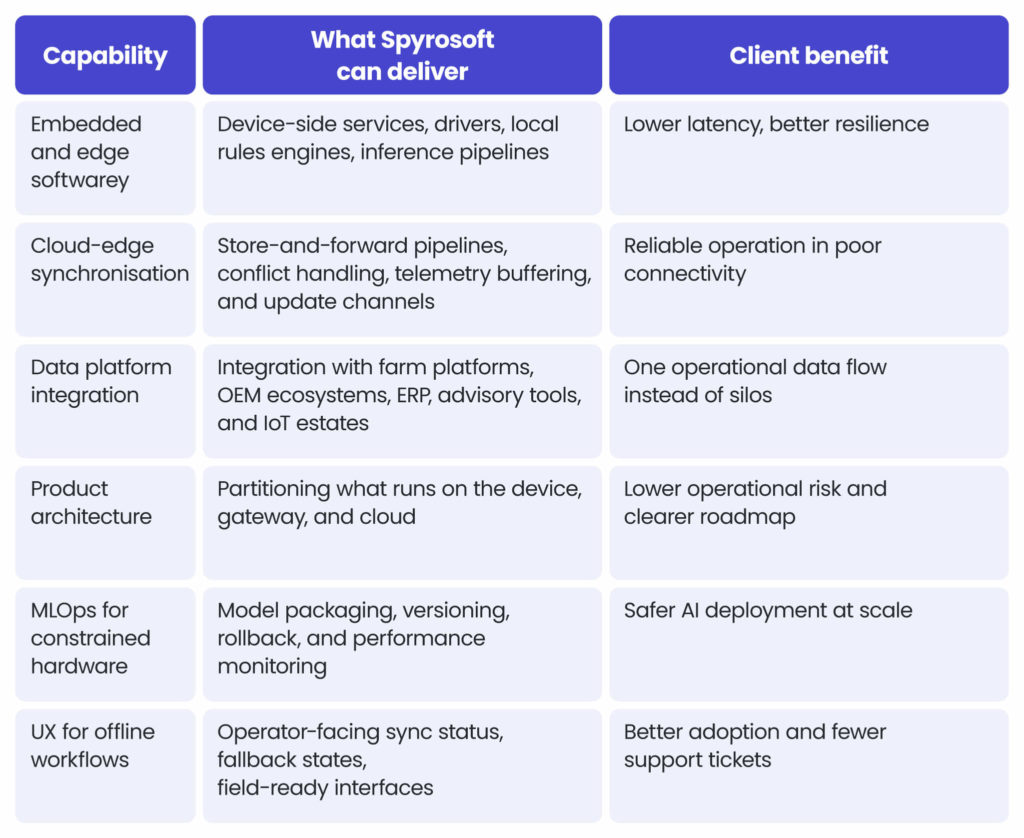
يمكن لـ Spyrosoft دعم الذكاء الاصطناعي الطرفي في الزراعة والزراعة الذكية عند المستوى الذي تفشل فيه العديد من البرامج: تحويل النماذج الأولية المجزأة إلى أنظمة برمجية جاهزة للإنتاج.
ما يمكن أن يتضمنه هذا الدعم
تلخيص الذكاء الاصطناعي الطرفي في الزراعة
Edge AI in agriculture is not mainly about putting models on a device. It is about engineering systems that remain useful for precision agriculture when connectivity is weak, partial, delayed, or absent. That means local decision logic, deployment-ready models, durable local storage, resilient synchronisation, and clear product behaviour during failure states.
The market direction is clear. Rural connectivity is improving, but the quality gap remains material enough that agricultural software cannot assume stable cloud access as its operating baseline. Teams that build for intermittent connectivity will deliver more reliable products, stronger adoption, and better commercial outcomes than teams that continue to treat offline resilience as a secondary enhancement.
إذا كنت تبحث عن المساعدة في بناء منصات الزراعة الدقيقة والحلول مع مراعاة المرونة دون اتصال والاتصال المتقطع، تواصل مع خبرائنا باستخدام نموذج الاتصال أدناه.
المصطلحات
الذكاء الاصطناعي الطرفي – الذكاء الاصطناعي الذي يُنفَّذ بالقرب من مصدر البيانات، مثل على آلة أو وحدة تحكم أو بوابة أو خادم محلي.
العمل دون اتصال أولاً – نهج تصميمي يعمل فيه سير العمل الأساسي دون اتصال مباشر بالإنترنت ويتم المزامنة لاحقًا.
التخزين وإعادة التوجيه – نمط اتصال حيث يتم حفظ البيانات محلياً ونقلها عند توفر الاتصال.
الاستدلال المحلي – تشغيل نموذج مدرَّب على جهاز محلي بدلاً من إرسال البيانات إلى خدمة سحابية بعيدة للتنبؤ.
تعارض المزامنة – عدم تطابق ينشأ عندما يتم تغيير نسختين من نفس السجل بشكل مستقل وتحتاجان لاحقًا إلى تسوية.
زمن الاستجابة – التأخير الزمني بين وقوع حدث واستجابة النظام.
التكميم – طريقة لتحسين النماذج تقلل استهلاك الذاكرة والحوسبة باستخدام تمثيل رقمي منخفض الدقة.
مصادر مختارة
OECD، الاتصال الرقمي يتوسع في جميع أنحاء منظمة التعاون الاقتصادي والتنمية، لكن المناطق الريفية تتخلف أكثر فأكثر، 10 يوليو 2025.
المفوضية الأوروبية، العقد الرقمي 2025: تغطية النطاق العريض في أوروبا 2024، 16 يونيو 2025.
Gong وآخرون، الزراعة الذكية الممكّنة بالحوسبة الطرفية: البنى التقنية، والتطور العملي، واختراقات الاختناقات، Sensors، 2025؛ وطارق وآخرون، إطار الزراعة الذكية المُمكّن بالحوسبة الطرفية، النتائج في الهندسة, 2025.
الأسئلة الشائعة
No. It is equally relevant for weather stations, disease models, irrigation controllers, handheld agronomy tools, mobile farm apps, local gateways, telematics units, and post-harvest monitoring systems.
لا. النموذج الأقوى هو السحابة بالإضافة إلى الحوسبة الطرفية، مع ملكية واضحة للقرارات والبيانات والمزامنة. تظل السحابة ضرورية لتحليلات الأسطول وإعادة التدريب وإعداد التقارير والتكامل.
No. Coverage has improved, but rural quality, consistency, and geography-based gaps remain significant. Even where coverage exists, latency variation, coverage holes, and machine mobility still justify offline-first architecture.
نعم، في وقت التصميم. لكن هذا التعقيد عادة ما يكون أقل تكلفة من عدم الاستقرار التشغيلي وفشل عمليات النشر وعدم ثقة المستخدمين بعد الطرح.
اختر سير عمل واحداً بالغ الأهمية، وانقل مسار قراره إلى الحوسبة الطرفية، ونفّذ تخزيناً محلياً متيناً، وأضف مزامنة مؤجلة مع حالة تشغيل واضحة.


arrow_circle_rightاتصل بنا
لنناقش كيف يمكننا مساعدتك في مشاريعك الزراعية التقنية
arrow_circle_right مقالاتنا