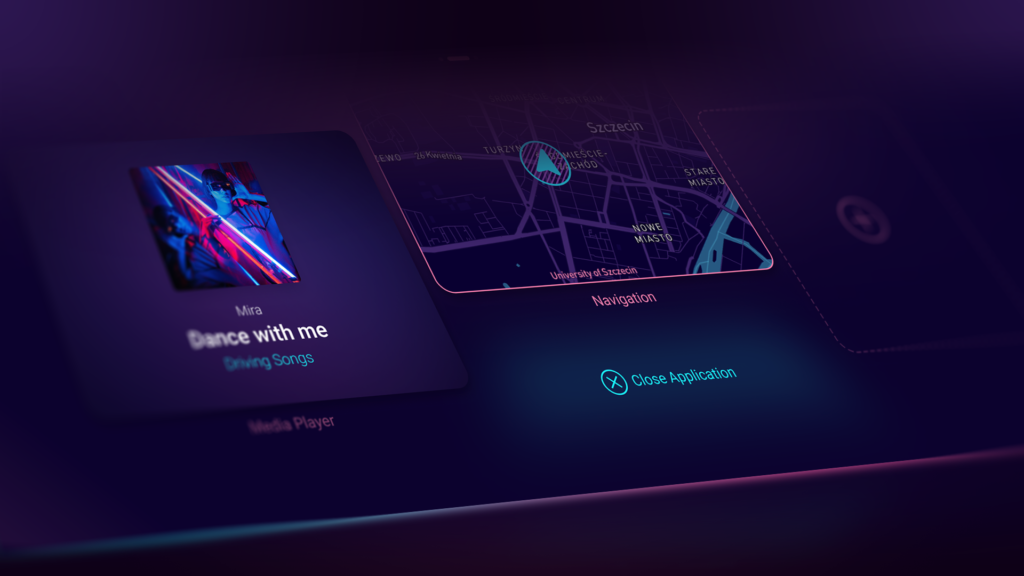
ארכיטקטורת MicroHMI עבור Android Automotive


For years, many OEMs built these systems on custom Linux stacks.
They worked, but scaling them was painful. Integrating new functions or redesigning the UI often meant touching the entire system. Every change required long integration and validation cycles.
Android Automotive OS (AAOS) has changed this dynamic.
With its modular structure and mature developer ecosystem, AAOS allows carmakers to design infotainment and cluster systems that can evolve over time, not just be frozen at SOP. It offers over-the-air updates, secure app isolation, access to Google services, and familiar Android tooling.
But modular software still needs modular design. That’s where MicroHMI architecture comes in.
מדוע MicroHMI חשוב?
The automotive HMI used to be a monolith – one codebase, one development flow, one large team. As vehicles move towards software-defined architectures, this approach no longer scales. Dozens of features must be developed, tested, and maintained in parallel by distributed teams and suppliers.
MicroHMI borrows the microservices idea from enterprise IT. Instead of one massive HMI, you create a set of lightweight, self-contained micro-applications, each responsible for a specific function: climate control, media, navigation, settings, or vehicle status.
כל מודול MicroHMI:
- Has a single responsibility and clear boundaries;
- Communicates through versioned interfaces or an event bus;
- Can be tested, updated, or replaced without touching the rest;
- ופועל כתהליך או כקונטיינר עצמאי.
The benefits are immediate: faster prototyping, easier parallel work, and reduced regression risk. For large OEM programmes, it also improves supplier collaboration – different teams can own separate features while maintaining system consistency through shared APIs.
We believe that MicroHMI is how you conquer cockpit complexity.

Android Automotive כמארח הטבעי
AAOS supports this architecture natively. Each function can be packaged as an independent Android app or service, signed and updated separately. The Vehicle HAL exposes signals from the car, and Android’s robust permission model keeps modules secure.
Android Automotive מאפשר גם:
- עדכוני OTA לשיפור מתמיד;
- Google Automotive Services integration (Assistant, Maps, Play);
- פרופילים מרובי משתמשים;
- Hardware abstraction across platforms such as Qualcomm SA8155P or other automotive SoCs.
For OEMs, that means faster time-to-market and a stable base for innovation. No need to reinvent frameworks for audio, navigation, or connectivity.
ממודולריות להתאמה
Breaking the HMI into micro-modules is only half the story.
The real opportunity lies in making the cockpit אדפטיבי. Drivers now expect the same conversational, context-aware behaviour from their cars that they get from their phones and smart speakers.
This is where Large Language Models (LLMs) enter the picture.
LLMs in the car: the shift from commands to conversation
Early voice control required strict phrasing: "התקשר לג׳ון סמית׳", "קבע טמפרטורה לעשרים ושתיים מעלות." LLMs and modern natural-language processing (NLP) change that entirely.
נהג יכול כעת לומר:
"אני קופא – אתה יכול לחמם את זה קצת?"
"מצא בית קפה בדרך."
"תוריד את המוזיקה, ואז נווט הביתה."
The assistant parses intent, understands context, and can chain multiple actions. It no longer matches keywords – it מפרש משמעות.
בתוך תא הטייס, המשמעות היא:
- Conversational UX: drivers speak naturally, not like to a computer.
- Context-aware behaviour: the system knows current destination, cabin temperature, and driver preferences.
- Task chaining: one utterance can control several functions.
מודלים לשוניים גדולים (LLMs) הופכים את ממשק האדם-מכונה (HMI) מולטי-מודאלי, combining voice, touch, and gesture in a seamless interaction model.
הצינור הרב-מודלי
To make this possible, an automotive HMI integrates several layers of AI and software logic.
- Wake word and Voice Activity Detection (VAD): always-on but low-power listening for the activation phrase.
- Automatic Speech Recognition (ASR): converts speech to text.
- NLU or LLM interpretation: extracts intent, entities, and context.
- Dialogue manager: maintains state across turns.
- Action orchestrator: maps intent to a MicroHMI API (for example, Climate.setTemperature(zone, value)).
- Feedback: provides Text-to-Speech response and UI update on the relevant screen.
Within this architecture, the MicroHMI modules act as executors of actions. The voice system doesn’t need to know כיצד to adjust the climate or play music, it just calls the right module interface.
This decoupling is what makes LLM integration scalable. The AI assistant can evolve independently of the underlying HMI features, and vice versa.
איזון בין ענן ל-AI בקצה
LLMs are large, but they don’t always need to run in the cloud. For privacy and latency reasons, many OEMs now deploy hybrid architectures:
- A lightweight on-device model handles common requests and wake-word detection
- A cloud model handles complex, open-domain queries when connectivity allows
This design ensures critical functions remain available offline, while advanced conversational capabilities are delivered when connected. It also gives OEMs flexibility to comply with regional data-protection laws such as GDPR.
Our engineers frequently combine this hybrid approach with context caching and intent confidence thresholds – the system decides dynamically whether to execute, ask for confirmation, or escalate to a cloud query.
בטיחות תפקודית ואיכות מלכתחילה
No matter how intelligent an assistant becomes, the automotive environment demands reliability and compliance.
With this in mind, we embed functional safety and process maturity directly into the HMI lifecycle:
- ISO 26262 for functional safety (ASIL levels A–D)
- Automotive SPICE ליכולת תהליכית
- IEC 61508 and ISO 14971 for risk management and safety-related software
ה Wavey platform integrates Squish GUI Tester in a Docker-based CI/CD pipeline, ensuring that every code change triggers unit, smoke, and regression tests. GitLab automation validates modules continuously – a practice essential for maintaining quality across distributed teams.
אגב, גלו את Wavey platform and learn how modular architecture, automated testing, and AI integration can transform your approach to automotive UX.
Automated testing isn’t just about efficiency. It’s about trust. When a car’s HMI controls critical functions, confidence in each release matters as much as innovation.
תכנון לסקיילביליות ושיתוף פעולה
A MicroHMI architecture supports true parallel development. Design and engineering teams can work independently yet synchronise through shared contracts.
לדוגמה:
- The UI/UX team designs the visual flow for a navigation tile
- The development team implements it in Qt/QML
- The QA team writes Squish scripts that test the module in isolation
All three can operate simultaneously. Continuous integration merges their outputs into a testable whole each night.
Spyrosoft often uses this structure in complex cockpit programmes, allowing multiple suppliers or in-house teams to deliver features without constant dependency management.
This modularity also simplifies variant management. The same set of MicroHMIs can be combined differently across model lines – for example, a premium trim might add 3D visualisation via Unity, while an entry version reuses the same base modules without it.
Voice, gesture, and touch: a multimodal experience
MicroHMI and AI together unlock truly multimodal interaction.
- Touch remains ideal for visual tasks: map exploration, detailed settings, media browsing
- Voice takes over during driving, when eyes-on-road is paramount
- Gestures add a natural, glance-free option for simple actions such as accepting a call or skipping a track
AI ties these modes together. Context recognition prevents conflicts – for instance, the system pauses gesture input when it detects voice interaction to avoid ambiguity.
This interplay creates an experience closer to human conversation than to computer control. It’s not just תכונה נוספת. It’s a step towards cognitive interaction design, the car adapting to the driver, and not the other way round.
ניהול הקשר והתאמה אישית
An effective in-car assistant remembers context across four layers:
- סשן: מה נאמר באינטראקציה זו.
- משתמש: העדפות והרגלים אישיים.
- Vehicle: current state – speed, temperature, route.
- יישום: איזה מודול HMI פעיל.
Combining these layers allows natural follow-ups. A driver can say, "נווט אל המטען הקרוב ביותר", ואז מיד, "הימנע מכבישים מהירים", והמערכת מבינה.
To maintain privacy, sensitive context is stored locally and synchronised selectively. A local dialogue manager filters what is shared to the cloud, anonymising identifiers where possible.
The goal is clear: make the car helpful without being intrusive.
ביצועים ואופטימיזציה
Real-time responsiveness is crucial. LLMs and voice models must fit within the strict latency budget of a moving vehicle.
טכניקות האופטימיזציה כוללות:
- Model quantisation and distillation to reduce size;
- האצת GPU או NPU על SoCs לרכב;
- Asynchronous pipelines to keep UI threads free;
- Dynamic throttling to balance performance and energy use.
The aim is for the system to acknowledge a command within about half a second, so it’s fast enough to feel instantaneous, yet reliable enough for safety-critical contexts.
To assure this, we monitor latency and success rates as key UX metrics alongside traditional KPIs like frame rate or boot time.
אבטחה, בטיחות ואמון המשתמש
Integrating AI in a vehicle raises natural questions about safety and data handling. Spyrosoft designs HMIs to comply with privacy regulations and driver-distraction standards from the start.
שיטות עבודה מומלצות כוללות:
- עיבוד אודיו באופן מקומי בכל מקום אפשרי;
- Requiring confirmation for critical actions;
- Providing clear visual indicators when the microphone is active;
- מאפשר למשתמשים להשתיק או למחוק נתונים;
- Following UNECE R155/R156 cybersecurity guidelines.
Building trust also means designing transparent behaviour. If the system mishears, it asks. If a request seems unsafe, it politely declines.
This isn’t only good UX. It’s compliance in action.
מהוכחת היתכנות לייצור
At Spyrosoft, we put these ideas into practice with Wavey, our in-house gesture-controlled IVI cockpit built on a Qt-based MicroHMI architecture for Android Automotive.
Each feature – navigation, media, HVAC – exists as a standalone micro-application. Automated Squish tests validate every build in Docker containers. Gesture and voice inputs feed into the same backend APIs, demonstrating the modular design’s flexibility.
Wavey shows how quickly a production-ready cockpit can be assembled when architecture, AI and testing are aligned. The result is a ready-to-deploy automotive IVI and cluster platform that’s both functional and brandable.
מלכודות נפוצות וכיצד להימנע מהן
When adopting MicroHMI and LLM-based interaction, teams often face recurring challenges:
- Over-reliance on the cloud: always provide offline fallbacks.
- Unclear module boundaries: define ownership and interfaces early.
- Lack of automated testing: every module should have its own CI pipeline.
- Ignoring real-world noise: test voice and gesture in actual cabin conditions.
- Privacy by afterthought: bake data-protection design into the first sprint.
Spyrosoft’s experience across OEM and Tier-1 projects shows that early architectural discipline prevents months of rework later.
הדרך קדימה
As vehicles become truly software-defined, the cockpit will be the user’s primary touchpoint, a fusion of safety system, information hub, and digital companion.
MicroHMI architecture provides the structure.
LLMs ו-AI מספקים את האינטליגנציה.
Android Automotive מספק את המערכת האקולוגית.
Together, they enable HMIs that are modular, adaptive, and continuously improving – essential traits for next-generation vehicles.
עבודה איתנו
Delivering such systems requires more than technology. It takes experience.
Our teams combine deep HMI engineering expertise with a practical understanding of automotive safety, testing, and AI integration.
הכישורים שלנו כוללים:
- פיתוח HMI ב-Qt/QML ו-C++;
- אינטגרציה עם Android Automotive OS;
- Squish ואוטומציה של CI/CD;
- בטיחות פונקציונלית (ISO 26262, ASPICE);
- שילוב בינה מלאכותית / LLM במכשיר ובענן;
- עיצוב UX מולטימודלי באמצעות מחוות וקול.
Whether you’re developing a new cockpit from scratch or enhancing an existing platform, we can help you:
- הגדרת ארכיטקטורת MicroHMI ניתנת להרחבה;
- שילוב עוזרים קוליים ועוזרי בינה מלאכותית באופן מאובטח;
- אוטומציה של בדיקות ועמידה ברגולציה;
- Accelerate time-to-market with our ready-made frameworks.
בואו נדבר על הקוקפיט הבא שלכם
Spyrosoft’s HMI development services empower OEMs and Tier-1s to design, test and launch intelligent, brandable in-vehicle systems built for the software-defined era.
התבוננו ב פתרונות HMI or get in touch with our HMI Director and discuss your HMI ideas.


arrow_circle_rightצור קשר
צרו קשר כדי לראות כיצד נוכל לתמוך בפרויקט שלכם
Przemyslaw Krzywania
מנהל HMI