Support technique IA : améliorez la productivité, rationalisez les opérations et réalisez des économies


IA, apprentissage automatique (ML) et le traitement du langage naturel (NLP) continue de dominer the front pages. These technologies and their applications in various industries are growing exponentially. One area where AI makes a massive positive change is technical customer support. AI technical support helps boost customer experiences and transform customer issues into positive interactions by providing instant support and accurate solutions. By quickly addressing customer issues, increasing response times, and offering proactive and comprehensive assistance, AI-driven support enhances satisfaction and builds trust, turning customer issues into positive experiences. This includes even the most specialised and technical sectors, where technical expertise is needed.
Que vous fabriquiez et gériez des éoliennes, exploitiez une ligne de production d'embouteillage ou gériez des équipements miniers souterrains, vous devriez envisager de mettre en œuvre des solutions d'IA pour le support client.
Technical support for software and hardware involves fully understanding the customer’s needs and context, analysing the situation using logs or application settings, identifying root causes and ultimately recommending the right solutions, delivering accurate and relevant answers, or dispatching technicians or human agents to fix the issue. AI can help with any of these steps.
Predictive analytics, ticket classification, advanced troubleshooting, AI-powered responses, 24/7 availability, and technician support are just some use cases that AI for tech support and customer service teams can handle. The great thing about AI in technical support is that it can be tailor-made and adjusted to specific needs to provide comprehensive assistance.
Le besoin croissant de support technique en IA dans les industries spécialisées
As specialised industries become more complex, the demand for AI technical support is increasing. Businesses face high volumes of complex cases with customer questions and service requests, skill gaps in support teams, the need for faster support and 24/7 assistance, and many other obstacles. The list goes on. In the long run, they hinder the productivity of support, customer experience, and business performance.
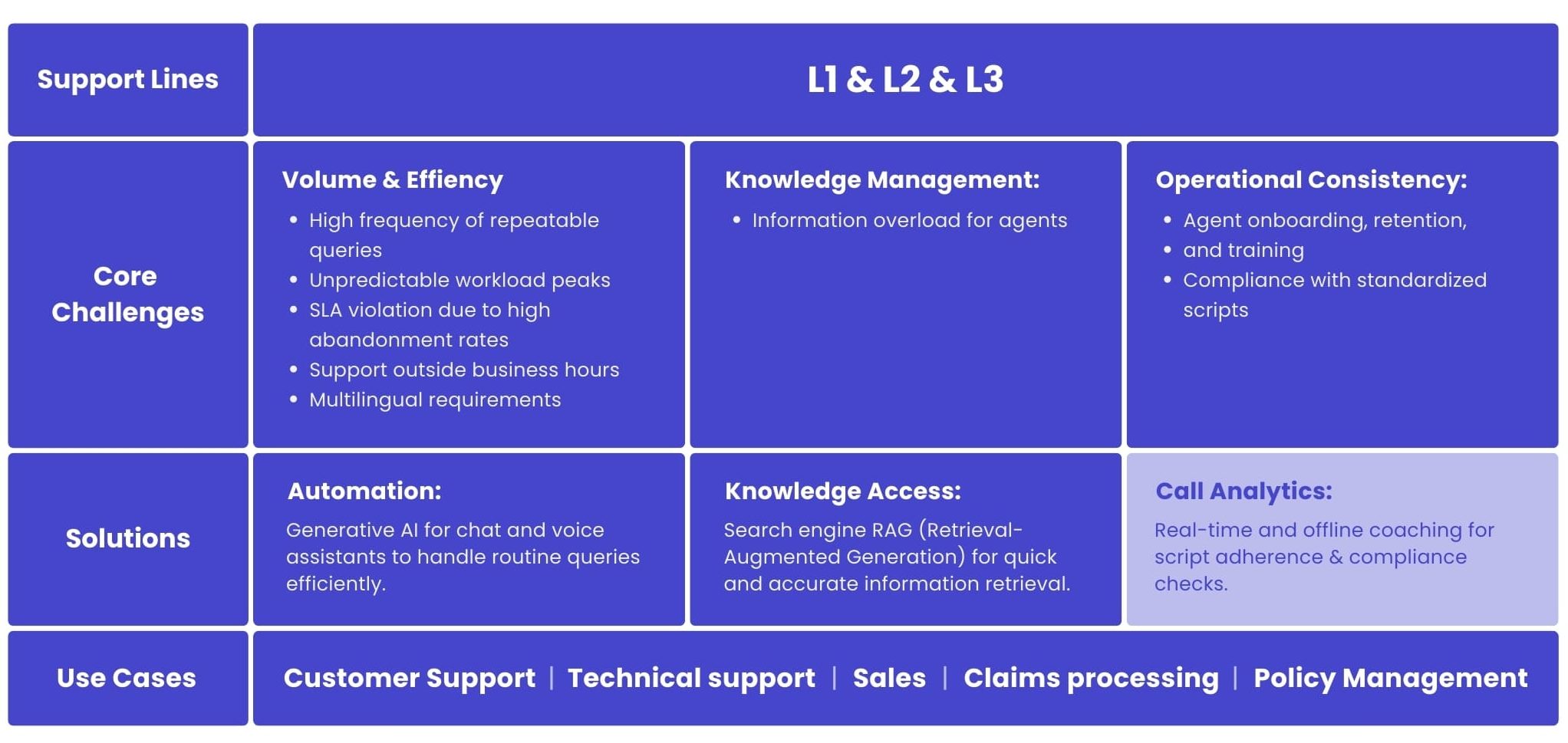
Artificial intelligence is transforming the way businesses handle these obstacles, offering automated solutions that streamline support processes and continuously optimise performance. AI-driven chatbots, predictive analytics, and smart knowledge bases, or AI agents and assistants, can improve response accuracy and technical support operations in numerous industries. Since AI is highly customisable, it can work in various support channels and all three lines, as needed.
Un meilleur accompagnement grâce à une approche holistique du support technique en IA
The great thing about AI in technical support is that it can be tailor-made and adjusted to specific needs. Artificial intelligence can be integrated with different technologies and in multiple areas of tech support. This allows bridging gaps between various fields and creating systems that are adaptable, insightful, and capable of addressing complex challenges in technical support.
Cela implique une collaboration transparente entre les outils, tels que les chatbots, les voicebots, les bases de connaissances, l'analyse prédictive ou les copilotes, afin de fournir un support technique efficace, précis et proactif.
Vous trouverez ci-dessous quelques courtes études de cas qui illustrent comment l'IA peut améliorer le support technique et atténuer certains problèmes.
Problème : volume massif de demandes clients
Technical support teams sometimes face an overwhelming volume of requests. This can have a terrible impact both on your customer and their customers – the end users. In cases of significant breakdowns, it can be challenging to mitigate such crises with limited resources.
Scénario réel : A call centre was responsible for handling system restarts for electric vehicle (EV) charging stations. Whenever a charging station malfunctioned, drivers had to call a dedicated support number for assistance. This process was inefficient, leading to long wait times, delays in operations, and increased workload for support agents.
Solution : 24/7 support chatbot or voicebot. In high-pressure situations like this, AI-driven chatbots or voicebots can significantly ease the burden on support teams. Automating the restart process with an AI-powered solution can streamline issue resolution, reduce downtime, and save costs.
Problème : Classification et triage imprécis des tickets
Customer inquiries should be directed to the right teams. When ticket classification and routing are done manually, mistakes can happen. Urgent issues may be misclassified as low priority, tickets might be assigned to the wrong department, or critical cases could get stuck in a backlog, leaving your customer with an unresolved issue.
Scénario réel : A manufacturing plant operator notices discrepancies in downtime classification for several production lines following a power outage. The system reports the shutdowns as “Operator Error,” but the operator suspects they should be categorised as “External Factors” due to an unexpected grid failure.
An analyst receives an email from the plant’s shift supervisor stating that workers attempted to restart the production lines at 8:00 AM but were unable to due to ongoing electrical instability. However, the system logs show the downtime starting at 6:00 AM and incorrectly attribute the cause to “Operator Error.”
Solution : Automated ticket categorisation. This can be handled by an AI-powered system that automatically reads emails, classifies events, and generates reports. Integration with ticketing platforms will ensure that classified incidents are logged in real-time, reducing the potential for manual input errors. This can save technicians time and effort.
Problème : Envoi inutile d'équipes de techniciens
Ce problème peut avoir deux causes : une classification incorrecte des tickets ou un dépannage inefficace.
Misdiagnosing the issue can lead to an unnecessary technician dispatch. If the initial assessment fails to pinpoint the root cause accurately, the team may end up responding to a false alarm or a problem that could have been resolved with more thorough analysis. This, however, requires detailed and smart troubleshooting.
Scénario réel : There was a problem on the bottle production line. A bottle fell over, and as the conveyor belt kept running, all the bottles behind it began tumbling down, smashing and causing chaos. The entire production line was in disarray. Instead of properly assessing the situation, the staff immediately assumed the issue was a serious mechanical failure and ordered a technician team to come out and fix the issue.
Le véritable problème était un mauvais diagnostic. La ligne de production avait simplement été perturbée par la chute de la bouteille, mais le personnel n'a pas pris le temps d'évaluer correctement la situation avant de faire appel à une aide externe.
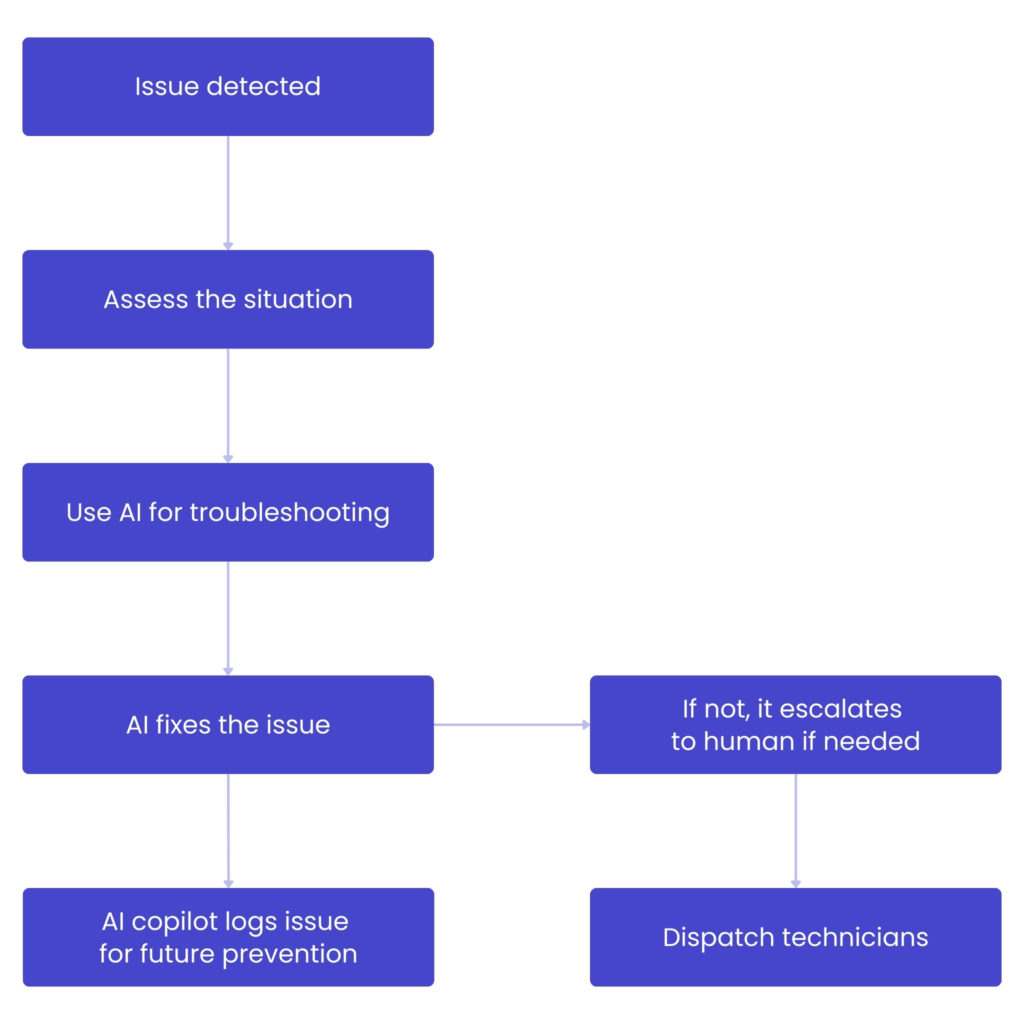
Solution : Chatbot handling simple and advanced troubleshooting. To avoid an unnecessary dispatch of technicians, you can implement an AI-powered chatbot that offers a powerful troubleshooting process of simple and advanced problems. These chatbots are designed to understand natural language, recognise user intent, access databases and logs to provide precise solutions to problems. In any other case, they’re smart enough to transfer a request to a human agent.
Problème : Manque de ressources en libre-service efficaces
Research shows that more and more customers are eager to find solutions to their problems on their own. This shift in behaviour shows a significant issue for many businesses: the lack of effective self-service resources that customers can access anytime they need.
Cela ne fait pas que diminuer la satisfaction client, mais entraîne également une charge de travail accrue pour les équipes de support technique client.
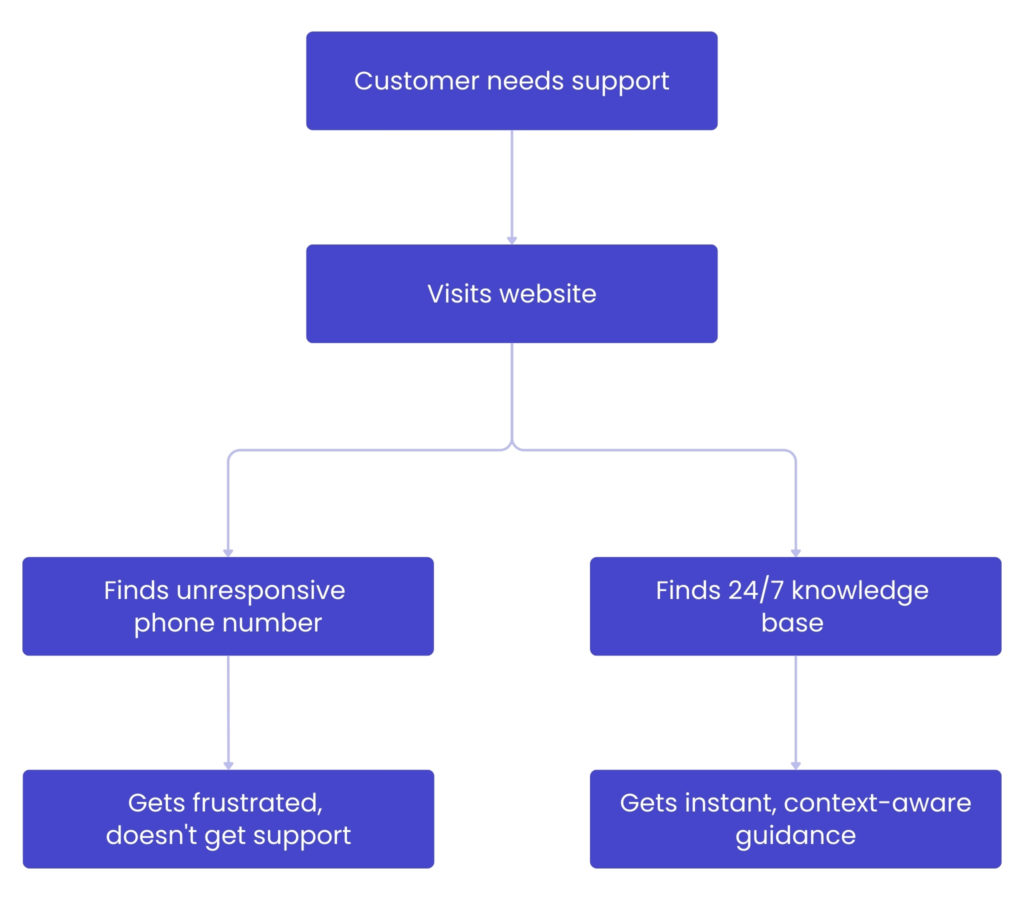
Scénario réel : A customer wants to buy paint but is unsure about which type of paint is best suited to their needs. They’re looking for a paint that is durable, easy to clean, and provides a smooth finish, but they aren’t sure whether to choose matte, satin, or gloss paint. They visit a paint manufacturer’s website to seek assistance, but all they get is a phone number which doesn’t respond.
Solution : Smart knowledge base. A great way to offer customer self-service is to implement an AI-powered knowledge base. It can improve customer support efficiency massively by leveraging internal knowledge bases and product documentation, so it can provide accurate and context-aware assistance.
Problème : absence de détection proactive des incidents
Without proactive detection, problems go unnoticed until they escalate. Since there is no system in place to identify early warning signs, minor faults, such as equipment wear, software glitches, or process inefficiencies, go unnoticed. However, sometimes, some malfunctions can be predicted.
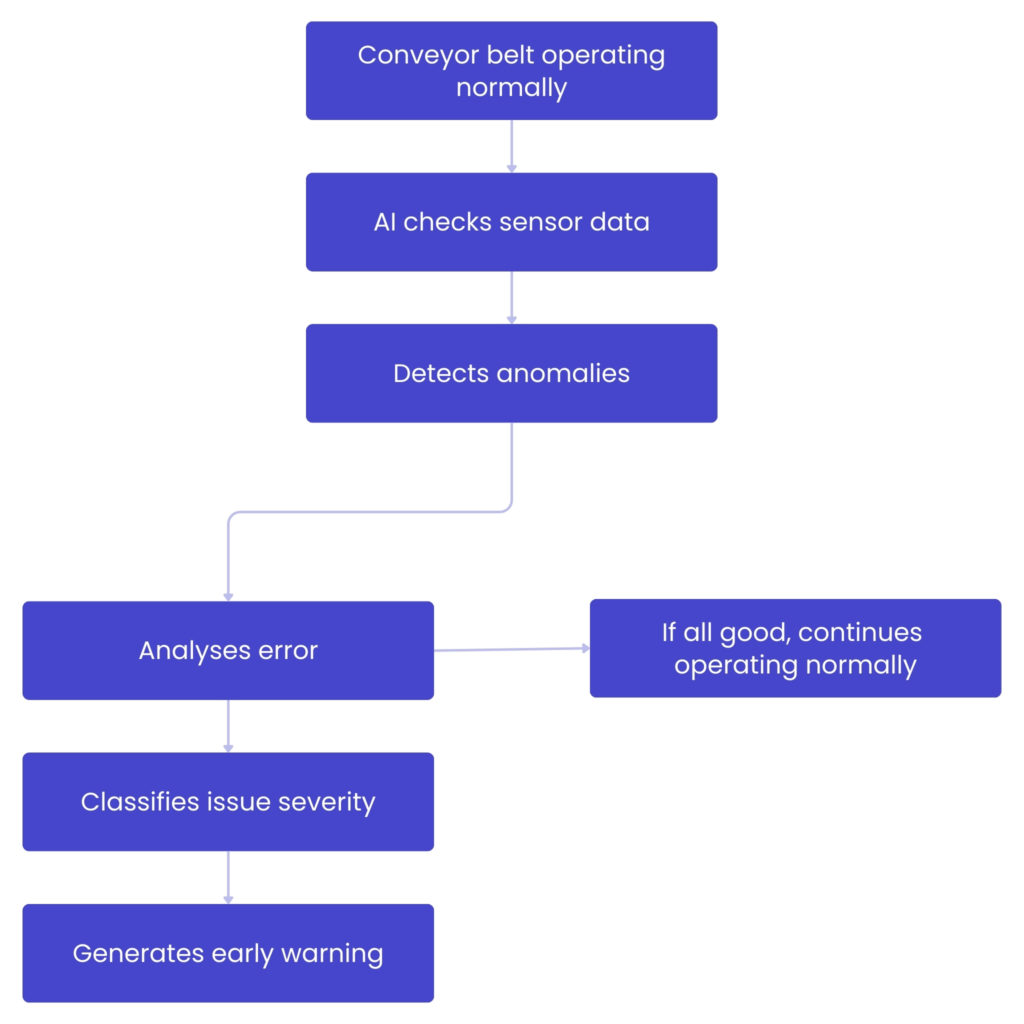
Scénario réel : Sur un site minier, les convoyeurs à bande transportent le charbon sans interruption, dans des conditions difficiles et poussiéreuses. Les convoyeurs à bande cessent régulièrement de fonctionner, mais personne ne sait quand cela se produira.
Solution : Predictive analytics. An AI-driven monitoring system can analyse system, sensor, or user data to identify potential issues before they escalate into major disruptions. By detecting anomalies in real time, such as irregular performance patterns, increased error rates, or abnormal power consumption, the system provides early warnings to prevent failures. Automated issue classification helps prioritise responses, ensuring that critical problems are addressed as quickly as possible.
Autres applications utiles de l'IA dans les équipes de support technique
L'intelligence artificielle peut également améliorer d'autres domaines de votre activité qui influencent la performance de vos équipes de support client : l'intégration des employés et la gestion des connaissances.
Intégration plus intelligente
Hiring and onboarding new support agents can be hard, especially if you manage multiple products or services with various customer inquiries. New hires need to process a lot of information quickly. Navigating complex documentation, understanding troubleshooting steps, and adapting to different customer scenarios can be overwhelming.
programmes de formation alimentés par l'IA
En utilisant l'IA, nous pouvons créer des programmes de formation sur mesure qui intègrent les employés et garantissent qu'ils acquièrent l'expertise nécessaire pour donner le meilleur d'eux-mêmes.
One of our clients faced a challenge with their technicians, who were entering a new product domain. Despite their experience, these technicians struggled to grasp the specifics of the new products. Our solution helps address this gap by implementing AI-based tests and assessments that continuously evaluate their knowledge, providing personalised learning paths.
Transfert de connaissances
One of the biggest challenges in technical support is the ageing workforce and the loss of expertise when experienced employees retire. Much of their knowledge goes undocumented and exists only in their minds. When they leave, critical troubleshooting skills, historical insights, and best practices risk being lost.
By implementing an AI-powered documentation tool, internal chatbots, or searchable knowledge bases, organisations can capture and retain knowledge. This allows new and existing team members to access expert insights even after senior employees have moved on.
Copilotes de support
Support copilots can be set up to provide real-time transcription, analysis, and intelligent assistance to support technicians, whether online or on-site. They not only offer instant access to troubleshooting guides, repair manuals, and best practices but also suggest possible failure causes, guide human agents with relevant diagnostic questions, and extract key insights during interactions.
Les copilotes de support peuvent créer une représentation numérique en temps réel de l'état d'une machine, aidant les techniciens à diagnostiquer les problèmes plus rapidement et avec une meilleure précision.
Découvrez comment nous pouvons optimiser vos opérations grâce à des solutions d'IA

Votre entreprise a-t-elle besoin d'un support client propulsé par l'IA ?
AI is a versatile tool. This allows businesses to address a wide range of challenges, from online stores to factories. Implementing AI into your operations will streamline troubleshooting, automate ticketing, and enhance decision-making, reducing response times and minimising operational costs.
Chez Spyrosoft, nous maîtrisons l'IA sur le bout des doigts et nous serons ravis de partager notre expertise pour vous aider à améliorer votre activité. Que votre priorité soit les chatbots, les voicebots, les agents IA, les bases de connaissances intelligentes ou d'autres solutions personnalisées, nous adaptons nos services à vos besoins spécifiques.
FAQ
L'IA dans le support technique désigne l'utilisation de l'intelligence artificielle et des technologies d'apprentissage automatique pour automatiser ou améliorer les opérations de service client et le support technique. Cela inclut l'utilisation d'outils tels que les chatbots, les assistants virtuels, les bases de connaissances, l'analyse prédictive, ainsi que les agents et copilotes IA.
L'IA est utilisée pour automatiser les réponses, catégoriser et prioriser les tickets, assister les agents humains, fournir un support 24/7 et analyser le comportement des clients afin d'améliorer la prestation du support. Elle aide à gérer les demandes des clients, à fournir des réponses instantanées, à proposer des recommandations personnalisées et même à prédire les problèmes futurs sur la base des données historiques – améliorant considérablement les temps de réponse et l'expérience client globale.
Les principaux avantages de l'utilisation de l'IA dans le support technique comprennent des temps de réponse plus rapides, une disponibilité 24h/24 et 7j/7, ainsi que la capacité de traiter de grands volumes de requêtes répétitives sans fatigue humaine. Les systèmes pilotés par l'IA peuvent également réduire la charge opérationnelle en automatisant les tâches routinières et améliorer la précision de la résolution des problèmes grâce à des informations fondées sur les données. Cela conduit à une expérience client plus cohérente et plus évolutive, tout en libérant les agents humains pour qu'ils se concentrent sur des problèmes plus complexes et stratégiquement importants.
L'IA peut améliorer tous les niveaux du support technique en automatisant et en optimisant différentes tâches selon leur complexité. Dans le support L1, les chatbots et assistants virtuels alimentés par l'IA peuvent traiter les requêtes courantes, réinitialiser les mots de passe et fournir un dépannage de base. Pour le L2, les outils d'IA peuvent assister les agents humains en analysant les journaux, en suggérant des solutions et en automatisant les diagnostics. Dans le support L3, l'IA peut soutenir les ingénieurs en identifiant des schémas dans de grands ensembles de données, en accélérant l'analyse des causes profondes et même en prédisant les problèmes système récurrents avant qu'ils ne s'aggravent.




arrow_circle_rightContactez-nous
Discutons de la manière dont nous pouvons soutenir vos projets d'IA

Tomasz Smolarczyk
Directrice de l'Intelligence Artificielle
arrow_circle_right Autres articles