Ingénieur IA déployé en avant-garde : un nouveau paradigme de développement logiciel


A new kind of consulting role is changing how businesses commission and receive custom software. The Forward Deployed AI Engineer (FDE) – part domain expert, part solution architect, part AI orchestrator – makes it possible to deliver production-ready applications in weeks rather than months, at a fraction of the traditional cost. In this article, we break down how it works in practice, why it’s particularly relevant for mid-market and traditional enterprises, and what you need to understand before committing to your next digital investment.
Quand le développement traditionnel ne fonctionne pas
A significant number of organisations that need custom digital tools simply can’t afford to have them built the traditional way. The standard playbook – a Product Owner, a Scrum team, a Scrum Master, a 3-to-12-month delivery timeline – was never designed with mid-sized enterprises in mind. It was designed for companies that could absorb the risk. Manufacturing firms running on legacy processes, logistics operators managing workflows through spreadsheets, healthcare organisations trying to digitise manual operations – they need solutions just as urgently, but the traditional model prices them out before the conversation even begins.
AI has now fundamentally changed the economics of building software – and with it, the economics of consulting. The question is whether the consulting model has caught up with how quickly AI can accelerate development. For a growing number of organisations, it has.
Ce changement est déjà en cours : OpenAI a récemment lancé l'OpenAI Deployment Company spécifiquement pour intégrer des Forward Deployed Engineers au sein des organisations clientes, soutenue par plus de 4 milliards de dollars d'investissement initial. Anthropic exploite un modèle similaire via ses propres partenariats de déploiement. Le signal est clair – les principales entreprises d'IA mondiales considèrent désormais le déploiement direct, en contexte, comme un élément essentiel de la manière dont l'IA génère une réelle valeur business.
Le vecteur de cette livraison est un nouveau type de praticien : l'ingénieur IA déployé en première ligne.
Pour qui ce modèle est-il réellement conçu ?
The FDE didn’t emerge in a vacuum. At Spyrosoft, we developed the Agentic Software Delivery Framework (ASDF) specifically to address a problem that traditional development has never adequately solved: mid-sized and traditional enterprises need custom digital tools, but lack the budget, internal IT capability, or risk appetite for conventional development projects. ASDF (and the FDE role at its core) is built around exactly this gap.
| Développement logiciel traditionnel | Agentic Software Delivery Framework (ASDF) | |
| Délai jusqu'à la première version | 3-12 mois | Jours / semaines |
| Vitesse d'itération | 2-4 semaines | 2-4 heures |
| Time to market | Mois | Semaines |
En pratique, cela est particulièrement pertinent pour :
- Entreprises manufacturières cherchant à digitaliser leurs processus opérationnels
- Opérateurs logistiques gérant les flux de travail manuellement ou via des systèmes déconnectés
- Fournisseurs de services ayant besoin d'outils personnalisés destinés aux clients ou à usage interne
- Les organisations de santé qui remplacent les processus papier ou basés sur des tableurs
- Les institutions du secteur public contraintes par la complexité des marchés publics et les cycles budgétaires
What unites these organisations is their situation – they need software that fits their specific context. They can’t afford three to twelve months of uncertainty. And they want a partner who takes ongoing responsibility for what gets built, not one who delivers a project and moves on.
The ongoing responsibility piece is significant. Post-deployment, the model covers infrastructure management, continuous improvement, additional feature development, and even 24/7 support services. The relationship shifts from a project engagement to a digital platform partnership.
Ce que signifie réellement « forward deployed »
The term comes from a military and logistics concept: deploying resources as close to the point of need as possible, rather than operating from a distant headquarters. In software consulting, it means a specialist who doesn’t sit behind a requirements document but works directly inside your business context – having deep business understanding of your operational workflows and constraints.
Il ne s'agit pas d'un analyste métier qui prend des notes et les transmet à une équipe de développement. Un Forward Deployed AI Engineer réunit trois compétences distinctes en un seul rôle :
- Expertise sectorielle: ils comprennent votre secteur, sa logique opérationnelle, son environnement réglementaire et ses contraintes réelles.
- Expérience de conseil: ils peuvent identifier des inefficacités et des opportunités manquées que vous n'avez peut-être pas encore formulées.
- Construction de solutions assistée par l'IA : ils co-conçoivent et orchestrent activement une delivery pilotée par l'IA.
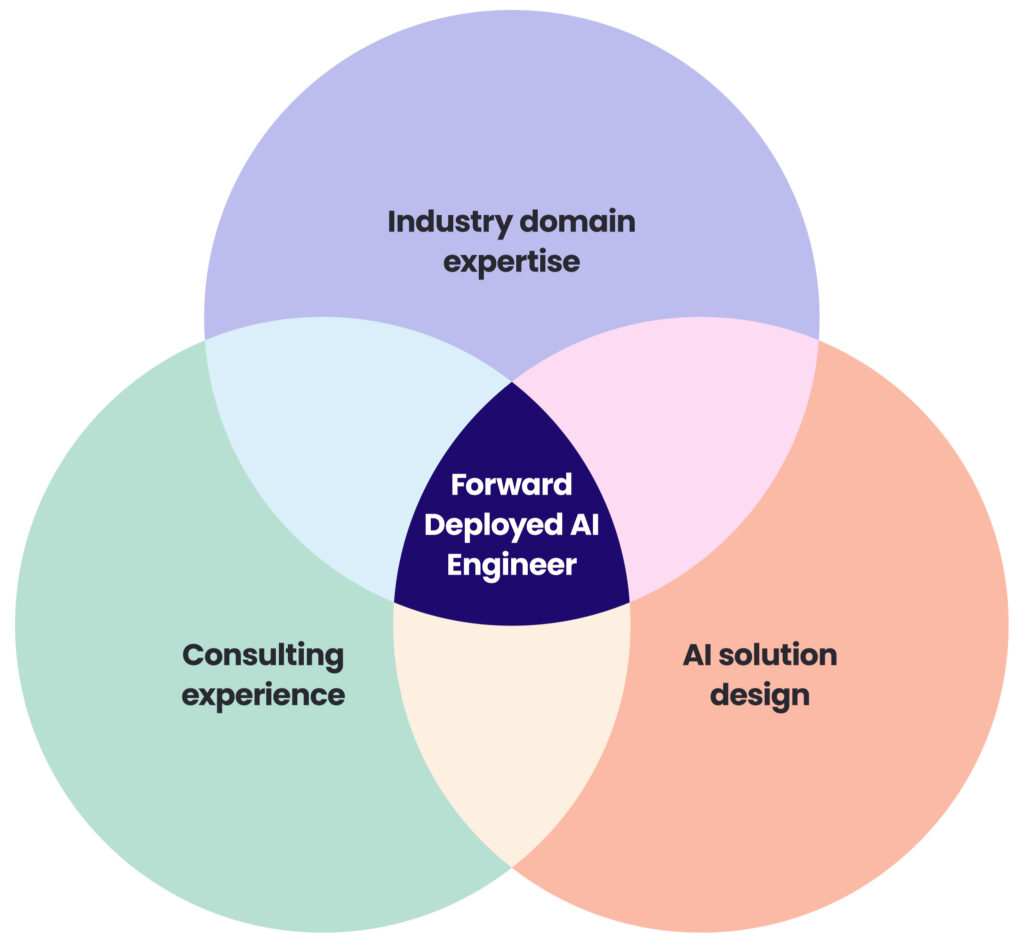
The result is something quite different from traditional requirements gathering – FDEs bridge the gap between technical and business teams, acting as solution architects who ensure alignment before a single line of code is written. It’s closer to solution advisory: a process where the expert helps you shape the right problem before ever discussing the solution.
This distinction matters more than it might seem. Organisations often arrive with a problem statement that is really a symptom. The value of a truly Forward Deployed Engineer is their ability to reframe the question before any resources are committed to answering the wrong one.
De plusieurs mois à quelques semaines : le modèle de livraison derrière le rôle
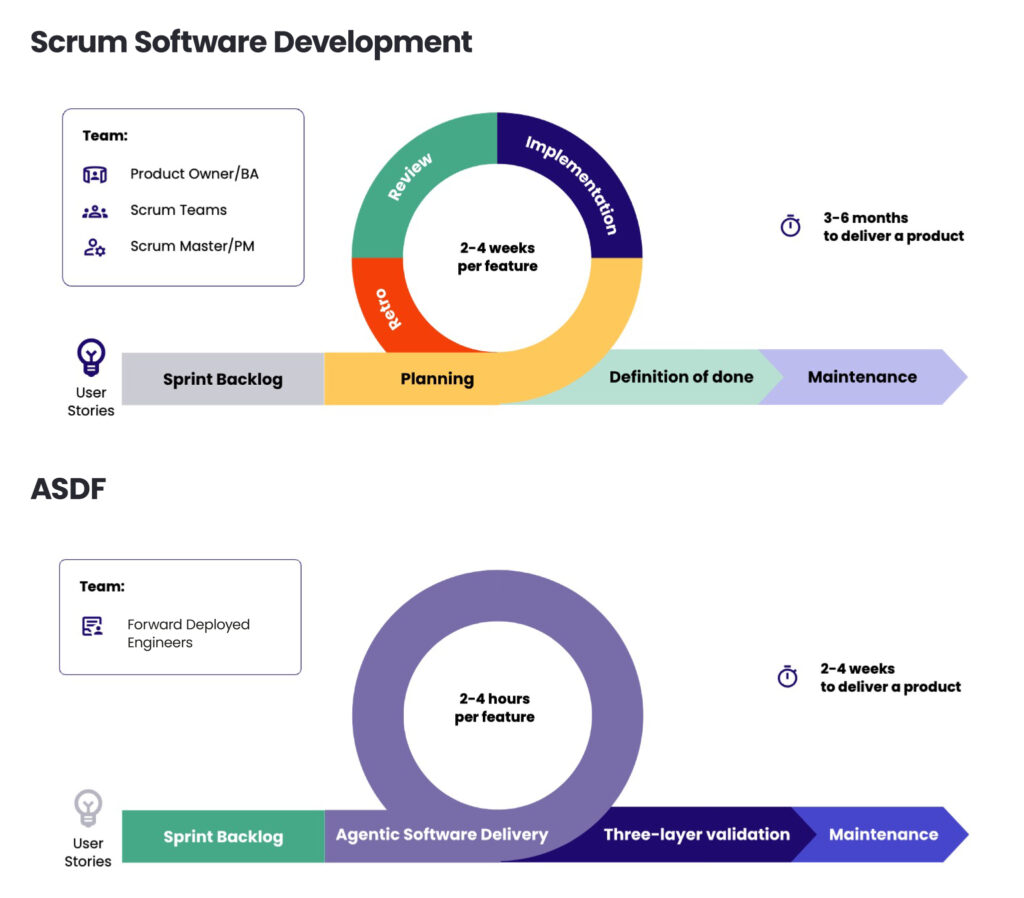
The role only makes sense alongside the delivery model it enables. Under a traditional Scrum approach, each feature takes two to four weeks to build. A full product takes three to six months. The cost is high, the timeline is long, and the risk falls disproportionately on the client.
The Agentic Software Delivery Framework inverts this. With the FDE acting as the primary consultant and AI agents handling orchestrated implementation, individual features can be built in two to four hours. Full products reach the market in two to four weeks. The upfront cost drops significantly – in many cases to a small initial fee against a flat multi-year contract. FDEs deliver early versions of solutions quickly, often launching a working prototype in 2–6 weeks, allowing value to become visible in days or weeks rather than months.
Les quatre étapes de la livraison
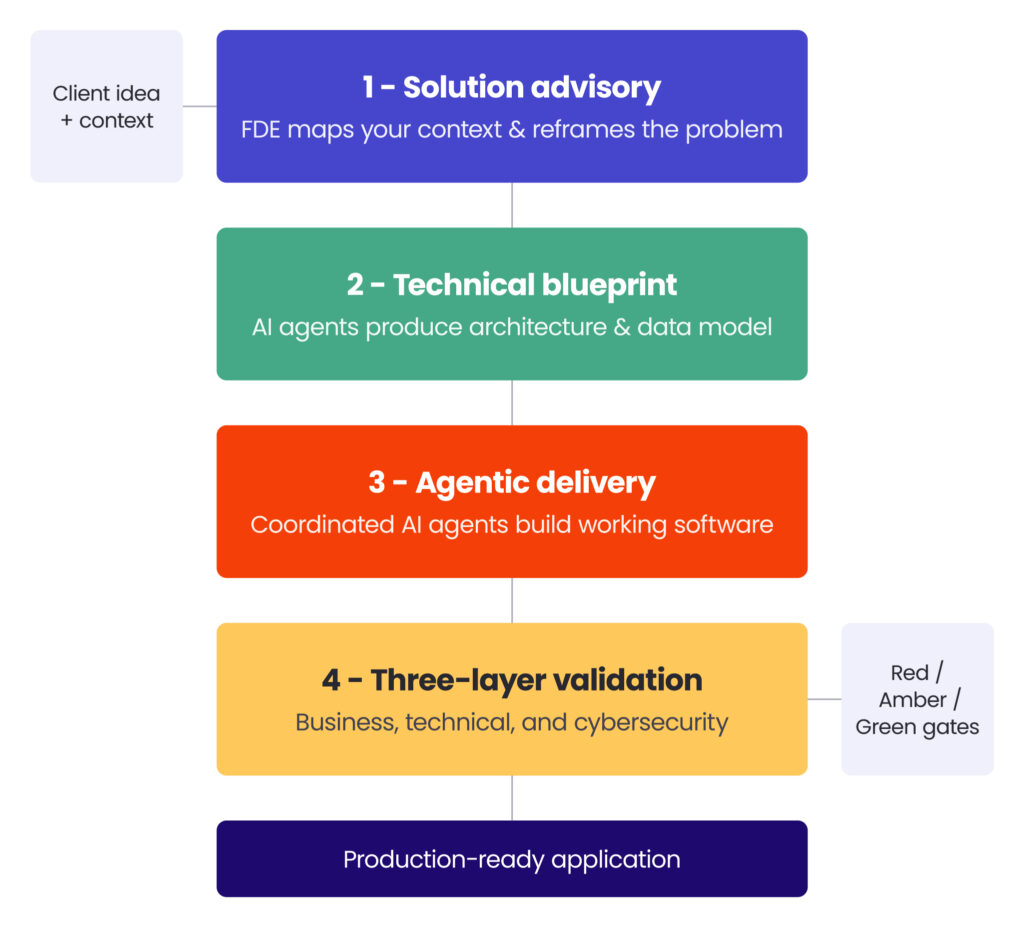
Le processus se déroule en quatre étapes :
1. Idée du client → Conseil en solutions
The FDE works directly with you to understand the business context, map the current process, identify where it breaks down, and propose digital solutions. This is the phase where domain expertise is most critical – and where generic consultancies most often fail.
2. Exigences → Plan technique
Instead of a manual requirements document, orchestrated AI agents analyse the project definition, identify gaps, ask clarifying questions, and produce a structured technical specification covering application modules, system architecture, data model, integrations, and user roles. What used to take weeks of back-and-forth now takes days.
3. Livraison logicielle agentique
A coordinated system of AI agents handles the implementation phase, each with a specific responsibility: implementation planning, plan validation, and coding. The FDE supervises and steers. The output is a working software, not just a demonstration, ensuring the solution is functional and operational within your environment.
4. Validation à trois niveaux
Before anything reaches production, the application passes through three human-led validation gates – business, technical, and cybersecurity – assessed on a Red/Amber/Green scale. Red issues must be fixed before deployment. Amber issues are deployable with accepted and documented risk. Green means production-ready.
Supervision humaine, intégrée dès la conception
L'une des décisions de conception fondamentales d'ASDF est que la supervision humaine est intégrée à chaque étape de la livraison. Voici pourquoi cela compte en pratique.
AI accelerates implementation, but it doesn’t replace judgement. The value of the Forward Deployed AI Engineer is precisely that the speed of AI delivery only pays off when you’re building the right thing – and working that out requires human expertise that AI can’t currently replicate.
The three-layer validation model reflects this directly. Business validation checks that what was built matches what was actually needed. Technical validation ensures code quality, architecture, and technical debt are sustainable. Cybersecurity validation confirms the application meets current vulnerability and risk standards – including compliance with the EU AI Act, which now applies to many AI-assisted software deployments.
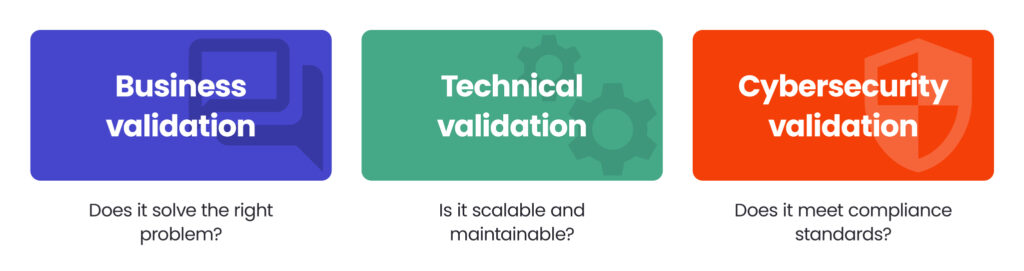
Si vous évaluez un cabinet de conseil assisté par l'IA, voici le cadre de gestion des risques que vous devriez leur demander d'expliquer. Une livraison rapide sans validation structurée n'est qu'un échec rapide.
Ce qui rend cela plus difficile qu'il n'y paraît – et pourquoi cela vous concerne
Le modèle FDE fonctionne, mais il convient d'être honnête sur les raisons pour lesquelles ce n'est pas l'option la plus facile.
Les exigences du poste sont bien réelles
Running at this pace – delivering working software in weeks, iterating in hours – puts real pressure on the engineer. Your FDE is simultaneously managing your business context, steering AI agents, validating output, and translating technical decisions into language your stakeholders can act on. That’s a demanding role, and not everyone who calls themselves a forward deployed engineer can actually do it.
Ce que cela signifie lorsque vous choisissez un partenaire
What this means for you in practice: the quality of the FDE you work with determines the quality of the outcome. This isn’t like hiring a development team where the process compensates for individual variation. The FDE’s ability to understand your business, ask the right questions early, and make sound architectural decisions shapes everything that follows. Ask hard questions about their sector experience before you commit.
It also means the first few weeks of engagement matter disproportionately. The requirements-to-blueprint phase, where your FDE works with AI agents to define the technical specification, sets the trajectory for the whole project. Rushing this phase to get to implementation faster is the most common mistake – and the hardest to fix once the build is underway.
Pourquoi les contraintes peuvent être considérées comme un avantage
La bonne nouvelle est que ces contraintes sont des caractéristiques, et non des défauts. Parce que le modèle est construit autour d'une petite équipe ciblée plutôt que d'une grande équipe distribuée, les décisions sont plus rapides, la communication est plus claire et la responsabilité est bien définie.
And as your application evolves (new features, new integrations, changing requirements) the FDE model scales in a way that traditional project delivery doesn’t. Rather than re-scoping a contract or spinning up a new team, you iterate within an ongoing platform relationship. The engineer who understands your business on day one is still the one making decisions on day three hundred.
Le virage stratégique autour des solutions d'IA
Il y a une perspective plus large qui dépasse toute mission individuelle.
The traditional consulting and software delivery model organises itself around discrete projects: scope, budget, timeline, handover. The ASDF is organised around something different – continuous digital platforms and services. The shift is from one-off project delivery to ongoing, evolving partnerships.
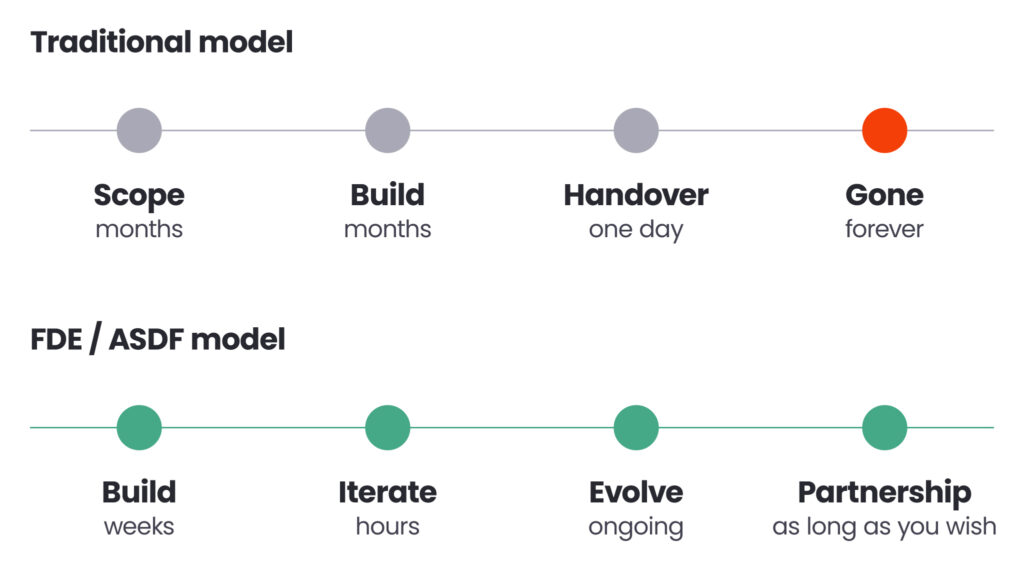
Points clés pratiques
Si vous évaluez si ce modèle est pertinent pour votre organisation, voici les questions qui comptent le plus.
Avant de faire appel à un partenaire de conseil assisté par l'IA :
- Demandez-leur de distinguer la livraison assistée par IA de la livraison agentique – s'ils n'y parviennent pas, ils pratiquent probablement la première en la qualifiant de seconde.
- Demandez précisément comment fonctionne la validation et qui est responsable à chaque étape.
- Demandez une répartition claire de ce que couvre le rôle de FDE par rapport à ce que gèrent les agents IA.
- Demandez comment le modèle de tarification reflète la relation pluriannuelle, et pas seulement la construction initiale.
Signaux d'alerte à surveiller :
- Aucun processus de validation structuré au-delà des tests automatisés.
- Des FDE qui agissent comme des collecteurs d'exigences plutôt que comme des conseillers en solutions.
- Aucune réponse claire sur la responsabilité après le déploiement.
- Affirmations sur les délais sans explication du processus correspondant.
Les signaux positifs qui indiquent une réelle compétence :
- Une expertise métier spécifique à votre secteur, et non générique.
- Un modèle de validation avec des responsabilités nommées (métier, technique, sécurité).
- Une tarification transparente basée sur les tokens ou l'usage, qui évolue de manière prévisible.
- Preuve de relations continues avec la plateforme, et non de projets simplement achevés.

Conclusion
Les Forward Deployed AI Engineers ne sont pas des analystes métier rebaptisés avec un abonnement ChatGPT. Nous les considérons comme un type fondamentalement différent de praticiens, rendu possible par un modèle de livraison différent.
For organisations that have historically been priced out of custom software – and for decision-makers who have watched development budgets grow while timelines stretched – this model offers something genuinely new: fast delivery, structured oversight, and a long-term partner who stays accountable after the launch.
Cet article s'appuie sur le Agentic Software Delivery Framework développé par Spyrosoft. Pour en savoir plus ou discuter de la manière dont il pourrait s'appliquer à votre organisation, contactez-nous via le formulaire ci-dessous.
FAQ : Ingénieurs IA déployés sur site
Forward deployed engineers operate much closer to the business context. While traditional software engineers focus on building predefined requirements, FDEs help define the problem itself, shape the solution, and oversee delivery. They bridge the gap between technical systems and business needs, rather than working in isolation within a development team.
Agentic software delivery refers to a model where AI agents handle large parts of the software development process (such as planning, validation, and coding) under human supervision. This allows software development to move significantly faster while maintaining quality through structured validation and oversight.
With the right setup, individual features can be developed in hours, and full enterprise software solutions can be delivered in a matter of weeks. However, speed depends on proper problem definition, clear validation processes, and the expertise of the person guiding the process.
No. AI systems augment software engineers rather than replace them. Human expertise remains critical for decision-making, architecture design, and ensuring that AI-generated outputs align with business goals. The role of engineers is evolving toward higher-level problem solving and orchestration.
The main risks include building the wrong solution quickly, lack of proper validation, and over-reliance on automation without human oversight. That’s why structured validation (business, technical, and security) is essential in any AI-driven delivery model.
Quality is ensured through a multi-layer validation process involving human experts. This typically includes business validation (does it solve the right problem?), technical validation (is it scalable and maintainable?), and cybersecurity validation (does it meet compliance and risk standards?).
Unlike traditional project-based professional services, this model is built around ongoing partnerships. The same team (often led by the FDE) continues to support, improve, and scale the solution – or turns its attention to the next opportunity, identifying new workflows and processes within your organisation that are ready for AI-driven optimisation.
Oui. Bien qu'elles soient particulièrement précieuses dans les services professionnels, les FDE peuvent également soutenir les entreprises de produits en accélérant le développement d'outils internes, le prototypage de nouvelles fonctionnalités et l'amélioration des systèmes techniques existants grâce à des solutions d'IA.




arrow_circle_rightContactez-nous
Découvrons si l'ingénierie déployée en amont vous convient

Tomasz Smolarczyk
Directrice de l'Intelligence Artificielle
arrow_circle_right Nos articles


