Connaissement : traitement automatique par GenAI


Dans le secteur de la logistique, le traitement des connaissements est une tâche chronophage qui peut mobiliser des ressources et nuire à l'efficacité opérationnelle.
Whether you are dedicating countless hours of your employees’ time to manual data entry or outsourcing the work overseas at a significant cost, the traditional methods are far from ideal. The constant risk of mistakes, misplaced documents, and operational delays adds to the frustration and financial burden, leaving companies searching for a better solution.
Selon une enquête menée par Council of Supply Chain Management Professionals, la gestion documentaire est une préoccupation majeure pour la logistique tierce, 59 % des répondants la citant comme un défi.
Examinons l'IA générative et son potentiel pour révolutionner la gestion des BOL, en offrant un aperçu approfondi des avantages et de la mise en œuvre de cette approche innovante.
L'importance d'une gestion précise des connaissements
The bill of lading is a fundamental document in international trade logistics. It links various stakeholders in the supply chain and fulfills several vital functions, for examples: it acts as a receipt for shipped goods, a document of title, and a contract of carriage between the shipper and the carrier. Ensuring the accuracy and integrity of the BOL is crucial, as even minor errors can lead to significant operational disruptions and financial losses.
For carriers, an accurate BOL guarantees the efficient and dispute-free transport of goods, minimising the risk of claims and legal issues. Insurers depend on these documents to assess risks accurately and validate claims, maintaining the financial stability of shipping operations. Customs agencies utilise the BOL to verify the legitimacy and compliance of shipments, which is essential for preventing fraud and ensuring security. Seaports and air cargo facilities rely on them for the orderly processing and handling of goods, facilitating seamless transitions through these logistics’ hubs. Production companies managing their own logistics need accurate BOLs to synchronise their supply chains, maintain optimal inventory levels, and meet delivery schedules.
Les défis actuels du traitement des BOL
Every day you receive dozens of bills of lading via email. Each document must be painstakingly entered into your system manually. Throughout this process, there is a constant fear of misplacing a document, which can result in lost business opportunities. The errors made during manual data entry must be caught and corrected before they escalate into major problems when the goods are received.
Comme vous pouvez le constater, le processus de traitement des connaissements dans le secteur de la logistique est semé d'embûches susceptibles d'impacter votre rentabilité. À l'heure actuelle, les tâches les plus lourdes auxquelles les organisations sont confrontées sont les suivantes :
Problèmes liés au traitement manuel
La saisie manuelle des données est intrinsèquement lente et gourmande en main-d'œuvre. Les employés doivent saisir méticuleusement chaque détail, ce qui est fastidieux et hautement inefficace. Cela consomme un temps précieux qui pourrait être mieux investi dans des tâches plus stratégiques.
Risque de perte de documents
Chaque document arrivant par e-mail puis étant traité manuellement, il existe un risque que le BOL soit perdu ou mal classé. De telles pertes peuvent inciter les clients à chercher d'autres fournisseurs, et plus vous traitez ces listes lentement, plus vous perdez de business.
Erreurs de saisie de données
Human error is an inevitable aspect of manual data entry. Even the most diligent employees can make mistakes that result in incorrect information being recorded. They can cause delays, disputes and financial losses, especially if the mistakes are not discovered until the goods reach their destination.
Processus chronophages
Le volume considérable de BOL à traiter chaque jour rend la tâche extrêmement chronophage. Cet investissement de temps important nuit à la productivité globale de l'organisation, entraînant des retards dans d'autres opérations critiques.
The cumulative effect of manual processing, the risk of lost documents and data entry errors significantly increases the potential for costly mistakes and operational inefficiencies. These challenges increase operational costs and undermine customer satisfaction and corporate reputation.
Comment l'adoption de l'IA générative transforme le connaissement automatique
Mise en œuvre de l'IA intelligence artificielle streamlines the bill of lading process from start to finish by automating tasks that were previously tedious. With GenAI, the process begins as soon as a BOL email is received, requiring no manual intervention to initiate. Advanced algorithms identify and extract all relevant information from the BOL, such as shipment details, consignee information and cargo specifications. This eliminates the need for manual data entry, dramatically reducing the time and effort required to process each document. By upgrading your system with AI, you will be able to handle a large number of BOLs, ensuring that no document is missed, and all data is captured accurately.
Once extracted, the data is seamlessly integrated into your existing logistics management system. This means that all relevant information is immediately available in your system. As changes occur, such as changes to shipping schedules or delivery addresses, the AI system automatically updates the data in real time, ensuring that it is always up to date and reducing the likelihood of operational errors and delays. It also provides instant access to accurate information, critical for making informed decisions and maintaining efficient logistics operations.
Manual bill of lading processing is inherently prone to human error, which can lead to costly mistakes and operational inefficiencies. GenAI solves these problems by maintaining consistency in data processing. The system’s error detection and correction capabilities ensure that any discrepancies or anomalies are quickly identified and resolved, while maintaining high data quality standards. For example, AI can compare data against pre-defined policies and historical records to detect inconsistencies and flag potential problems before they escalate.
Planifiez une démonstration pour découvrir comment notre solution basée sur l'IA peut transformer les opérations logistiques.
En savoir plus
Avantages du traitement automatique par IA générative
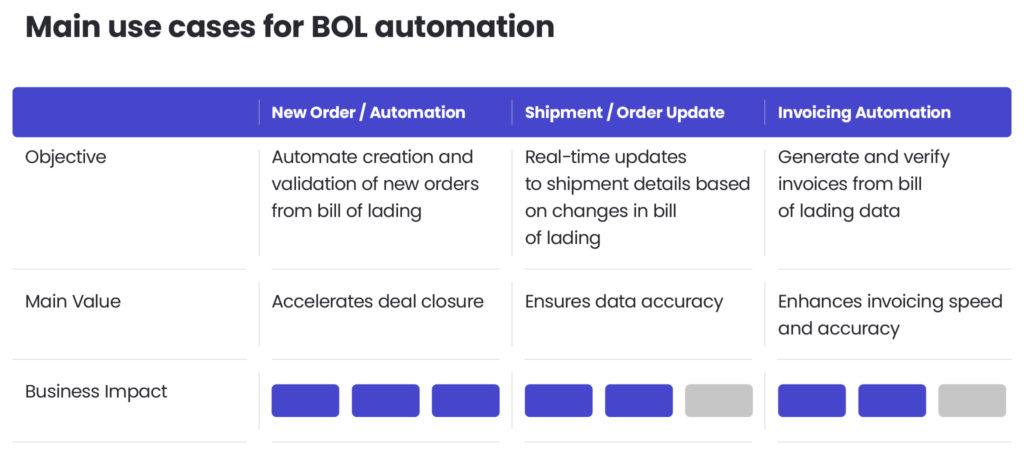
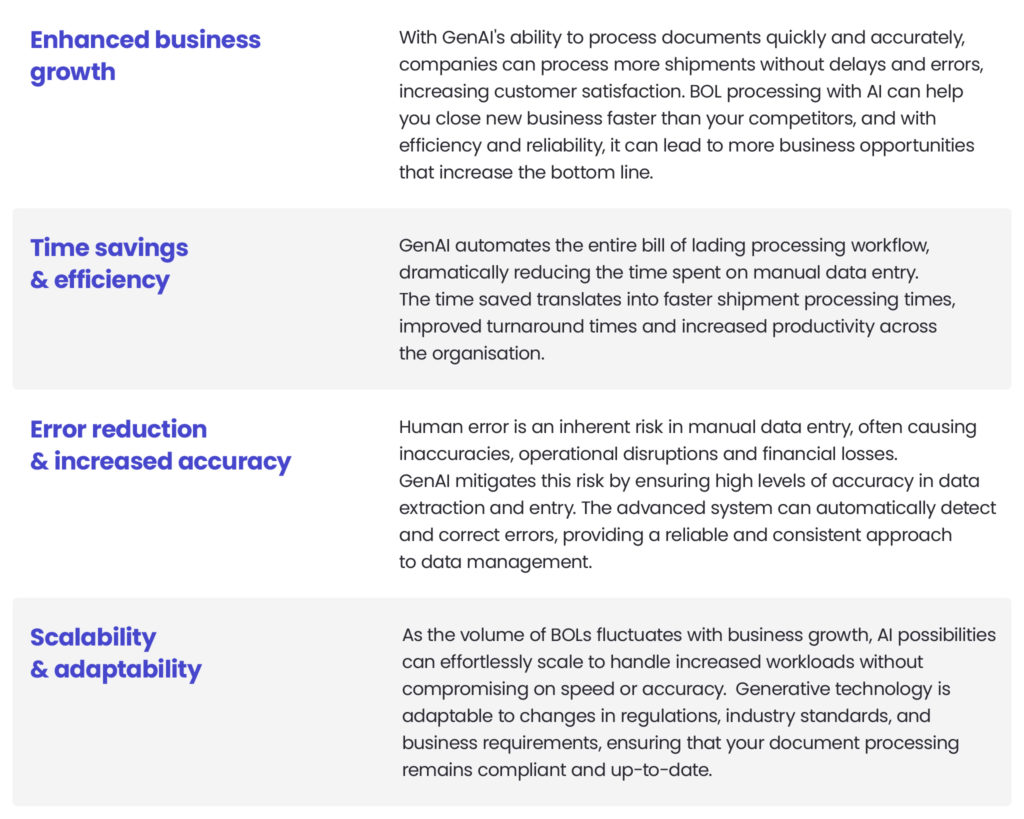
IA générative in bill of lading processing delivers benefits that significantly improve business operations and outcomes in the shipping industry. Firstly, financially, reducing manual work and associated errors leads to cost savings and improved margins. And secondly, it ensures accurate and timely data entry, helping to avoid issues that could disrupt the supply chain.
Découvrez la mise en œuvre réussie de l'IA générative pour le traitement des connaissements
Our client, a logistics company based in the US, needed to build and implement an automated system to process pickup orders. The goal was to achieve full automation in the order pickup and confirmation processes. The company was handling a high volume of 600 e-mails par jour, à partir desquels jusqu'à 24 champs d'information différents devaient être extraits avec précision. Les principaux besoins métier incluaient l'obtention d'un98% taux de précision dans l'extraction d'informations et réduction du temps de traitement, car les délais actuels entraînaient un traitement de certaines commandes de plus de 48 heures, ce qui se traduisait par une perte de clients.
We were responsible for developing and implementing an AI model capable of understanding and extracting data from various email formats. Alongside that, we were also focused on performance monitoring to ensure the AI system met the accuracy rate in its early stages, with continuous improvements made based on feedback to enhance the AI model’s efficiency and reliability.
À vous de jouer
Découvrez par vous-même la solution d'IA qui lit automatiquement les BOL depuis votre messagerie, saisit avec précision vos données dans le système et surveille et met à jour ces informations en continu et en temps réel à mesure que les changements surviennent.
Pour commencer, remplissez le formulaire ci-dessous et faites le premier pas vers l'optimisation de votre gestion des BOL !
The bill of lading is a key document in international trade, serving as a receipt, a contract of carriage, and a document of title. Errors in BOLs can cause delays, financial losses, and disputes. Accurate management ensures seamless operations for carriers, insurers, customs agencies, ports, and production companies relying on efficient supply chains.
Manual processing is slow, error-prone, and resource-intensive. Common issues include data entry mistakes, lost or misplaced documents, and time-consuming workflows that delay shipments and impact customer satisfaction. These inefficiencies drive up costs and reduce operational effectiveness.
Generative AI automates the entire BOL process, from reading incoming emails to extracting key data and entering it into logistics systems. It eliminates manual work, detects and corrects errors, and keeps data updated in real time, ensuring accuracy and efficiency at every stage of the process.
mplementing AI in bill of lading processing leads to significant time and cost savings, reduces human errors and operational risks, ensures real-time updates and data accuracy, accelerates document processing to improve supply chain visibility, and enhances decision-making through consistent and reliable data.
n a real-world example, a US-based logistics company processing 600 emails per day achieved 98% data extraction accuracy and drastically reduced order processing times from over 48 hours to near real-time. The solution boosted efficiency, minimised customer losses, and provided a scalable foundation for further automation.




arrow_circle_right nos articles
Choisissez votre prochaine lecture




arrow_circle_rightnous contacter
Transformez votre entreprise grâce à des innovations technologiques de pointe.

Tomasz Smolarczyk
Directrice de l'Intelligence Artificielle