كيفية اختيار أفضل تقنية لضبط نموذج LLM للمشروع؟


We’re witnessing an unprecedented AI rivalry nowadays. Companies across all sectors are deploying artificial intelligence solutions rapidly, recognising that AI implementation is no longer an option but a necessity for maintaining competitive advantage.
The truth is, AI is everywhere. You turn on your smart speaker, and the AI wishes you a pleasant day. You open a banking app, and AI helps you navigate financial decisions. AI creates your marketing materials, and recommendation systems suggest entertainment choices.
With new Large Language Models (LLMs) popping up every single week, constantly improving on the benchmarkings, you may wonder: Does it make sense to improve LLMs’ performance by yourself at all? And if so, how to effectively approach it and which strategy to choose?
In this article, I will guide you through the decision-making process for selecting the optimal LLM fine-tuning technique for your specific business needs. I will present three scenarios, each describing a particular use case.
ما هو الضبط الدقيق لنماذج اللغة الكبيرة؟
Fine-tuning of AI models is a technique that allows models to learn additional skills. It involves taking a pre-trained model and further training it on a task-specific dataset. AI models can be viewed as mathematical functions – there’s an input, processing, and an outcome. Training on large datasets allows it to gain intelligence.
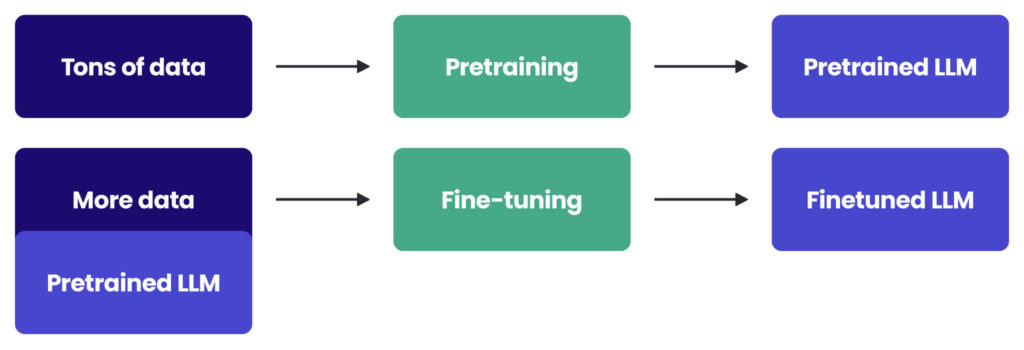
With this in mind, an LLM is a neural network algorithm that knows only as much as the data used during its training. It learns from the content we use to feed it. Such transparency isn’t available when integrating third-party LLMs into your AI system. Even with open-source models, the training datasets typically remain unpublished, with very few exceptions such as StarCoder2.
After implementing fine-tuning, you gain additional influence over the model’s behaviour and skills that an LLM possesses. While LLMs available on the market can perform remarkable tasks, they often lack your organisation’s specific knowledge, the company’s best practices and data structures, specialised jargon, or domain-specific information. The fine-tuning of LLMs allows you to teach them these elements.
There is another important thing to note – the fine-tuning offers independence. If your AI system relies on LLMs via external APIs, you need to continuously monitor changes in these interfaces so that you can swiftly adjust the system in case a particular model is no longer supported by the provider. With your own fine-tuned models, there are no such dependencies, and the stability of your AI system is greater.
من أين تبدأ في الضبط الدقيق لنماذج LLM؟
You have an idea to kick off an AI project. Perfect! However, before you can celebrate success, you must thoroughly understand the project’s goals, requirements, and constraints. For simplicity, our goal here is to focus on the fine-tuning of LLM.
Goal
ابدأ بصياغة هدفك في جملة واحدة واضحة ومفهومة.
Task
حدد المهارات التي يجب أن يمتلكها نموذجك: الإجابة على الأسئلة (QA)، وإكمال الكود، والمعرفة المتخصصة بالمجال (الطبي، والمالي، والقانوني)، وقدرات تعدد المهام، والترجمة، وغير ذلك.
البيانات
صِغ متطلبات البيانات للمهمة وتأكد من توفر هذه البيانات لديك. وإذا لم تكن متوفرة، فاجمعها وأعدّها. قد تكون مجموعات البيانات المتاحة للعموم مفيدة أيضاً (على سبيل المثال على منصة Hugging Face. يتطلب الضبط الدقيق بيانات تدريب عالية الجودة (يفضل التحقق منها بواسطة البشر) ومتنوعة وبحجم كافٍ.
Team
The LLM fine-tuning projects require multi-domain expertise, including data engineers, prompt engineers, data scientists, and MLOps specialists. Incorporating models into existing software demands programmers familiar with it. Domain experts play a crucial role in verifying model outputs.
النموذج الأساسي
قبل الاستثمار في الضبط الدقيق، قم بتقييم النماذج الموجودة حالياً (المذكورة سابقاً Hugging Face أوOllama). This assessment requires a systematic approach (benchmarking), potentially with custom metrics relevant to your specific use case. It ensures that models are compared fairly using standardised criteria. It’s very important to check whether the model is open-source or under a commercial licence.
الجدول الزمني
The project steps involve selecting a base model, creating benchmarks, and collecting and preparing data. The LLM fine-tuning takes at least a couple of iterations of training and validation. Then deployment, integration and testing. You must consider all of this in the timeline.
اعرف المزيد عن التخفيف من مخاطر الذكاء الاصطناعي من خلال اختبار LLM
اقرأ المزيد
موارد الحوسبة
Working with LLMs requires substantial computing power, which is often costly. The fine-tuning demands even more resources than response generation (inference). Data security and privacy are key factors to consider when choosing infrastructure. Even skilled AI engineers need multiple experiments to optimise model parameters such as learning rate, batch size, and dropout. This is highly use-case specific. Moreover, the results depend on combinations of parameters rather than on individual values.
التقديم
Decisions on whether to deploy the fine-tuned model with cloud services or on-premise solutions significantly impact the project. They affect model performance, scalability, costs, and implementation timeline. For highly sensitive data, you may need local processing or safer protocols. Response latency is often as critical as output quality. Acceptable waiting times, whether 10 seconds or several minutes, must meet user expectations and business requirements. Larger models generally deliver better results, but with increased latency and computing power consumption. Longer prompts with more context require additional processing time. Stronger hardware reduces response times but increases expenses.
الآن بعد أن عرفت كيفية تحديد أسس المشروع، دعنا نتعمق في بعض السيناريوهات العملية لمشاريع الذكاء الاصطناعي مع ضبط نماذج LLM ضمن النطاق.
السيناريو 1 – الضبط الكامل لنموذج لغوي كبير
The healthcare technology company provides software solutions to optimise clinical data workflows for multiple hospitals and medical facilities. The technical team includes experienced ML engineers with expertise in healthcare AI applications. The company established partnerships with clinical experts and possessed a comprehensive dataset containing over 50,000 anonymised patient records, each paired with clinical summaries created by experienced clinicians. The company’s cloud infrastructure includes NVIDIA H100 GPUs, providing substantial computational power for machine learning applications. Security of sensitive healthcare data is ensured and maintained in accordance with relevant regulations.
![LLM fine-tuning technique for Connected healthcare [Subtitle] Intelligent clinical data ecosystem [ Middle] AI platform [Other] Hospital Clinic Lab facility Medical centre](/wp-content/uploads/2025/06/image-22-1-1024x746.jpg)
الهدف:
«بصفتي متخصصاً في المجال الطبي، أرغب في الوصول إلى نظام ذكاء اصطناعي يُنشئ ملخصات سريرية موحّدة من السجلات الطبية للمرضى ونتائج المختبرات والملاحظات السريرية.»
The LLM must be able to synthesise complex medical information from multiple sources and generate comprehensive clinical summaries that meet strict medical documentation standards. As a result, the time spent on administrative documentation will be reduced, allowing for a greater focus on direct patient care. The standardised summaries will improve communication between healthcare providers and ensure consistent quality of documentation.
يجب إنجاز المشروع خلال ستة أشهر.
After assessing available models, the team determined that existing pre-trained models fail to meet the specific requirements and lack the specialised medical knowledge required for this application. The team proposes to conduct full fine-tuning of the Llama 3.3 70B model due to its open-source nature, high parameter number with substantial knowledge capacity, and promising instruction-following capabilities.
The team’s proposal makes sense, as the desired solution requires specialised medical knowledge beyond what’s available in general models. The decision to go with full fine-tuning is also supported by available resources. The project’s timeline is reasonable, considering the task’s complexity. The team has required expertise and support from domain experts. There is also a large amount of high-quality data available. The cloud infrastructure with NVIDIA H100 GPUs will support the computational demands of full fine-tuning a 70B parameter model. Once deployed, the fine-tuned model will operate on secured cloud infrastructure, generating summaries nightly for patients scheduled for appointments the following day, with additional on-demand processing available within minutes when needed. The results will be stored in a secure database for easy retrieval by authorised healthcare providers.
As demonstrated in this case, if you’re building an AI system for highly specific areas like healthcare – where accuracy, compliance, and specialised knowledge are critical – you should prioritise access to domain experts and conduct the full fine-tuning of high-capacity models. Doing so helps ensure that your infrastructure can handle specific data and deliver quality outputs in line with the standards of a particular sector.
السيناريو 2 – الضبط الدقيق الفعّال بالمعاملات (PEFT)
This scenario describes my very recent project. We executed it in partnership with Qt. The Qt company created Qt Creator IDE, a cross-platform, integrated development environment (IDE) for application developers to create applications for multiple desktops, embedded, and mobile devices. Qt Creator’s advanced code editor supports C++, QML, JavaScript, Python, Rust, .NET, Swift, Java/Kotlin and other languages. It features code completion, syntax highlighting, refactoring and has built-in documentation at your fingertips.
أرادت شركة Qt دمج الذكاء الاصطناعي في بيئة تطوير Qt Creator IDE لتعزيز إنتاجية المطورين بشكل أكبر. وقد تحقق ذلك؛ يمكنك الاطلاع علىQt AI Assistant. One of the Qt AI Assistant skills is code completion in QML language, which will be the focus of this scenario. QML is a declarative language that allows for describing user interfaces in terms of their visual components and how they interact and relate with one another. Qt 6 is the latest version of Qt.
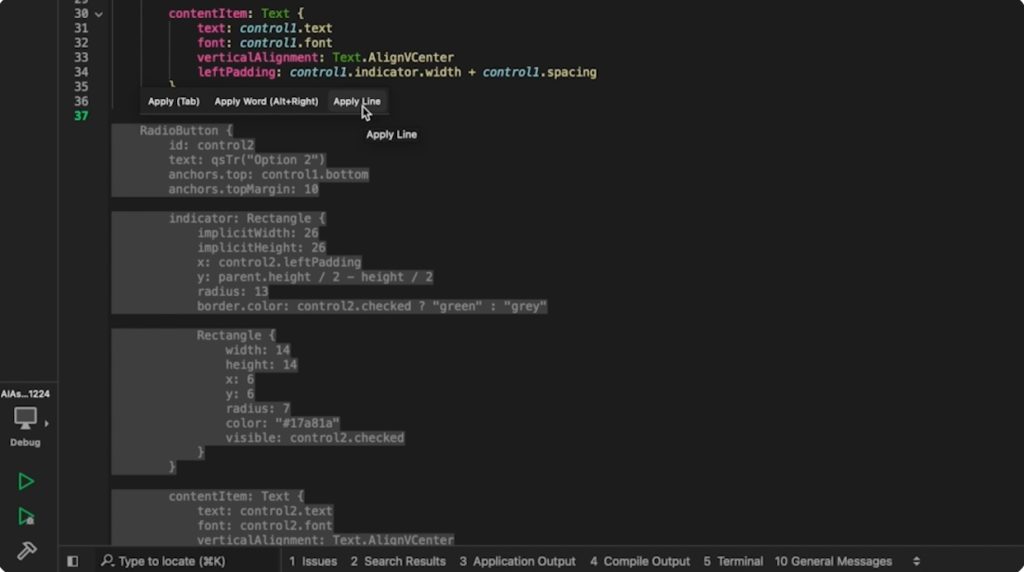
المصدر: Qt AI Assistant
الهدف:
«كمطور، أحتاج إلى الوصول إلى خبير في نماذج اللغة الكبيرة في برمجة QML Qt6 يمكنه توفير إكمال ذكي للشيفرة داخل بيئة تطوير Qt Creator.»
The Qt company has skilled engineers on board. Team composition with Spyrosoft as a partner was a piece of cake. The team consists of Qt Creator developers, and experienced AI and software engineers.
Qt has created a specialised dataset consisting of over 5,700 high-quality QML Qt6 code samples written by dedicated developers. These samples were processed into training triplets (prefix – code before the cursor, middle – to be suggested by LLM, and suffix – code after the cursor) for the Fill-in-the-Middle (FIM) task, resulting in an enormous number of training examples reflecting the way code is being developed accurately.
The team created a custom benchmarking tool to evaluate available models. Such a benchmarking approach helped determine that existing pre-trained models achieve mostly about 50- 60% accuracy, with some going even over 80%, but all are missing many of the latest features and best practices specific to QML Qt6. However, there are specialised code2code models performing very well in common programming languages such as Python or C++.
The Parameter-Efficient Fine-Tuning (PEFT) technique was used to create the LLM-expert in QML Qt6 coding. PEFT fine-tuning is like personalising a pre-trained AI model by adjusting only a small part of it rather than the whole model. This approach saves both time and computing resources while also providing excellent results for specific tasks. The chosen base models are Code Llama 7B and 13B due to their strong code generation capabilities, being open-source and smaller size, enabling local deployment (though Code Llama 13B performs much better through the cloud). For fine-tuning training, a multi-GPU cluster with NVIDIA A100 cards was enough; for inference, a single A100 card provides close to real-time code suggestions.
The custom models are integrated seamlessly with the Qt Creator IDE, along with preprocessing of requests and post-processing of the responses for even better QML Qt6 code quality. The models are also available on Hugging Face and Ollama platforms in an open-source manner, making them even more accessible to the broader Qt developer community.
This example shows that if you care about the swift creation of custom models that deliver expert-level completions for subjects or coding languages not handled by available LLMs, you can benefit by using Parameter-Efficient Fine-Tuning (PEFT). With already prepared high-quality data or samples and the option to personalise only a chunk of an open-source model fast, you can easily optimise required resources, performance, and outcomes for specific tasks and your unique needs.
السيناريو 3 – بدائل لطرق الضبط الدقيق
The mid-size insurance company processes thousands of claims daily. The company has established a clear workflow for maintaining documentation quality and regular updates to policy guidelines. The technical team consists of data scientists and DevOps professionals. The company possesses a large corpus of insurance documents, internal policies and guidelines, as well as relevant regulations. There are frequent updates and changes to the documents. The document database is already implemented and maintained. The stored data contains proprietary and sensitive information. The company’s infrastructure includes API access in a secure cloud environment, but it lacks GPU machines for large-scale AI deployments.
مضاعفة الكفاءة من خلال أتمتة الذكاء الاصطناعي لشركة تأمين
الانتقال إلى دراسة الحالة
الهدف:
«بصفتي وكيل مطالبات، أريد أن يكون لديّ مساعد ذكاء اصطناعي يمكنه الإجابة على أسئلتي حول تفاصيل الوثيقة والمطالبات.»
The AI system must be able to access, retrieve, and synthesise information from multiple documents to provide accurate answers about claim details, policies, and regulations. It is also crucial for the system to provide references and citations to ensure transparency and explainability. As a result, claim processing time can be reduced, allowing for more efficient customer service and improved productivity.
المدة الزمنية للمشروع هي ثلاثة أشهر.
Having analysed the project requirements and constraints, the team determined that fine-tuning is not possible due to limited resources and timeline. Moreover, frequent data changes wouldn’t be available without retraining. The team proposes building a Retrieval Augmented Generation (RAG) system using GPT-4o or Claude 3.5 Sonnet in a secure cloud environment. Both models have large context windows to digest multiple documents and strong domain understanding. The database with all the documents is already in place.
The proposed solution enables the quick incorporation of updated information and provides explainability through references and citations. The large corpus of documentation creates a solid foundation for the knowledge database. The cloud API infrastructure supports secure deployment in a closed environment. The RAG system can connect to the company’s document database and retrieve relevant information based on claim processors’ queries.
In this example, you can see that when operating in a domain with frequent changes and updates of documents and data, it is worth considering alternative approaches instead of fine-tuning, such as RAG (Retrieval Augmented Generation). They can handle information updates and seamlessly integrate them into responses without compromising quality, speed, or security.
استكشف المزيد من خيارات الذكاء الاصطناعي لمشروعك
عرض المزيد
خلاصة حول طرق الضبط الدقيق لنماذج اللغة الكبيرة
لا يوجد نهج شامل لتطبيق حلول النماذج اللغوية الكبيرة. تعتمد التقنية المناسبة على مزيجك الفريد من الهدف والموارد والقيود.
Your choice fundamentally depends on the given use case: company readiness, including the team and their expertise, data availability, and computing resources. Timeline constraints directly impact the decision on approach – successful fine-tuning requires significant time, whereas alternatives such as RAG can be delivered faster. The quality of responses from currently available models determines the need for additional training. Frequent changes in data make continuous retraining impractical. Serving options offer flexibility in system design – integrating third-party APIs ensures low latency, local deployment provides excellent control and security, and cloud environments deliver scalable performance for your custom models.
If available solutions don’t meet your expectations, don’t worry. You can create your own. While LLMs are impressive, large general-purpose models aren’t always necessary. Smaller LLMs can be remarkably powerful with customisation and additional training for specific needs. Properly fine-tuned models can outperform larger general models for specialised tasks.
AI implementation is a journey of continual learning and adaptation. As technology evolves and your organisation changes, the approach may need to evolve as well. The most successful AI strategies remain flexible, focusing on delivering tangible business value.
تبحث عن نهج مناسب لضبط النماذج اللغوية الكبيرة لتوسيع حلول الذكاء الاصطناعي وتلبية تحديات أعمالك؟ لنتحدث عن كيف يمكننا مساعدتك في إيجاد أفضل استراتيجية لمشروعك.




Fine-tuning is the process of training a pre-built language model on your own domain-specific data so it produces outputs tailored to your context. You need it when a general-purpose model lacks the specific knowledge, terminology, or behaviour your use case requires, and when prompting alone is insufficient to achieve consistent results.
Full fine-tuning updates all model parameters on your dataset, which requires significant compute but produces the most specialised results. Parameter-Efficient Fine-Tuning (PEFT) updates only a subset of parameters, conserving resources while still achieving strong domain performance. Retrieval Augmented Generation (RAG) retrieves relevant documents at inference time rather than baking knowledge into the model, making it better suited to frequently changing information.
Before selecting a technique, you need clear goals, defined tasks, high-quality training data of sufficient volume, appropriate compute infrastructure, and a realistic timeline. The choice of technique depends on the interaction of all these factors. Teams with limited GPU access and dynamic data are often better served by RAG than by fine-tuning.
Full fine-tuning of large models such as Llama 3.3 70B requires significant GPU resources such as NVIDIA H100 hardware. PEFT approaches using smaller models like Code Llama 7B or 13B are considerably less resource-intensive, making them viable for organisations without dedicated high-performance compute infrastructure.
Fine-tuning is not well-suited to frequently changing data because the model would need continuous retraining. RAG handles this scenario more practically, retrieving up-to-date documents at inference time without requiring a new training run. An insurance company with regularly updated policy documentation is a good example of where RAG outperforms fine-tuning.
arrow_circle_rightاتصل بنا
تواصل معنا ولنناقش كيف يمكننا مساعدتك

Tomasz Smolarczyk
مدير الذكاء الاصطناعي
arrow_circle_right مقالاتنا