التخفيف من مخاطر الذكاء الاصطناعي بأفضل الممارسات لاختبار LLM


Imagine launching a groundbreaking AI tool, only to have it propose biased decisions, fabricate legal citations, or misdiagnose a health condition. These aren’t hypothetical scenarios – they’re real-world failures that erode trust and create serious risks. Notable examples include models like Gemini and ChatGPT providing inaccurate information about science and history, Air Canada’s customer service AI chatbot offering non-existent promotions and refunds to the clients, and AI-powered health assistants generating misleading medical advice or recommending unsafe treatments. Hallucinations can have various causes, but usually, we can detect them through LLM testing and take corrective action when needed.
اعتماد أحدث نماذج الذكاء الاصطناعي, switching to another one, or expanding system capabilities is appealing. The pace of updates and the variety of adaptations has accelerated, with multiple major model releases and an increasing number of new use cases in short timeframes. These imply changes in our productivity, enhance our capabilities, and help us focus on what matters, but also introduce risk for the end-user.
Balancing innovation with reliability requires testing protocols. As AI technology advances, so do the strategies and frameworks for ensuring dependable performance. In this blog post, we’ll first explore the key risks of unreliable AI and then discuss LLM testing protocols to mitigate these challenges.
المخاطر الرئيسية التي يجب معالجتها في اختبار LLM
تقدم نماذج الذكاء الاصطناعي قدرات قوية ولكنها تجلب أيضاً تحديات. وفيما يلي بعض من أكثر المخاطر إلحاحاً التي يجب على المؤسسات مراعاتها عند نشر وصيانة النماذج اللغوية الكبيرة (LLMs).
مخرجات غير متسقة أو غير متوافقة
One of the biggest challenges in testing large language models is ensuring consistency and alignment with expected behaviour. LLMs can produce responses that vary significantly for similar inputs, leading to reliability issues in applications requiring precise or repeatable answers. Additionally, models may generate outputs that deviate from brand guidelines, ethical considerations, or regulatory requirements.
تراجع الأداء في المهام الرئيسية
When upgrading your model to a newer version, you need to take particular care, as it doesn’t always lead to universal improvement. A 2024 study found that model updates can degrade performance in specific tasks, impacting critical applications like content moderation and customer feedback analysis.
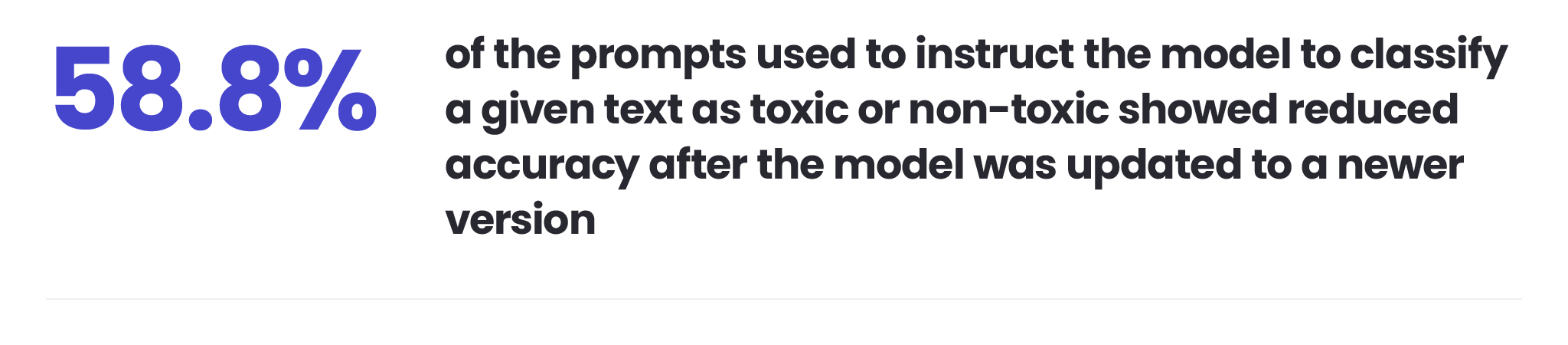
Insight: A 2024 study on Regression Testing for Evolving LLM APIs showed that 58.8% of prompts used to instruct the model to classify given text as toxic or non-toxic exhibited decreased accuracy after the model was updated to a newer, more advanced version.
المصدر: (لماذا) هل يزداد طلبي سوءاً؟ إعادة التفكير في اختبار الانحدار لواجهات برمجة تطبيقات LLM المتطورة
انحراف البيانات
AI models depend on the data used to train them. Over time, changes in language, emerging trends, or shifts in customer behaviour can render models less accurate. This phenomenon, known as “data drift,” can lead to outdated or irrelevant predictions.
تهديدات الأمن الخاصة بالذكاء الاصطناعي
AI systems face unique security risks, including prompt injections (tricking AI into generating unintended or harmful outputs), data poisoning (feeding malicious data to corrupt results), and data leakage (unintentionally exposing sensitive information). Tools like Lakera Guard help secure large language models in real time.
رؤية: هل أنت فضولي بشأن هجمات التلقين؟ جرّب Gandalf by Lakera – لعبة تختبر فيها مهاراتك لخداع النموذج وكشف معلومات سرية.
زمن الاستجابة والاستجابات البطيئة
Large AI models can be computationally intensive, leading to slower response times. For real-time applications – such as financial trading algorithms or live customer support – these delays can have significant repercussions, including missed opportunities, disrupted workflows, and frustrated users. In high-stakes environments, even slight lags can lead to financial losses, security risks, or decreased trust in AI-driven decisions.
تصاعد التكاليف
Sophisticated AI models typically require increased computational resources. Cloud processing fees, storage demands, and energy consumption can accumulate, complicating scalability. Achieving a balance between performance and cost is needed for sustainable AI integration.
مخاطر الامتثال التنظيمي
With regulations like the EU AI Act and GDPR taking effect, AI compliance is critical. Organisations must ensure their artificial intelligence systems do not violate legal standards, such as data privacy laws or restrictions on high-risk AI applications.
تعرّف على تأثير قانون الذكاء الاصطناعي الأوروبي على الصناعة الكيميائية
اقرأ المزيد
بروتوكولات اختبار الذكاء الاصطناعي والنماذج اللغوية الكبيرة
Understanding AI risks is just the first step in building proactive testing strategies. To ensure LLMs and AI models deliver consistent, high-quality outputs, we need structured validation methods.
قياس جودة استجابة النموذج
A straightforward approach to validating AI reliability is to build a dataset containing a collection of prompts paired with expected response guidelines. Such a solution acts as a benchmark to test whether the model behaves as intended across key scenarios.
أثناء الاختبار، تتم مقارنة مخرجات النموذج بالردود المتوقعة لتقييم مسائل مثل:
- الاتساق – هل ينتج الذكاء الاصطناعي استجابات مستقرة للمُدخل نفسه؟
- الصحة – هل المخرجات دقيقة واقعيًا ومتوافقة مع الإرشادات؟
- المتانة – هل يمكن للنموذج التعامل مع تنويعات الصياغة دون تناقضات؟
- التنسيق – هل تتبع الاستجابة البنية المطلوبة (مثل JSON، الجداول)؟
- الامتثال – هل يفي الذكاء الاصطناعي بالمعايير الأخلاقية والقانونية والسياساتية؟
إذا ظهرت تناقضات، يمكننا معالجتها من خلال الضبط الدقيق أو تعديل المطالبات أو آليات الاحتياط.
دراسة حالة: استخراج البيانات باستخدام النماذج اللغوية الكبيرة
For several of our clients from the ecommerce and logistics sectors, we created an automated data extraction solution. The enhanced process of separating and verifying business data from PDF files and operational documents has helped them eliminate slow, manual data entry and email forwarding. Using the GPT4o model, structured data was extracted and validated through automated routines, generating accurate JSON outputs ready for further processing in seconds, rather than minutes, per document.
- سير عمل LlamaIndex سهّلت التحسينات التكرارية، وصقلت جودة الاستخراج في الحالات المعقدة حيث فشل التنفيذ الأولي في التحقق.
- MLflow، المستخدم على نطاق واسع لإدارة دورة حياة التعلم الآلي، تم دمجه لتتبع التجارب ومراقبة الأداء.
As a result of these projects, our solutions drastically reduced processing time, improved accuracy, and minimised manual intervention, enabling faster decision-making and streamlined operations.
اطّلع على كيفية مساعدة استخراج البيانات بالذكاء الاصطناعي لعميلنا في قطاع التأمين
اطّلع على دراسة الحالة
النموذج الذي يعمل كحَكَم
When tasks require subjective judgment – such as evaluating conversational AI, summarising complex texts, or translating nuanced content – the LLM-as-a-judge framework can be highly effective. This approach leverages the AI’s capabilities to critique and score its outputs.
Carefully designed evaluation prompts enable performance assessment. Specially designed instructions allow us to assess how well a model performs under certain conditions. This method is particularly valuable when we need a human-like judgment, but full automation remains the goal.
دراسة حالة: التحقق من الترجمة لقطاع الصناعات الكيميائية
As part of our project for a leading company in the chemical industry, we validated AI-generated translations of its website content, which included product information and marketing materials. Our goal was to ensure factual accuracy and compliance, as errors in toxicity warnings, numerical values, and health-related terms could mislead customers and harm brand credibility.
A competing LLM, developed by another AI provider, validated the original outputs for toxicity detection, health and safety risks, and factual accuracy – focusing on named entities, numbers, dates, and units. Tools like Promptfoo تمكين مقارنات النماذج والأوامر التوجيهية، وتحديد التكوينات الأكثر فعالية لضمان الاتساق والدقة في المجالات الحساسة.
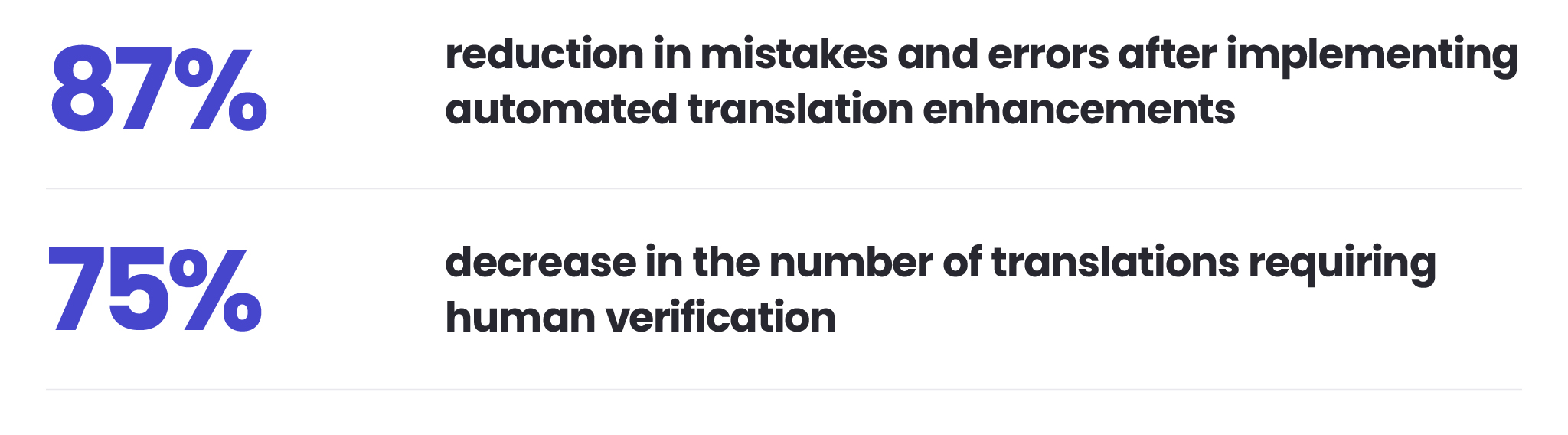
Results for Polish as the pilot language with translations across more than 200 websites show an 87% decrease in error rates after automated translation improvements. The project also brought a 75% reduction in translations requiring human review, significantly improving content reliability, reducing costs, and minimising manual effort.
ابدأ بالمراجعات اليدوية، ثم انتقل إلى الاختبارات الآلية
In some cases, initial manual evaluations are necessary to set up quality benchmarks. By analysing patterns in high- and low-quality outputs, we can get insights that help design automated testing workflows.
The collected inputs can be reused to prevent performance regression. Reprocessing historical data with updated models, in a process known as backtesting, ensures consistency and reliability over time.
دراسة حالة: ضمان اتساق الترجمة من خلال اختبار والتحقق من نماذج اللغة الكبيرة (LLM)
During our project assessing AI-generated translations, it became clear that inconsistencies in proprietary terms, marketing slogans, and industry-specific phrases were a significant challenge. Wanting to translate content into 28 languages from various language groups, such as Germanic, Romanic, Slavic, Asian, Middle Eastern, and Finno-Ugric, the client needed a new approach to address the issue.
Experts created a glossary of approved translations, ensuring that key terms remained uniform across all languages, with some left in English to preserve brand identity. The glossary was then integrated into the validation process, helping automated translations maintain accuracy and consistency across international markets.
تخصيص مجموعة اختبارات نماذج اللغة الكبيرة
Industry experts use the approaches outlined above widely. However, it is important to remember that AI systems vary in complexity, capabilities, and limitations. That’s why, to ensure effective LLM testing, you may need strategies tailored to specific functions and behaviours.
For example, retrieval-augmented generation (RAG) models require validation of how well they integrate external data, while models with different memory mechanisms demand specialised consistency checks. Similarly, agent-based AI workflows, designed to operate autonomously, need testing frameworks that assess decision-making and adaptability.
من خلال مواءمة استراتيجيات الاختبار مع الخصائص الفريدة لكل نموذج، يمكن للمؤسسات ضمان أنظمة ذكاء اصطناعي أكثر موثوقية ووعياً بالسياق وعالية الأداء.
مراقبة أداء الذكاء الاصطناعي وتكاليفه
Assuring long-term AI reliability requires ongoing tracking of performance and resource usage. Continuous monitoring helps detect anomalies, optimise efficiency, and prevent regressions in production environments.
Optimising computational resources, managing token consumption, and refining model usage help balance performance with efficiency. Regular audits and adjustments ensure sustainable AI operations without unnecessary costs.
أدوات المراقبة الآلية، مثللوحة تحكم واجهة برمجة تطبيقات OpenAI, AWS CloudWatch، و Azure Monitor، وتتبع مقاييس الأداء الرئيسية وتحديد الانحرافات. يساعد هذا النهج الاستباقي في الحفاظ على اتساق النموذج واستجابته.
خط أنابيب اختبار LLM
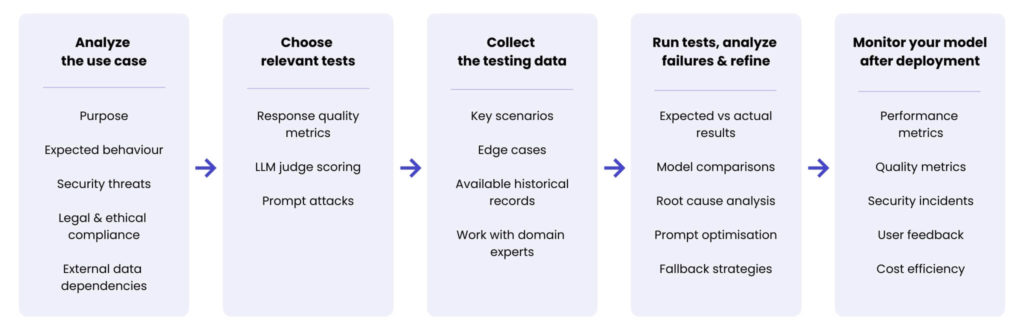
The LLM Testing Pipeline diagram presented below puts all the key concepts discussed in this article in order. By following this structured approach – from analysing the use case to monitoring performance – teams can systematically assess model quality, refine outputs, and maintain long-term reliability.
استفد من بروتوكولات اختبار النماذج اللغوية الكبيرة مع شريك تقني موثوق
بدون تقييم منظم، قد تُدخل تحديثات النموذج تفاوتات، أو تُخفض الدقة، أو تزيد التكاليف التشغيلية، مما يقوّض الثقة والكفاءة.
Fortunately, AI testing has evolved alongside the technology itself. From structured validation techniques to automated monitoring, businesses can now access methodologies that mitigate risks without stifling innovation.
As the adoption of large language models accelerates, the demand for specialised AI and LLM testing expertise will only grow. Organisations that invest in strong validation frameworks today will have the best chance to harness AI’s full potential – while maintaining control over performance, security, and costs.
لذا، إذا كنت ترغب في الحفاظ على مؤسستك في طليعة الابتكار من خلال الاستفادة من حلول الذكاء الاصطناعي المُثبتة والمُختبرة بدقة وتوسيع نطاقها، فتواصل معنا عبر النموذج أدناه.
الأسئلة الشائعة
Common concerns are hallucinations, inconsistent responses, and misleading outputs that lead to reliability issues. Performance drops can also pose risks, as upgrading a model doesn’t always guarantee better results. Data drift is also challenging, with AI data becoming outdated as languages, trends, and user behaviour evolve. AI-specific security threats, such as prompt injections, data poisoning, and leakage, can compromise models, while latency issues may slow real-time processing. Additionally, maintaining AI infrastructure can be costly due to high computational demands, and involves aligning with regulatory standards.
LLM testing helps identify weaknesses and ensures consistent performance by evaluating response accuracy and stability, detecting model regressions after updates, and monitoring for security vulnerabilities. It can also play a significant role in ensuring regulatory and ethical compliance.
Implementing LLM testing effectively requires a structured approach. The process should include manual reviews to set quality benchmarks and automated testing to improve performance and efficiency. Measuring model response quality involves comparing outputs against expected answers to assess accuracy. Using LLM as a judge helps leverage the AI’s capabilities to critique and evaluate its outputs, while backtesting helps ensure model consistency over time, even after new model updates.
To balance AI performance with cost efficiency, businesses should optimise computational resources, and manage token and model usage to prevent waste. Cost-effective cloud solutions can help manage expenses, while implementing performance monitoring tools like OpenAI’s API Dashboard, AWS CloudWatch, and Azure Monitor ensures efficient use of resources without sacrificing reliability.
Without structured evaluation, AI systems can introduce inconsistencies, degrade accuracy, and increase costs. Robust LLM testing frameworks ensure that models remain reliable, compliant, and efficient, helping businesses unlock AI’s full potential while mitigating risks associated with unpredictable performance.




arrow_circle_rightاتصل بنا
لنناقش كيف يمكننا دعم مشاريعك في مجال الذكاء الاصطناعي

Tomasz Smolarczyk
مدير الذكاء الاصطناعي
arrow_circle_right مقالات أخرى