תחומי תהליך במודל CMMI 2.0


The use of improvement models, like CMMI, by organisations in very competitive industries can be helpful. Therefore, it is important to know all their components and understand changes and adjustments made to them over time.
In this article, we tackle some changes made in CMMI 2.0 and their impact on architecture of a model and more specifically on Process Areas, now known as Practice Areas.
מהו CMMI?
The Capability Maturity Model Integration, also known as CMMI, is a process model developed by Software Engineering Institute at Carnegie Mellon University (SEI). In the creation process, they collaborate with the U.S. Department of Defence (DoD) and U.S. Government. Therefore, using CMMI is usually required in software development contracts with those institutions. The model is currently managed by CMMI Institute.
We can define the CMMI standard as a behavioural and process model that describes critical elements and best practices in the industry. It provides a framework that helps organisations to conduct improvements in processes and create behaviours that reduce risks and defaults in product, service, and software development.
CMMI was first released in 2002 as an extension of the Capability Maturity Model (CMM). Originally that model was prepared for software, but now it also can be applied to hardware and service development in multiple industries. The newest version of the model was published in 2018 and is known as CMMI 2.0.
ייצוגי מודל CMMI
While approaching CMMI we can choose one of two representations, each of them helps to pursue a different set of improvement objectives. Those two model types are:
- ייצוג מדורג – uses a pre-defined set of process areas and provides proven sequences of improvements, each serving as a foundation for the next.
- ייצוג רציף – uses processes selected in a way that the organisation considers the most appropriate and effective to reach business goals. Because of that, this representation is more similar to other quality standards, such as ISO 15504 or ASPICE.
It is worth mentioning that there is no difference between these two representations in terms of essential content, only in the way how it is organised.
שינוי מודל ל-CMMI 2.0
Like many other models in the industry, CMMI also had to change over time. The goal of these modifications is usually to make the model easier to understand and implement. In case of changes from CMMI 1.3 to CMMI 2.0 המטרות היו:
- שיפור היעילות העסקית.
- לעשות שימוש טוב יותר בשיטות העבודה המומלצות הקיימות.
- Building an agile system with high flexibility and scale.
- הקלת אימוץ המודל.
A new version of the model focuses on performance, understanding of its needs and how it can impact a company’s business. It also provides information on how to establish performance goals and how to navigate them at different maturity levels. Another new thing in the model is its better integration with Agile and Scrum, which helps to work around and improve already established processes. In addition, all those changes make the CMMI model even more profitable for businesses to integrate and apply.
Architecture of a model in version 2.0 is composed of four Category Areas, twelve Capability Areas, twenty-five Practice Areas and six Maturity Levels.
CMMI 2.0. רמות בגרות (ML)
Maturity levels in CMMI 2.0 are quite similar to those in the previous version of a model. The main change is that now CMMI breaks down organisational maturity into six and not five levels. The newest addition is Maturity Level 0, which refers to incomplete or unknown processes in the organisation. In using CMMI the goal is to reach the highest level possible.
כל רמות הבשלות הן כדלקמן:
רמת בגירות 0 – Incomplete – describes company processes as incomplete, unprepared and unknown.
רמת בגירות 1 – Initial – characterises processes as unpredictable and therefore fails to ensure that work is completed on time and on budget.
רמת בגירות 2 – Managed – applies to processes that are planned, performed, measured, and controlled on a project level but not yet company-wide.
רמת בגירות 3 – Defined – refers to companies that apply good standards across the organisation, understand their business goals, and know how to address them.
רמת בגירות 4 – Quantitatively managed – characterises organisations that use a data-driven approach to process improvement while ensuring that processes are predictable and aligned with partners’ needs.
רמת בגירות 5 – Optimising – relates to companies that are focused on constant improvement, and adjustment to changing environments, while also creating innovations.
Organisations are considered high maturity when they hit levels 4 and 5. A high level of maturity in the company means that the firm is continuously evolving and adapting to fulfill the needs of stakeholders, partners, and clients.
>> גלו עוד על CMMI 2.0 במגזר הרכב
תחומי קטגוריה ותחומי יכולת
Modifications in the CMMI model came with new terminology and changes in the grouping of requirements that are now known as Category Areas and Capability Areas.
The new version of the model has four Category Areas. These are groupings made up of related areas where practices are defined to improve specific activities of an organisation or project. These four areas are:
- Doing – covers areas related to the production, purchase, and delivery of high-quality solutions.
- Managing – includes areas related to the ability to plan and manage work and the workforce.
- Enabling – covers areas related to the analysis of causes, decision-making, maintaining product integrity, and communication with stakeholders.
- Improving – involves areas that concentrate on the development, management, and improvement of processes and related assets, with the main focus on improving organisational performance
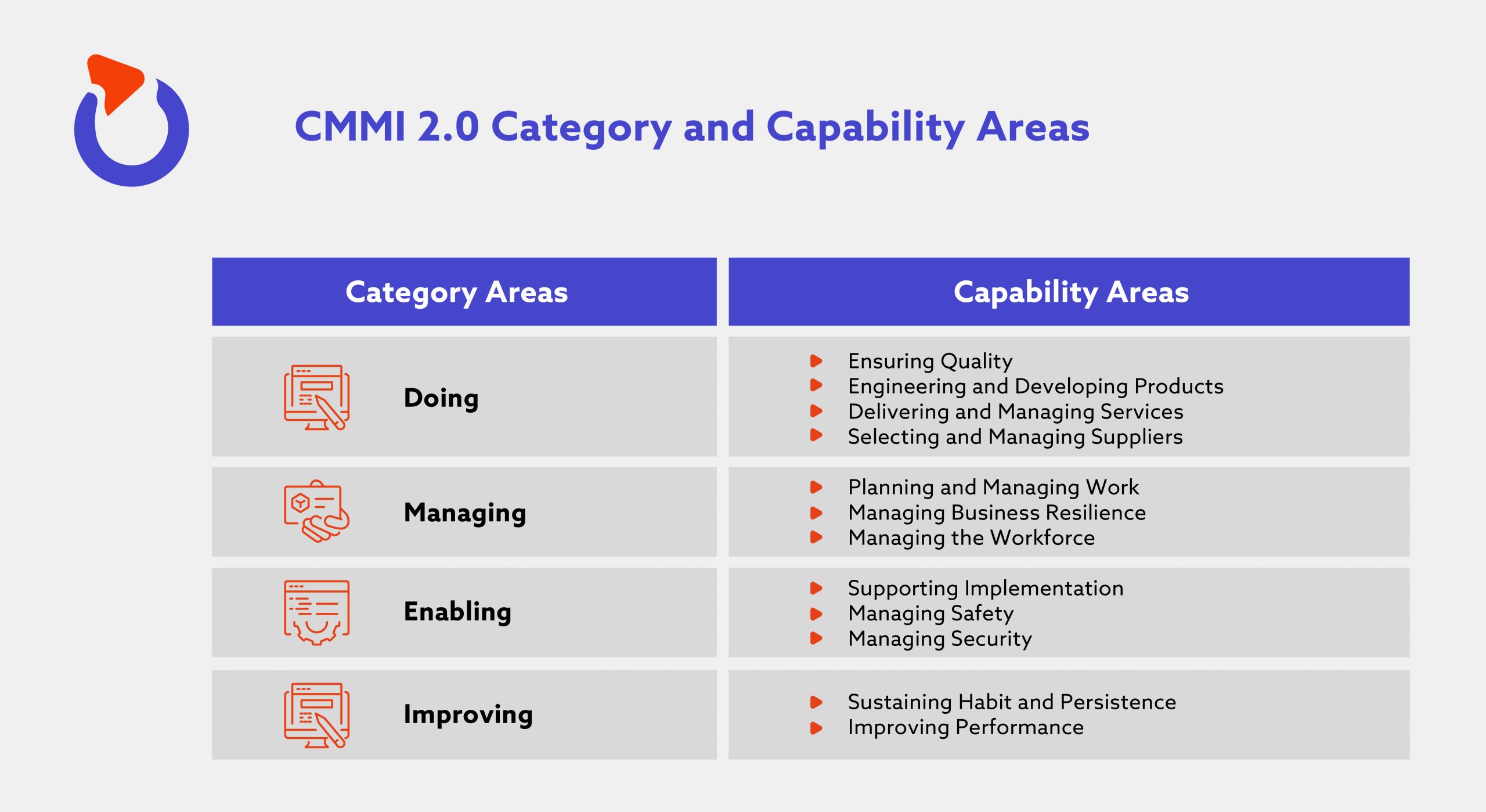
Each Category Area consists of specifically identified Capability Areas. They represent groups of related and common practices that are typically encountered during product creation and development.
תחומי היכולת של Doing הם:
- Ensuring Quality – Helps to improve the quality of product and service.
- Engineering the Developing Products – Allows to look at the project from a development perspective.
- Delivering and Managing Services – Allows to look at the project from a services’ perspective.
- Selecting and Managing Suppliers – Helps establish a partnership between buyer and supplier to ensure that quality solutions are delivered to the customer.
תחומי היכולת לניהול הם:
- Planning and Managing Work – Helps to determine the amount of work that needs to be done and planning and managing it so that it is done according to plan.
- Managing Business Resilience – Addresses the ability to anticipate, prepare for and manage risk, and defines a minimum set of critical functions that must continue in the event of significant disruption to normal operations.
- Managing the Workforce – Refers to the way an organisation develops and keeps the human resources required to perform current and future work.
תחומי היכולת לאפשור הם:
- Supporting Implementation – includes identifying and resolving the causes of selected results. Assists in establishing decision-making structures and maintaining the integrity of work products and the quality of communication between stakeholders.
- ניהול בטיחות
- ניהול אבטחה
תחומי היכולת לשיפור הם:
- Sustaining Habit and Persistence – ensures that processes are sustainable and regularly performed throughout the organisation and are effective in achieving business goals
- Improving Performance – focuses on measuring, analysing, and understanding the project capability and efficiency along with their process improvement priorities and needs.
תחומי תרגול ב-CMMI 2.0
Before CMMI 2.0. Process Areas were known as defined requirements grouped into four general categories: Process Management, Project Management, Engineering, and Support. With changes in the new version, Process Areas become Practice Areas. There are 25 of them, and they all can apply to an organisation at Maturity Level 3. Similarly, to prior versions of the model, all those areas describe requirements and critical operations that define the intent of the practice.
It is worth mention that Generic Practices, known from the previous version of CMMI, are now included to model also as specific Practice Areas. Each practice is assigned to a specific Capability Area but addresses them differently depending on their Maturity Level (ML).
The new Practice Areas in each Capability Area and their understanding, based on maturity level, are listed as follows:
הבטחת איכות
Requirements Development and Management (RDM)
RDM helps to develop and update a joint understanding of the necessities and expectations of the solution. The intention of the practice is to identify requirements and ensure shared stakeholder understanding and adjustment of requirements, plans and work products. The value of this practice is to ensure that the client’s needs are met. (Maturity Level 1=ML1, ML2, ML3)
הבטחת איכות תהליכים (PQA)
PQA helps to identify and prevent adverse effects, while ensuring the recurrence of positive results. Addressing the root problems quickly reduces the need for subsequent rework and therefore improves productivity. (ML1, ML2, ML3)
אימות ותיקוף (VV)
VV ensures that requirements are fulfilled, and the solution works as planned in the target environment. Its intention is to confirm and validate that selected solutions and components match the requirements and fulfil their intended use in the target environment. Value from verification and validation of selected solutions and components is the increase of likelihood that the solution will be satisfying for clients. (ML1, ML2, ML3)
סקירות עמיתים (PR)
It helps to identify defects and issues in the solution. PR intention is to find and address product defaults and issues through peers and experts’ reviews. The value from this practice comes with reduction of costs and reworks by uncovering defects early. (ML1, ML2, ML3)
הנדסת המוצרים המפותחים
פתרון טכני (TS)
This Practice Area focuses on designing and building products and their components. Its intention is to ensure that designed and prepared products are in line with customer requirements. TS value is providing effective design and solution that meets customer requirements while reducing costs and reworks. (ML1, ML2, ML3)
אינטגרציה של מוצר (PI)
It covers the assembly of the products and their deliveries to the clients, while also ensuring the required functionality and quality features. The intention of PI is to provide solutions that address functional and quality requirements. Its value is the increase in customer satisfaction, that comes with giving them a solution that matches or exceeds their requirements. (ML1, ML2, ML3)
אספקה וניהול שירותים
ניהול אספקת שירותים (SDM)
It focuses on delivering services in accordance with the established agreements. SDM’s main intention is to provide and manage the service delivery system. It helps to increase customer satisfaction by managing the delivery system in line with their expectations. (ML1, ML2, ML3)
ניהול שירותים אסטרטגי (STSM)
It helps to develop and keep an updated portfolio of standard services that align with strategic plans and needs. Its intention is to have and use standard services that are aligned with strategic business objectives. (ML1, ML2, ML3)
בחירה וניהול ספקים
בחירת מקור ספק (SSS)
It focuses on selecting and evaluating suppliers and their products. SSS helps to improve the ability to select the most qualified partners to deliver solutions. (ML1, ML2, ML3)
ניהול הסכמי ספקים (SAM)
It helps to develop and keep the supplier agreement updated, while ensuring that both sides perform according to the terms of the contract. The value of this Practice Area comes with providing an understanding between two sides of an agreement to maximise the success of the supplier’s agreed delivery efforts. (ML1, ML2, ML3, ML4)
תכנון וניהול עבודה
הערכה (EST)
It helps with forecasting and estimating the size, effort, and costs for the work required in a development process. It provides a basis for planning, making commitments and decreasing uncertainty, that helps to make early corrections and increase the likelihood of achieving the objectives. (ML1, ML2, ML3)
תכנון (PLAN)
It covers the use of estimates for planning schedules and budgets. It helps to identify the resources required to implement any plans and what is needed to carry out the work within the organisation’s standards and constraints. (ML1, ML2, ML3, ML4)
ניטור ובקרה (MC)
It helps to see and understand project progress and to take quick corrective action. Taking early actions to correct significant deviations in performance increases the likelihood of achieving targets. (ML1, ML2, ML3)
ניהול חוסן עסקי
ניהול סיכונים והזדמנויות (RSK)
It helps identify risks and opportunities and assesses the likelihood of their appearance. Its main value is to mitigate negative influences and focus on exploiting the positive impact to increase the likelihood of success. (ML1, ML2, ML3)
טיפול ומניעת אירועים (IRP)
It includes identification of actual and potential incidents that may have an impact on the project. It also helps to define how to behave when incidents and errors occur. Its intention is to minimise the impact of disruptions and to address them quicker. (ML1, ML2, ML3)
רציפות (CONT)
It helps to plan and validate the critical set of functions and resources that are needed to continue operations when significant or catastrophic events happen. CONT can also be of help in identifying and prioritising the functions and resources essential for business continuity. (ML1, ML2, ML3)
ניהול כוח האדם
הדרכה ארגונית (OT)
It provides a strategy for training that supports the organisations business goals. It helps to develop and enhance the skills and knowledge of employees to improve work performance. (ML1, ML2, ML3)
תמיכה ביישום
ניתוח סיבתי ופתרון (CAR)
It helps to identify causes of selected outcomes and act to either prevent the undesirable ones or ensure recurrence of positive outcomes. It also addresses the root causes of problems, thus eliminating rework and directly improving quality and productivity. (ML1, ML2, ML3, ML4, ML5)
ניתוח החלטות ופתרון (DAR)
It assists in decision-making by evaluating alternatives and recording results. It also helps to increase the objectivity of the decision-making process and the probability of choosing the optimal solution. (ML1, ML2, ML3)
ניהול תצורה (CM)
It helps to manage the integrity of work products by using configuration identification and audits. Its intention is to minimise work loss and maximise the ability to provide the customer with the correct version of the solution. (ML1, ML2, ML3)
שימור הרגל והתמדה
ממשל (GOV)
It provides guidance to senior management on its role in managing process activities and determines whether they are performed in a manner appropriate to the organisation. (ML1, ML2, ML3, ML4)
תשתית מימוש (II)
It provides a framework to ensure that processes are used and improved. It helps to maintain the ability to achieve goals and objectives consistently in an efficient and effective way. (ML1, ML2, ML3)
שיפור ביצועים
ניהול תהליכים (PCM)
It helps to manage and elevate performance by planning, implementing, and deploying improvements based on the understanding of the current strengths and weaknesses of the processes in the organisation. (ML1, ML2, ML3, ML4)
פיתוח נכסי תהליך (PAD)
It helps to develop and keep updated the process assets necessary to successfully perform the work. Its value is to ensure the ability to understand and repeat successful results. (ML1, ML2, ML3)
ניהול ביצועים ומדידה (MPM)
It helps to manage performance and ensure that benefits and business objectives are the leading factors driving its improvement. MPM intention is to maximise the return on business investment by improving effectiveness and quality of performance. (ML1, ML2, ML3, ML4, ML5)
ערכי CMMI 2.0
The business value from changes made in CMMI 2.0 lies in the simplified way of presenting company concepts for evolution through different stages of maturity and process capability.
The naming change between Process and Practice Areas was made to avoid misunderstandings that there was a sequential relationship between the Process Areas. The benefit to the business of this change is that it highlights CMMI as a set of best practices rather than a collection of processes to be applied. Another value from modifications in CMMI 2.0 made in the new concept and grouping of Category and Capability Areas is a clearer path for building capacity and improvement.
CMMI can be crucial in the process of product development, and now with a 2.0 version, it is easier than ever to use it to boost overall performance.
If you need any support with introducing the CMMI model to your organisation, feel free to contact our רכב צוות.
שאלות נפוצות: תחומי תהליך ב-CMMI 2.0
Capability Maturity Model Integration (CMMI) is a process improvement framework designed to help organisations enhance performance, reduce risk, and improve the quality of products and services. It was originally developed by the Software Engineering Institute at Carnegie Mellon University in collaboration with the United States Department of Defense.
CMMI provides best practices that help organisations:
– שיפור אפקטיביות התהליך
– הפחתת פגמים ועבודות חוזרות
– הגברת יכולת החיזוי של התוצאות
– הגברת שביעות רצון הלקוחות
– יישור קו הפעילות עם יעדי העסק
It supports continuous improvement across software, hardware, and service development.
In earlier versions (e.g. CMMI 1.3), requirements were grouped into Process Areas. In CMMI 2.0, they are now called Practice Areas.
This change clarifies that CMMI represents a collection of best practices rather than a rigid sequence of processes. It reduces the misconception that areas must be implemented in a strict order.
CMMI 2.0 מגדיר שישה רמות בגרות:
– Level 0 – Incomplete: Processes are unknown or incomplete
– Level 1 – Initial: Processes are unpredictable and reactive
– Level 2 – Managed: Processes are planned and managed at project level
– Level 3 – Defined: Organisation-wide standards are established
– Level 4 – Quantitatively Managed: Data-driven performance control
– Level 5 – Optimising: Continuous improvement and innovation
Organisations at Levels 4 and 5 are considered high maturity.
CMMI 2.0 groups practices into four Category Areas:
– Doing – Producing and delivering high-quality solutions
– Managing – Planning and managing work and workforce
– Enabling – Supporting decision-making, safety, and communication
– Improving – Enhancing organisational performance and processes
These categories provide a clearer structure for improvement activities.
CMMI 2.0 integrates more smoothly with Agile and Scrum frameworks. Instead of replacing Agile methods, it enhances them by adding structure, measurement, and long-term performance management.




arrow_circle_rightצרו קשר
אנחנו נעזור לכם ליישם תקני בטיחות לרכב

arrow_circle_right המאמרים שלנו