Modernisation par l'IA : transformer les systèmes bancaires hérités


À l'ère d'une numérisation croissante, de nombreuses banques traditionnelles ont pris des mesures pour s'adapter aux nouvelles réalités. La technologie évolue à un rythme effréné, et de nombreux acteurs du secteur bancaire ont besoin d'être guidés sur les solutions numériques à mettre en œuvre.
Bien que les plateformes existantes remplissent toujours leurs fonctions d'origine, au fil 40 % des banques still rely on COBOL, a programming language dating back to 1959, as the backbone of their legacy systems. The technological revolution has brought new tools to everyday life and changed consumer behaviour and expectations. Traditional banking models are becoming less efficient, delivering lower profits and facing increasing competition from new entrants. As a result, banks are moving towards platform-centric models like BaaS that prioritise interactions clients et garantir que les services sont fluides et intuitifs.
Let’s examine why it’s worth modernising outdated systems and outline strategies for updating banking platforms. This will help you recognise the signals that indicate the need for modernisation and familiarise you with the benefits of modernising the infrastructure.
Le rôle de l'IA dans la modernisation des systèmes bancaires
Selon une enquête de l'Economist Intelligence Unit, 77% des banquiers estiment que l'adoption de l'IA est le facteur différenciant essentiel entre les institutions financières gagnantes et perdantes.
De nombreux applications de l'intelligence artificielle include personalised customer service through chatbots and virtual assistants, predictive analytics for risk management, and real-time fraud detection systems. Implementing this technology facilitates modernising supporting systems, such as data management and cybersecurity, ensuring their robustness and efficiency. Also, AI has transformed online banking, offering seamless transactions, personalised financial advice and innovative services like robo-advisors. These advances improve the customer experience, reduce operational costs and mitigate risk, potentially adding up to 1 000 milliards $ de valeur au secteur bancaire chaque année.
For one of our clients, a global banking group, we have designed a robust application, capable of handling complex processes while maintaining user-friendliness. The system had to adhere to international banking standards for reporting and credit reserve calculation to minimise human error and ensure the accuracy and reliability of data. The application also aimed to automate workflows to improve operational efficiency and reduce reliance on paper-based processes, aligning with the bank’s sustainability initiatives. Ensuring scalability and the security of sensitive financial data in this project was paramount.
Pourquoi il vaut la peine de moderniser les systèmes obsolètes
La modernisation des systèmes hérités obsolètes est une étape stratégique pour toute organisation cherchant à rester compétitive et à réussir. Selon 80% des responsables informatiques, le fait de ne pas moderniser les systèmes informatiques entravera leur croissance à long terme, ce qui met en évidence la reconnaissance généralisée parmi les experts du secteur que la mise à niveau est essentielle.
Pour répondre à la question de savoir pourquoi il vaut la peine d'investir dans la modernisation de ces systèmes, voici quelques raisons :
Performance et efficacité améliorées
Legacy systems are often modernised by upgrading outdated hardware and software, streamlining procedures, and integrating new technologies. This process can lead companies to faster processing times, reduced downtime, and smoother operations. Thanks to increased performance, the system can manage higher volumes of data and transactions more effectively. Improved efficiency eliminates bottlenecks and manual intervention, allowing banking personnel to focus on more critical responsibilities.
Avantage concurrentiel
Organisations that modernise their outdated systems can react faster to market developments and client needs. They are able to benefit from new features, services, and technology that competitors could not offer, establishing themselves as leaders in innovative approaches. With agility and the ability to grow quickly, banks may differentiate themselves in the market, acquiring new clients while retaining old ones through superior products and services.
Sécurité des données et confiance renforcées
Legacy systems are often vulnerable to security breaches due to outdated protocols and updates. Modern systems use advanced security measures such as advanced encryption, multi-factor authentication and regular security patches, which significantly reduce the risk of cyber-attacks and data breaches and ensure the protection of sensitive data.
Réduction des coûts et économies à long terme
L'investissement initial pour moderniser des systèmes plus anciens peut être important, mais il se traduira par des économies financières substantielles au fil du temps. Les systèmes modernes sont fiables et nécessitent moins de maintenance, ce qui réduit les coûts d'exploitation continus.
Prenons l'exemple deThe Royal Bank of Scotland Group, which has been modernising its technological infrastructure since the government bailed it out following the 2007 banking crisis. The bank’s efforts have focused on re-platforming its legacy systems from physical servers to virtualised and cloud-based services, using private and public cloud solutions from AWS and Microsoft Azure. This move to modern platforms has enabled the implementation of automation, resulting in savings of approximately 9 millions $ dans les processus serveur manuels dans les deux ans suivant la mise en œuvre.
Opportunités stratégiques pour les banques qui intègrent le BaaS
As customer dissatisfaction with traditional banking services continues to grow, integrating Banking-as-a-Service (BaaS) presents a critical opportunity for financial institutions to innovate and differentiate themselves in the marketplace. BaaS enables banks to leverage technology platforms to deliver seamless financial services to their customers, meeting evolving demands.
Avec 30% de clients envisageant de changer de banque et 42% using ‘buy now, pay later’ services, the demand for flexible and accessible financial solutions is straightforward. Banks that leverage Banking-as-a-Service can meet changing preferences and reap significant economic benefits, such as a potential doubling return on average assets (ROAA).
Compte tenu de ces avantages significatifs, les banques peuvent se concentrer sur trois domaines clés pour maximiser le potentiel du BaaS :
- Améliorer l'expérience client grâce à la finance embarquée: Banks can offer embedded finance solutions that significantly enhance the customer journey by integrating banking services directly into non-financial platforms. For example, they can provide loans at the point of sale or integrate payment solutions into ride-sharing apps. Such seamless integration improves customer convenience and engagement, making financial services a natural part of everyday activities and purchases.
- Exploiter des informations issues des données: BaaS platforms give banks access to vast amounts of data, enabling them to gain deeper insights into customer behaviour and preferences. By leveraging advanced analytics and artificial intelligence, they can offer more relevant and timely financial products, improving customer satisfaction and loyalty. For example, predictive analytics can help banks identify customers interested in mortgage refinancing based on their spending patterns and financial history, enabling proactive and personalised service offerings.
- Garantir une sécurité et une conformité robustes: Modern BaaS platforms are designed with robust security features and compliance tools to help banks meet regulatory requirements. These features ensure that customer data is protected, and regulatory obligations are met, reducing the risk of penalties and increasing customer confidence. By leveraging these built-in capabilities, banks can streamline compliance processes and focus on delivering value-added services rather than getting bogged down in regulatory complexities.
L'intégration du BaaS est un choix stratégique qui positionne les banques pour tirer parti de nouvelles opportunités, améliorer l'expérience client et stimuler l'innovation. Profitez denos conseils d'experts et découvrez comment le BaaS peut aider votre institution à attirer et fidéliser les clients tout en optimisant la performance financière.
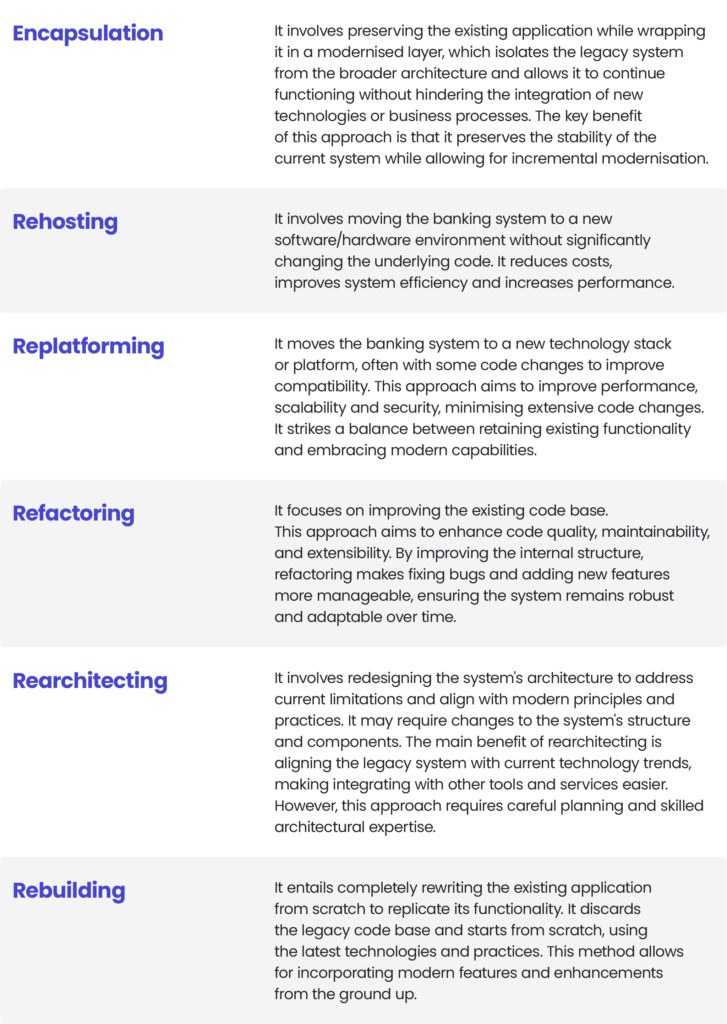
Principales approches de modernisation
Il existe plusieurs approches de modernisation, chacune traitant différemment le code et l'infrastructure existante. Examinons chacune de ces méthodes.
Signes avant-coureurs indiquant que votre système financier hérité nécessite une mise à jour
Ratio d'efficacité en baisse
When the efficiency ratio falls, it often signals a decline in operational efficiency. Legacy systems can slow down processing times and increase the potential for errors, negatively impacting the overall efficiency of the banking system. Employees may resort to manual workarounds to overcome system limitations, which are time-consuming and error-prone. In addition, legacy systems often require more human intervention and maintenance, limiting overall efficiency.
Délai de mise sur le marché plus long pour les nouveaux produits
The long time it takes to bring new products to market is a critical indicator that a financial system needs to be upgraded. Legacy systems may have difficulty integrating new technologies and may not support modern development practices, resulting in extended development and release cycles. These banking systems often lack the flexibility to accommodate rapid changes or new functionality, delaying the introduction of new products and services.
Augmentation Coût total de possession (TCO)
As systems age, maintenance costs tend to rise due to the need for specialised skills, which can be costly and hard to find as technologies become obsolete. Frequent outages and increased system failures lead to higher repair costs and lost productivity. Integrating legacy systems with modern applications can be challenging and expensive, contributing to increased operational costs.
La mise en œuvre des changements réglementaires prend du temps
Keeping up with regulatory requirements using outdated systems can be cumbersome, as these systems may not easily support necessary updates or new compliance features. Legacy systems are often rigid, making it difficult to implement even minor changes without extensive reworking. Delays in updating systems to meet regulatory standards can result in non-compliance risks, potentially leading to fines and legal issues.
Pourquoi vous devriez vous associer à Spyrosoft pour vos projets de modernisation
Modernising legacy banking systems can be daunting. It involves thoroughly analysing existing applications, selecting the optimal modernisation strategy, and seamlessly implementing changes. The complexity and risks associated with these projects can be challenging.
Cependant, choisir le bon partenaire de modernisation numérique peut simplifier ce processus. Notre étude de cas surtransformer la documentation du code hérité avec l'IA générative démontre notre expertise et nos résultats probants.
Contactez directement notre expert en remplissant le formulaire ci-dessous pour plus d'informations sur la manière dont nous pouvons soutenir votre système bancaire !
La modernisation des systèmes hérités améliore les performances, la sécurité et l'évolutivité tout en réduisant les coûts de maintenance. Elle permet également une innovation plus rapide et garantit la conformité aux réglementations en évolution.
Le BaaS permet aux banques d'intégrer des services financiers dans des plateformes non financières, offrant ainsi aux clients des solutions fluides et flexibles. Il améliore l'expérience client et peut augmenter considérablement la rentabilité.
L'IA rationalise les opérations grâce à l'automatisation, améliore la détection de la fraude et permet une prise de décision fondée sur les données. Elle personnalise également l'expérience client, améliorant ainsi la satisfaction et la fidélisation.
Les signes avant-coureurs incluent une baisse de l'efficacité, des délais de lancement de produits prolongés, une hausse des coûts de maintenance et des difficultés à satisfaire aux exigences réglementaires. Ces éléments indiquent que l'infrastructure héritée limite la croissance et l'agilité.
Spyrosoft combine une expertise approfondie du secteur financier avec une expérience éprouvée en transformation numérique et en IA. Nous fournissons des solutions évolutives, sécurisées et tournées vers l'avenir, adaptées aux besoins de chaque client.




arrow_circle_right nos articles
Choisissez votre prochaine lecture



arrow_circle_rightContactez-nous
