Étapes pour vous aider à réduire le TCO et optimiser les coûts dans le cloud


Cloud computing has revolutionised businesses’ operations, offering scalability, flexibility and accessibility. However, with the benefits come challenges, particularly in managing costs. As organisations increasingly migrate their workloads to the cloud, understanding and controlling the total cost of ownership (TCO) becomes essential.
In this article, we’ll present practical steps you can take to reduce TCO and optimise costs in the cloud. Each step is designed to maximise cost efficiency without compromising performance or availability. Implementing these strategies can lead to significant savings and better resource utilisation in your cloud deployment, whether a small startup or a large enterprise.
Qu'est-ce que le coût total de possession exactement ?
Total Cost of Ownership (TCO) is a financial estimate that includes all direct and indirect costs associated with acquiring, implementing, using and maintaining a product or service throughout its lifecycle. It provides a comprehensive view of the costs of owning and operating a particular asset or solution.
La méthode correcte de calcul du TCO dépend du type de produit ou de service. Il peut être calculé comme le prix d'achat initial plus le coût de possession sur la durée de vie du produit ou du service.
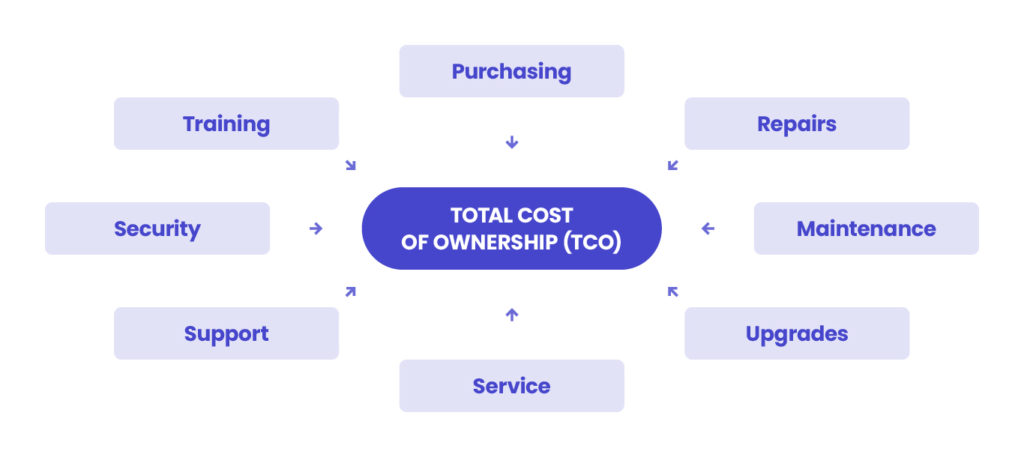
There are various methods of calculating TCO, each tailored to specific products or services. For tangible assets such as machinery, equipment or vehicles, TCO typically includes the initial purchase cost as well as the costs incurred over the life of the asset. This includes maintenance, repairs, energy consumption, insurance and eventual disposal or replacement costs. By taking these ongoing expenses into account, organisations can make informed investment decisions that consider the long-term financial impact. Similarly, for software or technology solutions, TCO extends beyond the initial licence or implementation fees to include the costs associated with deployment, integration, training, support and upgrades. Understanding the full lifecycle costs enables organisations to assess the true value proposition of a solution and effectively compare alternatives.
In cloud computing, TCO analysis aims to provide organisations with a comprehensive understanding of the total cost implications of adopting cloud services compared to traditional on-premises solutions. By considering all relevant cost components and performing a thorough cost-benefit analysis, organisations can make informed decisions about cloud adoption, resource allocation and optimisation strategies to maximise value and minimise total cost over time.
Comment réduire le TCO et optimiser les coûts ?
In a scalable business, effective management of total cost of ownership (TCO) is critical to aligning with current business needs. Below we introduce several operational areas that can be improved, including cost of ownership and observability. Through these strategies, we aim to demonstrate how companies can increase efficiency, reduce expenditure and maximise the value of their cloud investments.
Découvrez nos offres de services gérés !
En savoir plus
Opérations
Optimiser l'infrastructure cloud – L'optimisation de votre infrastructure cloud est une étape essentielle dans la gestion des dépenses opérationnelles. En allouant stratégiquement les ressources, vous pouvez garantir efficacité et rentabilité sans compromettre les performances ni la fiabilité.
Start with evaluating your storage usage patterns, assessing the volume and types of data stored in your cloud environment and determining optimal storage tiers for different categories of data. Implement data compression, deduplication and lifecycle policies to minimise storage consumption and associated costs. By aligning your storage infrastructure with your specific data needs, you can significantly reduce unnecessary spending while ensuring that critical data remains easily accessible.
Additionally, consider autoscaling, which allows the launch of virtual servers based on current utilisation. When the load decreases, surplus instances are removed. Another strategy is using spot instances, which can reduce computational costs by up to several percent. However, computations on these instances must be fault-tolerant because they can be taken away at any moment, leading to the loss of generated computational results.
Utilising serverless technologies such as AWS Fargate, Azure Container Instances (ACI), or Google Cloud Run allows the running of containers without the need to set up infrastructure, with payment only for the actual usage time. Similarly, solutions like AWS Lambda, Azure Functions, or Google Cloud Functions enable running applications in the chosen programming language without the need to set up infrastructure or even package the application in a container. You only need to upload your code and pay for what you use, as the application runs on request. Selecting the appropriate types of instances is crucial. All clouds offer various types of instances. If the deployed solution’s architecture requires virtual servers, instances should be chosen based on the server’s purpose. Available instances include General-Purpose, Compute-Optimised, Memory-Optimised, Storage-Optimised, and special-purpose instances, each with different pricing. It is essential to select the right type and size of instance tailored to your needs, enabling efficient resource and cost management.
Mettre en œuvre l'automatisation – Identify repetitive tasks such as resource provisioning, deployment and scaling that can be automated to streamline operations and improve efficiency. Leverage Infrastructure as Code (IaC) tools to codify and automate the provisioning and management of cloud resources, minimising the need for manual intervention and reducing labour costs. By embracing automation, you can achieve new levels of agility and responsiveness while reducing the risk of human error. Automation also plays a critical role in disaster recovery (DR) by enabling faster recovery of the environment, helping to avoid loss. Automated DR processes can rapidly restore services and infrastructure to their pre-disaster state, ensuring business continuity and reducing downtime.
Coût de possession
Migrez vers le cloud et réduisez l'usage sur site – La migration vers le cloud offre des avantages considérables au-delà de la simple libération d'espace serveur physique ou de la réduction des besoins en climatisation, en sécurité physique ou en gestion de l'alimentation électrique.
By moving to cloud-native services and platforms, you can replace legacy on-premises applications and significantly reduce licensing costs and hardware requirements. This shift eliminates the need to maintain and upgrade physical hardware and leverages the scalability, reliability and flexibility of cloud environments. In addition, cloud migration can result in significant cost savings. On average, organisations can achieve a minimum 25% reduction in infrastructure costs by moving legacy applications to the cloud. This is due to the efficient resource management, automated updates and reduced maintenance.
Pour l'un de nos clients, nous avons réalisé une migration en utilisant le AWS Migration Acceleration Program (MAP). It’s a proven solution that draws on AWS’ extensive enterprise migration experience and provides tools, customised training, and a three-phase framework (Assess, Mobilize, and Migrate & Modernise) to accelerate the entire migration process. With this solution, we helped Corab build a solid Fondation AWS, réduire les risques et compenser les coûts de migration initiaux en leur permettant de tirer parti des performances, de la sécurité et de la fiabilité du cloud.
Leverage cloud backup and disaster recovery – Mettre en œuvre une sauvegarde basée sur le cloud et reprise après sinistre solutions to improve your data resiliency and recovery time. By leveraging the scalability and durability of cloud storage, you can protect critical data and systems without the need for costly secondary data centres or failover sites. The mechanisms such as backup and redundancy save money by eliminating the need to build a whole new infrastructure for this application. These solutions improve data resiliency, minimise downtime during disasters, ensure business continuity and protect against potential financial loss.
Observabilité
Analyser les dépenses actuelles – Conduct an analysis of your current cloud spending to gain a comprehensive understanding of where your financial resources are allocated. Identify areas of high spending and pinpoint unused or under-utilised resources. By drilling down into your spending patterns, you can gain valuable insight into which services or resources are consuming the most of your budget. This analysis provides the basis for targeted optimisation strategies to maximise cost efficiency and resource utilisation. In addition, cloud platforms offer built-in cost control and management tools that break down bills per resource or group of resources, allowing you to track infrastructure costs for each project separately. This granularity allows you to closely monitor and manage spending, ensuring that each project comes within budget and that resources are allocated efficiently.
Revue et optimisation régulières – Establish a cadence for regular review and optimisation to maintain cost efficiency and performance excellence in your cloud environment. Establish regular checkpoints to assess spend, identify areas for improvement, and adjust optimisation strategies accordingly. Continuously monitor cloud usage, performance metrics, and cost reports to identify further optimisation and refinement opportunities. By taking a proactive and iterative approach to cloud management, you can drive continuous improvement and maximise the value of your cloud investments.
Reducing TCO and optimising costs in the cloud is essential for today’s businesses to succeed in a competitive environment. By implementing strategies such as resource optimisation, leveraging multiple pricing models, adopting serverless architectures and embracing managed services, organisations can achieve significant cost efficiencies while increasing their agility and ability to innovate. As cloud computing continues to evolve, organisations must continually evaluate and refine their cost optimisation strategies to stay ahead of the curve and maximise the value of their cloud investments.
Marcin Szremski – Head of DevOps
Conclusion
Reducing total cost of ownership and optimising costs in the cloud does not end with implementing initial savings measures. Ongoing monitoring and adjustments are essential to ensure your cloud spend’s continued performance and effectiveness. Organisations must recognise the dynamic cloud environment, with usage patterns, technologies and pricing models constantly evolving. That’s why it’s important to regularly monitor cloud usage, performance metrics and cost analysis to identify areas for improvement, spot anomalies and take advantage of new optimisation opportunities.
In addition, organisations should prioritise cost optimisation as an integral part of their cloud strategy rather than a one-off initiative. With continuous monitoring, adaptation and a commitment to cost optimisation, organisations can unlock the full potential of the cloud to drive long-term growth, innovation and sustainable success.
Si vous recherchez un partenaire technologique stratégique pour vous aider à gérer efficacement vos coûts cloud et à réduire votre TCO, contactez-nous dès aujourd'hui ! Remplissez le formulaire ci-dessous pour commencer ou explorez notre offre de services gérés pour en savoir plus !
Le TCO représente le coût total d'utilisation et de maintenance des services cloud sur l'ensemble de leur cycle de vie. Il inclut non seulement les dépenses initiales, mais aussi les coûts récurrents tels que la maintenance, le support, le stockage des données et les mises à niveau.
Sans une gestion adéquate du TCO, les coûts cloud peuvent augmenter rapidement en raison d'un surprovisionnement, d'une utilisation inefficace des ressources ou de dépenses non surveillées. Maîtriser le TCO garantit l'efficacité financière tout en maintenant des performances et une disponibilité élevées du système.
les technologies, et en examinant régulièrement l'utilisation des ressources. Ensemble, ces étapes minimisent le gaspillage et améliorent l'efficacité des coûts.
L'observabilité permet aux entreprises de suivre les dépenses, de surveiller les performances et de détecter les inefficacités en temps réel. Grâce à cette visibilité, les organisations peuvent procéder à des ajustements fondés sur les données afin de réduire les coûts et d'améliorer l'utilisation des ressources.
Spyrosoft fournit une expertise de bout en bout en matière d'optimisation cloud, d'automatisation et de gestion des coûts. Nos spécialistes aident à concevoir des environnements évolutifs et efficaces qui réduisent le TCO tout en maintenant la sécurité et les performances.


arrow_circle_right nos articles
Choisissez votre prochaine lecture


arrow_circle_rightContactez-nous
Concentrez-vous sur votre cœur de métier, pendant que nous gérons la maintenance de votre infrastructure informatique

Filip Rozanski
Responsable des services gérés