Banque omnicanale : 4 façons dont l'IA générative transforme le secteur financier


À mesure que les exigences des clients des banques et des institutions financières augmentent, le rôle de la technologie dans la mise en œuvre de solutions facilitant la navigation fluide des services bancaires s'accroît également.
The emergence of generative AI in banking is driving many changes in the way financial institutions engage with clients and manage operations. Let’s take a look at the impact of Gen AI on omnichannel banking, zooming into the ways in which it’s changing industry dynamics.
L'omnichannel est de retour et plus disponible que jamais
Omnichannel banking is a holistic approach that integrates multiple channels, such as branches, online banking, mobile applications, and call centres. It enables customers to switch between online, mobile, and in-person channels. Omnichannel retail banking also refers to the integration of these channels to provide customers with a consistent and personalised shopping experience across multiple touchpoints.
De nos jours, les gens attendent des expériences numériques fluides dans tous les aspects de leur vie, en particulier la génération Z, et le secteur bancaire ne fait pas exception. Cependant, seuls 34 % des clients mobiles et 44 % des consommateurs en ligne ont trouvé leurs services bancaires en ligne faciles à utiliser.
La banque omnicanale deviendra un besoin stratégique pour obtenir un avantage concurrentiel en atteignant les clients là où ils se trouvent, à tout moment et chaque fois qu'ils ont besoin de services bancaires. Les statistiques parlent d'elles-mêmes, un chiffre stupéfiant de 80% des clients bancaires exigent une expérience omnicanale transparente.
En tant qu'utilisateur d'une banque, vous partez naturellement du principe que votre banque est informée des données que vous lui fournissez. Une banque ne devrait pas vous appeler avec des offres de prêt si vous venez d'ouvrir un dépôt à terme.
Cela met en évidence le besoin critique pour les banques d'adopter une approche intégrée et réactive pour répondre à l'évolution des attentes de leurs clients.
Tendances en 2024 créées par l'IA
L'intelligence artificielle offre un éventail d'opportunités dans la banque omnicanale, transformant la manière dont les institutions financières interagissent avec leurs clients et gèrent leurs opérations.
Surhumain assisté par l'IA
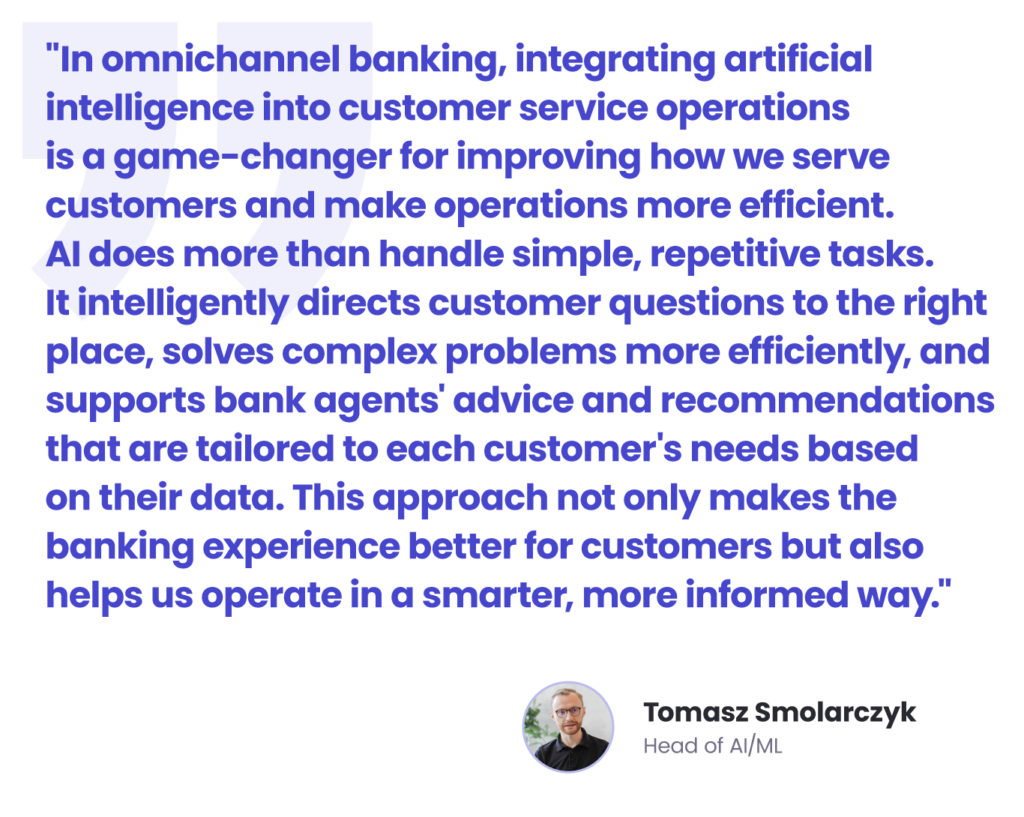
Artificial intelligence enables financial institutions and bankers to become superhuman by combining their skills with intelligent tools. AI-powered systems can provide real-time insights, automate repetitive tasks, and assist in the decision-making process. For instance, AI can support bankers in analysing customer data helping bank agent to provide recommendations. At the same time, fraud detection is improving security measures.
Automatisation du support client
AI-powered chatbots and virtual assistants are revolutionising customer support in omnichannel banking. These systems are available 24/7 to respond immediately to customer queries, answer frequently asked questions and guide users through various banking processes such as account management, transaction history checks or loan applications. Banks are expanding bots’ capabilities, so often something that has started with basic intent recognition is turning into a much larger system.
Personnalisation du contenu
Analysing individual data has long been a compliance and ethical challenge, but gradually, banks are figuring out how to do that correctly. My personal favourite is the Monzo year-in-review feature and campaign. This leading UK neobank leveraged spending data to amuse their clients in the app but also in public campaigns (aggregated data only). Monzo used a casual narrative and even joked with some of the users about their spending habits instead of providing dull facts and analysis. It turned out to be hugely engaging, with major positive social and traditional media feedback. AI will make such campaigns easier to deliver.
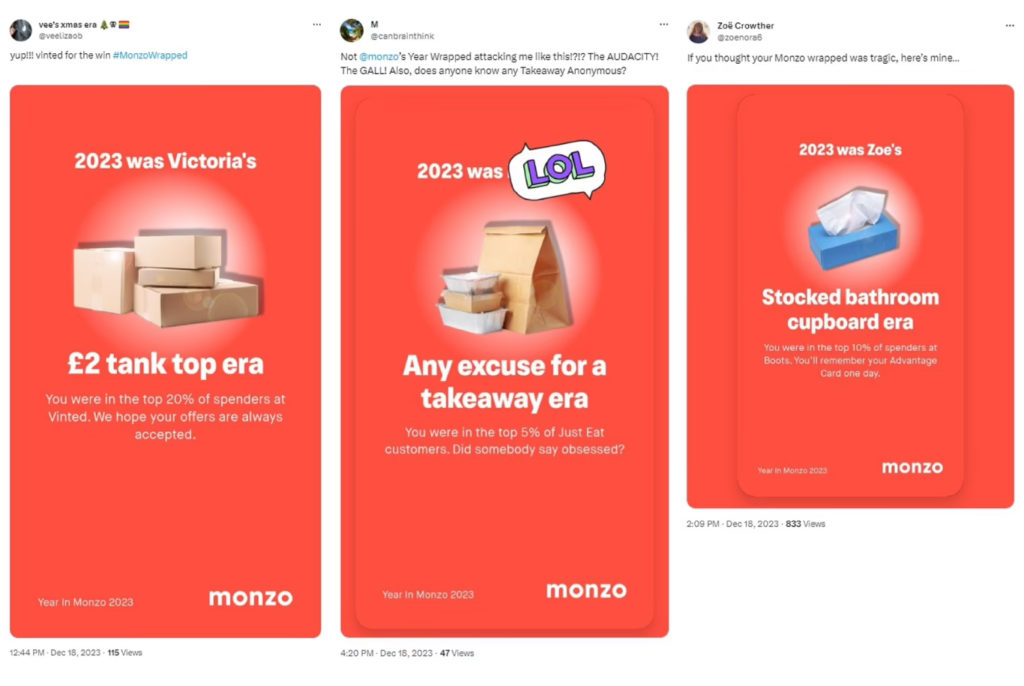
Source : https://twitter.com/monzo & https://www.dailymail.co.uk/news/article-12880227/monzo-wrapped-spending-banking-app-cash.html
L'analytique prédictive dans le secteur bancaire
Predictive analytics enables banks to anticipate customer needs, behaviours and market trends accurately. By analysing historical data and identifying patterns, algorithms can predict future financial transactions, assess credit risk, detect fraudulent activity and optimise pricing strategies. These insights allow banks to proactively address customer concerns, tailor product offerings and mitigate risk, thereby increasing profitability and competitiveness in the marketplace.
Les avantages de la banque omnicanale pour les institutions financières
Omnichannel banking offers several benefits, including higher customer satisfaction, increased engagement and streamlined operations. However, its primary benefit lies in delivering a personalised customer experience across multiple channels, fostering customer loyalty.
Engagement client amélioré
En consolidant les interactions clients, les banques acquièrent une compréhension globale des préférences, des comportements et des besoins. Cette vision permet des recommandations, des promotions et un accompagnement personnalisés, renforçant ainsi l'engagement et la fidélité.
Efficacité opérationnelle et rentabilité
L'intégration des canaux et des processus permet une allocation optimisée des ressources, une réduction des redondances et une efficacité accrue. En conséquence, les banques réalisent des économies et une meilleure utilisation des ressources humaines, ce qui conduit à une exploitation plus rentable.
Accès aux données en temps réel
L'accès aux données en temps réel permet aux banques de prendre des décisions éclairées et de répondre rapidement aux besoins des clients. Il facilite l'identification des tendances, l'anticipation de la demande et la résolution proactive des problèmes.
Intégration des technologies émergentes
Omnichannel banking incorporates technologies such as AI and chatbots that automate tasks, provide instant support, and deliver advanced customer services. The more data points and technologies that are integrated the greater the value. PSD2, PSD3, open finance APIs can enhance the capabilities of omnichannel experience.
Par exemple, les chatbots alimentés par l'IA peuvent exploiter des moteurs LLM et créer une expérience conversationnelle personnalisant l'interaction, initiant des actions et améliorant l'expérience bancaire globale.
Polish banks are facing pressure to improve customer service efficiency. Our voicebot solution tackles this challenge by utilising AI to automate many frequently asked questions and routine tasks. This frees up valuable time for human advisors to focus on more complex customer issues. If you’d like to see how our voicebot helped a Polish bank streamline their operations, consultez notre étude de cas détaillée!
Obstacles et limites
AI is not a plug-and-play silver bullet for banks. There are reasonable arguments to limit and control how machines interact with end users, especially at this early stage. At the same time, it’s best to explore the AI opportunity, test its performance, and learn how to apply AI-driven automation. Humans will not be replaced anytime soon, but their work can be made easier and more effective if backed by technology.
Conclusion
As you can see, the prospects for omnichannel banking in the financial industry are promising. At Spyrosoft, we’re equipped to help you overcome obstacles, ensure the delivery of excellent customer experiences, drive growth and maintain competitiveness in the era of the digital banking revolution. The future of banking lies in leveraging omnichannel strategies that deliver convenience, personalisation and integrated experiences to customers across multiple channels.
Contactez nos experts dès aujourd'hui, remplissez le formulaire ci-dessous et commencez à cartographier vos opportunités omnicanales pour des gains rapides avec l'IA générative !
FAQ
Omnichannel banking is a customer-centric approach that allows users to access financial services seamlessly across multiple touchpoints, such as mobile apps, online platforms, call centres, and physical branches, while maintaining a consistent experience and data flow.
L'IA générative stimule l'innovation dans le secteur financier en automatisant les tâches, en générant des insights et en améliorant les interactions avec les clients. Elle aide les banques à améliorer leur efficacité, à offrir des expériences personnalisées et à prendre des décisions plus éclairées et fondées sur les données.
L'IA générative permet une hyper-personnalisation en analysant les données clients pour anticiper les besoins, recommander des produits et offrir des conseils financiers sur mesure. Elle alimente également des chatbots intelligents et des assistants virtuels pour un support instantané 24h/24 et 7j/7.
L'IA générative aide à identifier les fraudes potentielles, à détecter les anomalies dans les transactions et à garantir la conformité réglementaire. Elle peut générer des rapports, synthétiser des données complexes et aider les institutions financières à maintenir la transparence et la responsabilité.
The future lies in fully integrated AI-driven ecosystems where every channel works together to deliver seamless, intelligent, and secure banking experiences. GenAI will continue to enhance automation, personalisation, and operational agility across the financial sector.




arrow_circle_rightNOUS CONTACTER
Contactez-moi pour discuter de la manière dont nous pouvons vous aider

arrow_circle_right Autres articles