Prédiction de l'attrition client avec Google AutoML


In today’s highly competitive business landscape, customer retention is essential for the long-term success of any company. One major challenge organisations face is customer churn prediction. It refers to the rate at which customers stop doing business with a company. the rate at which customers discontinue doing business with a company is a major challenge that businesses face. Google’s AutoML offers a suite of tools that allow developers to build and déployer des modèles d'apprentissage automatique avec un effort minimal. À son tour, cela vous aide à identifier les schémas et les facteurs qui contribuent à l'attrition des clients.
En utilisant AutoML, vous pouvez exploiter l'apprentissage automatique pour la prédiction de l'attrition client et créer des modèles précis qui prévoient le départ des clients. Cela vous permet de prendre des mesures proactives pour améliorer l'expérience client et la fidélisation.
In this article, written by Dawid Marczak (AI Data Scientist), and based on a solution developed by Piotr Zakrzewski (Senior AI Data Scientist), we will explore how Google AutoML can help you predict customer churn and effectively implement retention strategies.
Préparation et exploration des données – la première étape de la prédiction de l'attrition client
The first step is to examine the available data to gain insights about the customers. Google Cloud Platform offers a great tool for data analytics and data trends visualisation called Looker. The dataset used for this analysis includes approximately 7,000 users based in the UK, with 1,869 of them classified as “churn”.
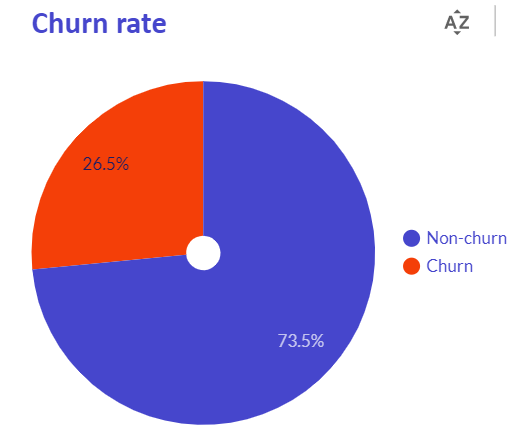
Comprendre le jeu de données
Le jeu de données contient des variables telles que l'ancienneté, le type de contrat, les charges totales, les charges mensuelles, le mode de paiement, le genre, ainsi que divers indicateurs des services de télécommunications utilisés, comme la TV, Internet et les films en streaming.
In the sample dataset we’re analysing, one of the most significant driving factors for customer retention is tenure, which refers to how long a customer has been using the company’s services. This raises an interesting “which comes first?” debate regarding retention and tenure. However, it’s not surprising that customers who have been loyal to a company for many years continue to be so. This trend is evident in the IBM telecom data when comparing “churn” and “non-churn” users across different tenure values.
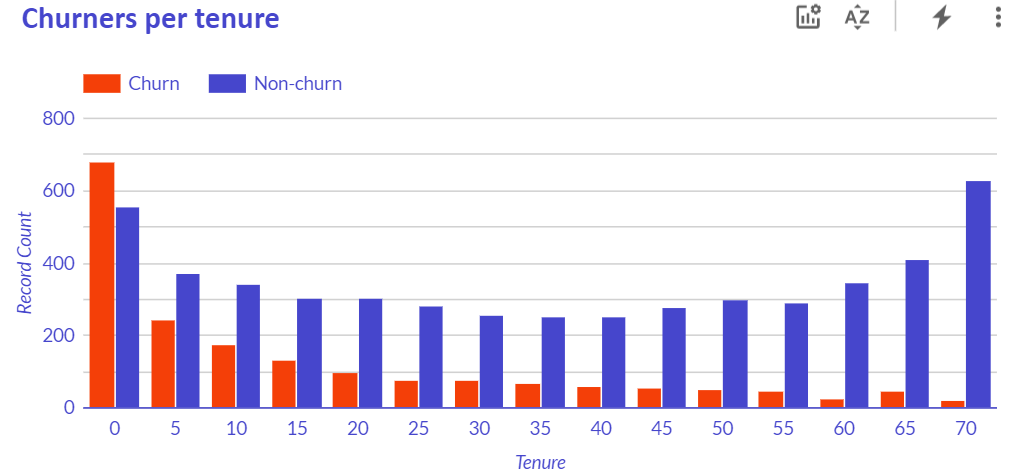
Les types de contrats et leur impact sur l'attrition
Après un examen plus approfondi des points de données, nous constatons que l'entreprise propose trois types de périodes contractuelles :
- Mois par mois
- Un an
- CIO années
This categorisation could significantly influence customer churn as we analyse the average monthly charges in relation to the average tenure for each group. Month-to-month users pay the most out of the three contract types and tend to remain with the company for the shortest period. It averages less than 20 months. In contrast, the users with two-year contracts stay the longest, averaging about 24 months. They also enjoy the lowest monthly charges, just under $61.
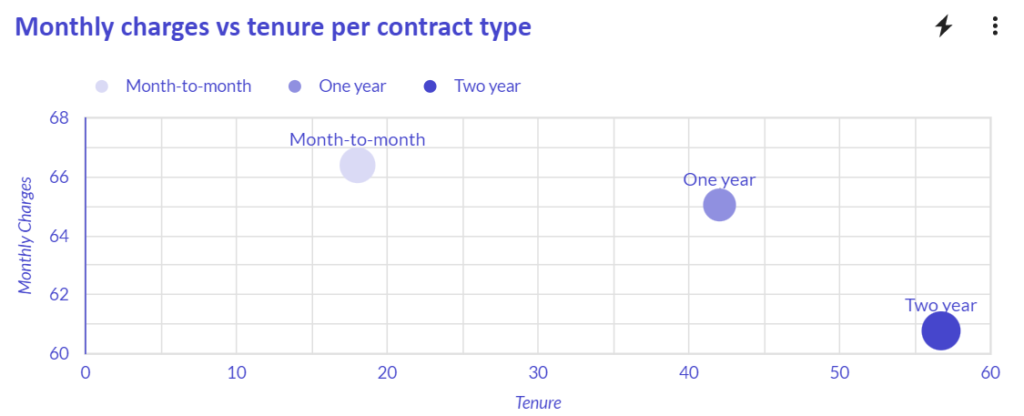
Aperçus des revenus en fonction des types de contrats
Un constat business simple à en tirer est le revenu moyen généré par un utilisateur de chaque groupe :
| Type de contrat | Revenu moyen par utilisateur (ancienneté x frais) |
| Mois par mois | $1,188 (18 x $66) |
| Un an | $2,730 (42 x $65) |
| CIO année | $3,416 (56 x $61) |
Firstly, it’s important to note that a “One-year” user generates $1,500 more revenue than a “Month-to-month” user. On average, monthly users tend to stay with the company for 18 months, which is more than a year. Therefore, upgrading their contract to a yearly subscription would benefit them with lower monthly charges and provide the company with increased revenue over a longer period.
A similar situation arises when converting a “One-year” user to “Two-year” subscription. On average, a “One-year” user generates $2,730 in revenue and remains with the company for 42 months. If these users were converted to a “Two-year” subscription, it could result in an additional revenue increase of $700 per user.
Quel que soit le type de contrat, l'idée principale est claire : plus un utilisateur reste fidèle à l'entreprise, plus il génère de revenus. Pour fidéliser efficacement les clients, il est essentiel d'identifier les utilisateurs qui risquent de se désabonner et de créer des incitations qui les encouragent à continuer à utiliser les services de l'entreprise.
Modèle d'apprentissage automatique pour prédire l'attrition client
AutoML, or Automated Machine Learning, is revolutionising the way businesses tackle machine learning and predict customer churn. It automates various time-consuming tasks, such as feature engineering, hyperparameter tuning, and model selection, which are necessary for a traditional machine learning approach. This enables rapid experimentation with high-quality models tailored to specific business needs.
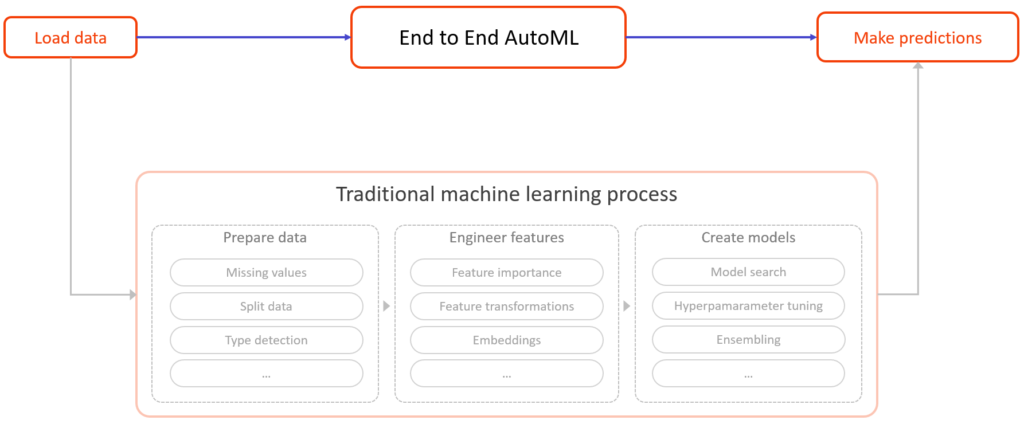
Source : YouTube
Entraîner votre modèle de prédiction du churn avec Vertex AI
Google Cloud propose un outil puissant qui permet d'exécuter facilement des tâches AutoML – Vertex AI. Une fois les données chargées dans Google Cloud, suivez ces étapes pour entraîner un nouveau modèle.
Instructions étape par étape
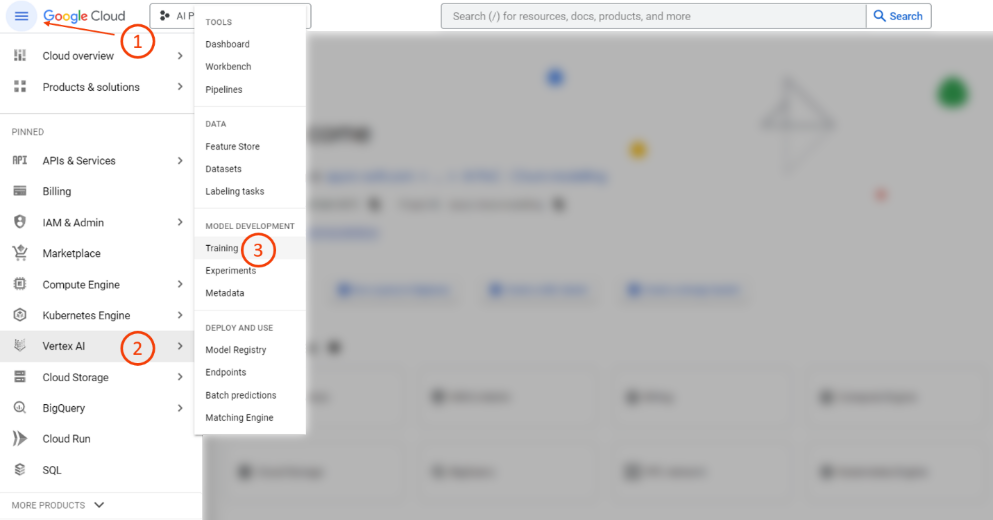
1. Connectez-vous à Google Cloud Platform et accédez à Vertex AI > Training. S'il s'agit de votre première utilisation, vous devrez peut-être le trouver sous « MORE PRODUCTS ».
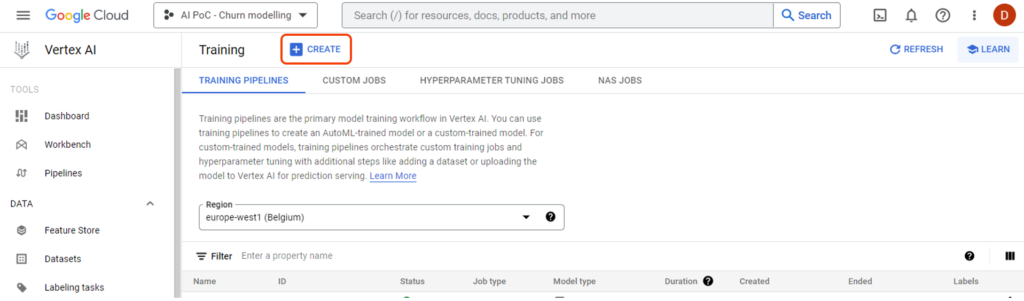
2. Créez un nouveau modèle et lancez le processus d'entraînement.
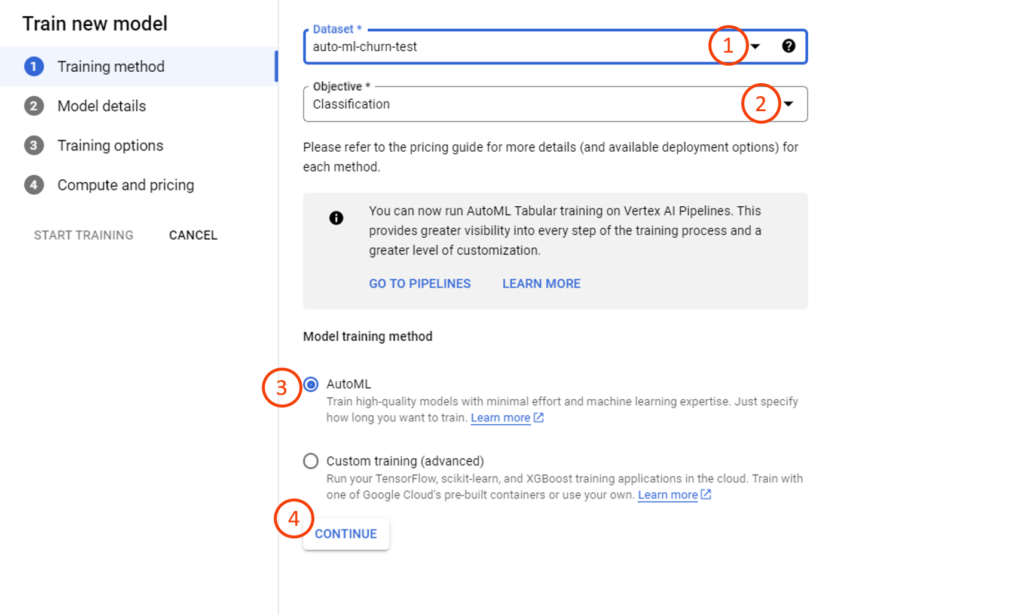
3. Sélectionnez votre jeu de données, qui dans ce cas est « auto-ml-churn-test ». Choisissez l'objectif « Classification », puis sélectionnez « AutoML ».
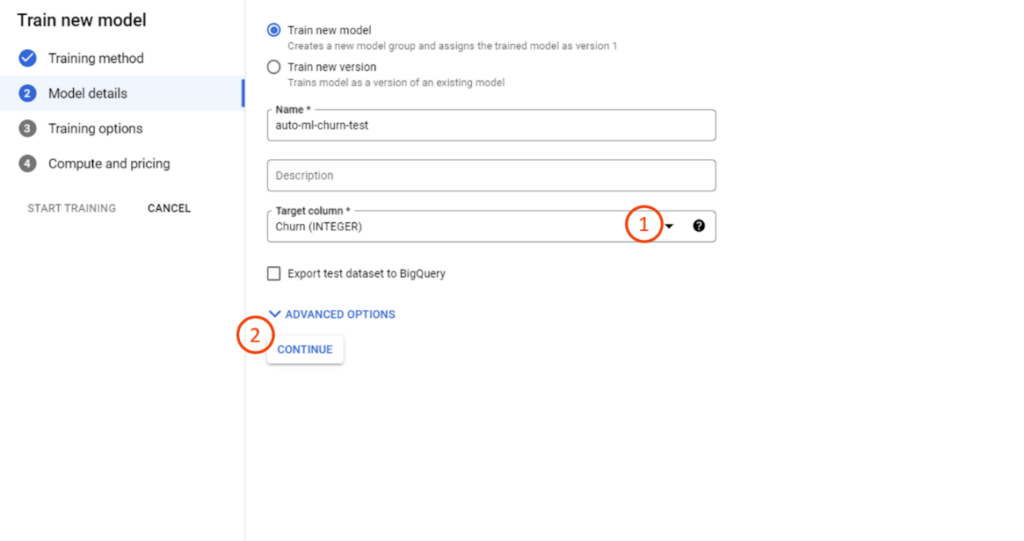
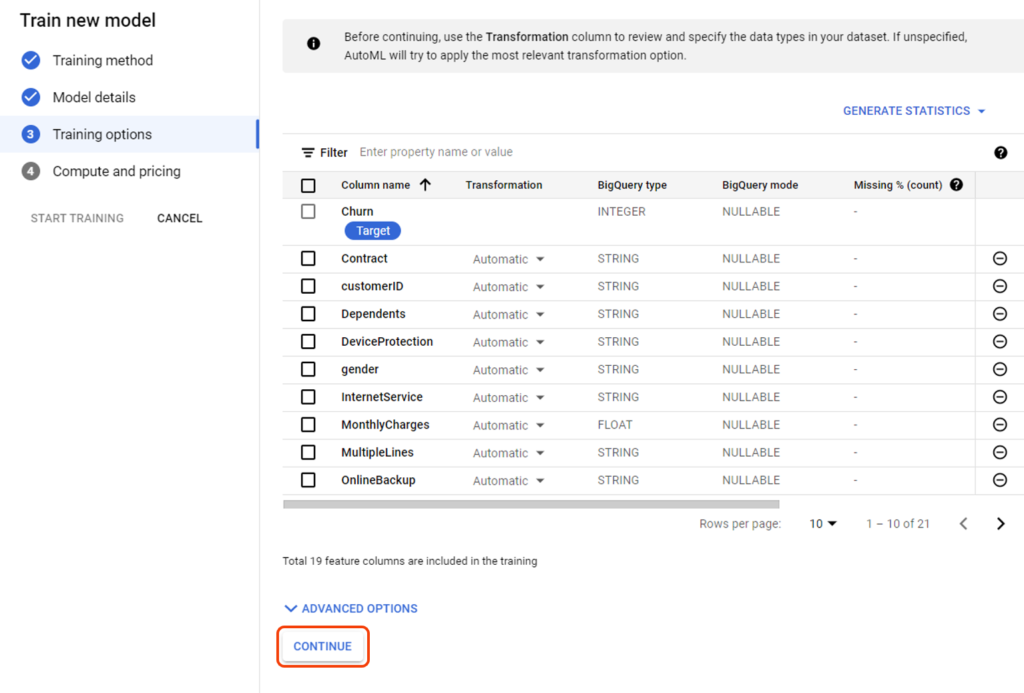
4. Remplissez tous les détails requis et assurez-vous de sélectionner la bonne colonne cible, telle que « Churn ». Il n'est pas nécessaire d'accéder aux « Options avancées ».
5. Confirmez si vous souhaitez utiliser toutes les colonnes disponibles et vérifiez que la colonne cible est correcte.
6. Now it’s time for the best part. You can specify the number of hours you wish to allocate for training. In this case, we opted for only 2 hours, as the churn dataset is small. Additionally, you have the option to “Enable early stopping”, which will terminate the model training if it stops making progress.
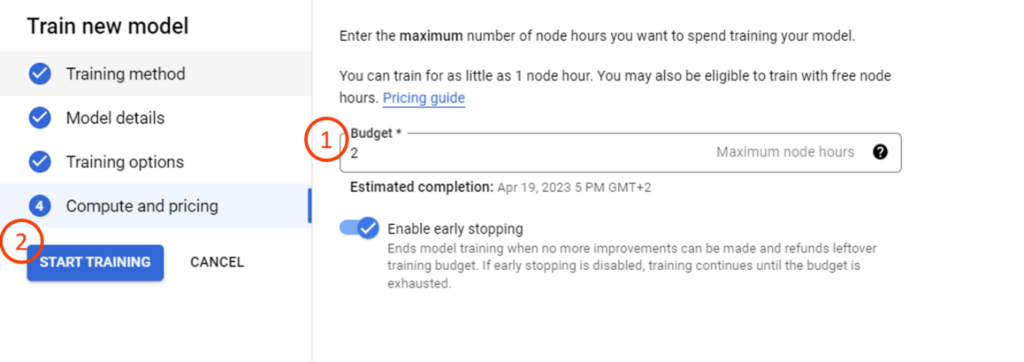
7. Une fois le temps d'entraînement désigné écoulé, votre modèle sera prêt. Les résultats seront accessibles dans le Registre des modèles au sein de Vertex AI.
Résultats et perspectives
In our Telecom churn dataset analysis, we achieved an ROC AUC score of 0.889, which indicates that the model is of very high quality. Furthermore, at a confidence threshold of 0.7, the model attained a Precision score of 88.6%. This means that 9 out of 10 predictions made by the model for the “Churn” label in the test set were correct.
Principaux facteurs du taux d'attrition
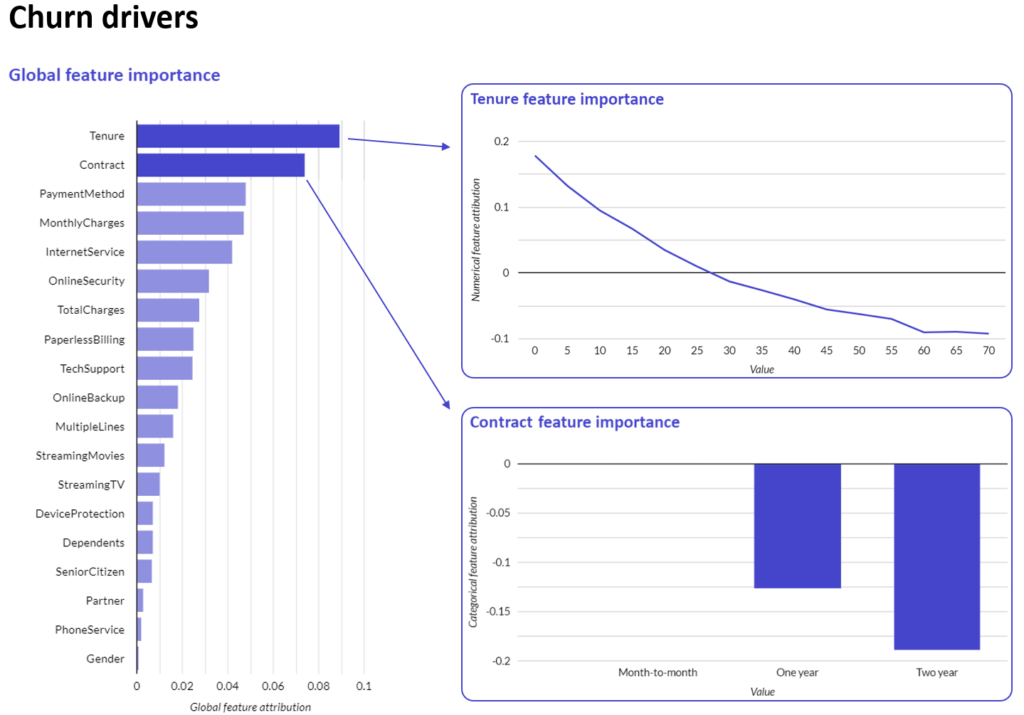
At Spyrosoft, we focus on the practical application of AI in business to maximise value for our clients. Combining the power of the model feature importance in Vertex AI and the visual capabilities of Looker dashboards, we identified Tenure and Contract features as the two most significant drivers of churn in the data.
The bar chart on the left side illustrates the importance of each feature in the data, indicating their impact on user retention. The line chart below shows that lower tenure is associated with a higher likelihood of churn. We observed the highest churn rates at a tenure of zero months, and the lowest rates occurred between 60 and 70 months.
The bar chart showing feature importance for contracts suggests that users on two-year contracts are significantly more likely to remain with the company compared to those on month-to-month contracts. This further reinforces the insights we gained during our initial analysis of the data.
Analyse de rétention et d'attrition au niveau individuel
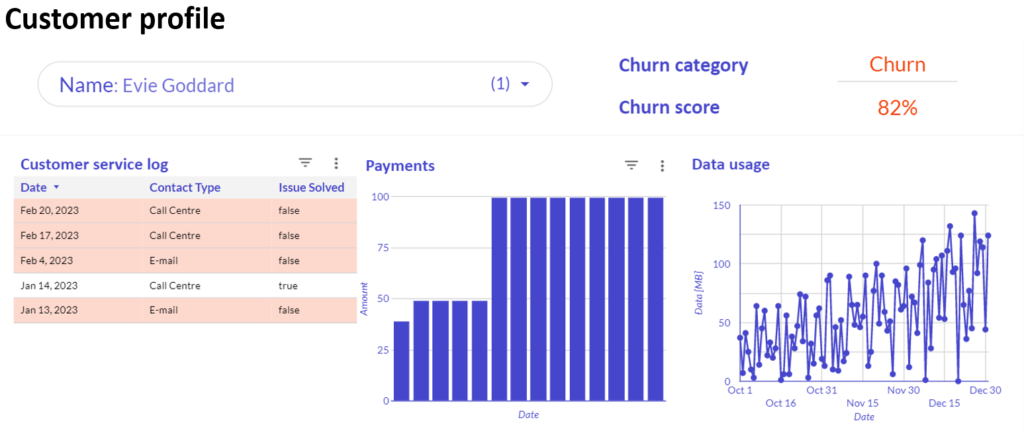
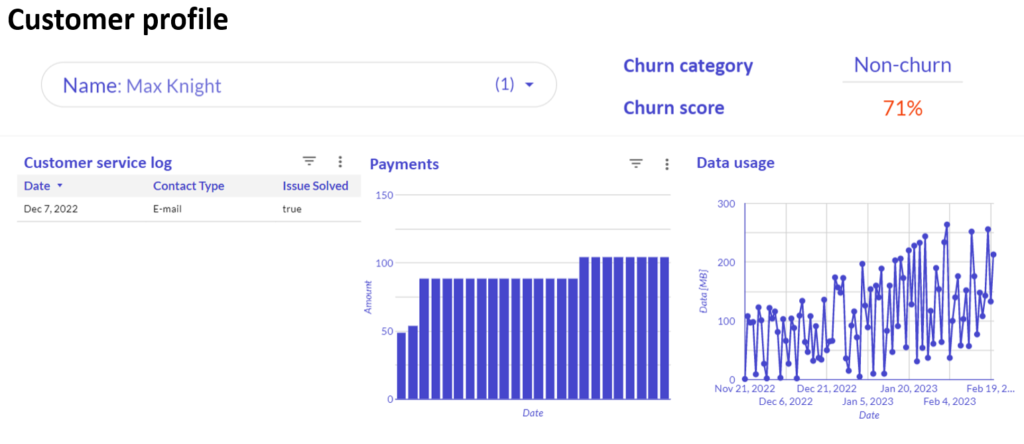
The next step in analysing and predicting customer churn is to focus on specific individuals who are likely to leave. By examining factors such as a customer’s churn score, service call log, monthly payment, and data usage, we can gain a clearer understanding of their current situation and identify potential pain points. To illustrate this, we provide a comparison of two customer profiles below: Evie Goddard and Max Knight (fictional names).
Exemple 1 : Evie Goddard – déjà désabonnée
Evie Goddard is an example of a customer who has already churned. Many of her issues went unresolved, and her monthly payments increased dramatically. This ultimately resulted in her dropping the company’s services. Although there is little that can be done in Evie’s case, her situation provides valuable insights for the company’s future churn prediction efforts.
Exemple 2 : Max Knight – susceptible de résilier
On the other hand, Max Knight is a customer who continues to use the company services, but his churn score is notably high. This indicates that offering Max some incentives could make a significant difference in whether he chooses to stay with the company or decides to leave.
Agir sur les prédictions
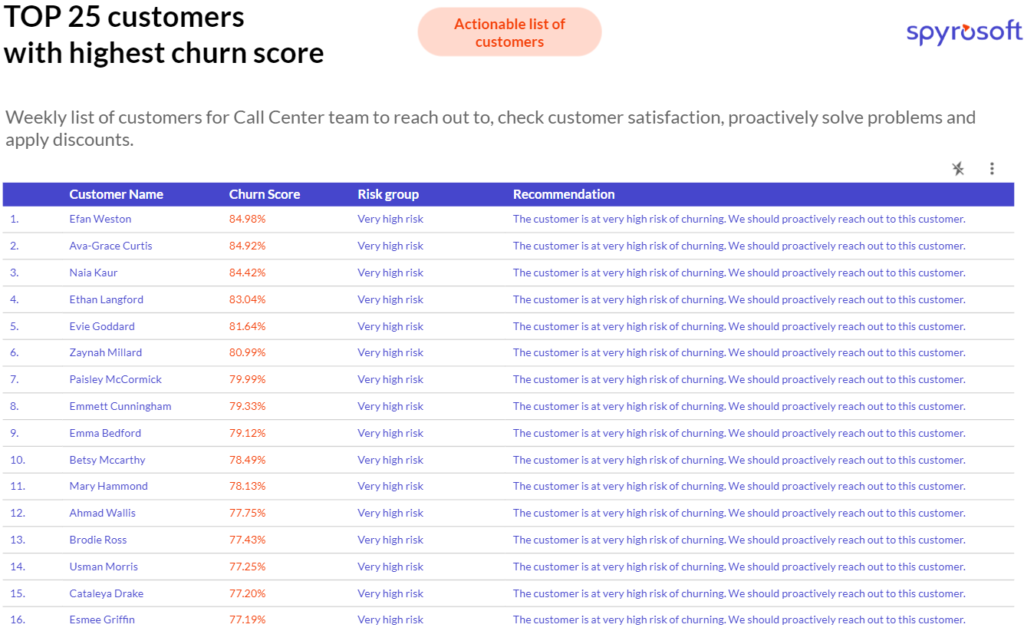
Finally, to enhance our focus on delivering value to our clients, we compiled a list of the top 25 customers with the highest churn scores. This list allows the telecom company to proactively reach out to the customers identified as high-risk. The company can offer them incentives or discounts to prevent churn and maintain their satisfaction. With more data on potential actions, we can create a tailored recommendations for each individual customer. However, in our demo, we didn’t have access to such data, so the recommendation provided was the same for everyone.
Conclusion : bénéficiez de la prédiction du départ des clients grâce à un modèle d'apprentissage automatique
Churn prediction of customers is a critical issue for businesses. With the help of Google Cloud Platform’s AutoML and Looker, companies can leverage machine learning algorithms to develop predictive models that accurately identify customers at risk of leaving. This technology allows businesses to take proactive steps to retain customers and augmenter la valeur vie client.
Google AutoML is an easy-to-use tool suitable for companies of all sizes. By adopting this technology, you can implement effective churn prediction. This can lead to improved customer retention, increased revenue, and a competitive advantage in their industry. Additionally, with support from Spyrosoft, businesses can take full advantage of Google’s machine learning solutions. It’s a good way to keep up in this fast-paced world of data-driven decision-making.
Tirez parti de notre expertise en IA pour transformer votre entreprise
En savoir plus
Exploiter un modèle d'Automatisation de l'Apprentissage Automatique pour prédire l'attrition des clients
At Spyrosoft, we are set on leveraging AI solutions and applying them in practice to maximise the value offered to our clients. For instance, one compelling application is customer churn prediction, where machine learning models and the AutoML approach can have a significant impact. However, there are many other examples of its usefulness, such as propensity modeling, predictive maintenance, sales and demand forecasting, and many others.
Contactez-nous si vous souhaitez en savoir plus sur la manière dontAlgorithmes d'IA et d'apprentissage automatiquepourrait aider votre entreprise.
FAQ : Prédiction du churn client
A churn prediction model is a predictive model that uses customer data, such as usage patterns, transaction history, and support interactions, to forecast whether a customer is likely to stop using a service. It applies machine learning techniques like decision trees, support vector machines, or neural networks to learn from historical data and identify patterns associated with high churn risk.
The churn rate represents the percentage of customers who stop doing business with a company during a given period. Monitoring this metric helps organisations evaluate their customer retention strategies and take action to reduce churn, ultimately increasing the value of their customer base.
To build a robust churn model, you need a well-structured data that includes customer behavior, demographics, usage history, product/service interactions, and whether or not a customer has churned in the past. The more detailed the customer data, the more accurate your model will be.
Churn analysis helps teams understand why customers are leaving and what can be done to retain them. It supports customer success by providing insights that inform personalised interventions, improved onboarding, and better engagement strategies. This helps improve customer satisfaction and loyalty.
Yes. By helping companies reduce customer churn, churn prediction models indirectly lower the pressure on customer acquisition. Keeping existing customers is often more cost-effective than acquiring new customers, making retention efforts key to long-term profitability.




arrow_circle_rightContactez-nous
Parlons de la façon dont nos solutions d'IA peuvent transformer votre entreprise

Tomasz Smolarczyk
Directrice de l'Intelligence Artificielle
arrow_circle_right Nos articles


