Recouvrement de créances automatisé : tirer parti des technologies avancées pour réussir


The debt collection industry is undergoing a transformation, driven by the need for greater efficiency, accuracy and compliance. Traditional methods, often based on manual processes and outdated systems, are no longer sufficient to meet the demands of modern debt collection. The pressure to reduce costs, improve recovery rates and maintain regulatory compliance has led many financial institutions and debt collectors to explore advanced technology solutions.
Selon les rapports du secteur, l'utilisation de technologies avancées a augmenté le recouvrement des créances de 65 %. Un Gartner une étude suggère également que les centres d'appels du monde entier pourraient économiser jusqu'à 80 milliards de dollars de revenus d'ici 2026.
Dans cet article, nous explorerons les principales solutions technologiques permettant d'automatiser le recouvrement de créances et la manière dont elles peuvent être déployées efficacement pour améliorer l'efficacité opérationnelle, optimiser les stratégies de recouvrement et garantir la conformité.
Les technologies clés qui pilotent l'automatisation du recouvrement de créances
À mesure que le recouvrement de créances évolue, plusieurs technologies avancées sont apparues comme des éléments révolutionnaires dans le secteur. Ces technologies avancées rationalisent les opérations et augmentent la précision et l'efficacité des efforts de recouvrement de créances.
Intelligence artificielle et apprentissage automatique (IA & ML)
Those technologies are changing the way debt collection works, introducing sophisticated tools that improve prediction, communication and decision-making. They enable debt collection agencies to operate with greater accuracy and efficiency, particularly by using predictive analytics to analyse large data sets and uncover patterns in debtor behaviour.
By understanding these patterns, agencies can anticipate payment delays or defaults and tailor their collection strategies to individual debtors, increasing the likelihood of successful recoveries. Artificial intelligence is revolutionising the way agencies interact with debtors through AI-powered communication channels, such as chatbots et assistants virtuels. These tools can manage a significant proportion of debtor interactions, delivering timely, consistent and personalised communications without the need for human intervention, resulting in reduced workload for human agents and improved customer retention rates by providing debtors with the information they need quickly and efficiently.
En outre, IA et ML sont essentiels dansautomatiser le processus de prise de décision. By analysing a debtor’s financial situation and risk profile in real time, these technologies can speed up or even automate decisions regarding debt settlement offers, payment plans or escalation procedures. It ensures that decisions are data-driven, unbiased and aligned with business objectives.
Automatisation robotisée des processus (RPA)
RPA is another key technology driving the automation of debt collection activities. It focuses on automating repetitive, rule-based tasks that are common in the debt collection process, freeing up human resources to focus on more complex, value-added activities.
For example, RPA can be used to automate the sending of payment reminders, the processing of payments and the generation of reports, all of which are essential but time-consuming tasks. By eliminating manual intervention in these processes, RPA increases operational efficiency, and reduces the risk of error, resulting in faster and more accurate debt collection.
One of the essential strengths of robotic process automation is its ability to integrate seamlessly with existing legacy systems. Many financial institutions and debt collectors operate on a patchwork of legacy systems, making a complete overhaul of their IT infrastructure both costly and disruptive. RPA tools can interact with these systèmes hérités, en extrayant et en traitant les données selon les besoins pour maintenir le bon fonctionnement des opérations sans nécessiter le remplacement complet du système.
Les défis du processus de recouvrement de créances
Escalade des coûts opérationnels
The financial burden of managing the debt collection process can be significant and have a direct impact on the overall profitability of the business. These costs can include staff, technology, compliance and other overheads that, if not optimised, can erode margins and affect financial performance.
Sécurisation des accords avec les débiteurs
A significant challenge is the low rate of debtor compliance, reflecting the difficulty in convincing debtors to commit to repayment plans. This may be due to inadequate communication strategies, insufficient incentives, a lack of confidence in the process, or poor customer relationships.
Rentabilité sous pression
High operating costs combined with sub-optimal collection success rates can have a significant impact on profitability. Inefficiencies in the collection process can lead to a mismatch between expenses and revenues, making it difficult to maintain financial viability.
Difficultés à contacter les débiteurs
Reaching debtors remains a critical challenge, often due to outdated contact information, unresponsive debtors, or legal and regulatory restrictions. This barrier can delay or derail collection efforts, resulting in longer recovery times and reduced effectiveness.
Gestion fragmentée des données
Storing debtor information in multiple systems can lead to disorganised data management, creating inefficiencies in accessing, updating and using critical information. This fragmentation can hinder the decision-making process and lead to missed opportunities for timely and effective collections.
Manque d'automatisation et d'optimisation des processus
Relying on manual processes for routine debt collection tasks increases the risk of errors and inefficiencies. A lack of workflow automation can slow down operations, reduce accuracy, and ultimately decrease the overall effectiveness of the debt collection process. Incorporating automation can streamline operations, reduce costs and improve consistency of results.
As experts in the financial sector, we understand the challenges our customers in the debt management sector struggle with. Our answer is to adjust your current solution to a digital, customer self-service era, using cutting-edge technologies, which will increase your debt collection rate.
Michal Kaleta, Directeur des Services Financiers
Comment l'automatisation alimentée par l'IA peut aider les sociétés de recouvrement de créances
Efficacité accrue pour les agents de recouvrement
Integrating AI automation into collections streamlines repetitive tasks such as data management and documentation, allowing agents to spend more time on high-impact activities such as negotiation and conflict resolution. By automating manual processes, artificial intelligence reduces the time and resources required to manage collections, leading to greater efficiency and productivity in operations.
Coûts réduits
AI automation offers significant cost savings in debt collection by reducing the costs associated with staff, training and resource management. By minimising the need for human intervention and optimising workflows, AI enables collection agencies to strategically allocate resources and achieve significant savings. As a result, these cost reductions allow agencies to invest more in technology and innovation, increasing their overall profitability.
Analyse prédictive avancée
AI algorithms use extensive historical data to anticipate debtor behaviour and predict future trends, enabling debt collectors to proactively target delinquent accounts. Through predictive analytics, AI increases the effectiveness of collection strategies, improves resource allocation and reduces the risk of non-compliance, which allows agencies to prevent defaults, minimise write-offs and ultimately maximise recovery rates.
Expérience client améliorée
With AI automation, debt collection agencies can provide personalised and compassionate customer interactions, increasing overall satisfaction and the chances of successful debt recovery. AI-based tools can analyse debtor behaviour and preferences to tailor communication methods, payment plans and negotiation strategies to individual needs, building trust, transparency and collaboration. This level of personalisation increases customer satisfaction, and fosters stronger, long-term relationships.
Une solution automatisée unique pour le recouvrement de créances
DebtPro est un logiciel de gestion de la dette hautement personnalisable, conçu pour optimiser et simplifier les processus de recouvrement. Il s'intègre parfaitement aux systèmes existants, offrant des options avancées de libre-service client tout en réduisant les coûts opérationnels.
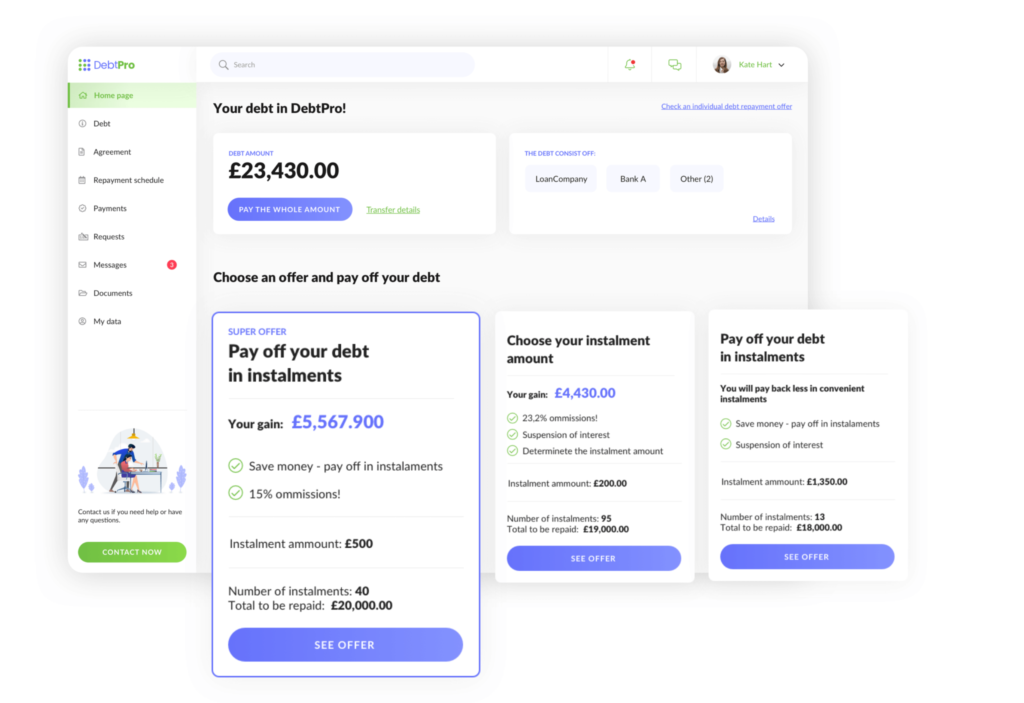
Our platform is fully customisable and can enhance current debt management systems or operate as a standalone solution. Key features include online payment management, electronic document signing and integrated communication tools, all accessible through an intuitive, user-friendly dashboard.
Le logiciel offre des avantages significatifs tels qu'environ augmentation de 10 % in contract signatures, reduced operational costs and easy online document access almost immediately after its full implementation. It is suitable for both B2C and B2B applications and operates independently of open banking services, ensuring it can be tailored to meet the unique needs of any business.
Rendez la gestion de la dette plus efficace !
Obtenez une démo gratuite
À vous de jouer
Un processus automatisé de recouvrement de créances vous permet de vous concentrer sur le cœur de votre activité et de maximiser l'efficacité de vos processus.
You can leverage the full potential of data to benefit you and your customers. Industry leaders rely on well-implemented automation for its reliability and effectiveness. The bottom line is smoother cash flow, increased profits, reduced expenses and satisfied customers.
Si vous souhaitez voir comment fonctionne concrètement un logiciel de gestion de la dette et de recouvrement, contactez notre expert dès aujourd'hui et découvrez notre plateforme entièrement personnalisable !
Traditional debt collection methods rely heavily on manual processes and outdated systems, limiting efficiency, accuracy and compliance. Automation can help to overcome these challenges by streamlining operations, reducing costs, improving recovery rates and ensuring regulatory compliance. According to industry data, advanced technologies can increase debt recoveries by up to 65%.
AI and machine learning (ML) enhance the debt collection process by providing predictive analytics, personalised communication and automated decision-making. By analysing large data sets, these technologies can predict debtor behaviour, tailor repayment strategies and automate settlement offers, leading to faster, fairer and more effective recoveries.
RPA (Robotic Process Automation) is a technology that automates repetitive, rule-based tasks such as sending payment reminders, processing transactions and generating reports. It can be integrated with legacy systems, eliminating the need for costly replacements and reducing manual errors. This frees up human agents to focus on complex cases that require personal attention.
Key challenges include rising operational costs, difficulty contacting debtors, fragmented data management and limited automation. Many organisations also struggle with low debtor compliance and profitability pressures caused by inefficient manual processes. Implementing automation can help to address these issues.
DebtPro is a highly customisable debt management platform designed to optimise the collection process. It offers features such as online payments, e-signatures and integrated communication tools, all of which are accessible via an intuitive dashboard. Businesses using DebtPro typically experience reduced operational costs, faster access to documents, and an increase of up to 10% in contract signatures.




arrow_circle_right Nos articles
Choisissez votre prochaine lecture





arrow_circle_rightnous contacter
