L'IA dans la finance : découvrez les dernières tendances


Artificial Intelligence is growing rapidly in every sector, and the broadly understood financial sector is no exception. Banks and other financial institutions are currently looking for ways to make the most of both generative and traditional AI while maintaining high compliance and legal standards. We’ve analysed the latest trends that modern financial companies should be aware of if they want to implement AI (and believe us, they do!).
Tout d'abord, il est important de comprendre la situation actuelle en ce qui concerne l'IA dans la finance. Presque toutes les grandes banques affirment utiliser activement l'IA à de multiples fins. Intelligence artificielle les solutions couvrent des domaines tels que la détection de fraude, gestion des risques, le service client automatisé et autres services financiers. Cette demande est apparue bien avant l'avènement de l'IA générative. Mais la première grande question que nous devons nous poser est la suivante :
Sommes-nous bientôt arrivés ?
From our perspective, the answer is: almost. Even though AI in finance is surely a dynamically growing trend, there are hardly any solutions that rely on the technology fully. Artificial Intelligence is still treated more as a component of a solution, not a solution itself. Take a look at this chart showing last year’s (2022) and predicted (2025) AI adoption rates in financial companies:
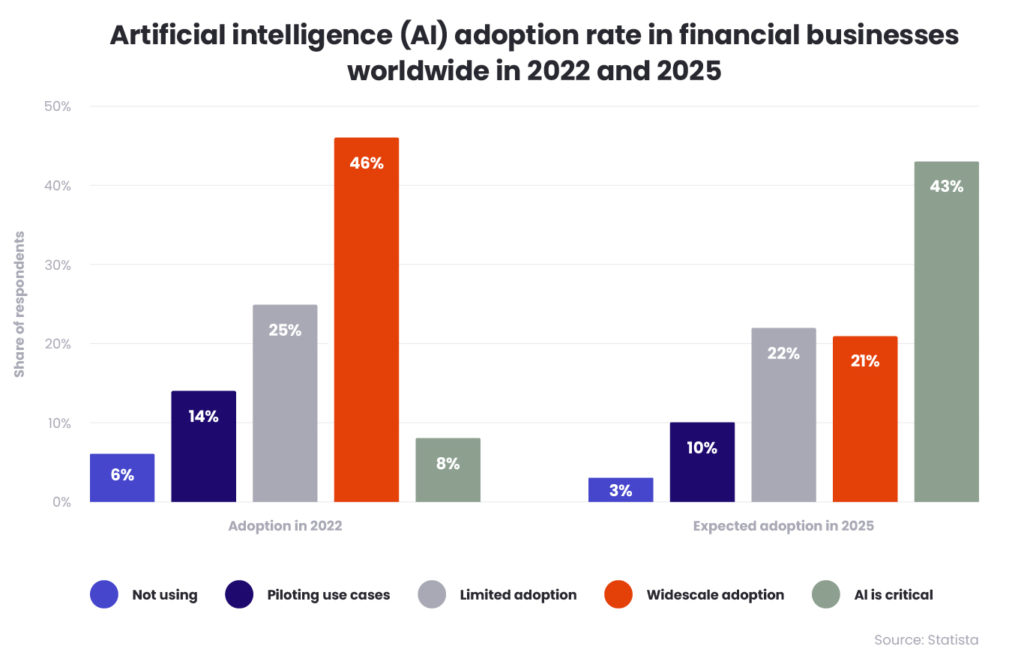
As you can see, back in 2022, 54% of financial companies had a widescale adoption of AI or considered it a critical asset. Worth mentioning here is the fact that in 2022, solutions such as GenAI hadn’t been so popular, since ChatGPT was published on November 30, 2022. The predictions are that in 2025, a higher percentage of companies will consider AI critical to their business than just a supportive element.
Chatbots and voicebots are a perfect example of how recent advances might completely change interaction with clients. A new generation of chatbots and voicebots are capable of having a natural conversation with clients and understanding their needs and requests without asking for hardcoded options. Banks more and more commonly introduce Chatbots alimentés par l'IA pour leurs clients, but it is important to tightly control their behaviour and leverage Generative AI wisely, as Large Language Models may provide customers with the wrong information or suggestions, which can have severe consequences in this sector. That’s why, usually, the dialog flows must be monitored and managed to keep the communication at the expected but also safe level.
Comment l'IA est utilisée dans la finance : rapport NVIDIA
Plus tôt cette année, NVIDIA a publié un rapport présentant les principales applications de l'IA dans la finance (hors Chine). Il est intéressant de noter que, parmi les 21 cas d'usage différents analysés dans l'enquête, dix sont utilisés par plus de 20 % des répondants, ce qui montre un fort potentiel de développement futur :
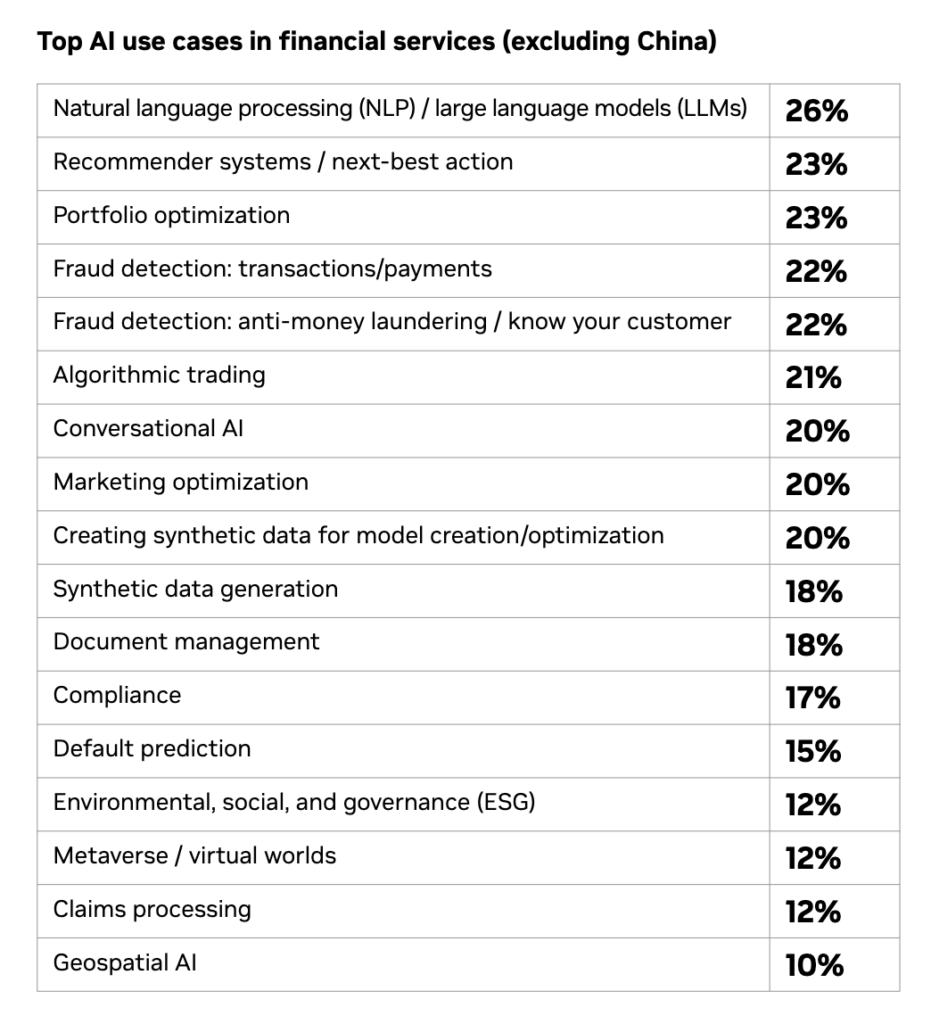
Comme vous pouvez le constater, les applications les plus populaires incluent l'utilisation de l'IA générative (LLM), mais aussi des systèmes de personnalisation et des outils d'optimisation de portefeuille. Nous mentionnons également ces applications dans cet article.
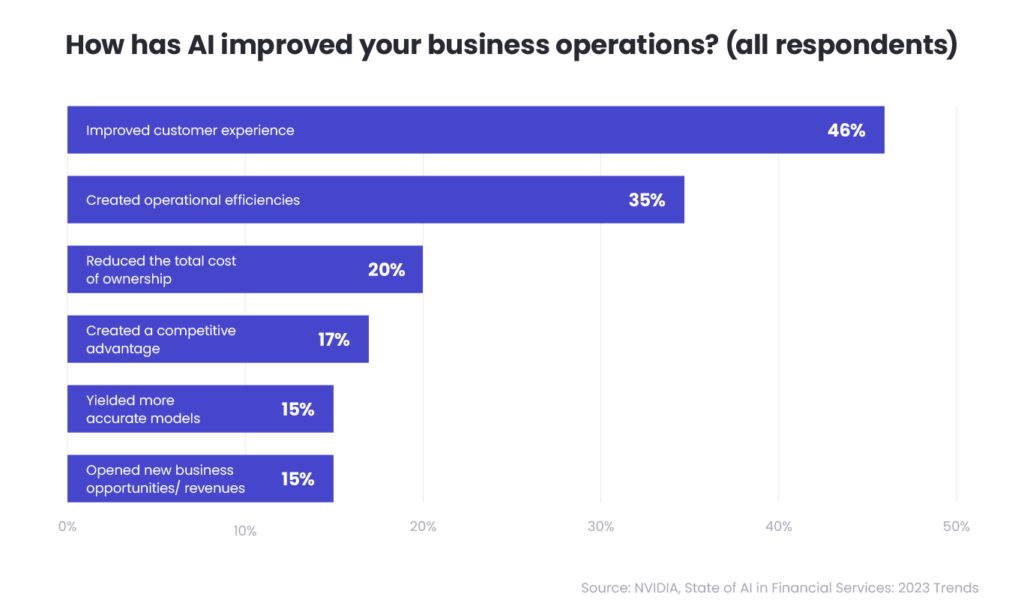
NVIDIA a également interrogé les répondants sur les résultats de l'application de l'IA dans la finance au sein de leurs entreprises. Sans surprise, la majorité des entreprises constatent plusieurs avantages significatifs, l'amélioration de l'expérience client arrivant en tête (près de 50 % des réponses) :
Le rôle croissant des réglementations juridiques
Dans le secteur financier, non seulement les banques mais aussi institutions juridiques et réglementaires s'intéressent de plus en plus à l'utilisation de l'IA. Les institutions de régulation doivent savoir que l'IA dans la finance est avant tout sûre et peut être utilisée avec un risque minimal pour les informations personnelles et financières des clients.
C'est un phénomène qui se produit déjà. Par exemple, fin 2022, les États-Unis ont publié un document d'orientation non contraignant Déclaration des droits de l'IA. La Déclaration des droits de l'IA n'est pas spécifique au secteur financier, mais elle fournit des orientations instructives sur cinq droits fondamentaux qui devraient être pris en compte dans l'élaboration des politiques et l'utilisation de l'IA dans tous les secteurs, y compris la finance et la banque.
Des actions similaires sont menées de l'autre côté de l'océan. L'Union européenne travaille actuellement sur le Règlement européen sur l'IA. SelonCiti Group, il devrait s'agir du premier Règlement complet sur l'IA qui devrait s'appliquer à tous les secteurs. Les travaux le concernant sont déjà à un stade avancé, et son le texte a été provisoirement approuvé par les institutions européennes compétentes, offrant une opportunité d'adoption rapide de l'EU AI Act en 2024.
Ces réglementations ont plusieurs objectifs à atteindre :
- Ils veillent à ce que l'Intelligence Artificielle soit utilisée de manière sûre qui n'implique aucun risque significatif pour les données et les décisions des clients.
- Ils limitent les risques potentiels de fraude et introduire les mesures de sécurité nécessaires.
- Ils minimisent le risque de biais lorsqu'il s'agit de traiter avec des clients représentant différentes nationalités et origines ethniques.
The growing number and complexity of financial regulations will likely trigger the advent of more RegTech (Regulation Technology) tools and companies. RegTech allows financial institutions to more efficiently manage the ever-growing number of regulatory requirements they must comply with (source: Apertera).
Utilisation de l'IA et transition vers l'IA générative
Comme nous l'avons déjà mentionné, les banques et autres institutions financières utilisent massivement l'IA pour assister les employés, servir les clients et obtenir les informations nécessaires.
In the financial sector, the integration of AI is a strategic imperative, not just a technological upgrade. AI’s role extends beyond automating routine tasks; it’s about enhancing analytical depth and operational efficiency. Financial institutions are now harnessing AI to refine decision-making processes and optimise client services. This shift is less about replacing human roles and more about augmenting human capabilities, allowing teams to focus on strategic initiatives and client engagement. We see AI as a critical driver in the future of finance and innovation reshaping the industry.
Tomasz Smolarczyk, Head of Artificial Intelligence chez Spyrosoft
One of the most popular Generative AI use cases is within customer service teams where they are enabling teams to work with customers in a more effective way. This is where the role of generative AI is becoming increasingly important. Banks want to use this technology because of the tremendous potential it offers.
Des outils intelligents alimentés par l'IA peuvent aider les banques sur des tâches telles que :
• Analyse de documents plus rapide: Pourquoi lire un contrat de prêt immobilier de 50 pages quand l'IA peut le faire pour vous en quelques secondes ?
• Recherche des documents et fichiers nécessaires: Grâce à l'IA, nous pouvons créer des moteurs de recherche sémantique ultra-avancés capables de rechercher des documents (même des scans) contenant des informations spécifiques.
• Génération de résumés de documents: Avec l'IA générative, nous pouvons facilement générer des rapports et des synthèses à usage interne.
• Fournir aux clients toutes les informations requises: L'IA peut soutenir les employés lors des conversations avec les clients, en leur donnant un accès instantané à toutes les informations cruciales abordées pendant une conversation.
• Procédures KYC: Avec l'IA, les banques ont accès à des procédures de vigilance renforcée (EDD) et de vigilance à l'égard de la clientèle (CDD), ainsi qu'à d'autres mesures de conformité. Elles peuvent ainsi vérifier les nouveaux clients de manière efficace et automatisée.
The game is surely worth the candle! Deloitte predicts that the top 14 global investment banks will be able to increase front-office productivity by an average of 25% thanks to generative AI. This could translate to earning additional revenue of $3 million per front-office employee as soon as 2026 (source: PR Newswire).
Découvrez nos offres basées sur l'IA !
En savoir plus
Cas d'usage : « ChatGPT interne »
For one of our clients here at Spyrosoft, we built a chatbot that’s based on Azure OpenAI models (the same as ChatGPT) but works fully in the client’s internal cloud ecosystem and is intended to support employees in their daily tasks and communication with customers. Because everything is developed internally (we used Microsoft Azure), all the conversations conducted by employees are not used to train any language models and there is no risk of leaking any confidential or sensitive data to the market.
Une telle solution est sûre et efficace et le travail des agents du service client est considérablement rationalisé – ils n'ont pas besoin de passer beaucoup de temps à structurer des notes ou des documents, à réfléchir à des idées ou à rédiger des e-mails.
Il ne s'agit pas d'une approche révolutionnaire. Il existe des dizaines d'outils basés sur les modèles de langage développés par OpenAI, et ils sont utilisés pour obtenir toute une série de résultats différents.
Une nouvelle approche de l'IA dans la finance : la vente croisée personnalisée
The integration of Generative AI in finance is paving the way for a more personalised approach to cross-selling. By harnessing this technology, financial institutions can tailor their offerings to each customer’s unique needs and preferences. The potential of AI lies in its ability to analyse vast amounts of data to identify the most relevant financial products, such as credit and debit cards, for individual customers. This targeted approach goes beyond traditional methods, engaging customers through intelligent, conversational interfaces within digital banking apps. Imagine a smart assistant that not only informs customers about the latest card offers but also explains their specific benefits in a context that resonates with the customer’s financial goals. This level of personalisation enhances customer experience, making interactions more engaging and increasing the likelihood of successful cross-selling. Ultimately, Generative AI stands to transform customer communication in finance, leading to higher conversion rates and a more nuanced understanding of customer needs.
Personnalisation client
This is another interesting field of generative AI application. With access to customer data and their purchasing habits, AI algorithms can provide customers with personalised information on how to improve their finances and what they can do to manage their home budgets more effectively.
C'est ce que British TSB Bank sur lequel nous travaillons actuellement :
Nous souhaitons utiliser l'IA et le ML pour identifier les événements clés de la vie du client susceptibles de nécessiter un soutien financier et utiliser cette réponse pour aider les clients à atteindre leurs ambitions de vie.
Avec l'utilisation de l'IA dans la finance, les banques peuvent personnaliser les recommandations de produits, les suggestions sur les habitudes de dépenses et même les opportunités d'investissement.
Le défi du développement de l'IA pour les langues moins répandues
In the realm of Generative AI, English understandably takes the lead due to its global prevalence. Developing AI solutions in English is more straightforward because of the vast array of existing resources and models. However, tailoring these solutions for less common languages, especially those with unique linguistic structures like Polish, presents a distinct set of challenges. The complexity lies not in starting from scratch, but in gathering enough training data and adapting and refining existing models to accommodate the nuances of these languages. Despite these challenges, progress is being made. A prime example is boost.ai‘s success in the Nordic countries. Their ability to effectively adapt AI solutions to Nordic languages demonstrates that with the right approach and dedication, it’s feasible to extend sophisticated AI capabilities to a broader linguistic spectrum. This success story provides valuable insights and methodologies for developing AI tools in other less-common language spheres, paving the way for more inclusive and diverse AI applications.
En conclusion
Banks and other financial institutions will surely use Artificial Intelligence more and more frequently, especially the generative kind. This direction is obvious, and some solutions are already in place, even though there is still a lot to achieve. We still need to solve some of the pressing challenges, including compliance with privacy regulations and solutions for non-English-speaking countries. But there’s no doubt we will eventually get there!
Et si tel est également votre objectif, contactez-nous via le formulaire ci-dessous, et voyons ce que nous pouvons accomplir ensemble !
AI supports banks and financial institutions in fraud detection, risk management, customer service, and data analysis. It helps automate processes and improve decision-making. While most solutions still combine AI with traditional methods, adoption is rapidly growing.
Financial companies report improved customer experience, faster processes, and better risk control as key outcomes. AI enhances efficiency by reducing manual work and supporting more accurate insights. Generative AI also helps personalise services and speed up operations.
The main challenges include meeting strict regulatory and compliance standards and protecting sensitive customer data. Additionally, managing AI’s potential biases and ensuring accuracy in customer interactions remain critical. Adapting generative models for non-English languages adds another layer of complexity.
Governments and institutions are introducing frameworks like the U.S. AI Bill of Rights and the EU AI Act to ensure safe, transparent AI use. These aim to minimise fraud, bias, and data risks. As a result, RegTech tools are becoming essential for compliance management.
Generative AI will continue transforming customer service, personalisation, and internal operations. Banks are increasingly adopting secure, internal AI tools to streamline work and protect data. The future lies in blending innovation with compliance for scalable, responsible AI growth.




arrow_circle_rightContactez-nous
Laissez vos coordonnées et nous vous recontacterons dans les plus brefs délais

Tomasz Smolarczyk
Directrice de l'Intelligence Artificielle
arrow_circle_right nos articles


![[hero] why manual trading is costing you more than you think](/wp-content/uploads/2025/08/hero-why-manual-trading-is-costing-you-more-than-you-think-scaled-1-1024x574.jpeg)
