Digitalisation des prêts hypothécaires : conseils stratégiques pour rester compétitif


Alors que les avancées technologiques continuent de transformer les pratiques traditionnelles et d'offrir des innovations sans précédent dans le secteur financier, la demande de digitalisation dans le crédit immobilier ne cesse de croître. Le rapport McKinsey souligne que plus de 60% des clients européens, particulièrement en Pologne et au Royaume-Uni, préfèrent un parcours hypothécaire numérique. Cette tendance recèle un immense potentiel, simplifiant les processus, améliorant l'accessibilité et générant un impact positif sur l'ensemble du marché hypothécaire.
Cet article explore le potentiel de la digitalisation des prêts hypothécaires et examine les changements positifs qu'elle peut apporter tant aux consommateurs qu'aux institutions financières.
La seule voie à suivre pour les banquiers et leurs clients
The beginning of mortgage journey holds great promise and opportunity. Past experiences may have created challenges, but they have also paved the way for improvements. In the pre-pandemic times, navigating the mortgage process often seemed like a daunting task for customers. However, these experiences have led to advances that have made the journey more efficient. Despite its historical complexity, the back-office mortgage lending process is evolving to become more streamlined and less prone to error. With each improvement, the potential for a smooth and expedited experience increases, ensuring that even the smallest details are processed to prevent delays.
Recently, banks have started to add some incremental innovations such as OCR and automation. Over the next 2-3 years, there is expected to be an obvious trend towards increased digitalisation in mortgage lending. The pace of this transformation is expected to vary, influenced by regional differences and compliance requirements that can either hinder or facilitate the transition. However, there is only one direction to move forward – Numérisez-le !
Avez-vous besoin d'aide pour votre digitalisation ?
Parlons-enPourquoi la digitalisation des prêts hypothécaires est-elle un si bon pari ?
Users expect digital mortgages and there is no going back. Digital solutions are essential for meeting customer expectations in the mortgage industry. Can you imagine Gen Z clients patiently filling out paper loan applications and queuing up in a bank if the competition offers digital? Most users expect digitalisation of services and excellent UX, the last banks to digitalise will miss out on the key market.
Le processus de digitalisation lui-même présente de nombreux avantages. Ceux-ci incluent :
Durée du parcours client – jusqu'à 4 fois plus courte
Rapport de Forbes et Freddie Mac hinted that the average time to close mortgage real estate deals in the US is around 40 days. At the same time, United Wholesale Mortgage (UMI), considered to be one of the leaders in digitalisation, assured customers that their average has dropped to around 16 days, and they are hoping to reduce this to 10 days .
Il n'est pas nécessaire d'être un spécialiste de l'expérience client pour comprendre les avantages d'un processus 3 à 4 fois plus court pour quiconque cherche à acquérir un nouveau logement.
La gestion des coûts d'octroi de prêts diminue tout autant que la conformité climatique ajoute de la complexité au processus
L'ampleur exacte des économies est impossible à prévoir, car les coûts varient selon les marchés et les organisations, mais nous disposons de quelques repères et études pour ancrer les attentes.
In a Forbes survey, just over half (55%) of small and medium sized banks expected to reduce mortgage origination costs by more than 25% by 2023 with process digitalisation. US credit union executives surveyed appear to be slightly less optimistic, with 47% of them sharing similar optimism.
Un autre aspect des facilitateurs de la digitalisation est le soutien aux objectifs de durabilité. Un bon exemple est Nationale Netherlanden, une entreprise qui génère des milliards de nouveaux prêts hypothécaires (8,7 milliards en 2022) and is aiming high with its sustainable development goals. This means processing additional data in the loan origination process to track the climate impact of the property. With little or no digitalisation, the cost of estimating climate risk exposure can be high.
Qualité des données
Anyone who has experienced document management processes knows the pain of poor data quality. OCR (optical character recognition) mistakes, typos, human error, inconsistencies – you name it. With the AI revolution just around the corner, expect even higher standards. The latest AI engines can fail if the input data is corrupt. Additional manual data processes add cost and time and are also far from perfect. The digitalisation of mortgages is bound to improve this.
Innover grâce à l'intégration des données
Perspectives d'avenir – nous devrions nous attendre à une plus grande disponibilité des API et la finance ouverte améliorera les processus d'octroi de prêts. C'est l'un desd’Accenture top trends for the mortgage industry. Loan origination system (LOS) vendors are adopting open application programming interfaces, making it easier to customise, extend and improve workflows. This increases the need for IT teams to tailor integrations to the needs of the business. Humans will not be completely replaced, but bots will support data processes by analysing for inconsistencies, patterns and areas of risk.
Comment gérer la digitalisation du processus hypothécaire ?
Conseils de praticiens du marché :
Firstly, prioritise existing clients—this makes things easier on both sides. The banks’ data and CRMs enable a deep understanding of clients, allowing for proactive outreach before they start searching for loan providers. Reaching out to clients with an easy and transparent digital process will boost trust and satisfaction. Secondly, transform by creating building blocks and envisioning their future use cases. The Cash Loan process we built up was made of smart “Lego bricks”—some of it can be reused for mortgage flows. Finally, make sure your Agile teams adjust to the internal need for high-level timelines.
Szymon Kosnik, Directeur du risque de détail chez Santander Bank Polska
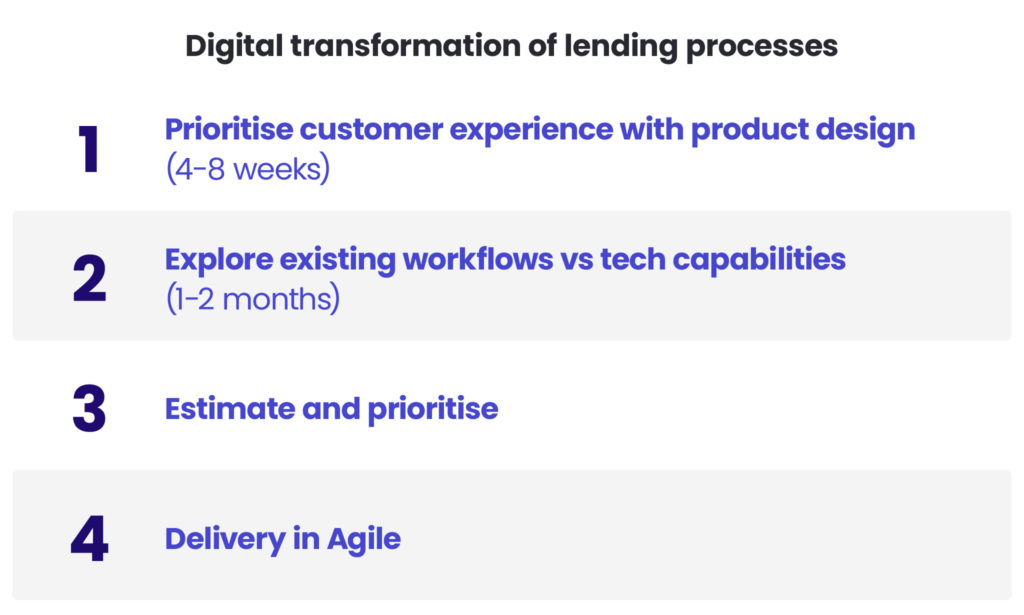
Chez Spyrosoft, nous avons divisé la transformation numérique de tous nos flux de travail de prêt en 4 étapes. Cela s'applique également aux prêts immobiliers, bien que ces parcours d'octroi de prêts présentent davantage de limitations externes à une numérisation complète.
Prioriser l'expérience client avec le design produit (4-8 semaines)
Use user expectations as the North Star of the transformation. Map user journeys for key user personas. I recommend doing this from two perspectives – “as is” and “to be” (in the perspective of 2-3 years time). This activity allows companies to visualise the expected impact of change, metrics to be improved, the “Lego bricks of the process” and stakeholders to include in the transformation plan.
Explorez les workflows existants par rapport aux capacités technologiques (1-2 mois)
A critical stage of every transformation. Knowing what your North Star is, you need to be able to understand what it will take to move in that direction. Methods such as Discovery Sprints are an agile and effective way to determine what it will take to achieve most of your aims. Don’t expect to have all the questions and details planned here, this is not what agile is about. In the meantime, your IT team or external IT consultancy should advise you on solution architecture, short- and long-term wins, and a milestone timeline. If your tech partners have an innovator’s mindset, you can expect them to advise you on how to align the transformation with AI strategies.
Estimer et hiérarchiser
The scope of the project will depend on your appetite for change and the starting point (in terms of workflow and technology). Expect an evolutionary process but address your stakeholders’ appetite for some early on. The final decision, as for the technology partner helping you in the transformation, should always be based on cost, quality and trust.
Livraison en Agile
As Spyrosoft, we like agile. This is the preference of most tech teams. Synchronising the agile manifesto with banks’ necessity of timelines is one of the areas where delivery needs to be particularly aware. We aim to ensure this with the seniority and experience of our team leaders, in particular the PM responsible for communication and identifying challenges early on.
Découvrez comment nous avons contribué au développement d'une solution de gestion de la dette pour les clients bancaires de Santander
At Spyrosoft, we started a joint project with one of the largest Polish retail banks – Santander – to develop an innovative solution for customer debt restructuring. The aim of the project was to improve debt management processes by providing users with an online self-service platform.
We created a user-friendly platform that integrates seamlessly with the bank’s existing systems. Key features include automated or semi-automated debt restructuring processes, alternative payment methods such as a different account or card, through an integrated payment provider, and active form that helps the bank’s representatives handle requests, as the form collects data at an early stage of the process.
Il convient de noter que la solution que nous avons proposée a considérablement réduit le processus de restructuration de la dette – environ un quart des décisions sont prises en ligne et l'ensemble du processus a été réduit d'environ 2 semaines et 2 visites en agence à 7 minutes.
Les retours des utilisateurs ont été extrêmement positifs, la solution ayant reçu une note élevée de 4,5 étoiles dans l'enquête de satisfaction de la banque, soulignant son efficacité à améliorer l'expérience client et l'efficacité opérationnelle.
Si vous souhaitez en savoir plus sur le déroulement du processus de développement, lisez notre étude de cas complète.
Digitalisation des prêts hypothécaires – une longue histoire en bref
Avec une part croissante de clients natifs du numérique et des objectifs de durabilité créant davantage d'exigences d'intégration des données, la transformation de tous les parcours de prêt est une nécessité.
If you’re a bank in Central or Northern Europe or a Credit institution in US, the competition is already setting the bar high. It’s only a matter of a few years before everyone, from fintechs to small banks and credit unions, will need to be on the same page with digital mortgage journeys. Being an early adopter can monetise a premium form a competitive advantage. Being behind doesn’t avoid the need for transformation, it just means paying an additional price for not meeting the soon-to-be market standards.
N'hésitez pas ànous contacter et nous vous aiderons à créer un plan étape par étape pour la transformation numérique de vos flux de prêt !
Plus de 60 % des clients européens préfèrent désormais un parcours de crédit immobilier numérique. La digitalisation aide les banques à répondre à ces attentes, à raccourcir les délais de traitement, à réduire les coûts et à offrir une expérience plus rapide et plus transparente tant aux prêteurs qu'aux emprunteurs.
Les principaux avantages incluent des délais d'approbation plus courts, des coûts d'origination de prêts réduits, une meilleure qualité des données, une conformité renforcée avec les objectifs de durabilité et des expériences client plus fluides et plus accessibles.
Les API ouvertes et l'automatisation pilotée par l'IA rationalisent l'octroi de prêts en améliorant la cohérence des données, en détectant les risques en amont et en réduisant les erreurs manuelles. Ces technologies rendent le processus plus efficace, plus précis et plus évolutif.
We recommend a four-stage approach to transforming mortgage workflows digitally. First, prioritise customer experience and design user journeys to guide the transformation. Next, analyse existing workflows and technologies to identify gaps and opportunities. Then, estimate and prioritise the scope of changes based on business objectives. Finally, deliver the project in an Agile model to ensure flexibility, transparency, and continuous alignment with evolving needs.
Avec des concurrents résolument numériques qui établissent de nouvelles normes, les premiers adoptants bénéficient d'un avantage concurrentiel solide. Attendre trop longtemps peut entraîner des coûts futurs plus élevés, des défis de conformité et une perte de parts de marché, à mesure que les expériences de prêt hypothécaire numérique deviennent la norme.




arrow_circle_right Nos articles
Choisissez votre prochaine lecture




arrow_circle_rightContactez-nous
