הבנת שילוב פרסומות ב-OTT: היתרונות וההבדלים המרכזיים

![[hero] media and entertainment - understanding ad insertion csai ssai](/wp-content/uploads/2025/10/hero-media-and-entertainment-understanding-ad-insertion-csai-ssai-scaled-1-1024x681.jpg)
Ad insertion has quietly become the streaming industry’s biggest headache. In 2024, 38% מאנשי מקצוע בתחום הווידאו ranked it as their top challenge – more than any other streaming issue.
The reason is simple: money. Global Over-the-Top (OTT) advertising spending is projected to reach $207.52 billion by 2025, making ad implementation a crucial revenue driver. Even Netflix, which famously resisted advertising for years, launched ad-supported tiers in 2022 after recognising the massive opportunity.
Understanding the differences between Client-Side Ad Insertion (CSAI) and Server-Side Ad Insertion (SSAI) – and when to use each approach – has become essential knowledge for any streaming platform serious about OTT advertising success.
If you’re still unsure about which dynamic ad insertion approach works best for your platform, you’re in the right place. The choice isn’t always obvious, and we’ll walk you through everything you need to know to make the right decision.
What is dynamic ad insertion in OTT streaming?
Ad insertion is the automated process that places advertisements into video streams at specific moments during content playback. This technology enables streaming services to monetise their content by delivering targeted advertisements to individual viewers based on real-time data analysis.
Unlike traditional broadcast television, where commercials are permanently embedded in content, הכנסת פרסומות ב-OTT פועלת באופן דינמי. The system can serve different advertisements to different viewers watching the same content, personalising the video ads experience based on factors like location, viewing history, and demographic data.
הטכנולוגיה מסתמכת עלסמני פרסום – digital timestamps embedded within video content that signal optimal placement points for advertisements. These markers can be inserted during content preparation for video-on-demand or dynamically during live streaming events.
כיצד פועלת השתלת פרסומות בפועל?
טכנולוגיית שילוב פרסומות פועלת באמצעות a coordinated process that identifies optimal moments for advertisement placement and delivers targeted content to viewers. The system begins when a video player encounters an ad marker.
At this trigger point, the platform’s dynamic ad insertion system analyses viewer data, including geographic location, device specifications, viewing history, and current TV advertising campaigns, to select the most relevant advertisement from available inventory. This selection process ensures viewers receive personalised video ads rather than generic broadcasts.
The technical implementation varies significantly depending on whether streaming platforms use Client-Side Ad Insertion or Server-Side Ad Insertion approaches, affecting everything from where processing occurs to how seamlessly advertisements integrate with content.
מהי Client-Side Ad Insertion?
Client-Side Ad Insertion (CSAI) is one of the two main ad insertion methods. In this method, the viewer’s device (such as their smartphone, smart TV, or computer) takes control of the advertising process, rather than your streaming video servers handling everything.
Think of CSAI as giving each viewer’s device its own personal advertising assistant. When someone watches your content and the video player reaches the ad markers we discussed, their device springs into action: it pauses the video, contacts your ad servers directly, downloads the correct advertisement, plays it, and then resumes the original content.
This approach shifts the technical workload from your platform’s servers to millions of individual devices.

כיצד פועל CSAI?
Here’s exactly what happens when a viewer encounters an advertisement using CSAI:
- זיהוי תוכן וסמני פרסום
Video players load content files from ad delivery networks along with those ad markers we discussed earlier. - הפעלת פרסומות
When playback reaches these ad markers, video players temporarily halt the main content and contact the advertising infrastructure to request relevant promotional content based on the viewer data analysis we described. - עיבוד תגובות
Advertising systems send back detailed instructions in industry-standard VAST format, containing everything the player needs: advertisement files, duration specifications, interaction tracking requirements, and performance measurement parameters. - ניהול פרסום מקומי
Viewers’ devices take over, downloading the promotional content and managing its display within the video interface. This includes handling any viewer interactions, such as clicks or completion tracking. - מעבר חלק
Once the advertising segment finishes, video players automatically return to the original content while simultaneously sending performance data back to analytics systems.
יתרונות מרכזיים של CSAI עבור שירותי סטרימינג
- אפשרויות עשירות לפרסום בווידאו: supports interactive surveys, clickable overlays, skippable ads, and engagement-driven content that generates higher revenue streams
- אנליטיקה מקיפה: generates extensive tracking data for every viewer interaction, helping justify premium advertising rates
- התאמה אישית מתקדמת: leverages detailed viewer data to deliver highly targeted advertisements that improve engagement rates
- גמישות ביישום: works with or without pre-embedded ad markers, giving platforms greater control over ad placement
אתגרים נפוצים ביישום CSAI
- בעיות באיכות הניגון: advertisement processing on viewer devices can cause frame drops, especially on older hardware
- חששות מפני השהיה: video players must pause content and contact ad servers, potentially disrupting smooth playback flow
- מגבלות שידור חי: struggles with real-time content, where seamless ad insertion becomes technically challenging
- תלות בשרת: relies heavily on external ad server performance, making the system vulnerable to technical disruptions
- פגיעות חוסם פרסומות: traditional ad-blocking software can prevent CSAI advertisements from loading, reducing fill rates and revenue potential
מהי Server-Side Ad Insertion?
Server-Side Ad Insertion (SSAI) represents the second major approach to ad insertion technology, working fundamentally differently from the client-side method discussed earlier. Instead of viewer devices handling advertisement delivery, SSAI processes everything on streaming platform servers before content reaches end users.
עם SSAI, advertisements get stitched directly into video streams at the server level, creating a unified content experience that resembles traditional broadcast television. Viewers receive a single, continuous video stream with advertisements seamlessly integrated, eliminating the technical handoffs between content and promotional segments.
This server-centric approach means that viewer devices never communicate directly with advertising systems, making SSAI particularly effective for reaching audiences that use ad-blocking software or devices with limited processing capabilities.
כיצד פועל SSAI?
Here’s exactly what happens when a viewer encounters an advertisement using SSAI:
- בקשת צפייה ראשונית
When someone starts watching content on a streaming platform, their request includes device information and viewing data that SSAI systems use for ad targeting decisions. - קבלת החלטות פרסום בזמן אמת
The streaming platform’s servers analyse viewer characteristics and contact advertising networks to identify the most suitable promotional content for that specific audience member. Unlike CSAI where viewer devices make these requests, SSAI handles all communication server-side. - תהליך הרכבת התוכן
Rather than keeping advertisements separate, SSAI technology combines promotional materials with the original video content at the server level, building a custom viewing experience for each user. - אופטימיזציה טכנית
Servers ensure all video elements – both original content and advertisements – maintain consistent quality standards, matching video resolution, audio levels, and playback specifications. - שידור בזרם בודד
The completed video package is presented to viewers as one uninterrupted stream, with promotional segments seamlessly integrated into the content rather than appearing as separate downloads. This contrasts sharply with CSAI’s pause-and-resume approach. - איסוף אנליטיקות בצד השרת
While viewers watch, streaming servers track advertisement performance and engagement metrics without requiring any data reporting from viewer devices.
Key benefits of Server-Side Ad Insertion for streaming services
- חוויית צפייה חלקה: creates television-like content flow with no pauses or interruptions between promotional segments and the main content
- יכולות הגעה משופרות: bypasses advertisement blocking technology since promotional content becomes part of the core video stream, making it impossible for ad-blockers to distinguish between ads and content
- תמיכה מפושטת במכשירים: functions across all viewing platforms without requiring specialised software installations or ongoing technical updates
- ביצועים מצוינים של תוכן חי: handles real-time streaming effectively, achieving consistently high advertisement completion rates
- הסתגלות לרשת: maintains stable playback quality regardless of the viewer’s internet connection fluctuations
- צמצום המורכבות הטכנית: minimises ongoing maintenance requirements by eliminating client-side code dependencies
אתגרים נפוצים ביישום SSAI
- מגבלות התאמה אישית: delivering highly customised ad experiences for individual viewers can strain server resources and reduce system efficiency
- סיבוכי מטמון: creating personalised content streams makes effective caching more challenging, potentially impacting content delivery performance
- סיכוני זיוף נתונים: devices can manipulate HTTP headers sent to ad servers, potentially affecting ad targeting accuracy and campaign reporting
What is the difference between CSAI and SSAI?
Now that we’ve explored both approaches individually, the natural question becomes: which one should your streaming platform actually use?
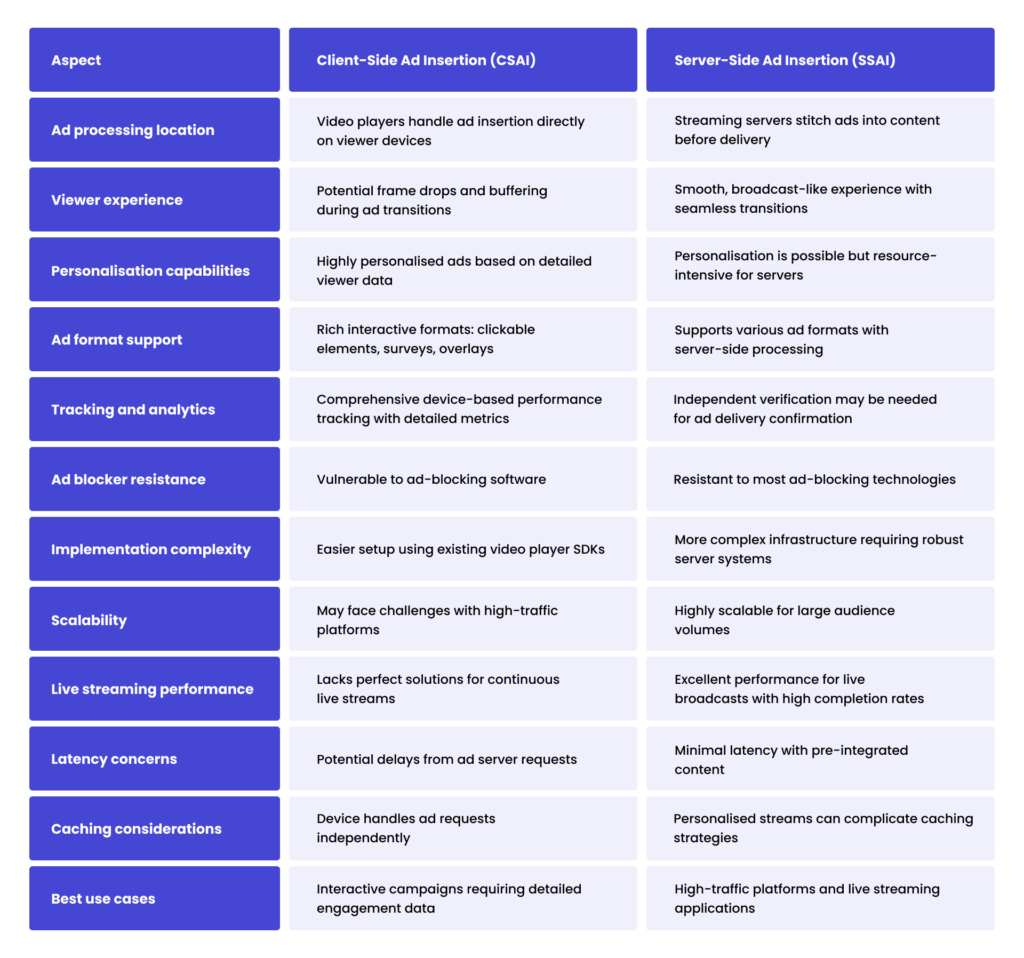
The reality is that CSAI and SSAI solve different problems for streaming businesses. CSAI excels when you need granular control over advertising experiences and detailed viewer engagement data. SSAI shines when you’re prioritising seamless playback and reaching massive target audiences without technical interruptions.
Below, we’ll compare the most critical factors:
בחרו אסטרטגיית שילוב פרסומות משלכם
עם 69.9% of streaming services now using AVOD monetisation – up from just 56% last year – implementing the right ad insertion approach has become critical for streaming success.
Whether you choose Client-Side Ad Insertion (CSAI) for its detailed analytics and interactive capabilities, Server-Side Ad Insertion (SSAI) for seamless viewing and scalability, or a strategic combination of both, the key is selecting a solution that matches your content goals and audience needs.
Ready to build a streaming platform that maximises your OTT advertising revenue? At Spyrosoft, we specialise in OTT development and understand the technical complexities of both CSAI and SSAI implementations. We’ll help you create the ideal ad insertion strategy tailored to your specific platform requirements.
גלו את שירותי פיתוח ה-OTT שלנו and discover how we can help you succeed in the streaming services landscape.
שאלות נפוצות
Client-Side Ad Insertion (CSAI) handles ad delivery on the viewer’s device, while Server-Side Ad Insertion (SSAI) processes and stitches ads into the content on the server before it reaches the viewer. In short – CSAI prioritises interactivity and data insights, while SSAI focuses on seamless playback and ad-blocker resistance.
SSAI is generally better suited for live streaming. Since it inserts ads at the server level, it avoids buffering issues and ensures a smoother experience for live viewers.
Yes. Many streaming platforms use a hybrid approach, combining SSAI for live content and CSAI for on-demand or interactive ad formats. This way, they balance scalability with engagement and precise data tracking.
מדדים מרכזיים כוללים זמן צפייה ממוצע, משך הפעלה, שיעורי השלמת תוכן ודפוסי צפייה רצופה. מדדים אלה מראים לא רק אם המשתמשים צופים, אלא עד כמה הם מעורבים.
It does, but with limitations. Personalising ads on the server side requires significant processing power and can impact performance. However, newer SSAI solutions increasingly use dynamic manifest manipulation and AI to improve targeting precision.


arrow_circle_rightצרו קשר
Discover the best ad insertion strategy for your platform

Bartlomiej Lozia
מנכ"ל Spyrosoft BSG

![[hero] media and entertainment - Subscriber acquisition vs retention](/wp-content/uploads/2025/09/hero-media-and-entertainment-subscriber-acquisition-vs-retention-scaled-1-1024x683.jpg)
![[hero] media and entertainment - cable vs streaming which strategy fits you best](/wp-content/uploads/2025/09/hero-media-and-entertainment-cable-vs-streaming-which-strategy-fits-you-best-scaled-1-1024x683.jpg)