כיצד AI פותר את מחסור כושר התחזוקה בתעופה


In our previous article, we unpacked the growing challenges facing aviation maintenance. If you haven’t seen it yet, dive into why traditional strategies are no longer enough. Now, let’s focus on the solution side. In this article, we’ll explore how predictive maintenance actually works, where the industry stands today, and what it takes to implement these systems in practice.
ספקטרום הבשלות של תחזוקה חזויה
Predictive maintenance isn’t all-or-nothing or a binary switch. Adoption across aviation varies widely. Maturity can be viewed on a five-stage spectrum:
- בדיקות במרווחי זמן קבועים (תחזוקה מבוססת זמן או מחזורים)
- ניטור (איסוף נתונים בסיסי, תובנות מוגבלות)
- אנליטי (some pattern recognition and trend analysis, but short predictive horizons)
- מבוסס נתונים (AI-based forecasting delivering actionable insights, broader integration)
- אופטימיזציה מתמשכת (fully integrated systems that use real-time, multi-source data and AI to continuously learn and adapt maintenance decisions)
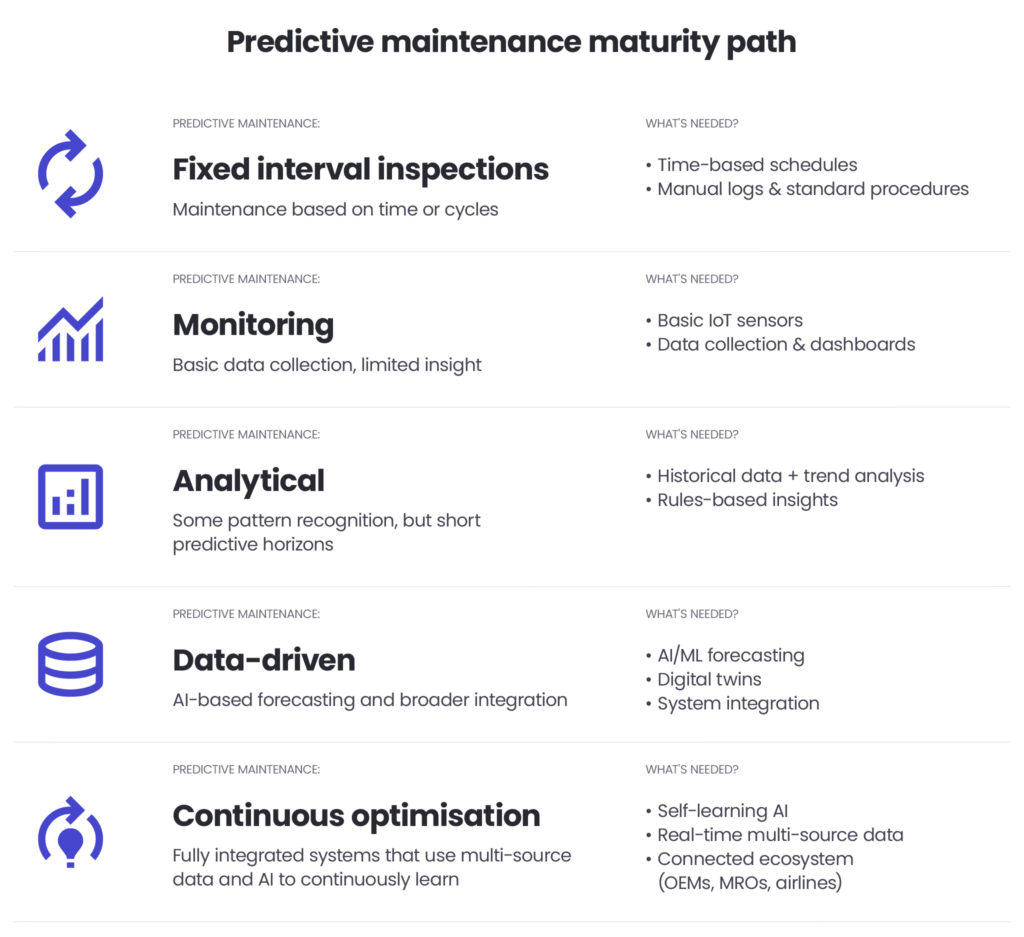
As organisations progress across these stages, not only do efficiency and cost benefits grow, but so does operational safety. The biggest gains await those that move toward levels 4 and 5.
AI ותאומים דיגיטליים בפעולה
Major aviation players are already using AI and digital twins to rewrite the rules of engine maintenance. What’s emerging isn’t just better data, but rather a connected ecosystem where insights from sensors, operations, and service histories flow into a single source of truth that drives smarter decisions.
Across the industry, we’re seeing powerful examples:
- GE Aerospace uses AI-powered digital twins across its engine fleet to model individual engine behaviour and forecast repair scope and part requirements before the engine arrives at the shop. Their predictive models provide recommendations down to the part number level, enabling precise logistics and minimising turnaround time.
- פלטפורמת Ascentia של Collins Aerospace (RTX), used by Japan Airlines, combines predictive analytics with operational data to help reduce unscheduled maintenance costs by up to 20%. It’s an example of how embedding intelligence into daily operations can deliver immediate savings.
- חוט הנתונים הכחול של רולס-רויס creates two-way flow of insights between OEMs, airline operators, and MRO providers. It enables real-time updates on part usage, component behaviour, and upcoming deadlines, helping to avoid unplanned failures and supporting better scheduling. It also helps improve sustainability metrics by reducing unnecessary part replacement and optimising component life.
Maximising uptime – the core business metric
In aviation, uptime is more than a performance metric.
Every grounded aircraft means lost revenue, cascading schedule disruptions, and a dent in passenger trust. Thanks to predictive maintenance, aircraft are kept in service longer, with fewer surprises.
By spotting potential issues before they happen, AI-powered systems help extend Mean Time Between Removals (MTBR) and drastically reduce these costly Aircraft on Ground (AOG) situations.

At Spyrosoft, we create predictive platforms that help you:
- ראו מה קורה ברחבי כל הצי שלך בזמן אמת.
- תכנון תחזוקה חכם יותר עם תחזיות מבוססות נתונים.
- שיפור ביצועים בזמן ולשמור על הצי שלכם מוכן לפעולה.
- לתת למהנדסים לפתור בעיות מוקדם במקום להגיב לכשלים.
In a high-pressure environment with limited capacity, uptime is the true competitive edge. With predictive maintenance (done right), that advantage becomes sustainable and scalable.
Data & integration challenges: What’s holding the industry back?
While the vision is clear, the path to implementation isn’t always smooth. Most aviation players still deal with fragmented systems, siloed data, and legacy IT architectures.
Valuable data is often locked away in disconnected sources, scattered across engine logs, OEM databases, maintenance records, and airline ERP systems. Even when the data is accessible, it’s not always clean, consistent, or easy to integrate.
To make predictive maintenance work in practice, organisations need:
- נתוני חיישני מנוע נקיים ומובנים.
- אינטגרציה חוצת-פלטפורמות של נתונים.
- Training and aligning maintenance crews with new predictive workflows.
- Collaboration between IT, engineering, supply chain, overhaul shops, and airlines.
- Managing data sovereignty, keeping sensitive information protected.
And that’s where the right strategic partner can make a difference.
Strategic ROI: Turning tech into business value
Predictive maintenance is more than an operational improvement. For airlines, engine OEMs, and MRO providers alike, the value goes far beyond fewer breakdowns. The entire ecosystem becomes leaner, faster, and more resilient.
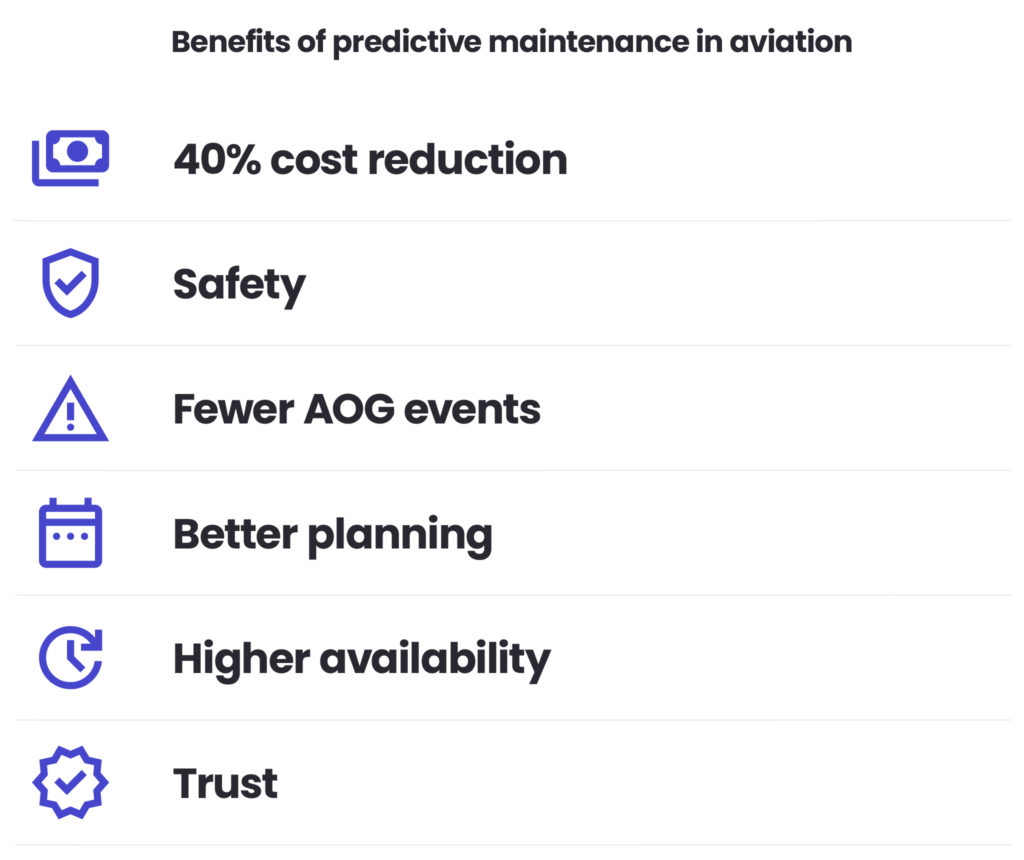
בואו נדבר על תוצאות:
- עדהפחתה של 40% בעלויות תחזוקה by minimising unnecessary part replacements and extending component life.
- בטיחות משופרת by reducing the risk of premature part failure.
- פחות אירועי AOG, as issues are addressed before they cause disruption.
- שיפור MTBR (Mean Time Between Removals), supporting longer service intervals and better engine utilisation.
- תכנון חלקים חכם יותר, תוך צמצום פסולת וחיכוך בשרשרת האספקה.
- חוויית לקוח משופרת thanks to fewer delays and greater schedule reliability.
Ultimately, in an industry defined by tight margins and rising demand, predictive maintenance helps airlines fly more passengers with fewer disruptions. It lets airlines scale with confidence, and deliver reliability that passengers notice.
מדוע שותפים לאינטגרציה דיגיטלית חשובים
To bridge the gap between insight and action, aviation players need solution architects who understand both aviation operations and intelligent digital systems.
Spyrosoft מסייעת לארגונים:
- Collect and standardise data from multiple systems in a secure way.
- Build predictive analytics platforms tailored to engine maintenance.
- Integrate AI into daily maintenance planning.
- Scale predictive capabilities across global fleets.
We act as a trusted partner and the architect of customised solutions. We help our partners bridge the technical and operational gaps – and integrate secure, intelligent predictive systems into the heart of engine MRO strategies. Every minute matters in aviation, and with the right data, you’re one step ahead.

מסקנה
Predictive maintenance used to be seen as an emerging innovation. Today, it’s quickly becoming the industry standard. This approach is a natural next step that builds on existing procedures, simplifying maintenance while simultaneously enhancing safety.
Success in aviation won’t come from simply having the latest technology. Instead, it will belong to those organisations that quickly adopt and effectively use digital tools to manage maintenance in smarter, more integrated ways.
By turning engine data into uptime with predictive AI, they’ll gain stronger customer confidence, greater fleet availability, and smarter use of capital and labour.
With the right digital partners, those capabilities don’t have to remain out of reach, and even the most grounded challenges can become gateways to transformation.
The industry operates across five stages: fixed interval inspections at level one, basic monitoring with limited insight at level two, analytical pattern recognition at level three, AI-driven forecasting with broader system integration at level four, and continuous optimisation using real-time multi-source data at level five. The biggest gains come from reaching levels four and five.
GE Aerospace uses AI-powered digital twins to forecast repair scope and parts requirements before engines arrive for servicing. Collins Aerospace’s Ascentia platform, used by Japan Airlines, combines predictive analytics with operational data to reduce unscheduled maintenance costs by up to 20%. Rolls-Royce’s Blue Data Thread creates bidirectional information flow between manufacturers, operators, and maintenance providers.
Organisations implementing AI-driven predictive maintenance report up to 40% reduction in maintenance costs, improved Mean Time Between Removals (MTBR), fewer Aircraft on Ground (AOG) incidents, and reduced risk of premature component failure.
Data is frequently locked in disconnected sources, scattered across engine logs, OEM databases, maintenance records, and airline ERP systems. The technical and organisational complexity of integrating these sources means that even organisations with rich data histories struggle to apply it systematically. Addressing this integration challenge is often the first practical step in a predictive maintenance programme.
Unscheduled maintenance, where a component fails unexpectedly, typically costs three to four times more than the equivalent planned intervention due to AOG time, expedited parts procurement, and disruption to operations. Predictive maintenance shifts the cost curve by identifying issues in advance and scheduling interventions at optimal times with parts and facilities already in place.
arrow_circle_rightצרו קשר
Explore how predictive tech could work for your fleet

arrow_circle_right המאמרים שלנו


