Comment le platform engineering peut booster la productivité des équipes de développement et réduire les coûts


The adoption of cloud platforms such as AWS, Azure and Google Cloud has transformed the way businesses develop and expand their technology. While these platforms offer remarkable flexibility and capability, they also introduce a new level of complexity. In the early stages of cloud adoption, it was common for each product team to design its own approach to infrastructure, monitoring and deployment. With every team running its own strategy, often with a dedicated DevOps engineer – this worked well enough on a small scale.
However, as organisations grew, this fragmentation became a major challenge. Different infrastructure setups created silos and inconsistent monitoring practices made system-wide observability difficult, and cloud costs began to spiral without unified controls.
Although initial attempts to address these issues, they didn’t eliminate the root cause. Every team was still solving the same infrastructure problems in isolation. The result was frustration, and inefficiency. Platform engineering came about precisely to solve these issues. By creating a standardised abstraction layer over cloud infrastructure, platform teams can unify deployments, streamline monitoring, optimise costs and empower product teams to focus on delivering business value rather than managing infrastructure.
In this article, we explore the key differences between cloud and developer platforms, explore the common issues that arise when they aren’t used, and explain how platform engineering addresses these problems through standardisation, automation and self-service.
Plateformes cloud vs plateformes de développement
In the context of cloud computing, major platforms such as AWS, Azure and Google Cloud are often referred to as landing zones. These are foundational environments that enable organisations to organise, provision, and secure server resources in the cloud according to enterprise governance, compliance, and security policies. A landing zone generally includes pre-configured networking, security controls and policies, ensuring that applications and workloads can run safely and consistently in the cloud. Cloud platforms primarily focus on infrastructure management, scalability, and resource allocation.
However, while these landing zones are vital, they do not fully address the day-to-day challenges that developers face. In such cases, developer platforms, or internal developer platforms, can provide a solution. These represent a significant emerging trend, specifically designed to address common challenges faced by developers, including reducing cognitive load, automating repetitive tasks, and standardising development workflows. Developer platforms are tailored environments built on top of cloud platforms, providing developer-centric features such as self-service provisioning, reusable templates, CI/CD pipelines, and automation for compliance and observability. The result is a streamlined and efficient developer experience, designed to maximise productivity.
Boostez la productivité des développeurs et réduisez les coûts cloud jusqu'à 30 %
En savoir plus
Put simply, while cloud platforms lay the foundations enterprise-level requirements, developer platforms pave the path for developer efficiency and velocity. Developer platforms offer the valuable benefit of abstraction and automation above the landing zone, enabling developers to focus on the core task of building and shipping applications. This is because they are no longer required to expend time and effort on infrastructure setup, access management or compliance processes. The combination of well-governed cloud landing zones and robust developer platforms is key to enabling development teams to deliver business value quickly, efficiently and securely.
Qu'est-ce que le platform engineering ?
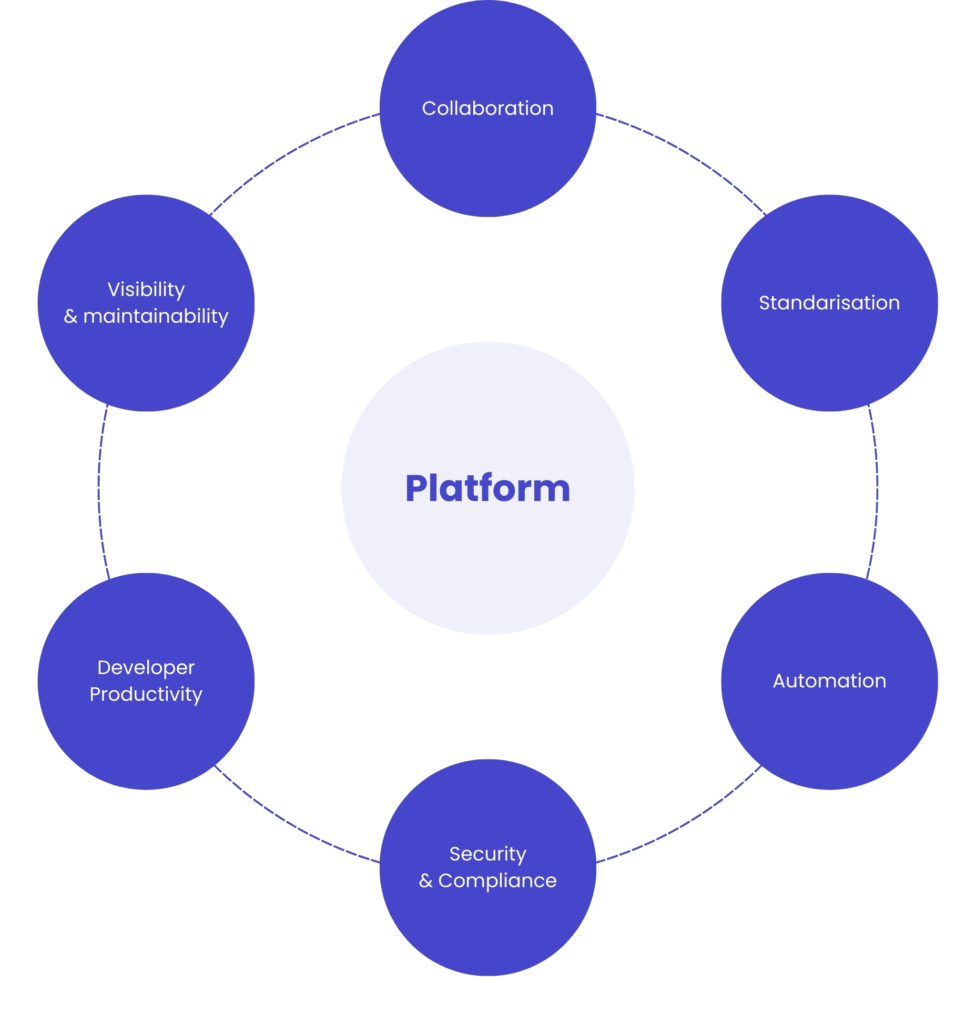
Platform engineering is the practice of developing and maintaining unified, developer-centric platforms that provide a stable foundation for software delivery. Unlike traditional approaches, in which teams work with fragmented tools and environments, platform engineering centralises workloads and creates a consistent, standardised ecosystem. This improves visibility and maintainability and makes it easier to manage costs and optimise resources.
At its core, platform engineering is about enhancing the developer experience. By embedding automation, security and compliance into the platform, engineering teams can accelerate delivery, reduce errors and enable faster, more reliable releases. Developers benefit from self-service capabilities, reusable templates and streamlined workflows that reduce cognitive load and free them up to focus on building features rather than dealing with infrastructure or repetitive setup tasks.
A well-designed platform also promotes collaboration and standardisation across teams, ensuring that everyone works with the same practices, tools and governance. This stability doesn’t limit innovation, instead, it encourages it. With a robust and secure foundation in place, businesses can experiment with, adapt to, and deploy new technologies more effectively, thus enabling rapid development without compromising reliability.
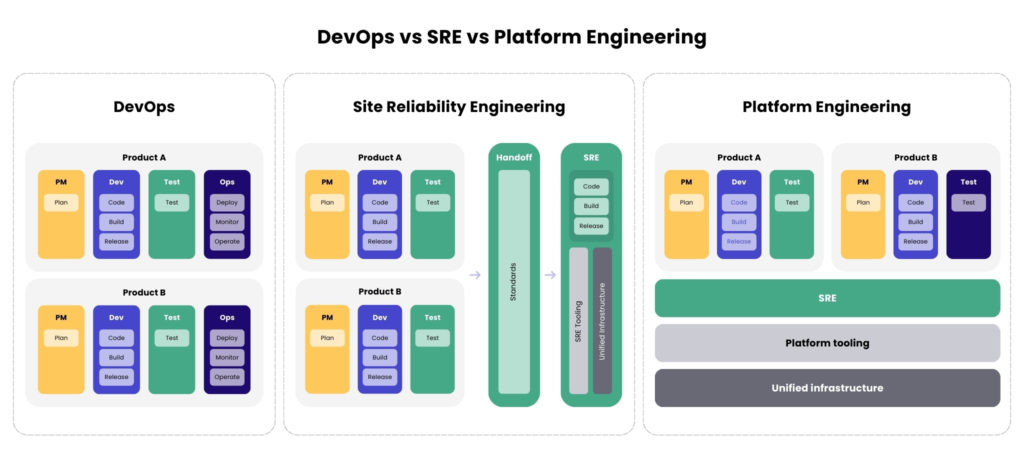
DevOps vs SRE vs Platform Engineering
DevOps, Site Reliability Engineering and Platform Engineering. Although these fields share common roots and goals, they address different layers of the software delivery lifecycle. It is essential to understand how they differ and complement one another in order to build scalable, reliable and cost-efficient systems.
- DevOps is a cultural and organisational approach that aims to eliminate the barriers between the development and operations teams. Its main objectives are to encourage collaboration, automate processes and deliver software more quickly and reliably. Rather than being a role or a single toolset, DevOps is a philosophy supported by practices such as continuous integration and delivery (CI/CD) and infrastructure as code.
- Ingénierie de fiabilité des sites originated at Google and can be seen as a concrete implementation of DevOps principles, focusing strongly on reliability and operational excellence. SRE teams use software engineering methods to solve operational problems, ensuring that systems are scalable, robust and accessible. They use metrics such as service-level objectives (SLOs) and error budgets to strike a balance between innovation and reliability.
- Ingénierie de plateforme, by contrast, provides the structured foundation on which DevOps and SRE practices can prosper. Rather than each development team building its own pipelines and tooling, platform engineers create a shared internal developer platform (IDP). This standardises workflows, integrates automation and security, and provides self-service capabilities, thereby reducing the cognitive load on developers and ensuring operational consistency.
Les défis que résout l'ingénierie de plateforme
Manque de standardisation
In many organisations, each development team sets up its own tools, pipelines and monitoring methods. While this offers flexibility, it quickly leads to fragmentation and inconsistent practices. These inconsistencies complicate debugging and incident response, and increase operational risks when scaling across teams or regions.
Résolution -> Platform engineering establishes a consistent layer of tooling, processes, and environments, eliminating duplicated efforts and ensuring teams adhere to well-defined best practices. The result is improved reliability, reduced cognitive load and faster onboarding for new engineers.
Hausse des coûts
While the cloud offers flexibility, it also comes at a price. Without proper oversight, expenses can escalate due to underutilised resources, shadow IT or poorly optimised deployment strategies. Various industry studies have highlighted that cloud spending is now one of the fastest-growing areas of IT budgets.
Résolution -> A cloud-smart platform integrates cost monitoring, automated rightsizing and resource governance directly into the workflows of developers. This gives teams visibility of actual usage patterns, leading to more responsible consumption. Organisations that have adopted these practices have reported significant savings, with infrastructure spending often being reduced by up to 60% while maintaining performance.
Faible productivité des développeurs
Development teams often spend an excessive amount of time on tasks such as provisioning infrastructure, configuring CI/CD pipelines and troubleshooting cloud environments. This diverts their focus away from their core mission of delivering customer value. In highly competitive markets, this inefficiency results in a slower time-to-market.
Résolution -> By abstracting infrastructure management behind self-service capabilities and reusable components, developers can focus on building business-critical features instead of reinventing the wheel. Platform engineering provides teams with secure, ready-to-use environments, thereby improving delivery speed, job satisfaction and innovation capacity.
Les principaux avantages du platform engineering
Productivité et expérience des développeurs améliorées
- Flux de travail rationalisés et automatisation – Le platform engineering élimine les complexités liées à l'infrastructure, permettant aux développeurs de se concentrer sur la création de logiciels plutôt que sur la gestion des environnements et des configurations. Cela conduit à une vélocité et une satisfaction professionnelle accrues.
- Libre-service et standardisation – Les développeurs peuvent provisionner des ressources et déployer des applications eux-mêmes, ce qui réduit les goulots d'étranglement et accélère les cycles de livraison.
- Environnements de développement cohérents – Des environnements de développement et de déploiement uniformes minimisent les erreurs et les changements de contexte, permettant une intégration plus rapide et une collaboration plus efficace
Agilité commerciale, évolutivité et efficacité des coûts
- mise sur le marché plus rapide – Les pipelines CI/CD automatisés et les processus standardisés permettent des lancements rapides de fonctionnalités et de produits, préservant ainsi la compétitivité.
- évolutivité par conception – Les plateformes permettent une mise à l'échelle transparente des applications et des services, s'adaptant facilement à la croissance de l'entreprise ou à l'évolution des besoins.
- Optimisation des coûts – L'utilisation des ressources et les dépenses cloud sont gérées et dimensionnées de manière optimale, réduisant le gaspillage et améliorant l'efficacité opérationnelle. Généralement, ces coûts sont réduits de 15 à 30 % lors de la phase initiale de mise en œuvre.
Sécurité, conformité et collaboration
- Sécurité et conformité intégrées – La gestion centralisée garantit des contrôles de sécurité robustes, des vérifications de conformité et une gouvernance par défaut, atténuant les risques.
- Opérations fiables – Les systèmes automatisés de surveillance, d'alerte et de restauration améliorent la disponibilité et la résilience du système, renforçant ainsi la confiance des clients.
- Collaboration inter-équipes renforcée – En brisant les silos, les plateformes fournissent des outils partagés et des processus standardisés qui renforcent la communication entre les équipes de développement, DevOps et métier.
En conclusion
The message is simple – the more time your development teams spend grappling with infrastructure issues, the less time they have to deliver value. Platform engineering solves this problem by providing teams with the right tools, standardised processes and automation to enable them to work smarter, faster and with greater cost control.
Ainsi, si vous cherchez à stimuler la productivité des développeurs, à gérer les dépenses cloud plus efficacement et à établir une base pour un succès à long terme, il est temps d'adopter ingénierie de plateformeContactez nos spécialistes pour découvrir comment nous pouvons vous aider à concevoir et à mettre en œuvre une plateforme sur mesure pour votre entreprise.
Cloud platforms such as AWS, Azure and Google Cloud provide the foundational infrastructure (landing zones) necessary for running applications in a governed, secure and scalable manner. By contrast, developer platforms are built on top of cloud platforms to reduce cognitive load for developers. They offer self-service provisioning, reusable templates, continuous integration/continuous delivery (CI/CD) pipelines, and automation. This allows developers to concentrate on developing applications rather than managing infrastructure.
As companies grow, inconsistent infrastructure and practices across teams can create silos and inefficiencies, as well as rising cloud costs. Platform engineering tackles these problems by providing a unified, standardised developer platform that automates infrastructure management, streamlines workflows, incorporates security and compliance measures, and optimises costs.
Platform engineering streamlines infrastructure processes by automating repetitive and manual tasks, providing developers with self-service capabilities and pre-configured environments. This reduces the time spent on context switching and setup, enabling developers to focus more on building and delivering business-critical features.
Manque de standardisation – élimine la fragmentation des outils et des processus.
Hausse des coûts cloud – fournit gouvernance, suivi des coûts et optimisation automatisée des ressources.
, DevSecOps permet aux organisations de livrer des logiciels plus rapides, plus résilients et sécurisés.
DevOps promotes collaboration between development and operations, while SRE applies engineering practices to ensure reliability. Platform engineering complements both by providing a shared internal developer platform (IDP) that standardises workflows, embeds automation and compliance, and enables DevOps and SRE to scale more effectively.


arrow_circle_rightnous contacter
Concentrez-vous sur votre cœur de métier, pendant que nous gérons la maintenance de votre infrastructure informatique

Filip Rozanski
Responsable des services gérés
arrow_circle_right Articles recommandés


