DevSecOps : l'essor d'une approche de développement logiciel axée sur la sécurité


Software development is a complex discipline where security must be treated as equally critical as speed and functionality. As cyber threats become more frequent and sophisticated, traditional approaches that treat security as an afterthought are proving to be inadequate.
Enter DevSecOps, a change that integrates security into every stage of the development lifecycle. By embedding security practices alongside development and operations, organisations can proactively identify vulnerabilities, reduce risk, and deliver robust applications more quickly. This security-first approach is establishing itself as a critical standard for modern software development, ensuring that agility and protection go hand in hand.
Qu'est-ce que le DevSecOps, et pourquoi est-ce important ?
For years, security was often treated as a final checkpoint, a review performed just before release. This approach slowed down development, created bottlenecks and often allowed vulnerabilities to slip into production, making it costly and disruptive to fix them later on. Today’s applications are more complex than ever; they are cloud-native, distributed and dependent on numerous third-party libraries and services. Supply chain vulnerabilities, misconfigurations and evolving cyber threats mean that late-stage security checks are inadequate.
DevSecOps flips this traditional model – by embedding security in the earliest stages of planning, coding, testing and deployment, organisations can detect issues earlier, reduce costs and maintain rapid delivery. More importantly, it fosters a culture in which everyone takes responsibility for security, rather than leaving it to a specialised team at the eleventh hour.
For years, security was often treated as a final checkpoint, a review performed just before release. This approach slowed down development, created bottlenecks, and allowed vulnerabilities to slip into production, resulting in costly and disruptive fixes later on.
Aujourd'hui, toutefois, les enjeux sont plus élevés que jamais, en raison de cybermenaces de plus en plus sophistiquées et d'une pression réglementaire croissante. Des cadres tels que le Cyber Resilience Act are changing how software is developed, particularly for products containing digital elements that are entering the EU market. Compliance requires organisations to embed security throughout the entire software lifecycle rather than just validating it at the end.
Découvrez nos services de cybersécurité et renforcez la résilience de votre entreprise !
En savoir plusAt the same time, modern applications are more comple, being cloud-native, distributed, and reliant on numerous third-party libraries and services. Supply chain vulnerabilities, misconfigurations and evolving threats, combined with strict compliance requirements, mean that late-stage security checks are no longer sufficient.
DevSecOps flips this traditional model by embedding security into the earliest stages of planning, coding, testing and deployment. This approach enables organisations to detect issues earlier, reduce costs, maintain rapid delivery and ensure ongoing compliance with emerging regulations. Furthermore, it fosters a culture in which everyone takes responsibility for security, rather than leaving it to a specialised team at the last minute.
Du DevOps au DevSecOps – intégrer la sécurité au pipeline de développement
DevOps transformed software development by breaking down the traditional barriers between development and operations teams, enabling faster release cycles through practices such as continuous integration and continuous delivery, infrastructure automation and close cross-team collaboration. The main goal of DevOps is to speed up software delivery while ensuring system reliability and operational stability.
While DevOps emphasises speed, automation and continuous deployment, DevSecOps ensures that security controls are systematically integrated into every phase of the pipeline, from planning and coding to testing, deployment and monitoring. Rather than treating security as a separate review phase carried out late in the development cycle, DevSecOps incorporates continuous security validation into the development workflow.
Plusieurs caractéristiques distinguent le DevSecOps des implémentations DevOps traditionnelles.
- responsabilité partagée
In conventional DevOps environments, security responsibilities are often primarily assigned to specialised security teams. DevSecOps, however, promotes a shared responsibility model in which developers, operations engineers, and security specialists collaborate to identify and mitigate risks throughout the lifecycle. - Contrôles de sécurité intégrés
DevSecOps incorporates automated security mechanisms directly into CI/CD pipelines. These include practices such as Static Application Security Testing (SAST), Dynamic Application Security Testing (DAST), Software Composition Analysis (SCA), container image scanning and infrastructure-as-code (IaC) security validation. - Gestion continue des risques
Rather than relying on periodic audits or post-development security testing, DevSecOps enables the continuous assessment of vulnerabilities, misconfigurations and dependency risks. Automated feedback loops allow issues to be identified and resolved earlier in the development process.
Différences clés : DevOps vs DevSecOps
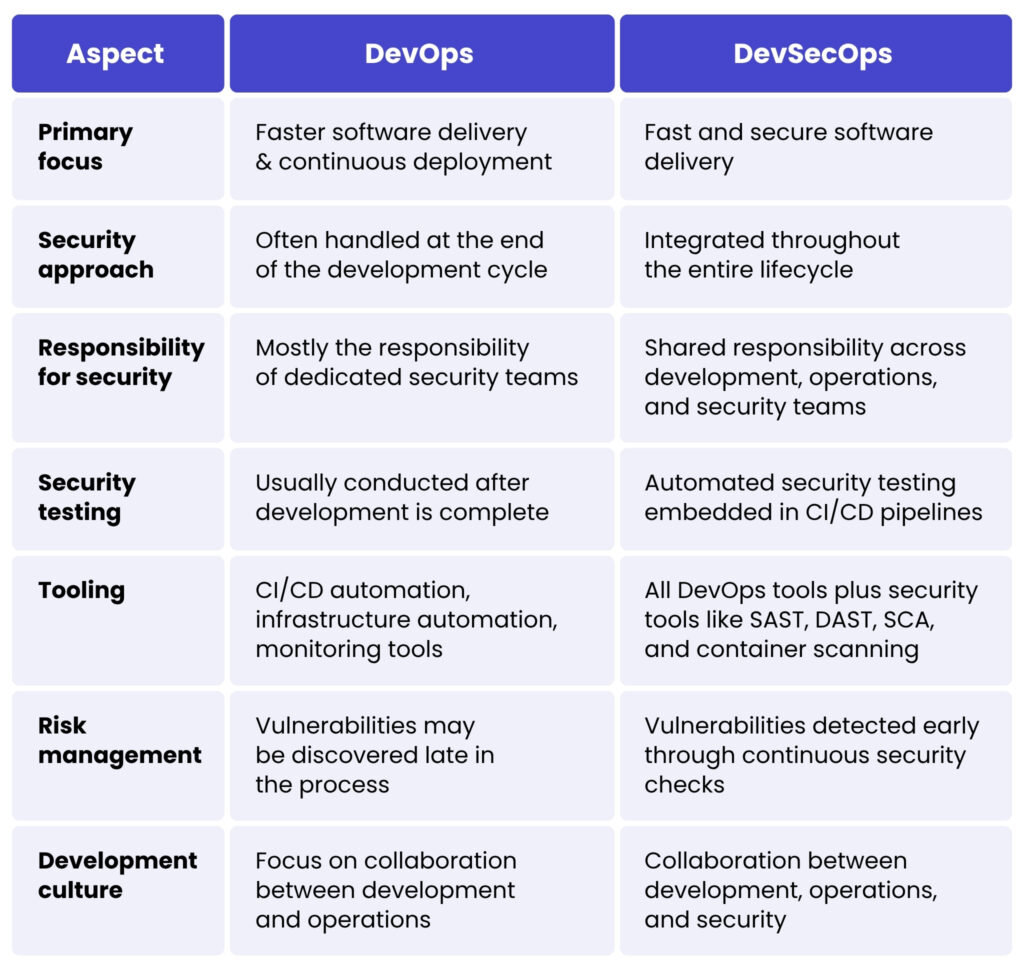
Ultimately, DevSecOps does not replace DevOps, but extends its principles to address the growing importance of security in complex, cloud-native environments. By integrating security controls into automated delivery pipelines and fostering collaboration between development, operations and security teams, organisations can maintain the speed and agility of DevOps while ensuring software is delivered securely and resiliently.
L'approche shift-left dans le DevSecOps
One of the most fundamental principles of DevSecOps is the concept of ‘shifting left’. In the context of the software development lifecycle, ‘left’ refers to the initial stages of the process, such as planning, design and coding, when decisions regarding architecture, dependencies and implementation are initially made. Traditionally, security validation occurred near the end of the development cycle, typically during dedicated testing phases or pre-release audits. The shift-left approach redefines this model by introducing security considerations at the earliest possible stage of development.
In practical terms, shifting security left involves embedding security practices directly into design reviews, development workflows and developer toolchains. Security requirements are defined during the planning phase, threat modelling becomes part of the system design process and developers use integrated tools that automatically analyse code for vulnerabilities as it is written. Automated checks such as static code analysis, dependency vulnerability scanning, and policy validation are increasingly included in modern development environments, allowing potential risks to be identified long before the software reaches production.
This early integration of security significantly improves the efficiency of vulnerability management. Issues detected during the design or development stages can usually be resolved swiftly with minimal disruption, often requiring only minor adjustments to the code or configuration. By contrast, vulnerabilities discovered late in the release cycle, or after deployment, can require extensive rework, emergency patches, or even architectural changes. Consequently, organisations that adopt shift-left practices often experience a substantial reduction in remediation costs and operational risk.
Another important outcome of this approach is that it empowers developers. Rather than relying solely on downstream security teams to identify and resolve issues, developers can now gain direct visibility into potential vulnerabilities within their own code. Inmécanismes de retour d'information intégrés, tels que des alertes automatisées dans les IDE ou les pipelines CI, permettent aux ingénieurs de traiter les problèmes de sécurité en temps réel au fur et à mesure qu'ils développent des fonctionnalités. Cela accélère la remédiation et favorise une meilleure sensibilisation aux pratiques de codage sécurisé.
Intégrer la sécurité tout au long du pipeline de livraison
In order to successfully implement DevSecOps, security must be embedded throughout the entire software delivery lifecycle, rather than being introduced as a separate, final step. The DevSecOps lifecycle incorporates automated security controls, testing procedures and monitoring capabilities into every stage of the DevOps pipeline. This ensures that potential vulnerabilities, misconfigurations and compliance issues are continuously identified and addressed.
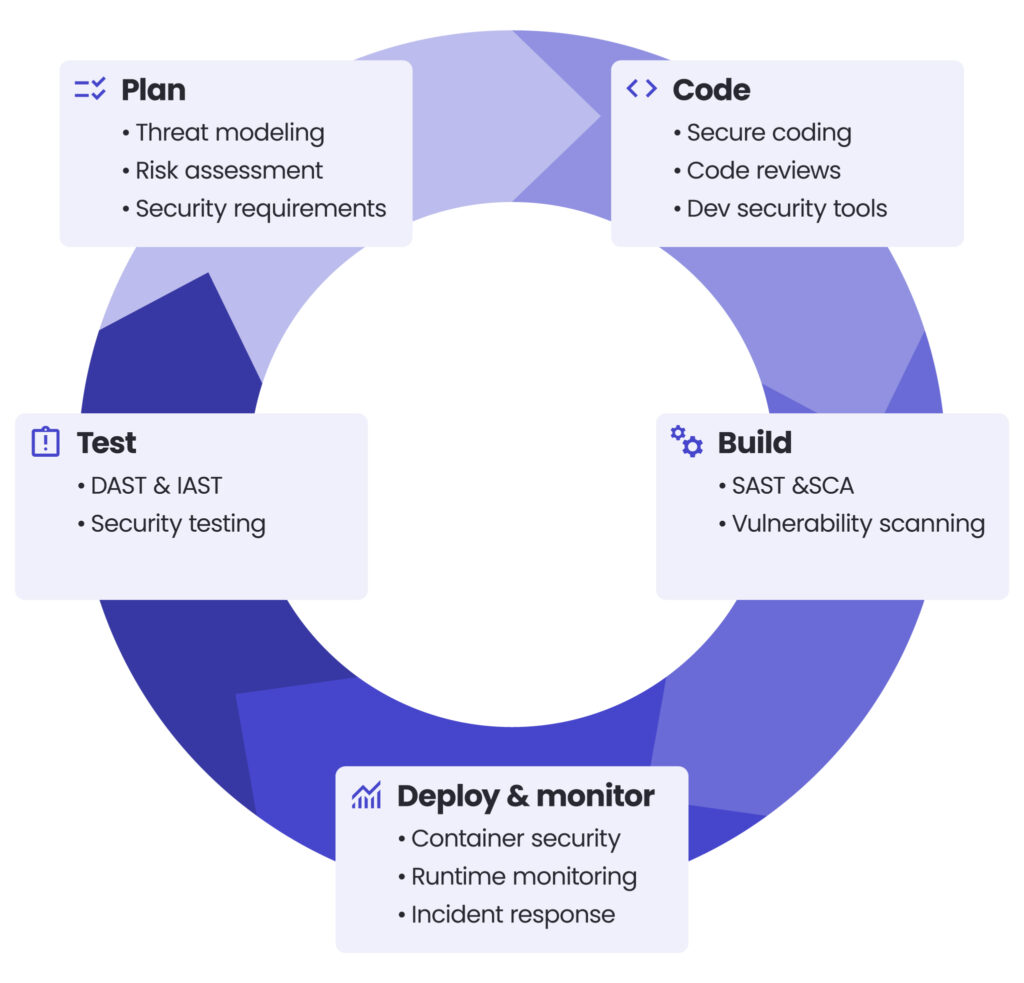
1. Planifier
The lifecycle begins with security-aware planning, during which potential risks are evaluated prior to the start of development. At this stage, teams carry out threat modelling to identify potential attack vectors and security vulnerabilities in the proposed architecture. This process enables developers and security specialists to anticipate risks relating to data flows, authentication mechanisms, external integrations and infrastructure components.
Parallèlement à la modélisation des menaces, les organisations réalisent des évaluations des risques afin de hiérarchiser les vulnérabilités potentielles en fonction de leur probabilité et de leur impact. Les exigences de sécurité, telles quechiffrement normes, authentification protocoles or réglementaire conformité obligations, sont ensuite formellement définies et intégrées dans la conception du système et la feuille de route de développement. Définir ces exigences dès le départ garantit que la sécurité est considérée comme un principe de conception fondamental plutôt que comme une réflexion après coup.
2. Coder
Pendant la phase de développement, les pratiques de sécurité sont intégrées directement dans le workflow de codage. Les équipes adopter des normes de codage sécurisé pour guider les développeurs dans l'évitement des vulnérabilités courantes, tels que les failles d'injection, l'authentification non sécurisée ou la gestion inappropriée des erreurs.
Code quality and security are reinforced further through peer code reviews, in which developers evaluate each other’s work for both functionality and adherence to security best practices. Additionally, automated linting tools and developer security plugins integrated into IDEs can identify potential issues, such as unsafe functions, exposed credentials or insecure dependencies, as code is written. These automated checks enable developers to identify and resolve security issues at an early stage in the development process.
3. Construire
L'étape de build intègre l'analyse de sécurité automatisée dans le pipeline d'intégration continue. L'une des principales techniques utilisées ici est tests de sécurité des applications statiques (SAST), qui analyse le code source, le bytecode ou les binaires compilés pour identifier les vulnérabilités potentielles sans exécuter l'application.
Une autre pratique essentielle est analyse de composition logicielle (SCA). Modern applications often rely heavily on open-source libraries and third-party dependencies, which may contain known vulnerabilities. SCA tools automatically scan project dependencies against vulnerability databases to identify outdated or insecure components.
En outre, l'analyse des vulnérabilités des dépendances garantit que tous les packages externes intégrés au processus de build sont continuellement évalués pour détecter tout problème de sécurité nouvellement découvert.
4. Tests
During the testing phase, security validation moves beyond static analysis to evaluate the behaviour of the application during execution. Dynamic Application Security Testing (DAST) involves simulating external attacks on running applications to identify vulnerabilities such as authentication weaknesses, configuration issues or input validation flaws.
Certaines organisations utilisent également Interactive tests de sécurité des applications (IAST), qui combine des éléments de tests statiques et dynamiques en surveillant le comportement de l'application lors des tests fonctionnels. Cette approche offre un aperçu plus approfondi de la manière dont les vulnérabilités se manifestent dans des conditions d'exécution réelles.
Parallèlement à l'analyse automatisée, les équipes réalisent souvent des tests d'intégration axés sur la sécurité afin de vérifier que les mécanismes d'authentification, les contrôles d'accès et les mesures de protection des données fonctionnent correctement sur l'ensemble des composants du système.
5. Déployer et surveiller
Les responsabilités en matière de sécurité ne s'arrêtent pas une fois l'application déployée. Dans le modèle DevSecOps, la surveillance de la sécurité à l'exécution joue un rôle essentiel dans l'identification des menaces émergentes et des vulnérabilités opérationnelles.
Prior to deployment, teams conduct container security checks and configuration scanning to prevent misconfigurations or exposed services from being introduced by container images, infrastructure configurations, and orchestration settings. Once the application is running, continuous monitoring systems analyse logs, system metrics and network activity to detect anomalous behaviour that may indicate a security incident.
Effective DevSecOps implementations also include incident detection and response mechanisms, enabling teams to swiftly investigate and mitigate potential breaches. Importantly, insights gathered from runtime monitoring are fed back into the development pipeline through continuous feedback loops. This enables teams to improve security controls, update configurations and refine development practices over time.
Outils essentiels et automatisation dans le DevSecOps
Although DevSecOps is frequently regarded as a cultural and procedural change, its practical implementation depends heavily on automation and specialised security tools. In modern software development environments characterised by rapid release cycles, distributed architectures and complex dependency chains, manual security checks are insufficient. DevSecOps addresses this challenge by integrating automated security controls directly into CI/CD pipelines, enabling continuous and scalable vulnerability detection throughout the development lifecycle.
Automation plays a central role in ensuring consistent security validation without slowing down delivery. Security tools are embedded within development workflows so that code, configurations, and dependencies are automatically analysed whenever changes are introduced. This approach enables development teams to identify potential vulnerabilities early on, receive immediate feedback and resolve issues before they propagate further into the pipeline.
Une chaîne d'outils DevSecOps typique intègre diverses catégories de technologies de sécurité, chacune d'elles traitant différentes couches de la pile applicative.
Analyse statique de sécurité des applications (SAST)
SAST tools analyse source code, bytecode or compiled binaries without executing the application. They scan codebases for patterns associated with common vulnerabilities, such as injection flaws, insecure authentication mechanisms or improper error handling. As SAST operates during the development and build phases, it allows developers to identify security issues before the application is deployed.
Tests de sécurité dynamiques des applications (DAST)
Unlike static analysis, DAST evaluates applications while they are running. By simulating external attacks against deployed applications, DAST tools can identify vulnerabilities, such as misconfigurations, authentication weaknesses and input validation issues, that may not be apparent through static code inspection alone.
Analyse de composition logicielle (SCA)
Modern applications often depend on a large number of open-source libraries and third-party dependencies. While these components can accelerate development, they can also introduce security risks if vulnerabilities exist within the external code. SCA tools continuously scan project dependencies against vulnerability databases and alert teams when outdated or insecure components are detected. This capability is particularly important for managing risks in the software supply chain.
Sécurité pour les conteneurs et Kubernetes
As organisations increasingly adopt containerised and cloud-native architectures, security measures must be extended to encompass runtime environments as well as application code. Container security tools scan container images for vulnerabilities, misconfigurations and outdated packages prior to deployment. Orchestration platforms such as Kubernetes offer additional security controls to help enforce policies related to network segmentation, access permissions, and workload isolation.
Les services les plus courants que nous couvrons chez Spyrosoft
The provisioning of infrastructure is becoming increasingly automated through the use of IaC technologies, such as Terraform, CloudFormation and ARM templates. While this approach improves scalability and consistency, misconfigurations within infrastructure definitions can expose systems to significant risk. Security scanning tools analyse infrastructure templates to detect insecure configurations, such as publicly exposed storage, overly permissive access controls or unencrypted data resources, before infrastructure is deployed.
Intégrer les retours de sécurité dans les flux de travail des développeurs
For security tools to be effective, they must integrate seamlessly into the environments in which developers work. These environments include integrated development environments (IDEs), version control systems, and CI/CD platforms. Automated alerts, pull request checks and pipeline feedback give developers immediate insight into potential security issues.
Importantly, DevSecOps tooling is designed to act as guidance for developers rather than as obstacles. Rather than hindering development progress with manual security reviews, automated tools offer continuous guidance to help developers adhere to secure coding practices while maintaining high delivery velocity.
En conclusion
As software systems become increasingly complex and interconnected, it is no longer sufficient to treat security as a final checkpoint. DevSecOps addresses this challenge by integrating security practices into every stage of the development lifecycle, from planning and coding to testing and deployment. Automation, continuous testing, and integrated security tools enable teams to detect vulnerabilities earlier and resolve them more efficiently.
En combinant la rapidité du DevOps avec une approche proactive approche de sécuritéCeux-ci disposent de systèmes d'exploitation connectés à Internet, permettant aux téléspectateurs de diffuser du contenu vidéo directement.
Adopting DevSecOps requires a change in the way that teams approach software development. This involves integrating security into CI/CD pipelines, providing developers with automated security checks and encouraging collaboration between development, operations and security teams. Organisations can then significantly strengthen their security posture while maintaining rapid delivery.
Contactez nos experts et commencez par identifier les opportunités d'introduire la sécurité plus tôt dans votre processus de développement, puis mettez en place un pipeline qui priorise une livraison logicielle sécurisée.
Le DevSecOps est une approche qui intègre la sécurité à chaque phase du développement logiciel, plutôt que de la traiter comme une étape finale. Il garantit que les applications sont conçues, testées et déployées en tenant compte de la sécurité dès le départ.
Alors que le DevOps se concentre sur la vitesse et l'efficacité, le DevSecOps ajoute une solide couche de sécurité sur l'ensemble du pipeline. La sécurité devient une responsabilité partagée et est continuellement validée par des outils et des processus automatisés.
Les applications modernes sont complexes, basées sur le cloud et fortement dépendantes de composants tiers, ce qui accroît les risques de sécurité. Le DevSecOps aide les organisations à identifier proactivement les vulnérabilités et à rester conformes aux réglementations en constante évolution.
Le shift-left consiste à introduire les pratiques de sécurité dès le début du cycle de développement, notamment lors de la planification et du codage. Cela permet aux équipes de détecter et de corriger les vulnérabilités plus tôt, réduisant ainsi les coûts et les retards.
DevSecOps améliore la sécurité, réduit les coûts de remédiation et accélère la livraison en détectant les problèmes en amont. Il favorise également une culture où les équipes de développement, d'exploitation et de sécurité collaborent plus efficacement.


arrow_circle_rightnous contacter
Concentrez-vous sur votre cœur de métier, pendant que nous gérons la maintenance de votre infrastructure informatique

Filip Rozanski
Responsable des services gérés
arrow_circle_right notre blog


