Outils low-code et IA dans le e-commerce : le prochain changement de donne ?


Are we on the verge of getting the next big game-changer in the ecommerce sector (and beyond)? The use of low-code applications combined with artificial intelligence in ecommerce is a promising direction of development that contributes to significant improvement in multiple aspects of online trade. In this article, we want to show you how low-code tools boosted by AI in ecommerce can make your work easier, faster and cheaper.
Développement traditionnel vs technologie low-code et IA
The traditional app development process involves a lot of coding – that’s why you need web/mobile developers working on your apps and tools for you. Things changed a bit recently, though. Now, we have access to low-code tools and platforms that enable the creation of digital tools using visual interfaces rather than code.
These platforms allow users to design and build functional applications using drag-and-drop editors, pre-built templates and ready-made configuration settings. This means that the actual coding is minimised, and in some cases, you don’t need to know any coding languages at all!
Let’s use a simple example – about 4-5 years ago, if you wanted to design and publish a new website, you needed to write every single line of code manually. Today, there are many super-intuitive CMS systems (e.g., Wix or Squarespace) with ready-made components. All you have to do is design the visual layer. This way, you can create a beautiful and functional website even if the term HTML doesn’t even ring a bell.
Il en va de même pour les applications et outils mobiles et web. Grâce aux plateformes low-code, vous pouvez créer votre propre outil ou mettre en œuvre l'automatisation du commerce électronique même si vous n'êtes pas un professionnel. De plus, l'utilisation deL'IA dans le e-commerce permet l'automatisation de nombreux aspects du commerce en ligne, notamment :
• Personnalisation des expériences d'achat
• Recommandations de produits intelligentes
• Gestion efficace des stocks
L'IA agit ici comme un catalyseur qui analyse les données liées au comportement des clients et utilise ces informations pour offrir à vos clients une meilleure UX.
Today, AI streamlines the code-writing process and will soon be able to quickly generate applications on its own, for example, for data integration purposes. This synergy of low-code and AI enables ecommerce companies to shorten the cycle of delivering new solutions to the market, improving efficiency and flexibility, as well as reducing application development costs. However, to be successful, it is crucial to thoroughly understand your business needs and focus on delivering value to your customers using these advanced tools.
La bonne approche pour le développement d'IA en low-code
Tous les modernes tendances du e-commerce concentrez-vous sur un élément crucial – l'UX. Avec des centaines de magasins proposant exactement les mêmes produits, l'UX est votre meilleur différenciateur, vous permettant de vous démarquer de la concurrence. Et sans aucun doute, les plateformes low-code peuvent vous aider à atteindre cet objectif.
However, what’s important is to focus on your customer experiences. Low-code platforms should help you serve your customers better, not just save time and money. Of course, you can still kill two birds with one stone, but UX should always be your primary concern. Only this way will your store continue to flourish.
De plus, gardez à l'esprit que les solutions prêtes à l'emploi sont principalement destinées aux acteurs de petite et moyenne taille qui n'ont pas le budget pour tout développer à partir de zéro. Les grandes entreprises aux besoins complexes et étendus devraient s'en tenir au développement traditionnel.
Exemples de plateformes low-code alimentées par l'IA
Actuellement, les plateformes low-code et no-code ne cessent de se multiplier. Le choix est très vaste et il est presque impossible de lister toutes les solutions disponibles. Nous souhaitons toutefois vous présenter quelques-unes de ces plateformes :
ADOBE APP BUILDER
This platform is a part of the Adobe Experience Manager. It enables you to easily build custom microservices and single-page applications (SPAs) to meet your business needs. With App Builder, you can connect your online store to a third-party system or build a specialised pipeline.
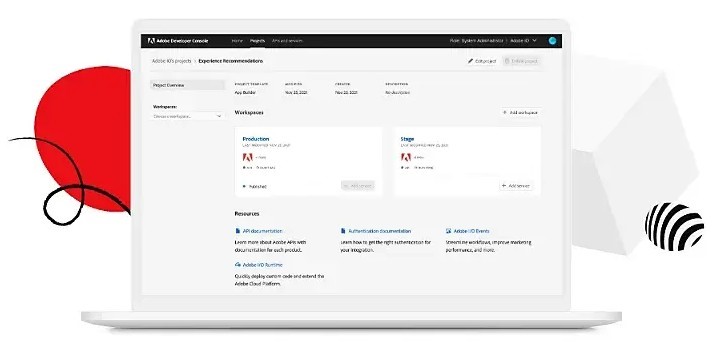
Source : https://business.adobe.com/products/experience-manager/developer-app-builder.html
BUBBLE.IO
This platform advertises itself as the world’s only full-stack, no-code platform. With Bubble, you can design, develop and launch production-grade applications and tools without the need to write a single line of code. As of November 2023, over 3 million apps are built using this platform, and Bubble offers over 6 thousand integrations with other tools.

Source : https://bubble.io/
RETOOL
Retool is a platform that allows users to build internal tools for their businesses without having to write code from scratch. It provides a drag-and-drop interface to create and customise various tools, interfaces, and dashboards by connecting to different data sources like databases, APIs, and more. Essentially, it enables teams to rapidly build and deploy internal tools, saving time and resources typically required for software development. It also allows integrating AI into apps and workflows with pre-built blocks.
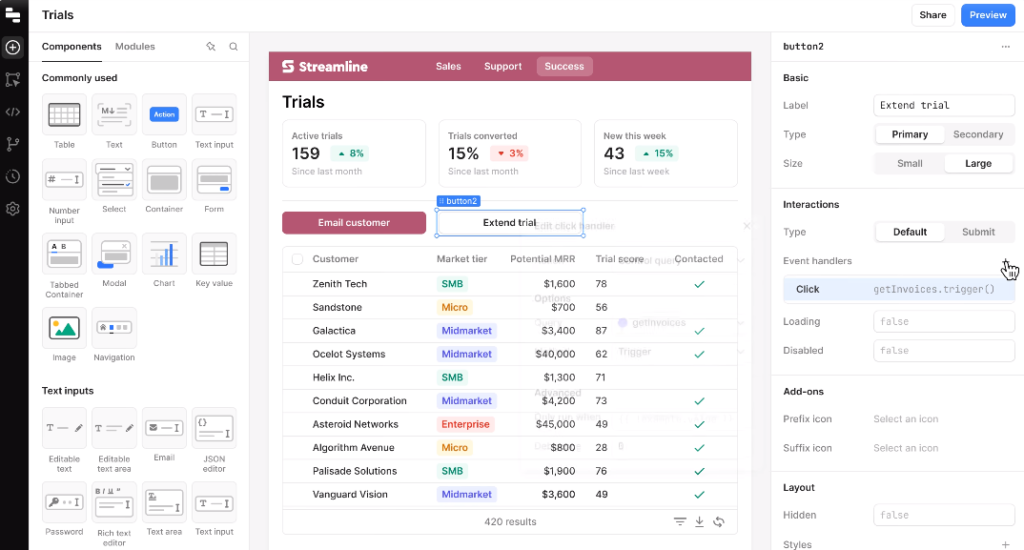
Source : https://retool.com
GITHUB COPILOT
It’s another low-code AI-powered platform developed by GitHub in cooperation with Microsoft. This platform uses the OpenAI Codex to suggest code and entire functions in real-time, right from the editor. According to their own research, developers using GitHub Copilot code up to 55% faster and feel more confident about the process.
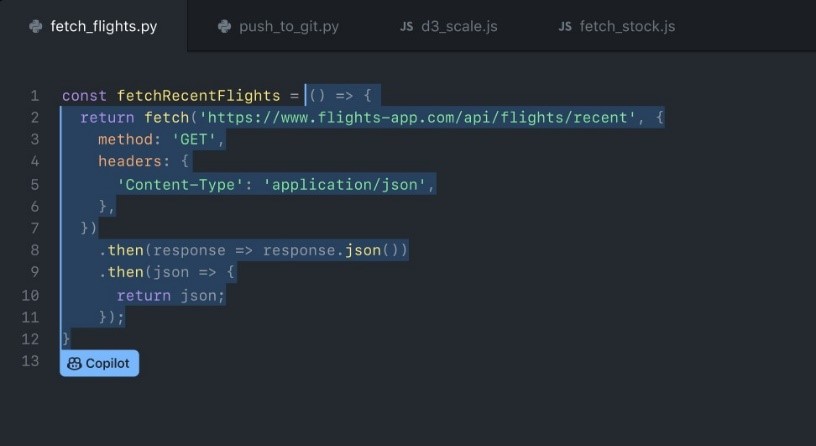
Source : https://resources.github.com/copilot-for-business/
Que pouvez-vous développer avec le développement d'IA low-code ?
The answer is more and more. Low-code platforms, as well as AI tools, are improving dynamically. What was unimaginable just five years ago is completely normal today. Of course, ChatGPT was a huge game-changer. Today, the 4.0 version can help you even write code from scratch for your ecommerce application.
In the near future, low-code platforms will be integrated with ChatGPT and other LLMs to give you this fantastic opportunity to just describe what you need and get it in a matter of minutes. Today, though, low-code platforms use artificial intelligence to streamline the process and provide you with real-time suggestions on what you can do to make your tool or app better.
Imagine, for instance, that you run a clothing online store and you want to integrate a ChatGPT-based assistant with your product search engine. This way, when someone looks for shirts, the assistant can ask them about the preferred colour or size. Moreover, the same platform that helped you design such an assistant can suggest you add a cross-selling feature so that your bot assistant can also advise your customers to also buy a tie or cufflinks that will go nicely with a chosen shirt.
In this example, the AI-powered assistant was designed primarily to help your customers. Naturally, you as a store owner also benefit because this assistant can help you increase sales, but that’s more of a side benefit. And that’s how you should think about low-code AI development and ecommerce automation in general.
Que pouvez-vous concevoir d'autre avec ces plateformes low-code ?
- Outils intelligents de recommandation de produits (L'IA peut suggérer des produits en fonction de l'historique d'achat et des produits recherchés de chaque client)
- Assistants virtuels autonomes (les chatbots n'ont pas besoin d'être intégrés au moteur de recherche ; ils peuvent fonctionner sur l'ensemble de votre site web et même sur vos profils de médias sociaux et soutenir vos efforts omnicanaux)
- Gestion et planification des stocks (vous pouvez utiliser des algorithmes d'IA pour la prévision de la demande afin d'optimiser les niveaux de stock, réduisant la probabilité de rupture de stock ou de surstock)
- Outils de vente croisée et de vente incitative (vous pouvez recommander à vos clients d'ajouter des outils complémentaires au panier ou leur suggérer d'envisager un modèle/une version supérieure du produit qu'ils ont choisi)
- Recherche intelligente (vous pouvez rendre votre moteur de recherche plus efficace en ajoutant davantage d'options de recherche, par exemple la recherche visuelle)
Et ce ne sont là que quelques exemples – avec le soutien d'un professionnel entreprise de développement ecommerce, il n'y a presque aucune limite à ce que vous pouvez concevoir.
Les avantages de l'utilisation de l'IA low-code dans l'ecommerce
There is one crucial advantage of using low-code AI development – speed. Low-code platforms provide users with drag-and-drop editors that offer ready-made or at least pre-configured solutions and pieces of code. With such a flexible environment, you can quickly implement and test new solutions and see how they work in practice.
You can also implement minor changes and new solutions without the need to involve your development team in the process. And lastly, with advanced language models such as ChatGPT, you can even get suggestions on what to improve or implement to make your app more useful from your customers’ perspective.
This way, you can go out of your “technological bubble” and fully adapt your online store, along with its features and processes, to what your customers expect. And that’s how we circle back to what we discussed in the beginning – UX should be your primary concern. Our advice is for you to use those solutions to guide your customers within the context they exist in – show them where they are, where they were and what you can give them – that’s the key to next-level personalisation that will allow your store to get ahead.
Avec ces plateformes d'IA low-code, vous pouvez disposer d'un outil ou d'un plugin pleinement opérationnel en quelques semaines. Un délai de mise sur le marché aussi court vous permet de réagir rapidement aux changements du marché et aux nouvelles tendances.
Un délai de mise sur le marché plus court signifie également que le coût de développement est nettement inférieur à celui d'un développement standard (d'ailleurs, le coût des erreurs et des fautes potentielles est également plus faible, ce qui permet à votre entreprise de tester plus activement de nouvelles solutions).
Globalement, l'utilisation d'outils low-code et de l'IA dans le commerce électronique réduit considérablement le coût de possession grâce à la diminution des coûts de développement, de maintenance et de formation, ainsi qu'à un déploiement plus rapide et une évolutivité facilitée.
Défis à prendre en compte
Enfin, nous souhaitons ajouter quelques mots sur les défis potentiels. Tout d'abord, gardez à l'esprit que les plateformes low-code sont aujourd'hui extrêmement populaires. Choisissez celle qui a le plus de chances de rester sur le marché plus de quelques semaines.
Secondly, don’t go overboard with low-code AI. If you implement this solution in everything you do, there is a serious risk that the quality of your company and its operations will go down. Don’t overcomplicate; if something can be achieved with standard development techniques, stick to them.
En outre, il est important de disposer d'une forme de mécanisme de contrôle – à chaque fois, vous devez prendre du recul et vous poser les questions suivantes :
• Est-ce que cela a du sens ?
• Combien de temps cela prendra-t-il ?
• Pouvons-nous rationaliser ce processus ?
• Existe-t-il une meilleure/plus rapide/plus simple façon d'obtenir le même résultat ?
Lastly, you need to define your long-term vision and pursue it in whatever you do concerning low-code AI platforms. Naturally, you won’t solve all of those problems yourself. You probably still need a web development partner that understands AI and supports you in your digital projects.
Si vous êtes encore à la recherche d'un telpartenaire de développement ecommerce – nous sommes à votre service !
Low-code platforms allow you to build applications without writing large amounts of code, using ready-made components and “drag-and-drop” interfaces. This makes the process of creating tools faster, more cost-effective, and accessible even to those without programming experience.
L'intégration de l'IA aux plateformes low-code permet l'automatisation des processus, la personnalisation de l'expérience client et un time-to-market plus rapide pour les nouvelles solutions. Cela se traduit par une meilleure UX, une plus grande flexibilité et des coûts opérationnels réduits.
Les plateformes low-code conviennent particulièrement bien aux petites et moyennes entreprises qui ont besoin de mettre en œuvre rapidement de nouvelles fonctionnalités. Pour les grandes entreprises, en revanche, des exigences complexes peuvent encore nécessiter une approche traditionnelle de développement logiciel.
The main challenges include selecting the right platform, maintaining a balance between automation and control, and avoiding an excessive number of tools that could overcomplicate processes. It’s also crucial to have a trusted technology partner to ensure the stability and security of your solutions.


arrow_circle_rightCONTACT
Avez-vous besoin d'aide pour mettre en œuvre l'IA dans le commerce électronique ?

arrow_circle_right nos articles