Choisir une plateforme e-commerce B2B pour une croissance stratégique de l'entreprise – que considérer avant la mise en œuvre ?


The B2B sales market is undergoing rapid digital transformation. Companies must adapt to rising customer expectations and fast-paced technological change, in a landscape where many organisations still lack a solid foundation, such as a modern B2B ecommerce platform.
Today, business clients expect a shopping experience similar to that of B2C: immediate access to product ranges, straightforward ordering processes and full self-service. At the same time, companies are under pressure to optimise operating costs and automate sales processes. As a result, the B2B platform is no longer merely an ‘add-on’ to sales, but is becoming its core, which is also often a customer requirement.
That is why in this article, we focus on providing a practical decision-making framework and outlining the key criteria for selecting a B2B ecommerce platform, so that it is easier to align available technology with the organisation’s chosen business strategy.
Pourquoi le choix d'une plateforme B2B est-il une décision stratégique, et non simplement technique ?
Le choix d'un B2B plateforme de commerce électronique directly influences the way an organisation sells, serves its customers and scales its business. It is a decision that can affect a company’s operations for years to come, which is why it should be analysed in the context of business strategy, rather than solely in terms of the system’s functionalities.
The technological aspects of choosing a platform are, of course, important, but they should only account for a fraction of the decision. Technology alone cannot be the starting point; however, it is worth remembering that it is a key factor that may determine the success of the entire venture. It is often technology that determines how effectively and how quickly an organisation can translate business objectives into tangible operational activities.
Therefore, it is crucial that technology supports a pre-established strategy, rather than defining or altering it. When selecting a platform, the focus should be on the company’s actual needs and decisions regarding its future development, such as: do we plan to expand into new markets? Are we opening up to new customer segments or sales channels (B2C, D2C)? It is only within this broader context that the choice of a B2B ecommerce platform takes on its true significance and can genuinely support the achievement of long-term objectives and positively impact business metrics.
Coût d'acquisition et de traitement des commandes
A B2B platform changes the sales cost structure. Thanks to self-service, customers can place orders, check statuses, generate bids, and download necessary documents and invoices themselves, thereby reducing the involvement of sales representatives and the customer service department. At the same time, the automation of processes – such as order validation, discount calculation and payment processing – reduces errors and operational costs. In practice, a well-chosen platform allows you to handle a higher volume of orders without a proportional increase in staff numbers.
Time-to-market pour les nouveaux marchés et canaux
A modern ecommerce platform enables the rapid launch of new languages, currencies or product catalogue versions, which is crucial for international expansion. Equally important is the ability to test new sales models, e.g., transitioning from an offline to a hybrid model or launching direct-to-consumer (D2C) sales. A platform with limited capabilities can significantly slow down these activities, resulting in missed market opportunities.
TCO (coût total de possession) sur une période de 3 à 5 ans
The cost of a platform is more than just the licence fee. You must take into account the costs of implementation, integration, development of new features, infrastructure maintenance, updates and technical support. For some solutions, costs rise in line with the scale of the business (e.g., licence fees), which can affect profitability. Therefore, a TCO analysis should cover realistic growth scenarios, not just the organisation’s current state.

Capacité d'intégration avec les systèmes (ERP, PIM, WMS, automatisation marketing)
A B2B platform rarely operates as an isolated system; it is usually part of a larger technological ecosystem. Integration with ERP handles the synchronisation of orders, stock levels and settlements; PIM manages product information; WMS supports logistics; and marketing automation tools enable personalised communication. If the platform does not offer flexible APIs or requires costly, bespoke integrations, it can quickly become an operational bottleneck.
Le coût d'un mauvais choix et les risques liés au changement de plateforme
Changing platforms after a short period of time (replatforming) is one of the most expensive undertakings in ecommerce. It involves not only technological costs (new implementation, data migration, integrations), but also business risks: drops in conversion rates, operational downtime, loss of organisational knowledge, or the need to retrain teams. Therefore, the decision on which platform to choose should minimise the risk of having to change it for at least the next few years.
Choosing the wrong B2B ecommerce platform can be very costly for a company, both financially and in operational and strategic terms. The implementation of a B2B platform alone is usually a process lasting several months, which requires mapping the company’s individual processes and integration with ERP, WMS, PIM or even PLM (Product Lifecycle Management) systems. The problem arises when, for example, a company changes its strategy after a year – it begins to develop a B2C or D2C sales model, expand abroad, or launch new brands following acquisitions.
It may then turn out that the platform, which initially met the requirements, begins to hinder business growth. This often leads to the need for replatforming, meaning another costly implementation lasting up to six months. Therefore, the decision on which technology to choose should take into consideration not only current needs, but also the company’s strategy and development plan for the next 3–4 years.
Un aperçu des plateformes de commerce électronique B2B
In the B2B ecommerce platform market, there is no single solution that is ideal or optimal for every business scenario. Each platform is developed differently, has its own pros and cons, and addresses different organisational needs. Some focus on flexibility and an extensive ecosystem, whilst others prioritise ready-made, built-in functionalities or speed of implementation.
Therefore, rather than searching for the ‘best’ platform, it is worth understanding its strengths and limitations, as well as the business context in which they work best. Only this knowledge, combined with an analysis of processes, needs and development plans, will help you choose the platform that best suits your business objectives.
Magento Open Source
Magento is one of the most recognisable and widely used ecommerce solutions in the world. Its greatest advantage is its maturity, which translates into a vast number of developed modules, agencies, implementation partners and specialists available on the market.
Although it is not a native B2B platform, thanks to its extensive community and ecosystem of ready-made extensions, it allows for the quick implementation of new features tailored to complex sales processes and business operations. This platform offers considerable scope for customisation, which is why it is particularly popular among companies that require a high degree of flexibility and control over the code.
At the same time, this very flexibility can become a challenge. Magento projects often evolve into highly customised solutions which, after a few years, may deviate significantly from the platform’s standard core. This can result in higher maintenance costs and difficulties in further development.
- Modèle de licence: open source (aucun frais de licence ; coûts de mise en œuvre et de maintenance à la charge de l'entreprise)
- Architecture: monolithique avec l'option d'une approche headless
- Capacités B2B prêtes à l'emploi: limité ; la plupart des fonctionnalités (par exemple, tarification contractuelle, workflow) nécessitent des extensions
- Écosystème d'intégration et d'extension: très étendue, avec des milliers de modules disponibles
- Communauté et expertise (PL/UE): très large – forte disponibilité de développeurs et d'agences
Découvrez comment nous avons modernisé une boutique ecommerce en implémentant Magento
En savoir plus
Adobe Commerce
Adobe Commerce est une solution sous licence qui étend les capacités de Magento, aimed primarily at the enterprise sector. It offers extensive B2B functionalities, support for global organisations, and integrations with Adobe tools. The platform combines the flexibility of Magento with additional modules and vendor support, enabling large companies to build a cohesive digital environment.
However, it is worth remembering that as the scope of functionalities increases, so do complexity and maintenance costs. Adobe Commerce works best where an organisation is ready to invest not only in technology but also in the processes and expertise needed to fully utilise the platform’s potential.
- Modèle de licence: propriétaire (licence payante, souvent dépendante de l'échelle de l'entreprise)
- Architecture: moderne, prêt pour le headless, évoluant vers le commerce composable
- B2B prêt à l'emploi: très complet (listes de prix personnalisées, structures d'entreprise, workflows d'approbation)
- Écosystème d'intégration et d'extension: robuste, soutenu par Adobe et ses partenaires
- Communauté et expertise (PL/UE): étendue, bien que plus spécialisée et coûteuse
Shopware 6
Shopware 6 est une plateforme ecommerce moderne développée selon une approche API-first, qui gagne en popularité, particulièrement en Europe. Elle combine flexibilité technologique et fonctionnalités B2B de plus en plus sophistiquées.
Shopware develops a significant portion of its features directly within the platform’s core, thereby reducing the need to rely on external modules. This allows organisations to take advantage of new capabilities sooner without having to integrate multiple extensions. In practice, this translates to a favourable price-to-quality ratio.
A notable advantage of Shopware 6 is its strong focus on tailoring solutions to the regulatory and business realities of the European market. The platform responds swiftly to changes arising from EU directives and regulations (e.g., in the area of price transparency), implementing tailored solutions within its core. For businesses, this means a reduced need to build their own bespoke solutions in this area.
- Modèle de licence: hybride (open core + modules payants)
- Architecture: API-first, headless-ready, basée sur une stack technologique moderne
- B2B prêt à l'emploi: modéré – disponible via des extensions (par ex., B2B Suite)
- Écosystème d'intégration et d'extension: en forte croissance, particulièrement en Europe
- Communauté et expertise (PL/UE): en croissance, avec un nombre croissant de partenaires en Pologne
Découvrez une success story sur une mise en œuvre étendue de Shopware B2B
En savoir plus
OroCommerce
OroCommerce is a platform designed from the ground up for B2B sales. Its main advantage is its ability to handle complex business processes without the need for extensive customisation. Many features that would require significant development on other platforms are available here immediately upon implementation. In many cases (assuming the company doesn’t have highly complex processes), a well-executed configuration can meet a significant portion of the organisation’s needs without the necessity of further intensive development.
An additional advantage of the platform is its built-in CRM module, which supports sales teams’ work. In addition to its embedded features, the platform also offers customisation options. However, it should be mentioned that this platform is still smaller than other, better-known solutions on the market – it is constantly evolving and is only just gaining popularity. This results in a limited availability of implementation partners, specialists or ready-made integration solutions.
- Modèle de licence : open source + version entreprise
- Architecture: API-first, modulaire, conçu pour l'intégration avec les systèmes métiers
- B2B prêt à l'emploi: très solide (devis, structures organisationnelles, workflow, rôles utilisateurs avancés)
- Écosystème d'intégration et d'extension : plus petit que celui de Magento, mais plus spécialisé
- Communauté et expertise (PL/UE) : encore assez petite, mais axée sur les projets B2B
Critères de choix d'une plateforme B2B
Le choix d'une plateforme de commerce électronique B2B doit être fondé sur sa capacité à s'aligner sur les caractéristiques, les processus et les plans de développement spécifiques de l'organisation. Les critères ci-dessous aident à structurer l'analyse et à définir les bonnes priorités.
Alignement avec le modèle de vente (self-service, assisté, hybride)
Every B2B organisation has a different approach to sales. In the self-service model, user convenience and automation are key, whereas in the assisted model, the role of the sales representative remains significant (e.g., in the quotation or negotiation process). In the hybrid model, both approaches coexist. The platform should support the chosen model without the need for major modifications, e.g., by enabling the assignment of account managers, bid management, or sharing the shopping basket between the customer and the sales representative.

Prise en charge de plusieurs marchés, devises, langues et entrepôts
International expansion requires flexible management of different versions of the offering. The platform should enable the creation of multiple storefronts, support for different currencies, handling of local taxes and regulations, and integration with multiple warehouses. It is also essential to manage differences in product ranges and pricing across markets.
Profondeur de la personnalisation (UI, logique tarifaire, processus)
In B2B, personalisation goes beyond the interface’s appearance. It includes, among other things, individual price lists, contract discounts, payment terms, and specific purchasing processes (e.g., multi-level order approval). The platform should allow for flexible modelling of these elements without the need to create custom code each time.
Préparation à l'intégration (ERP, PIM, CRM, paiements, logistique, etc.)
The availability of APIs and ready-made integration connectors is essential when making a choice. The platform should provide support for system integration and enable efficient, real-time or near-real-time data exchange between systems. It is also worth assessing whether integrations can be implemented in a scalable manner or whether every change requires modification of the platform’s code.
Évolutivité technique et financière
The platform should be able to handle growing traffic, user numbers, and order volumes without any drop in performance. Cost scalability is equally important: does business growth lead to a disproportionate increase in licence, infrastructure, or maintenance costs? It is worth analysing various growth scenarios and their impact on the budget.
Dépendance vis-à-vis d'un fournisseur vs. souveraineté technologique
Some platforms restrict the ability to modify the code or make the company dependent on a single supplier (vendor lock-in). Others, particularly open-source platforms, offer greater control but require more technical expertise. The choice should take into account the long-term strategy: does the company wish to build its own technological capabilities, or can it rely on external suppliers?
Temps et coût de mise en œuvre (MVP vs solution finale)
In practice, B2B ecommerce platform implementations are often carried out in stages. The key factor is whether the platform enables a fast MVP (Minimum Viable Product) launch, allowing you to start generating business value, followed by iterative development of features. It is also important to assess whether the system architecture supports such an approach or requires significant upfront investment.
One of the most frequently underestimated aspects of platform implementation is pricing and the logic behind assigning prices to customers. Companies often assume that a simple division into customer groups is sufficient, but in practice, it turns out that there are many exceptions, individual conditions, or special rules for specific product categories. It is only during the pre-implementation analysis that the true complexity of pricing processes comes to light. This often results in price lists being simplified right at the platform implementation stage, as the previous models were too complex to manage effectively.
Adapter la plateforme au scénario commercial
The choice of a B2B ecommerce platform should be based primarily on the organisation’s business context – its processes, scale of operations, development plans, and level of readiness for change. In practice, there are certain scenarios in which specific platforms are more often the right choice, but these are not set-in-stone rules. The final decision should be preceded by an analysis of the company’s requirements, processes, and development strategy.
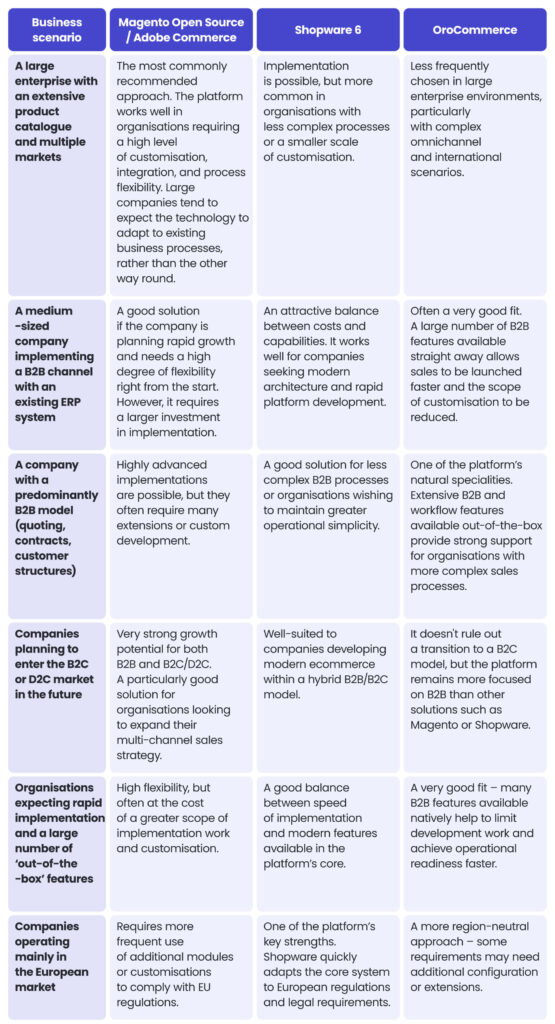
Liste de contrôle avant de choisir une plateforme e-commerce B2B
Before deciding on a B2B ecommerce platform, it is worth going through a set of questions that help clarify core business, technical, and operational requirements. Such an analysis often helps avoid costly mistakes already at the planning stage of implementation.
1. Stratégie commerciale, développement et objectifs du projet
- Savez-vous quels défis commerciaux la mise en œuvre d'une plateforme de commerce électronique B2B est censée relever ?
- Quels sont les plans stratégiques et les ambitions de croissance de l'organisation pour les 3 à 5 prochaines années ?
- Avez-vous défini les objectifs commerciaux et les KPI que la plateforme est censée atteindre ?
- Prévoyez-vous une expansion internationale ou l'entrée sur de nouveaux canaux de vente (par exemple, B2C, D2C) ?
- La plateforme est-elle destinée à prendre en charge plusieurs langues, devises, marchés ou entrepôts ?
- Êtes-vous davantage préoccupé par un lancement rapide d'un MVP (et son expansion ultérieure) ou par la construction d'une solution finale et évolutive ?
- La plateforme doit-elle permettre un développement par phases et une expansion progressive des fonctionnalités dans le temps ?
- Quelle est l'importance de pouvoir adapter rapidement la plateforme aux changements légaux et aux réglementations ?
2. Processus de vente et préparation technologique
- Avez-vous défini les processus d'achat de vos clients ?
- Les processus de commande sont-ils documentés et reproductibles ?
- À quoi ressemble le processus actuel de passation et d'exécution des commandes ?
- La gestion des réclamations et des retours est-elle standardisée ?
- Quelles fonctionnalités de la plateforme sont essentielles pour votre activité ?
- Quelles intégrations système sont critiques le jour du lancement ?
- Avez-vous des attentes concernant l'IA et l'automatisation, et si oui, quelles sont-elles ?
- Quelle importance accordez-vous à la possibilité de personnaliser davantage la plateforme ?
3. Données, produits et organisation de l'information
- Disposez-vous d'une base de données produits standardisée (PIM ou équivalent) ?
- Les données des clients et des fournisseurs sont-elles centralisées dans un système ERP ou CRM ?
- Les listes de prix et les conditions générales sont-elles organisées et gérées numériquement ?
- Quelle est l'ampleur et la complexité du catalogue de produits ?
- Les produits ont-ils des variantes, des configurations ou des dépendances ?
- À quelle fréquence les données produit, les prix et les disponibilités sont-ils mis à jour ?
- La logistique et les niveaux de stock sont-ils gérés par un système ?
4. Budget, ressources et organisation du projet
- Quelles ressources comptez-vous allouer à la mise en œuvre, à la maintenance et au développement de la plateforme ?
- Disposez-vous d'un budget approximatif défini et d'un calendrier de mise en œuvre ?
- Le TCO projeté (licence + mise en œuvre + maintenance + développement) pour les 3 prochaines années correspond-il à vos capacités financières ?
- Disposez-vous d'une expertise technique interne ou avez-vous besoin d'un partenaire de mise en œuvre ?
- Disposez-vous d'une équipe dédiée responsable du projet au sein de votre organisation ?
- Quelle est l'importance pour vous de la disponibilité des développeurs et des partenaires de mise en œuvre sur le marché ?

Avantages de la mise en œuvre d'une plateforme B2B
The benefits of implementing a B2B ecommerce platform may vary depending on the organisation’s specific nature, sales model, or stage of digital transformation. For some, the key KPI will be an increase in online orders; for others, it will be reducing customer service times, improving lead conversion rates, or reducing the number of errors and complaints. Therefore, the effectiveness of the implementation should be assessed primarily in the context of the organisation’s business objectives that the platform is designed to support.
Réduction des coûts d'exploitation
L'automatisation des commandes réduit la charge de travail des services commerciaux et du service client. Les clients peuvent passer des commandes, vérifier les statuts et télécharger des documents eux-mêmes sans avoir à contacter un représentant commercial ou le back-office.
In practice, the automation of after-sales service also generates significant savings. Invoices, corrections, delivery notes, and order history are accessible directly on the platform, significantly reducing the number of calls and messages regarding simple administrative tasks. This not only reduces costs but also speeds up customer service and enhances the convenience of cooperation.
Raccourcissement du cycle de vente
Les clients peuvent passer des commandes et générer des devis eux-mêmes sans avoir à contacter le service commercial. Cela est particulièrement important dans les situations où les décisions d'achat sont prises en dehors des heures ouvrables standard.
In practice, a B2B ecommerce platform often streamlines the process even before the order is formally placed. The customer does not have to wait to be contacted by a sales representative; they can place an order immediately, confident that it will be processed the next working day. This builds convenience and a habit of using the online channel, which directly contributes to an increase in the number of orders processed through the platform.
Valeur du panier augmentée
Les mécanismes de vente croisée et de vente incitative fonctionnent également dans le modèle B2B. La plateforme peut recommander des produits complémentaires, rappeler aux clients les articles achetés régulièrement ou présenter des conditions tarifaires individuelles pour un client spécifique.
Meilleure fidélisation de la clientèle
Personalisation and convenience boost loyalty. Today’s business customers expect not only an attractive offer, but also a fast, convenient, and predictable purchasing process. The ability to place orders at any time, along with quick access to order history, documents, and individual purchase terms, makes the platform a natural channel for business cooperation.
Les données comme avantage concurrentiel
The platform provides information on customer behaviour that can support sales and marketing strategies. Organisations can analyse, e.g., the frequency and volume of orders, as well as the effectiveness of offers, promotions, and individual price lists. In the long term, this data enables not only the optimisation of the sales process but also the faster identification of operational issues, such as sources of complaints, process errors, or areas that generate unnecessary losses or costs.
L'étape finale : choisir une plateforme B2B et un partenaire de mise en œuvre
There is no single ‘best’ B2B ecommerce platform. But there can be a solution best suited to your business model, processes, and growth ambitions. That is why choosing a platform should be the result of strategic analysis, rather than merely a technological decision or a comparison of feature lists.
La clé du succès est :
- comprendre vos propres besoins métier,
- une évaluation réaliste des ressources et des contraintes,
- choisir une technologie qui soutient votre stratégie, plutôt que de la définir.
In practice, this means moving away from thinking “which platform should we choose?” towards asking: “which platform should we choose to achieve our business goals over the next 3–5 years?” Only with this foundation in place, you can make an informed assessment of which direction is better – a more flexible and customisation-friendly solution, or a platform offering a greater number of features available immediately upon implementation.
If you are planning to implement a B2B ecommerce platform but need further support in defining your implementation requirements, or you are ready to proceed but are looking for an implementation partner with the necessary technical expertise, please get in touch with us via the form below. We will assist you at every stage of the implementation process, from concept and analysis through to integration and platform maintenance.
FAQ
The choice of a B2B ecommerce platform should be based primarily on the organisation’s business strategy, rather than solely on a list of technical features. Before implementation, it is worth defining the company’s development plans for the next 3–5 years, such as international expansion, the development of a B2C or D2C sales model, or the automation of sales processes. Only on this basis is it possible to assess which platform best supports your business objectives.
Les critères les plus importants incluent :
– l'alignement avec le modèle de vente (libre-service, assisté, hybride),
– capacités d'intégration avec ERP, PIM, WMS et CRM,
– évolutivité technique et tarifaire,
– prise en charge de plusieurs marchés, langues et devises,
– flexibilité dans la personnalisation des processus et des listes de prix,
– coût total de possession (TCO),
– disponibilité des partenaires de mise en œuvre et des développeurs.
TCO (Total Cost of Ownership) covers not only the cost of licences, but also implementation, integrations, functionality development, infrastructure maintenance, updates, and technical support. When analysing TCO, it is worth taking into account the organisation’s planned growth and potential cost increases as the business scales up.
Replatforming involves changing your ecommerce platform after you have first implemented another solution. This process generates high technological and operational costs, including data migration, new integrations, staff training, and the risk of sales downtime. That is why a B2B ecommerce platform should be thoroughly considered and chosen with a perspective of at least a few years of company growth.
Une plateforme B2B moderne devrait permettre l'intégration avec, par exemple :
– ERP,
– PIM ou DAM,
– WMS,
– CRM,
– systèmes de paiement,
– outils d'automatisation marketing,
– systèmes logistiques.
Cela permet l'automatisation des processus et la synchronisation des données en temps réel.
Magento remains one of the most popular ecommerce platforms thanks to its high flexibility, extensive ecosystem of extensions, and the wide availability of developers and implementation partners. It is a good solution for companies requiring complex integrations and customised business processes.
Absolument. Shopware 6 est également fréquemment choisi par les entreprises qui développent un ecommerce B2B et B2C moderne. La plateforme offre une architecture API-first, une capacité headless et une bonne adéquation avec les réglementations européennes et le marché de l'UE.
OroCommerce is particularly well-suited to organisations focused on B2B that have complex processes, such as quoting, commercial contracts, approval workflows, or multi-level customer structures. The platform offers many B2B features available out-of-the-box, which reduces the need for and scope of customisation.
Les erreurs les plus courantes sont :
– choisir une plateforme uniquement sur la base du prix,
- ne pas analyser la stratégie d'entreprise,
– sous-estimer la complexité des structures tarifaires et de la logique de prix,
– négliger les coûts d'intégration et de maintenance,
– absence de plan pour l'évolution de la plateforme,
– ne pas tenir compte du développement futur B2C ou D2C.
Implementation time depends on the scale of the project, the number of integrations, and the level of customisation. MVP projects can take several months, whilst large-scale enterprise implementations are often carried out in phases over 6–18 months or longer.
Lors du choix d'un partenaire de mise en œuvre, il convient de prendre en compte :
– expérience dans les projets B2B,
– capacités d'intégration,
– connaissance de la plateforme choisie,
- la disponibilité de l'équipe de développement,
– approche de l'analyse métier,
– la possibilité d'un support continu et d'un développement de la plateforme après la mise en œuvre.


arrow_circle_rightContactez-nous
Découvrez comment nous pouvons soutenir le développement de votre plateforme B2B


Tomasz Puszczyk
Responsable des ventes et des opérations de revenus
arrow_circle_right Nos articles