SPICE vers ASPICE – évolution des normes et mise en œuvre


Market competition in the software industry is leading to a steady increase in innovation and product quality. For companies in the sector to remain relevant the market, it is important to apply solutions that help them keep up with market pressure. Without the steady improvement of software development processes, it is nearly impossible to achieve adequate quality and efficiency. Implementing special standards such as ISO 15504 or Automotive SPICE helps to deliver proper results. In this article we are taking a look at these standards, their evolution and the benefits that come from implementing them in a company.
Qu'est-ce que SPICE (ISO15504) ?
ISO 15504 also known as SPICE (Software Process Improvement and Capability Determination) is an international norm made in collaboration between International Organisation for Standardisation (ISO) and International Electrotechnical Commission (IEC). Originally, SPICE was funded by the European Union and was its response to CMMI. The SPICE standard is prepared for software companies and its main goal is to assess and improve the capability of the development process.
The SPICE standard is designed to help identify the stages of software development that need improvement in order to make a holistic impact on improving the quality of products developed in the industry. The model can also be used to measure the effectiveness of the process. There are various models of evaluating software companies, but one of the most commonly used in the world is the ISO 15504 standard. According to ISO 15504, evaluation of the software production process should focus on project planning, project management, software development and organisational processes.
Le processus de certification SPICE comporte plusieurs étapes :
- Évaluation initiale
- Développement des processus
- Appliquer les processus dans les projets logiciels de votre entreprise
- Évaluation finale
- Certification
Dans le processus d'évaluation, SPICE utilise son propre PAM (Process Assessment Model) qui aide à définir la capacité des processus au sein d'une organisation. Il adopte une approche bidimensionnelle et définit :
- Process Dimension – se concentre sur tous les indicateurs fondamentaux pour évaluer la capacité d'un processus, comme les pratiques de base et les produits de travail.
- Dimension de capacité – se concentre davantage sur les indicateurs généraux de capacité des processus tels que les pratiques génériques, les ressources générales et les produits de travail génériques.
ISO 15504 fournit un cadre basé sur 6 niveaux de capacité sur une échelle de 0 à 5, mesurés par 9 attributs de processus :
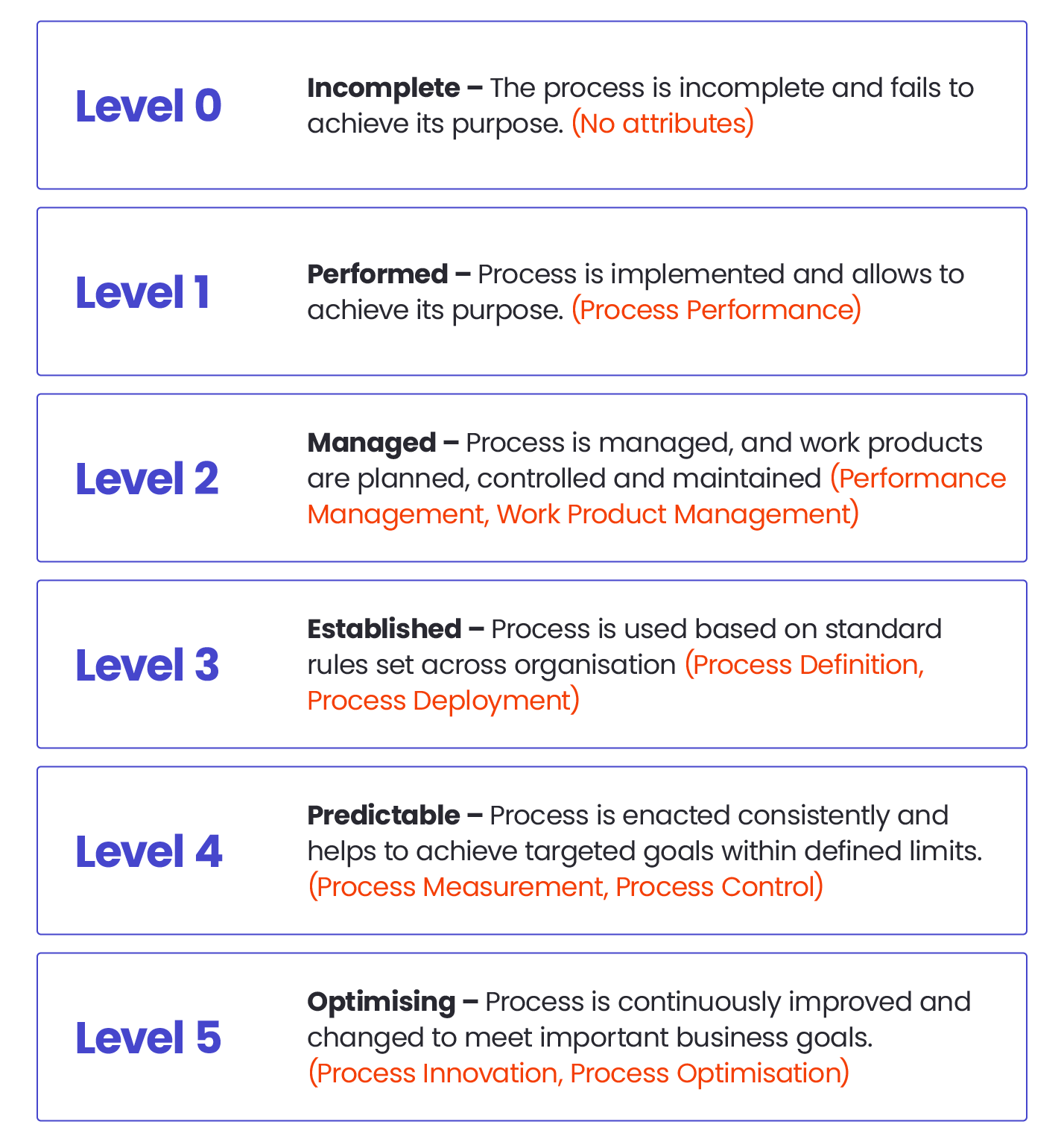
Chaque attribut de processus est évalué selon une échelle de notation à quatre points :
- Non atteint (peu ou pas de preuve de l'attribut dans le processus)
- Partiellement atteint (certaines preuves de l'attribut dans le processus, et certains aspects encore imprévisibles)
- Largement atteint (preuves significatives de l'attribut dans le processus, mais une certaine variation peut exister)
- Entièrement atteint (l'attribut est entièrement et systématiquement présent dans le processus).
Avec une notation attribuée à chaque attribut et à chaque processus, nous pouvons créer un profil d'évaluation qui peut prendre diverses formes, comme des tableaux ou des graphiques.
La norme SPICE ne contient pas de réglementations strictes en matière d'évaluation. Elle définit plutôt le champ d'application de base des exigences à respecter pour mener une évaluation conformément aux lignes directrices de l'ISO/IEC 15504.
The ISO/IEC 15504 model can be used in companies of different sizes and different areas of operation. The standard does not pay attention to the internal structure or business philosophy of the software company. Nor is it built for a specific software technology or development process. The model is intended to provide the basic requirements for quality software engineering.
De l'ISO 15504 à l'ISO 33000
In time ISO 15504 needed to evolve, therefore its numbering scheme was changed to ISO/IEC 33000. With that modification, the norm had a complete technical and conceptual overhaul on process assessment and now also offers in-depth review of the topic both for software developing organisations and for those who outsource such services. ISO 33000 revises ISO 15504 and provides a framework for assessment to cover the processes used in the development, maintenance and application of systems across IT area, and also those deployed in the design, improvement and delivery of services. In contrast to ISO 15504 one of the main objectives of ISO 33000 is to provide a global framework for process evaluation and a final framework for improvement processes and management systems. Results of assessment stay similar, which means it can help with improvement of process performance and identification of risks associated with the use of processes. In general, the actualisation to ISO 33000, was made to create a more complete and up-to-date standard.
L'ASPICE comme évolution du SPICE
Besides the change involved in ISO 15504 numbering modification, SPICE itself also evolved. The influence of various industries has played an important role in this process. The ISO/IEC 15504 norm is focused on software in general. Therefore, after the release of SPICE several process assessment models and extensions were developed for more specified industries, for example:
- Automotive SPICE
- Medi SPICE – Médecine
- SPICE pour l'ingénierie matérielle
- Mechanical SPICE
- Test SPICE
- Agile SPICE
- S4S – SPICE for SPACE – Technologie spatiale
- SPICE en action – Expériences de personnalisation et d'extension
ASPICE or Automotive SPICE is one of the norms that evolved from ISO 15504. As its main focus it provides best practices and processes in terms of automotive software development. Therefore, we can define ASPICE a lot like SPICE itself, as an assessment model that provides a framework for defining, implementing and evaluating software development processes. With the difference that it is applied only to the automotive industry and its own crucial demands.
Téléchargez notre Guidebook sur ASPICE
Obtenir l'ebook
La certification ASPICE peut garantir que des améliorations sont apportées à chaque étape du processus de production. ASPICE fonctionne également dans le contexte deISO-26262 et ISO SAE 21434. Malgré leurs différences, les normes sont complémentaires les unes des autres et peuvent fournir un meilleur processus de développement logiciel.
The structure of the Automotive SPICE model is very similar to ISO 15504. In the evaluation process, it also uses the two-dimensional framework of Process Dimension and Capability Dimension. Both are rated by the same scale of 6 levels of capability, 9 attributes of process assessment and achievement scale presented by 4 letters (N, P, L, F).
This evaluation model relates to the V-model, which includes a testing phase alongside every stage of development. ASPICE uses VDA scope, which can be defined as a minimal set of processes. This model, on its left side of the V, includes initial phases, such as:
- SYS.1 – Élicitation des exigences – la phase est hors du périmètre VDA, ce qui signifie que nous pouvons l'utiliser, mais elle n'est pas exigée par le OEM
- SYS.2 – Analyse des exigences système
- SYS.3 – Conception architecturale du système
- SWE.1 – Analyse des exigences logicielles
- SWE.2 – Conception architecturale logicielle
- SWE.3 – Conception détaillée du logiciel et construction des unités
Et sur son côté droit du V, il inclut des phases secondaires, telles que :
- SYS.4 – Intégration système et tests d'intégration
- SYS.5 – Test de qualification système
- SWE.4 – Vérification des unités logicielles
- SWE.5 – Intégration logicielle et test d'intégration
- SWE.6 – Test de qualification logicielle
Cette évaluation offre un meilleur contrôle du processus de développement logiciel et aide à garantir la qualité du produit, une mise sur le marché en temps voulu et, en identifiant rapidement les problèmes, réduit l'impact des coûts sur le développement du produit.
Avantages de la mise en œuvre de SPICE et ASPICE
Étant donné que les normes sont très similaires, elles partagent également certains avantages découlant de l'utilisation de ces modèles d'évaluation. Il est facile de trouver des avantages à l'utilisation de ces normes, parmi lesquels nous pouvons souligner les suivants :
- Identification des tâches et des compétences importantes pour le processus.
- Structuration et standardisation des processus.
- Offre la possibilité de mesurer la qualité du développement logiciel.
- Motiver les ingénieurs de processus à tirer le meilleur parti des ressources afin d'atteindre les objectifs de l'organisation.
- Contribue à instaurer une culture d'amélioration continue au sein de l'entreprise.
- Contribue à accroître la reconnaissance sur le marché et la confiance dans les produits de l'entreprise.
- Détectez et corrigez les défaillances possibles à chaque étape d'un projet.
- Accroître la satisfaction client.
La mise en œuvre de ces normes aide à traiter tout type de dysfonctionnement dans un projet logiciel tout en suivant des lignes directrices communes à toutes.
Using SPICE or ASPICE has the potential to reduce costs, missteps, and work time. Limitation of defaults and defects in the software developing process is especially important in the case of the automotive industry since it may prevent the manufacturer from putting a vehicle with flaws on the market.
Those standards can also improve contact with clients. They help to avoid miscommunications and provide greater transparency between producers and their business partners. From a client’s perspective, they can also be useful for measuring the maturity of a process in a supplier’s company and for determining the capabilities of a potential technology partner.
Another important advantage is related to the maturity of a process and its correlation with product maturity. Usually, the more a mature process is, the higher product maturity is. Which translates to finding out and fixing possible product faults at an early stage of the development process. All that also supports cost reduction, while encouraging innovation despite limited resources.
L'importance de l'utilisation de SPICE et ASPICE dans l'organisation
With all the value from the benefits shown here, the main reason to implement SPICE or ASPICE in a company still should be the need of being a competitive producer in a software market. In many cases, especially in the automotive industry, without those certificates it is hard to find partners or clients. Implementation of those standards helps to show who is a reliable cooperation partner.
Use of ASPICE seems to be crucial in the automotive industry. Since it requires both suppliers and customers to be very strict about the products they put on the road, the mutual use of a standards’ certification such as ASPICE simplifies work by ensuring the same approach. An approach that puts quality and safety first, for all parties involved in the process.
In Spyrosoft we see even more value in using those standards. As practitioners with a lot of experience in implementing both SPICE and Automotive SPICE, we also like to expand our portfolio to other standards related to safety and cybersecurity. Here, experience in ASPICE is a great advantage, because a lot of security and safety standards like FuSa are built on a base similar to the one in ISO 15504. Therefore, for us the extra value in using ASPICE is also treating it as a basic framework, that we already have and that helps with the implementation of other standards. In many cases, it means that we already have the base, and now we only need to adjust and add missing pieces to be compliant with other standards, for example with FuSa.
In conclusion, not having SPICE or ASPICE in a company can result in lack of confidence from other firms and business partners. While implementing those can have multiple benefits in terms of both product development processes and the business aspects of the company.
Si vous souhaitez en savoir plus sur les normes et les standards de sécurité automobiles, consultez notre ASPICE et FuSa offre.




arrow_circle_rightContactez-nous
Contactez-nous pour vérifier comment nous pourrions soutenir votre projet automobile

arrow_circle_right Nos articles