فهم شبكات توصيل المحتوى المتعددة (multi-CDN): الفوائد وأفضل الممارسات


Imagine that your latest piece of content just dropped, your viewers are trying to stream simultaneously, and suddenly your CDN provider experiences an outage. Within minutes, your social media channels are flooded with frustrated users, and your customer support team is overwhelmed. What’s worse, your reputation takes a hit that could last months.
This nightmare scenario has prompted media companies and content creators to adopt a multi-CDN strategy. This guide will show you how to build a multi-CDN solution that transforms your content delivery from a single point of failure into a robust, intelligent system that automatically adapts to deliver peak performance around the clock.
ما هي استراتيجية تعدد شبكات CDN؟
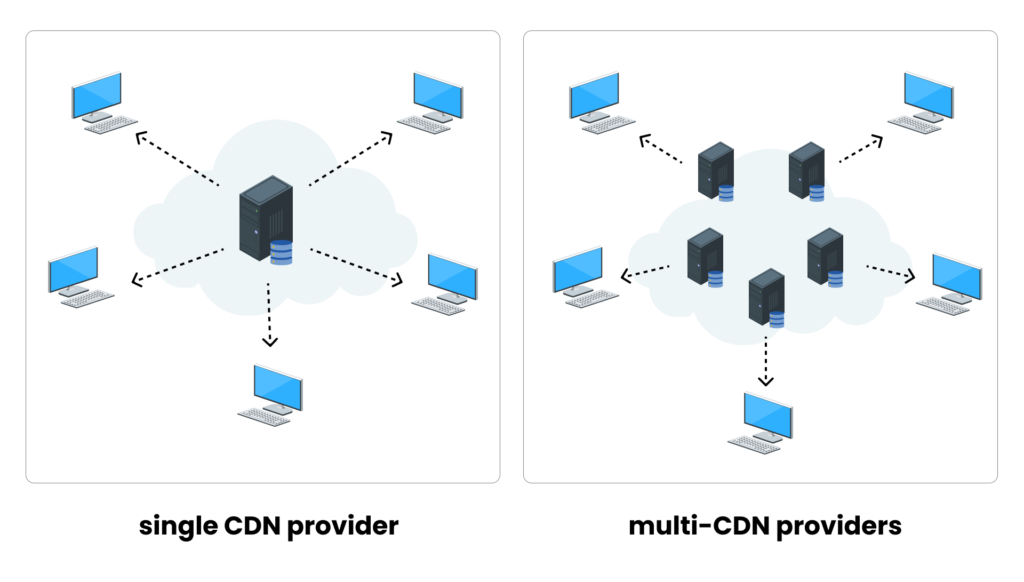
تتضمن استراتيجية تعدد شبكات CDN باستخدام مزودي CDN متعددين بدلاً من الاعتماد على مزود واحد. فكر في الأمر كما لو كان لديك خطط احتياطية متعددة لتوصيل محتواك إلى المستخدمين حول العالم.
عندما يريد شخص ما مشاهدة الفيديو الخاص بك أو تنزيل المحتوى الخاص بك، يختار النظام أسرع مزود.
With a single CDN, you’re stuck if that provider has problems. Your content goes down, and your users can’t access it. That’s risky. Multi-CDN infrastructure gives you backup options. If one CDN provider has outages or runs slowly, your content automatically switches to another provider. Your users never notice the difference, but you get much better reliability.
كيف تعمل شبكة توصيل المحتوى المتعددة (multi-CDN)؟
خلف الكواليس، تعمل أنظمة CDN المتعددة مثل وحدات التحكم الذكية في حركة المرور للإنترنت. بدلاً من إرسال كل المحتوى الخاص بك عبر مسار واحد، فإنها تراقب باستمرار مزوّدي شبكات توصيل المحتوى (CDN) الذين يحققون أفضل أداء وتوجّه حركة المرور تلقائيًا إلى أسرع خيار متاح.
Think of it like having multiple highways to get to the same destination. A smart GPS system would check traffic conditions in real-time and direct you down whichever route gets you there the fastest. That’s essentially what multi-CDN infrastructure does for your content.
عندما يطلب المستخدم محتوى، لدى النظام عدة طرق لتحديد مزود CDN الذي يجب أن يتعامل معه:
- موازنة الحمل عبر DNS can use simple round-robin (taking turns between providers), weighted distribution (sending more traffic to better CDN providers), or location-based routing (picking the closest provider to the user). For example, if someone in Tokyo requests a video, the system directs them to a provider with strong coverage in Asia. A user in New York gets duplicate content from a different provider optimised for North America. Both get optimal performance using other networks.
- موازنة الأحمال المدفوعة ببيانات الأداء takes it a step further by making decisions based on real-time information. The system continuously monitors the response times of each CDN provider, checking for outages or slowdowns, and then automatically selects the best-performing CDN at that moment.
- تكوينات الأساسي/الاحتياطي يستخدم البعض شبكة CDN أساسية مع مزوّدين احتياطيين، بينما يعتمد آخرون على منصات تجميع CDN التي تدير شبكات CDN متعددة عبر لوحة تحكم واحدة.
- قدرات التحويل التلقائي عند الفشل ضمان تحويل حركة المرور فوراً إلى النسخ الاحتياطية إذا واجه أحد مزوّدي شبكات توصيل المحتوى (CDN) مشكلات. يحدث هذا بسرعة كبيرة لدرجة أن المستخدمين نادراً ما يلاحظون الانقطاعات.
عزّز أداء البث لديك اليوم
اقرأ المزيد
إيجابيات وسلبيات استراتيجية CDN المتعددة
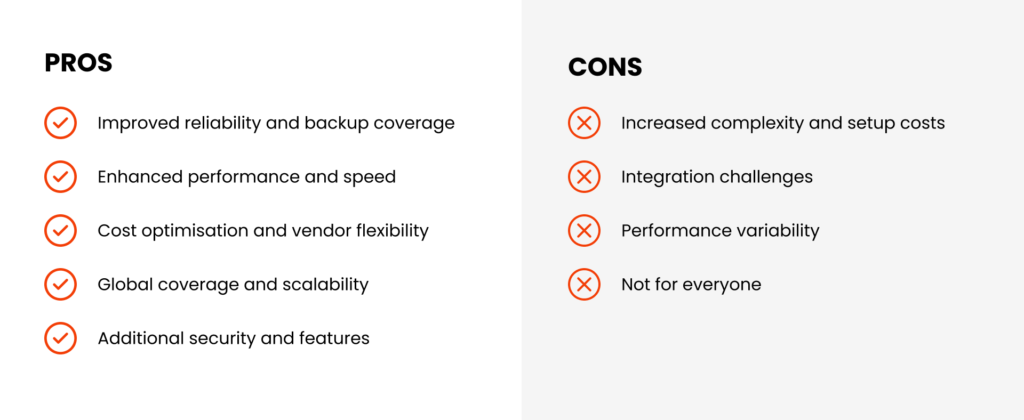
الإيجابيات
تحسين الموثوقية وتغطية النسخ الاحتياطي
The most significant advantage of multi-CDN is that when CDN provider outages happen, your content stays online because multiple CDNs automatically take over. Think of it like having various power sources for your home. If one fails, the others keep the lights on. A multi-CDN infrastructure provides the same reliability for your content, ensuring consistent and reliable content delivery even during unexpected issues.
أداء وسرعة محسّنان
Multiple CDN providers excel in different regions and content types. Some are lightning-fast in Asia, others dominate Europe, and some specialise in video streaming, while others handle websites better. The result is reduced latency, faster loading times, and a better user experience globally.
تحسين التكلفة ومرونة الموردين
A multi-CDN strategy often results in cost savings through intelligent traffic distribution. You can route expensive, high-priority content like live video streams through premium providers while using more affordable options for basic files like images and documents. This optimisation based on performance data helps control costs without sacrificing quality.
You also gain negotiating power with multiple vendors. Instead of being locked into one contract, you can leverage competition between providers to get better pricing and terms. If one CDN provider raises prices or reduces service quality, you can easily shift more traffic to alternatives without disrupting your service.
تغطية عالمية وقابلية للتوسع
Using multiple CDNs dramatically expands your reach. You get the combined global footprint of all your providers, rather than being limited to one CDN provider’s network. This approach also handles traffic spikes much better. When demand surges, load balancing across multiple providers prevents any single network from becoming overwhelmed. Your content delivery scales automatically as traffic grows, without requiring manual intervention or emergency upgrades.
أمان وميزات إضافية
Different CDN providers offer unique capabilities – some excel at DDoS protection, others provide advanced edge computing features, and some specialise in video optimisation. Multi-CDN combines these various strengths, giving you access to the best tools from each provider rather than settling for a single vendor’s comprehensive package. This diversity also improves security since distributing content across multiple providers reduces the impact of any single security breach or attack.
السلبيات
زيادة التعقيد وتكاليف الإعداد
Managing multiple CDN providers is significantly more complex than working with a single CDN provider. You need specialised expertise to configure and monitor each provider, plus separate contracts with multiple vendors. While multi-CDN can lead to cost savings through optimised traffic distribution and better negotiating power, the initial setup and administrative costs are higher.
تحديات التكامل
Getting multiple CDN providers to work together requires significant development effort. Each provider has different APIs and systems, making consistent content delivery across all providers technically challenging.
تباين الأداء
قد يؤدي استخدام مزودين متعددين أحياناً إلى تجارب مستخدم غير متسقة، حيث قد يختلف أداء مزودي CDN المختلفين باختلاف الظروف.
ليس للجميع
Multi-CDN infrastructure typically makes sense only for organisations with substantial global traffic and technical resources. Smaller companies may find a well-chosen single CDN provider more practical than managing the complexity of multiple CDN providers.
أفضل الممارسات لتنفيذ شبكات توصيل المحتوى المتعددة (Multi-CDN)
الاختيار الاستراتيجي للمزودين واختبارهم
Don’t rush into multi-CDN implementation – carefully evaluate different CDN providers based on geographic coverage, network performance, pricing models, and feature sets. Narrow your choices down to two providers and run proof-of-concept tests and A/B testing over several weeks to determine which of the multiple providers best meet your requirements.
Ensure that all your chosen CDN providers offer similar essential features, such as security protection, encrypted connections, content caching rules, and management interfaces. Your multi-CDN approach only works if all providers can deliver the same level of service and functionality that your users expect.
الانتقال التدريجي للحركة والإعدادات
Configure your new CDN provider by meticulously replicating settings from your primary single CDN setup. Each policy and behaviour needs careful configuration using the provider’s API, followed by rigorous testing to ensure optimal performance.
Initiate multi-CDN implementation with an active-active strategy, where multiple providers operate simultaneously. Begin by directing only 5-10% of traffic to the new provider while your leading provider handles 90-95%. Gradually increase the new provider’s share based on performance results and your comfort level, while closely monitoring network performance at each stage. This progressive approach enables you to test with real users without significant risk.
إدارة حركة المرور والمراقبة المتقدمة
Implement specialised traffic management tools that automate routing decisions based on real-time conditions. Avoid basic DNS switching services that lack visibility; instead, use solutions that provide comprehensive traffic insights and dynamic load balancing across multiple CDN providers.
Keep all CDN providers active, allocating a portion of the traffic to maintain warm caches. Never completely starve any provider, as this reduces the effectiveness of your multi-CDN architecture.
تحسين المحتوى ومراقبة الأداء
Group content by type to ensure each CDN provider handles what they do best. Route static content, such as images, through one provider while directing video streams through another that specialises in media delivery.
Establish consistent monitoring parameters across all providers to track network performance, latency, and availability. Use unified dashboards that integrate all CDN providers for comprehensive visibility into your content delivery infrastructure.
التجاوز التلقائي للفشل والتكرار الاحتياطي
Implement automated health checks that continuously monitor the availability and performance of each CDN provider. Set up automatic traffic redirection in the event of CDN provider outages, ensuring uninterrupted content delivery without manual intervention.
Design backup strategies that automatically reroute traffic during performance issues, minimising service disruptions and maintaining consistent user requests content fulfilment across your multi-CDN approach.
هل أنت مستعد لبناء استراتيجية CDN متعددة لديك؟
Implementing a successful multi-CDN strategy requires careful planning, technical expertise, and ongoing optimisation. At Spyrosoft BSG, we’ve helped media companies transform their content delivery infrastructure through proven multi-CDN implementations.
سواء كنت تتطلع إلى تحسين الموثوقية أو توسيع النطاق العالمي أو تحسين التكاليف، يمكن لفريقنا إرشادك عبر كل جانب من جوانب إعداد وتنفيذ شبكات توصيل المحتوى المتعددة (multi-CDN).
اطّلع على عرضنا لمعرفة كيف يمكننا مساعدتك في تحويل استراتيجية توصيل المحتوى الخاصة بك.


A multi-CDN strategy means using more than one content delivery network provider at the same time, with traffic automatically routed to whichever performs best at any given moment. Organisations use it primarily to avoid dependence on a single provider. If one CDN has an outage or performs poorly in a specific region, traffic shifts to another without manual intervention.
Several approaches exist. DNS load balancing distributes requests based on location or round-robin logic. Performance-driven balancing monitors real-time response times and routes traffic to the fastest available provider. Primary and backup configurations handle automatic failover. CDN aggregator platforms sit on top of all providers and manage routing through a single dashboard.
Different CDN providers tend to perform better in specific regions or for specific content types. A multi-CDN setup lets you take advantage of that by matching traffic to the provider best suited to serve it. It also gives cost flexibility — you can route high-priority content through premium providers and standard files through more economical options. Combined, multiple networks also handle traffic spikes more effectively than any single provider.
Complexity increases significantly. Each provider has its own API, dashboard, and configuration logic. Integrating and monitoring them consistently requires more engineering effort and usually higher setup costs. Performance can also vary between networks in ways that are harder to diagnose. For organisations without substantial global traffic volumes, the overhead may outweigh the benefit.
Start with a small traffic allocation — typically 5 to 10 percent — to a second provider before committing further. Test geographic coverage, performance metrics, and pricing against your actual traffic patterns rather than vendor benchmarks. Group content by type so each provider handles what it does best. Set up unified monitoring across all providers from the start so you have consistent visibility rather than switching between separate dashboards.
arrow_circle_rightاتصل بنا
لنتحدث عن استراتيجية CDN المتعددة الخاصة بك!

بارتوميي لوزيا
الرئيس التنفيذي لـ Spyrosoft BSG


