Comprendre le multi-CDN : avantages et bonnes pratiques


Imagine that your latest piece of content just dropped, your viewers are trying to stream simultaneously, and suddenly your CDN provider experiences an outage. Within minutes, your social media channels are flooded with frustrated users, and your customer support team is overwhelmed. What’s worse, your reputation takes a hit that could last months.
This nightmare scenario has prompted media companies and content creators to adopt a multi-CDN strategy. This guide will show you how to build a multi-CDN solution that transforms your content delivery from a single point of failure into a robust, intelligent system that automatically adapts to deliver peak performance around the clock.
Qu'est-ce qu'une stratégie multi-CDN ?
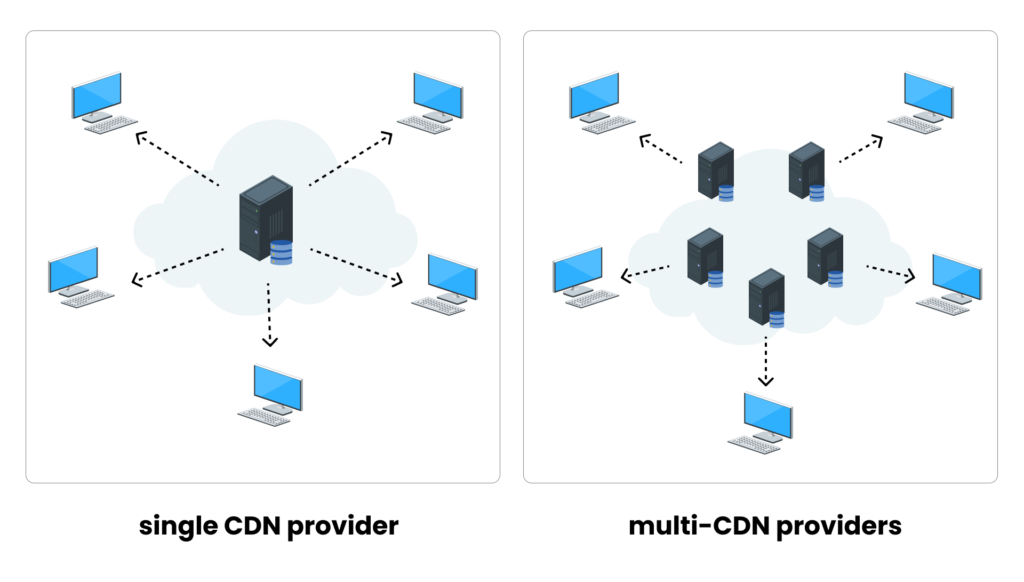
Une stratégie multi-CDN implique en utilisant plusieurs fournisseurs de CDN plutôt qu'un seul fournisseur. Considérez cela comme la possibilité de disposer de plusieurs plans de secours pour diffuser votre contenu aux utilisateurs du monde entier.
Lorsque quelqu'un souhaite regarder votre vidéo ou télécharger votre contenu, le système choisit le fournisseur le plus rapide.
With a single CDN, you’re stuck if that provider has problems. Your content goes down, and your users can’t access it. That’s risky. Multi-CDN infrastructure gives you backup options. If one CDN provider has outages or runs slowly, your content automatically switches to another provider. Your users never notice the difference, but you get much better reliability.
Comment fonctionne le multi-CDN ?
En coulisses, les systèmes multi-CDN fonctionnent comme des régulateurs de trafic intelligents pour Internet. Au lieu d'acheminer tout votre contenu par une seule voie, ils surveillent en permanence quels fournisseurs de CDN sont les plus performants et acheminent automatiquement le trafic vers l'option la plus rapide disponible.
Think of it like having multiple highways to get to the same destination. A smart GPS system would check traffic conditions in real-time and direct you down whichever route gets you there the fastest. That’s essentially what multi-CDN infrastructure does for your content.
Lorsqu'un utilisateur demande du contenu, le système dispose de plusieurs façons de décider quel fournisseur de CDN doit le traiter :
- Répartition de charge DNS can use simple round-robin (taking turns between providers), weighted distribution (sending more traffic to better CDN providers), or location-based routing (picking the closest provider to the user). For example, if someone in Tokyo requests a video, the system directs them to a provider with strong coverage in Asia. A user in New York gets duplicate content from a different provider optimised for North America. Both get optimal performance using other networks.
- Équilibrage de charge piloté par les données de performance takes it a step further by making decisions based on real-time information. The system continuously monitors the response times of each CDN provider, checking for outages or slowdowns, and then automatically selects the best-performing CDN at that moment.
- Configurations principale/secours utilisent un CDN principal avec des fournisseurs de secours, tandis que d'autres emploient des plateformes d'agrégation de CDN qui gèrent plusieurs CDN via un panneau de contrôle unique.
- Capacités de basculement automatique garantir que le trafic bascule immédiatement vers les sauvegardes si un fournisseur de CDN rencontre des problèmes. Cela se produit si rapidement que les utilisateurs remarquent rarement les interruptions.
Boostez vos performances de streaming dès aujourd'hui
En savoir plus
Avantages et inconvénients d'une stratégie multi-CDN
Avantages
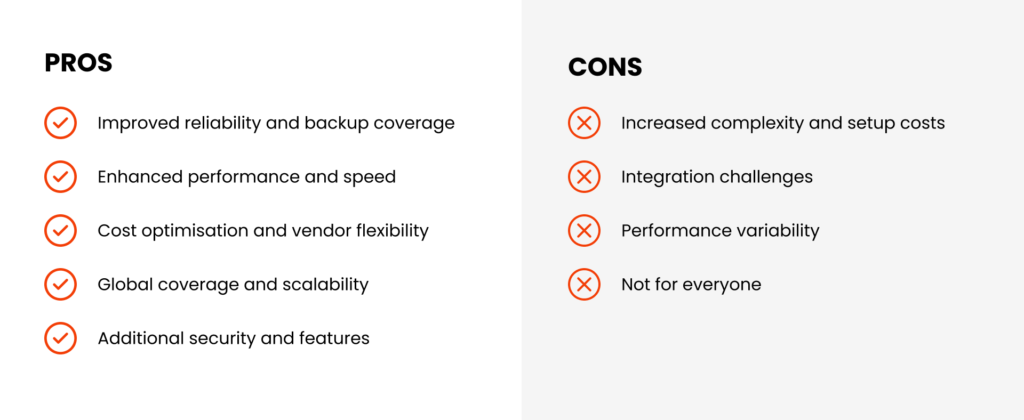
Fiabilité améliorée et couverture de sauvegarde
The most significant advantage of multi-CDN is that when CDN provider outages happen, your content stays online because multiple CDNs automatically take over. Think of it like having various power sources for your home. If one fails, the others keep the lights on. A multi-CDN infrastructure provides the same reliability for your content, ensuring consistent and reliable content delivery even during unexpected issues.
Performances et vitesse améliorées
Multiple CDN providers excel in different regions and content types. Some are lightning-fast in Asia, others dominate Europe, and some specialise in video streaming, while others handle websites better. The result is reduced latency, faster loading times, and a better user experience globally.
Optimisation des coûts et flexibilité des fournisseurs
A multi-CDN strategy often results in cost savings through intelligent traffic distribution. You can route expensive, high-priority content like live video streams through premium providers while using more affordable options for basic files like images and documents. This optimisation based on performance data helps control costs without sacrificing quality.
You also gain negotiating power with multiple vendors. Instead of being locked into one contract, you can leverage competition between providers to get better pricing and terms. If one CDN provider raises prices or reduces service quality, you can easily shift more traffic to alternatives without disrupting your service.
Couverture mondiale et évolutivité
Using multiple CDNs dramatically expands your reach. You get the combined global footprint of all your providers, rather than being limited to one CDN provider’s network. This approach also handles traffic spikes much better. When demand surges, load balancing across multiple providers prevents any single network from becoming overwhelmed. Your content delivery scales automatically as traffic grows, without requiring manual intervention or emergency upgrades.
Sécurité et fonctionnalités supplémentaires
Different CDN providers offer unique capabilities – some excel at DDoS protection, others provide advanced edge computing features, and some specialise in video optimisation. Multi-CDN combines these various strengths, giving you access to the best tools from each provider rather than settling for a single vendor’s comprehensive package. This diversity also improves security since distributing content across multiple providers reduces the impact of any single security breach or attack.
Inconvénients
Complexité et coûts de configuration accrus
Managing multiple CDN providers is significantly more complex than working with a single CDN provider. You need specialised expertise to configure and monitor each provider, plus separate contracts with multiple vendors. While multi-CDN can lead to cost savings through optimised traffic distribution and better negotiating power, the initial setup and administrative costs are higher.
Défis d'intégration
Faire collaborer plusieurs fournisseurs de CDN nécessite un effort de développement considérable. Chaque fournisseur dispose d'API et de systèmes différents, ce qui rend techniquement complexe une diffusion de contenu cohérente sur l'ensemble des fournisseurs.
Variabilité des performances
L'utilisation de plusieurs fournisseurs peut parfois créer des expériences utilisateur incohérentes, car différents fournisseurs de CDN peuvent avoir des performances variables selon les conditions.
Pas pour tout le monde
Multi-CDN infrastructure typically makes sense only for organisations with substantial global traffic and technical resources. Smaller companies may find a well-chosen single CDN provider more practical than managing the complexity of multiple CDN providers.
Meilleures pratiques pour la mise en œuvre multi-CDN
Sélection stratégique des fournisseurs et tests
Don’t rush into multi-CDN implementation – carefully evaluate different CDN providers based on geographic coverage, network performance, pricing models, and feature sets. Narrow your choices down to two providers and run proof-of-concept tests and A/B testing over several weeks to determine which of the multiple providers best meet your requirements.
Ensure that all your chosen CDN providers offer similar essential features, such as security protection, encrypted connections, content caching rules, and management interfaces. Your multi-CDN approach only works if all providers can deliver the same level of service and functionality that your users expect.
Transition progressive du trafic et configuration
Configurez votre nouveau fournisseur de CDN en répliquant méticuleusement les paramètres de votre configuration CDN unique principale. Chaque politique et comportement doit être configuré avec soin à l'aide de l'API du fournisseur, puis suivi de tests rigoureux pour garantir des performances optimales.
Initiate multi-CDN implementation with an active-active strategy, where multiple providers operate simultaneously. Begin by directing only 5-10% of traffic to the new provider while your leading provider handles 90-95%. Gradually increase the new provider’s share based on performance results and your comfort level, while closely monitoring network performance at each stage. This progressive approach enables you to test with real users without significant risk.
Gestion et surveillance avancées du trafic
Implement specialised traffic management tools that automate routing decisions based on real-time conditions. Avoid basic DNS switching services that lack visibility; instead, use solutions that provide comprehensive traffic insights and dynamic load balancing across multiple CDN providers.
Maintenez tous les fournisseurs CDN actifs, en allouant une partie du trafic pour préserver des caches chauds. Ne privez jamais complètement un fournisseur, car cela réduit l'efficacité de votre architecture multi-CDN.
Optimisation du contenu et surveillance des performances
Regroupez le contenu par type afin que chaque fournisseur de CDN gère ce qu'il fait de mieux. Acheminez le contenu statique, tel que les images, via un fournisseur tandis que les flux vidéo passent par un autre spécialisé dans la diffusion multimédia.
Établissez des paramètres de surveillance cohérents chez tous les fournisseurs pour suivre les performances du réseau, la latence et la disponibilité. Utilisez des tableaux de bord unifiés qui intègrent tous les fournisseurs de CDN pour une visibilité complète sur votre infrastructure de diffusion de contenu.
Basculement automatique et redondance
Implement automated health checks that continuously monitor the availability and performance of each CDN provider. Set up automatic traffic redirection in the event of CDN provider outages, ensuring uninterrupted content delivery without manual intervention.
Concevez des stratégies de secours qui redirigent automatiquement le trafic en cas de problèmes de performance, minimisant les interruptions de service et maintenant une satisfaction cohérente des demandes des utilisateurs dans votre approche multi-CDN.
Prêt à bâtir votre stratégie multi-CDN ?
Implementing a successful multi-CDN strategy requires careful planning, technical expertise, and ongoing optimisation. At Spyrosoft BSG, we’ve helped media companies transform their content delivery infrastructure through proven multi-CDN implementations.
Que vous cherchiez à améliorer la fiabilité, à étendre votre portée mondiale ou à optimiser les coûts, notre équipe peut vous guider à travers chaque aspect de la configuration et de la mise en œuvre multi-CDN.
Découvrez notre offre pour découvrir comment nous pouvons vous aider à transformer votre stratégie de diffusion de contenu.


A multi-CDN strategy means using more than one content delivery network provider at the same time, with traffic automatically routed to whichever performs best at any given moment. Organisations use it primarily to avoid dependence on a single provider. If one CDN has an outage or performs poorly in a specific region, traffic shifts to another without manual intervention.
Several approaches exist. DNS load balancing distributes requests based on location or round-robin logic. Performance-driven balancing monitors real-time response times and routes traffic to the fastest available provider. Primary and backup configurations handle automatic failover. CDN aggregator platforms sit on top of all providers and manage routing through a single dashboard.
Different CDN providers tend to perform better in specific regions or for specific content types. A multi-CDN setup lets you take advantage of that by matching traffic to the provider best suited to serve it. It also gives cost flexibility — you can route high-priority content through premium providers and standard files through more economical options. Combined, multiple networks also handle traffic spikes more effectively than any single provider.
Complexity increases significantly. Each provider has its own API, dashboard, and configuration logic. Integrating and monitoring them consistently requires more engineering effort and usually higher setup costs. Performance can also vary between networks in ways that are harder to diagnose. For organisations without substantial global traffic volumes, the overhead may outweigh the benefit.
Start with a small traffic allocation — typically 5 to 10 percent — to a second provider before committing further. Test geographic coverage, performance metrics, and pricing against your actual traffic patterns rather than vendor benchmarks. Group content by type so each provider handles what it does best. Set up unified monitoring across all providers from the start so you have consistent visibility rather than switching between separate dashboards.
arrow_circle_rightContactez-nous
Parlons de votre stratégie multi-CDN !

Bartlomiej Lozia
CEO Spyrosoft BSG
arrow_circle_right Nos articles


