استراتيجية NVIDIA من L2++ إلى L4: المنصة، والبنية المعمارية، وما هو قيد الإنتاج بالفعل


If you’re evaluating NVIDIA DRIVE as a platform decision, not just a component choice, this article gives you the system-level view. We cover what L2++ actually delivers in production today, how the Hyperion platform scales from L2++ to L4 on a consistent software and integration architecture, and why the choices that look like constraints are actually deliberate strategy.
مستوى L2++ قيد الإنتاج بالفعل
In Q1 2026, Mercedes-Benz started series production of the new CLA. It’s a consumer car that navigates point-to-point across motorways, suburbs, and dense urban traffic – with no lidar, no pre-built HD maps, and a single chip drawing under 45W.
هذه ليست مركبة مفهومية أو برنامجاً تجريبياً – إنها في الإنتاج اليوم.
L2++ is a widely used industry term for highly advanced consumer driver assistance, and NVIDIA’s implementation of it is a fundamental rethink of how autonomous driving software is built. And it scales directly to the L4 robotaxis that Uber and Mercedes-Benz plan to operate in San Francisco and Los Angeles by H1 2027.
The CLA earned Euro NCAP’s Best Performer award for 2025. It runs on NVIDIA Hyperion – a scalable reference platform designed to take the same architecture from L2++ all the way to L4. The L4 configuration, Hyperion 10, runs on roughly 8× the compute (dual Thor SoCs at 1,000 INT8 TOPS each), adds lidar, and is already committed to multiple OEM programmes.
نفس المنصة، ولكن المزيد من القدرة الحاسوبية، والمزيد من المستشعرات، ونموذج مسؤولية مختلف.
ما الذي تقدمه فعلياً تقنية L2++
Traditional L2 maps detected objects to predefined responses. NVIDIA’s L2++ works differently. It navigates point-to-point through urban environments, handles dynamic obstacles with context rather than reflexes, executes unprotected turns, and tracks multiple actors simultaneously.
In a live demonstration through San Francisco, the system spotted double-parked delivery vehicles and worked out the gap and timing to get through – it didn’t just flag an obstacle. It yielded when a vehicle reversed towards it, avoided an open car door, and completed an unprotected left turn while managing oncoming traffic and a crossing pedestrian at the same time.
In normal conditions, the end-to-end neural stack generates the active trajectory most of the time. The classical stack runs alongside it as a continuously enforced safety boundary, not a fallback waiting for the AI to fail.
اكتشف لماذا يُعد الاستثمار في مركز تسليم الذكاء الاصطناعي الخارجي فكرة جيدة >>
Eliminating lidar cuts the bill-of-materials enough to deploy this in a mainstream consumer vehicle. Dropping pre-built HD maps removes geographic fencing entirely – the system works in cities that have never been pre-mapped. Instead, the classical stack builds an HD map on the fly from raw camera input and navigation data: lane lines, connectivity, direction-of-travel, traffic light rules, and turn-lane associations – all generated on board, at runtime.
The driver interaction model is just as intentional. The driver can apply steering input mid-manoeuvre and the system doesn’t disengage. It treats the input as cooperative, keeps operating, and resumes full authority when you take your hands off the wheel. There’s no engage/disengage cycle; the driving software stays active throughout.
هذا التكوين L2++ قيد الإنتاج بالفعل في Mercedes-Benz CLA. وتتبعه Jaguar Land Rover اعتباراً من 2026، مع طرح برامج إضافية لمصنّعي المعدات الأصلية عبر المنصة حتى 2028.
البنية التي تجعله يعمل
Hyperion
At the centre of NVIDIA’s automotive offer is DRIVE AV: the full autonomous driving software stack. Hyperion is the production-ready reference platform built around it, combining validated compute hardware, a qualified sensor suite, and a defined integration boundary against the host vehicle. OEMs can build directly on Hyperion or work with NVIDIA on a fully customised implementation – as Mercedes-Benz, JLR, and Lucid are doing.
ثلاث تهيئات تتشارك في سلالة معمارية واحدة:
| التكوين | الحوسبة | الكاميرات | رادار | ليدار | المستوى |
| CLA (L2++) | 1× Orin – 254 TOPS | 10 | 5 | – | L2++ |
| Hyperion 8 | 2× Orin – 508 TOPS | 12 | 9 | 1 | تطوير L4 |
| Hyperion 10 | 2× Thor – 2×1,000 TOPS | 14 HD | 9 | 1 | إنتاج L4 |
The shared architecture is what makes the L2++ to L4 path realistic. An OEM that has already validated sensor mounting, time synchronisation, calibration, and harness routing for Hyperion 8 doesn’t need to redesign the integration for Hyperion 10. Same E/E architecture, but with scaled compute and sensors.
DRIVE OS
Beneath DRIVE AV sits DRIVE OS – TÜV SÜD-certified to ISO 26262 ASIL D, ASPICE-compliant, and aligned with ISO/SAE 21434 for cybersecurity engineering. It provides a deterministic, certifiable execution environment for the AV stack and exposes the heterogeneous compute of Orin and Thor to higher-level software.
The underlying silicon goes further: DRIVE AGX Orin holds its own ISO 26262 ASIL D certification at chip level, which significantly reduces the safety argumentation burden for OEMs building on the platform. Thor is on the same certification path.
الأجزاء الأكثر أهمية في مرحلة التكامل:
- Hypervisor مع عزل نظام التشغيل الضيف. NVIDIA’s Type-1 hypervisor runs QNX and Linux simultaneously in isolated partitions: QNX as the ASIL-D certified safety partition, Linux as the compute partition running the AI/ML stack, DriveWorks, and TensorRT. This lets you host ADAS, IVI, cluster, and DMS workloads on the same SoC without compromising the safety case.
- NvMedia وNvStreams. NvMedia loads camera frames straight into GPU memory with no buffer copies and no added latency. NvStreams extends that zero-copy guarantee across the GPU, DLA, PVA, and image signal processors. The result is a deterministic perception pipeline, which is a precondition for any credible ASIL argument.
- التكرار غير المتجانس. Critical workloads can run across different processor types – a primary perception path on the GPU and a redundant lighter-weight path on the DLA, reducing the risk that a single silicon fault eliminates the function entirely.
- استمرارية CUDA وTensorRT. تعمل واجهات برمجة التطبيقات نفسها من التدريب السحابي على DGX وصولاً إلى الاستدلال داخل المركبة. تُنشر النماذج إلى المركبة دون إعادة تنفيذ، مما يحافظ على اتساق سلوك التدريب والاستدلال.
المجموعة المزدوجة ومجال القوة الآمنة
يشغّل DRIVE AV مجموعتين متوازيتين للقيادة في الوقت نفسه، مع تجاوز أمان محدد رياضياً فوق كلتيهما:
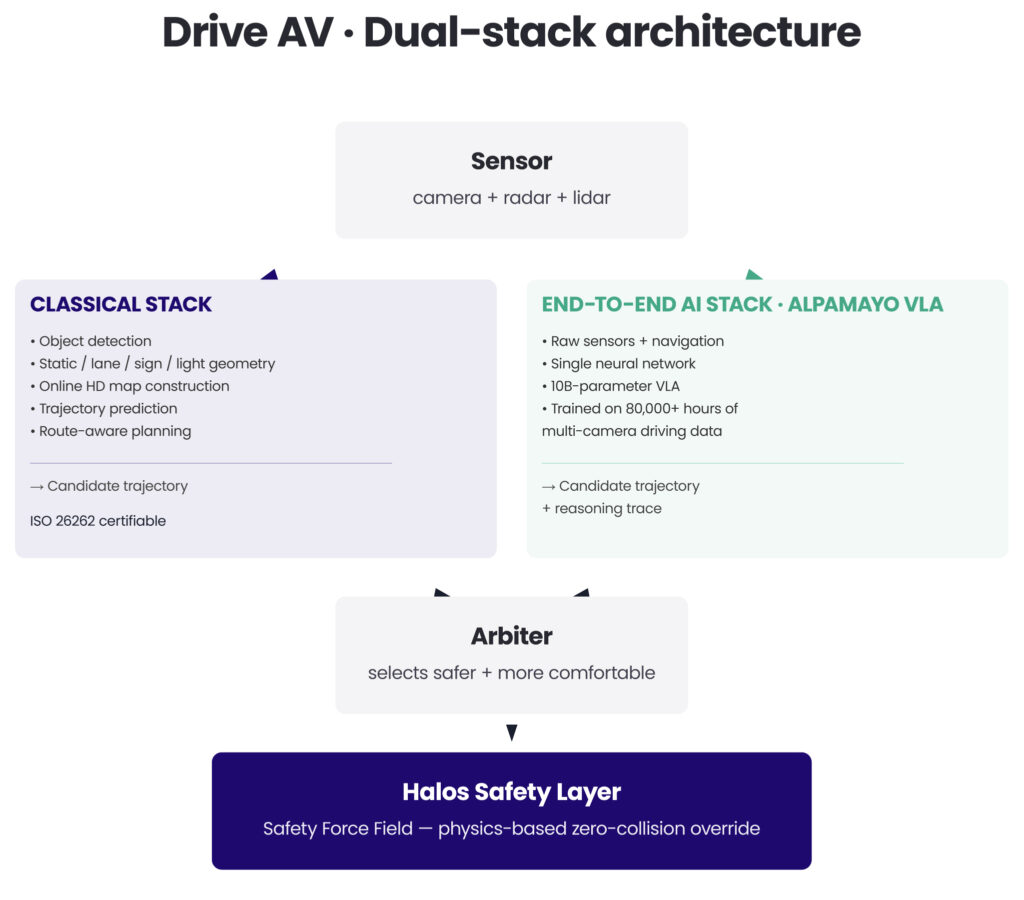
The classical stack gives you a certifiable safety envelope – formally analysable, traceable to ISO 26262 work products. The end-to-end stack handles the long tail of real-world edge cases that rules can’t enumerate. Both stacks produce candidate trajectories simultaneously. An arbiter picks the safer and more comfortable one, with the SFF providing the hard outer bound.
Halos: السلامة كخاصية عابرة للطبقات
فوق DRIVE OS والمكدس المزدوج يقع Halos. إنه إطار العمل الشامل للسلامة من NVIDIA، منظم على ثلاثة مستويات:
| المستوى | النطاق |
| التكنولوجيا | ASIL D SoC + DRIVE OS + Hyperion (المنصة)؛ واجهات برمجة تطبيقات بيانات السلامة، حزمة معيارية + شاملة من الطرف إلى الطرف (خوارزمية)؛ مجموعات بيانات منسقة، تقييم آلي، عجلة بيانات (المنظومة) |
| التطوير | قيود السلامة في وقت التصميم أثناء تدريب النموذج؛ ومراقبات وقت التشغيل عند النشر؛ وإعادة التشغيل والمحاكاة على نطاق واسع في وقت التحقق |
| الحوسبة | DGX (التدريب السحابي) + OVX (محاكاة Omniverse) + DRIVE AGX (النشر في المركبات) – تشكل الثلاثة معًا جزءًا من نظام السلامة؛ ويتم توليد أدلة التحقق عبر الثلاثة جميعًا |
One of its applications is the Safety Force Field (SFF), which sits downstream of both stacks as the last override before actuation. It’s a physics-based policy layer that computes a zero-collision envelope frame-by-frame. It’s mathematically deterministic (braking and steering evaluated jointly, not separately) and it overrides any upstream output that would breach the envelope.
Safety here isn’t bolted on at integration time. It’s a property of the cloud-simulation-vehicle triad. If you train off-platform and import models without OVX re-validation, the safety case breaks.
عقد من نمو القدرة الحاسوبية
The DRIVE platform has grown roughly 500× in TOPS at single-chip level since 2015 – from the original Drive PX (~2 TOPS, Maxwell) through Xavier (30 TOPS, Volta + DLA, 2017), Orin (254 TOPS, Ampere, 2022), to Thor (1,000 INT8 TOPS / 2,000 FP4 TOPS, Blackwell, 2025).
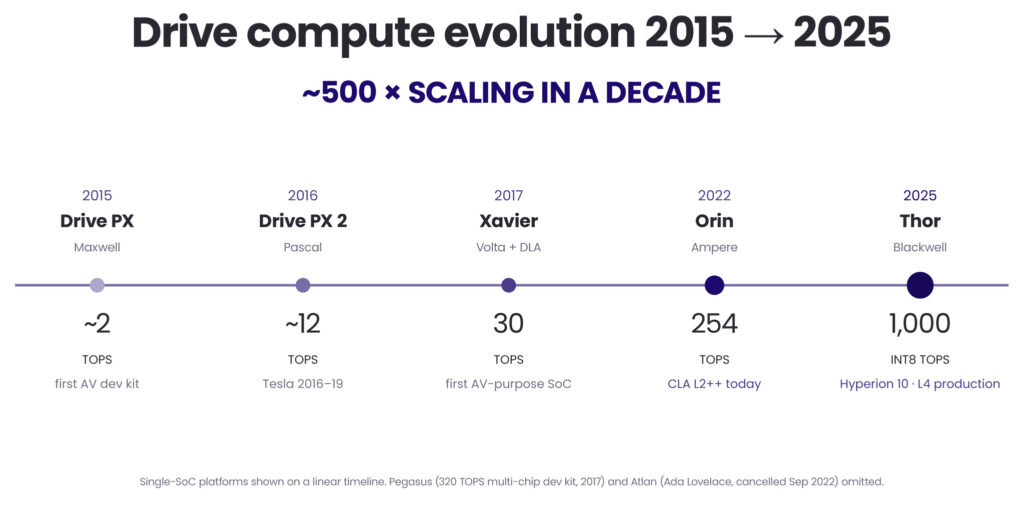
Two moments stand out. Xavier (2017) was the first NVIDIA chip designed from scratch for production AV. It introduced the DLA, a fixed-function neural-network accelerator separate from the GPU. Atlan, the planned Ada Lovelace-based AV chip announced in 2021, was cancelled in September 2022 in favour of jumping directly to Thor (Blackwell) – a clear signal of how fast the post-Ampere AI compute roadmap moved.
Thor (2025) consolidates all vehicle compute domains onto a single SoC: autonomous driving, parking, driver and occupant monitoring, instrument cluster, infotainment, rear-seat entertainment. It pairs an ARM Neoverse V3AE CPU with a Blackwell GPU, integrates a Transformer Engine for LLM- and VLA-class workloads, and uses NVLink-C2C for chip-to-chip bandwidth in dual-Thor Hyperion 10 configurations. Hardware partitioning keeps the ASIL D ADAS workload and the QM-rated infotainment workload isolated on the same die.
Thor makes centralised, software-defined-vehicle compute possible. It replaces the distributed ECU topology that’s defined automotive E/E architecture for decades. That transition is its own multi-year programme, separate from the AV stack running on top.
مستوى L4: ما الملتزم به وتوقيته
Before the timelines, the definition matters. L4 means a system that handles all driving tasks within a specific operational design domain – bounded geography, defined conditions, no human required.
NVIDIA’s commercial roadmap skips L3 entirely. The reason is practical: L3 requires the driver to be ready to take over instantly while not actively supervising. That handoff liability problem has kept most OEMs away from it.
Honda’s world-first L3 approval in 2021 covered just 100 lease-only vehicles in Japan. Mercedes-Benz’s Drive Pilot is one of the very few OEMs globally to have taken on L3 liability. NVIDIA positions L2++ and L4 because both have clean liability models – L2++ keeps the human actively in the loop, L4 takes full responsibility within a defined ODD. L2++ and L4 both have clear answers to ‘who’s responsible’. L3 doesn’t, and that’s why NVIDIA skips it.
ما يتطلبه المستوى L4 معمارياً بما يتجاوز L2++:
- حوسبة زائدة: 2× Thor بدلاً من 1× Orin
- أُضيف الليدار كمسار مستقل للتحقق من الإدراك
- خرائط HD معتمدة للسلامة مع خطوة تحقق يدوية
- Halos OS كطبقة نظام التشغيل للسلامة داخل المركبة
عمليات نشر ملتزم بها مع شركاء محددين بالاسم وجداول زمنية معلنة:
| الشريك | المركبة / الدور | الجدول الزمني |
| مرسيدس-بنز | S-Class – سيارة أجرة روبوتية فاخرة | أُعلن في يناير 2026 |
| Uber | عمليات الأسطول – لوس أنجلوس + سان فرانسيسكو | H1 2027 |
| Uber | التوسع العالمي – 28 مدينة، 4 قارات | 2028 |
| ستيلانتيس | K0 Van + STLA Small – 5,000 وحدة | 2028 SOP |
| BYD, Geely, Isuzu | مركبات L4 على منظومة NVIDIA الكاملة | 2025+ |
| Nissan | سيارة أجرة ذاتية القيادة من المستوى الرابع (عتاد Hyperion + برمجيات Wayve) | مشروع Uber التجريبي في طوكيو، أواخر 2026 |
| MCP | جميع المركبات الجديدة على منصة DRIVE | من عام 2026 |
| Lucid | تشكيلة المركبات الكهربائية متوسطة الحجم – DRIVE AGX Thor | أواخر عام 2026 |
More than 20 of the top 30 global EV makers have adopted DRIVE Orin. Every OEM on the platform feeds the shared data flywheel. It’s a network effect where platform capabilities compound regardless of which partner grows fastest.
التطوير المدعوم بالذكاء الاصطناعي في قطاع الابتكار
اكتشف كيف يمكننا مساعدتك
ما يعنيه هذا لك
Hyperion gives OEMs and Tier 1s a validated path from today’s L2++ production reality to committed L4 deployments, on a consistent software and integration architecture. The L2++ choices that may look like limitations (no lidar, no pre-mapped HD maps, online map construction, cooperative driver interaction) are the conditions that make mainstream deployment possible.
Understanding the platform at this level matters most when you’re deciding whether to build around it, integrate into it, or validate against it. That decision gets harder (and the safety obligations get more complex) once AI-based components enter the stack.
الجزء 2 of this article series covers exactly that: the AI leap behind Alpamayo VLA model, the data flywheel, the real L4 timelines, and what Spyrosoft’s hands-on work with the stack means for your integration programme.
اقرأ الجزء 2: NVIDIA Alpamayo وحالة الذكاء الاصطناعي للقيادة الذاتية من المستوى الرابع (L4)
اقرأ المزيد
إذا كنت تقوم بالفعل بتقييم تكامل NVIDIA DRIVE وترغب في إجراء محادثة تقنية حول موقع برنامجك، فتواصل مع فريق السيارات لدينا عبر النموذج أدناه.


arrow_circle_rightاتصل بنا
تواصل معنا لمناقشة احتياجاتك

arrow_circle_right مقالاتنا


