Alpamayo: الذكاء الاصطناعي الاستدلالي من NVIDIA للمركبات ذاتية القيادة – ما يحتاج صناع القرار إلى معرفته


NVIDIA’s Alpamayo is the first autonomous vehicle AI that explains every driving decision in plain text, in real time. This article covers the architecture, our test results, and what it means for your organisation.
المشكلة التي أبقت القيادة الذاتية متعثرة
For more than a decade, autonomous vehicle development has relied on imitation learning: train a model on millions of hours of footage, and it learns to drive like a human. It works well in common situations. It fails in rare ones – the long tail of unpredictable scenarios that do not appear often enough in training data to be learned reliably. No amount of additional data fully solves this, because a truly novel situation has no historical example to learn from.
The second problem is opacity. When a traditional AV system makes a wrong decision, you cannot ask it why. For regulators, fleet operators, and insurers, that is a direct barrier to certification and commercial deployment.
ما هو Alpamayo – ثلاث ركائز، معمارية واحدة
Alpamayo هي محفظة تطوير مفتوحة المصدر مبنية حول ثلاثة مكونات تعمل معاً: نموذج الذكاء الاصطناعي Alpamayo 1، وإطار المحاكاة AlpaSim، ومجموعات البيانات المفتوحة للذكاء الاصطناعي الفيزيائي.
Alpamayo 1: نموذج يشرح قراراته
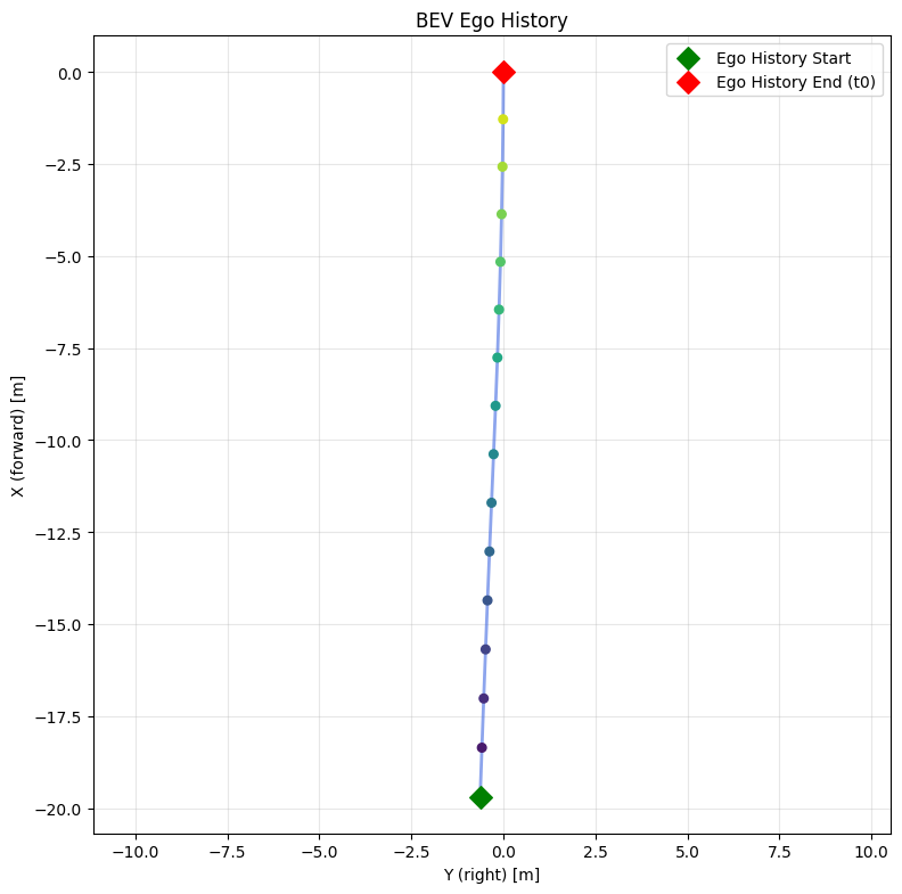
Alpamayo 1 is a Vision-Language-Action (VLA) model with 10 billion parameters. It takes multi-camera sensor input (front, left, right, and rear cameras) alongside the vehicle’s recent movement history (position and rotation sampled at 10Hz over the last 1.6 seconds), and produces both a text-based reasoning trace and a physical trajectory.
The reasoning trace is the key difference. Before generating any motion output, the model writes out why it is making its decision. This is the Chain-of-Causation (CoC). In real test scenarios, the model produces outputs such as: “Change to the left lane to stay in the through lane and avoid being forced into the right-turn slip lane at the upcoming intersection, while moderating speed to maintain gap to the lead vehicle and approach the marked crosswalk cautiously.” أو، عند إشارة المرور: “توقّف عند خط التوقف – إشارة المرور للمرور المباشر حمراء.”
This is not a post-hoc summary. The reasoning is generated first and directly informs the trajectory output. Because the model works from understood concepts (not memorised patterns) it can apply the same logic to situations it has never encountered before.
For vehicle trajectories, discrete token outputs create imprecision. Alpamayo 1 uses flow-matching diffusion models to generate trajectories as continuous values instead – producing smooth, physically realistic motion planning.
AlpaSim ومجموعة بيانات الذكاء الاصطناعي الفيزيائي
AlpaSim is a closed-loop simulation environment built on neural reconstruction of real-world scenes. It allows development teams to test against realistic road conditions without requiring physical test miles for every scenario. The Physical AI open dataset provides the multi-sensor real-world data that grounds both training and simulation in physical reality. Together, they significantly reduce the time between initial development and fleet-ready validation.
اكتشف خدمات التطوير المدعومة بالذكاء الاصطناعي لدينا
اكتشف كيف يمكننا مساعدتك
وضع ذلك موضع التنفيذ: كيف يبدو تشغيل Alpamayo
Alpamayo 1 is not a research paper. The model weights are available on Hugging Face and can be deployed today. Our team downloaded the 10B model weights (originally released at NeurIPS in December 2025) and ran the full inference pipeline on our DGX Spark, feeding it real multi-sensor inputs from the Physical AI AV dataset.
The setup involves passing a tokenised input dictionary – camera images from multiple viewpoints, attention masks, and ego-trajectory history sampled at 10Hz over the preceding 1.6 seconds – alongside a system prompt instructing the model to act as a safety-focused driving system. The model generates a Chain-of-Thought reasoning sequence first, then produces the corresponding continuous trajectory prediction.
السيناريو 1: التوقف عند الضوء الأحمر
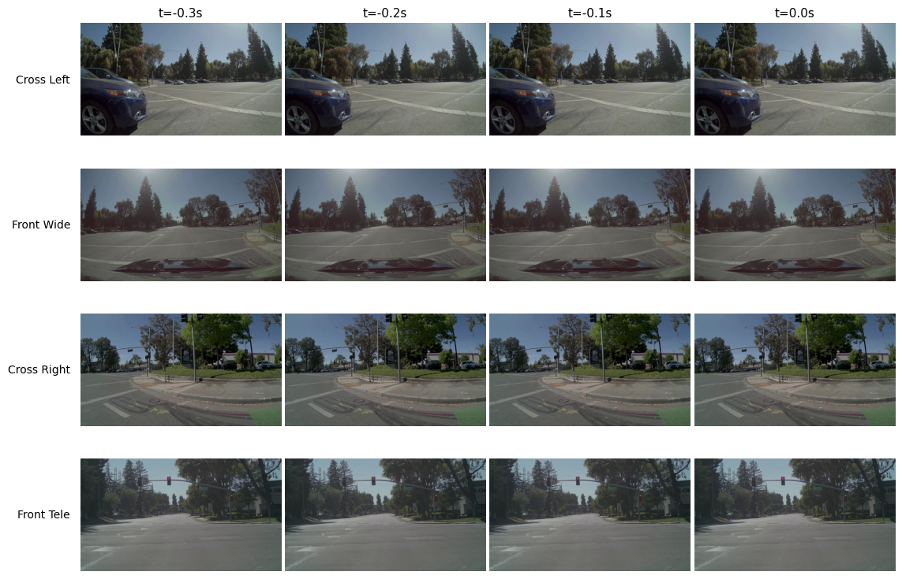
The vehicle is at an intersection. The front camera clearly shows a red traffic light. The model ingests four camera angles over the most recent 0.3 seconds and generates the following reasoning before outputting any trajectory.
مخرجات سلسلة السببية – التي أنتجها Alpamayo 1 خلال اختبارنا:
- “توقف عند خط التوقف لأن إشارة المرور للمسار المستقيم حمراء.“
- “تسارع للمضي عبر التقاطع بما أن إشارة المرور للمسار المستقيم تحولت إلى اللون الأخضر.“
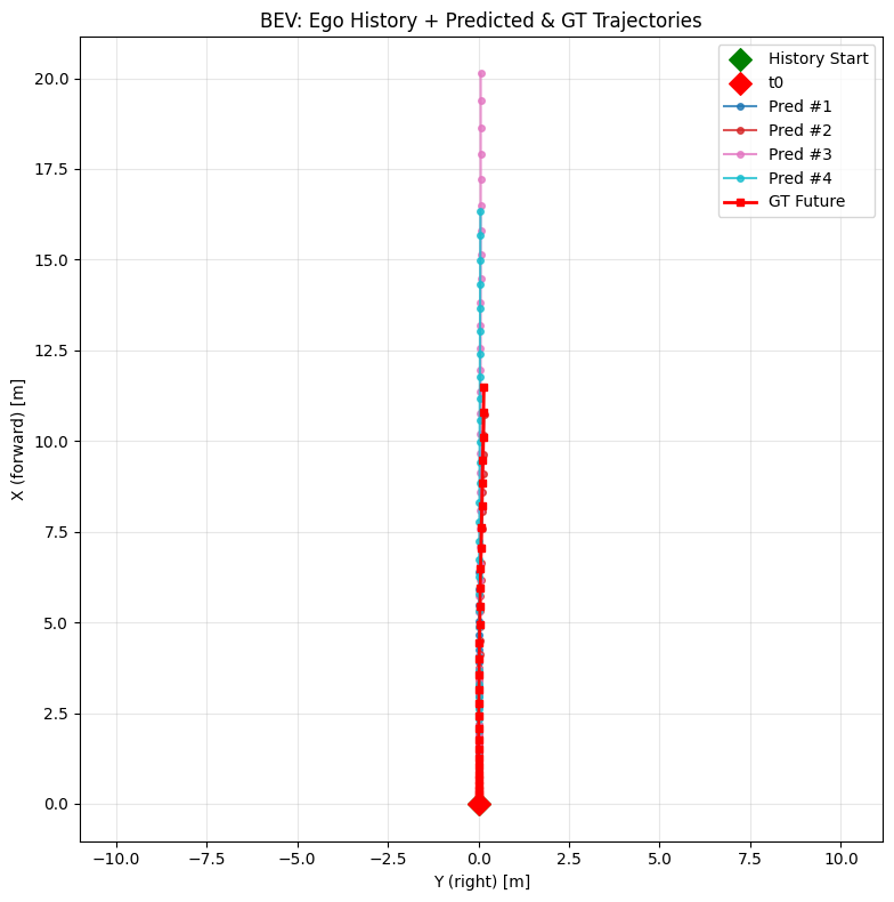
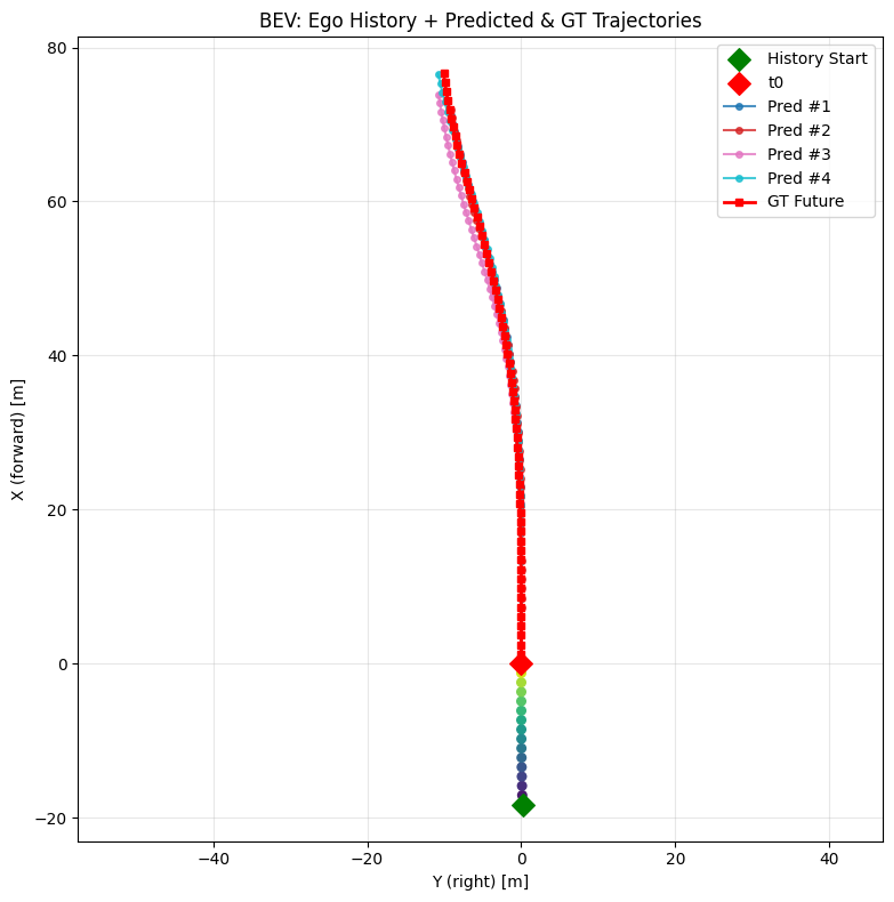
The camera grid below shows the multi-view input the model received at t=0.0s. The trajectory plot confirms the model’s predicted paths (Pred #1–4) align tightly with the ground truth future path (GT Future) – a straight stop at the line, with no lateral deviation.
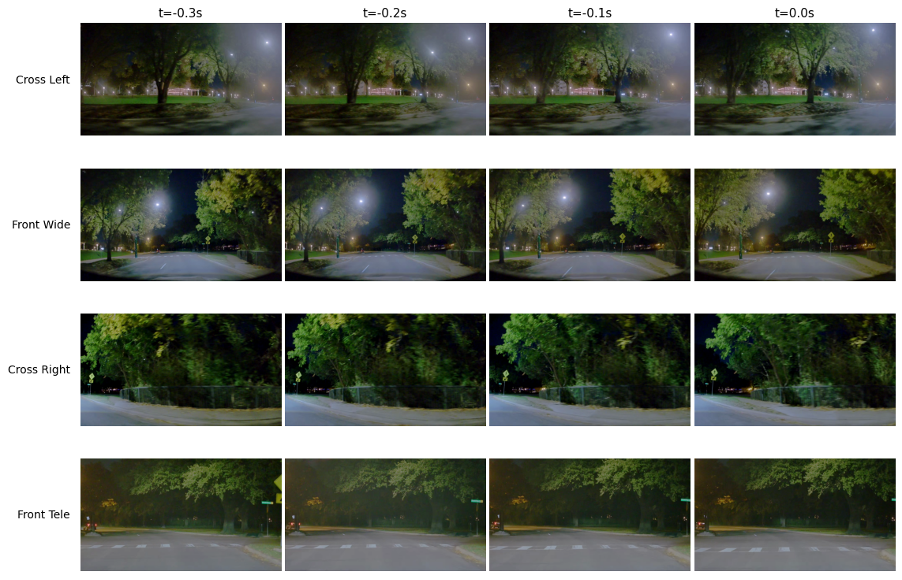
السيناريو 2: تغيير المسار ليلاً عند تقاطع طرق
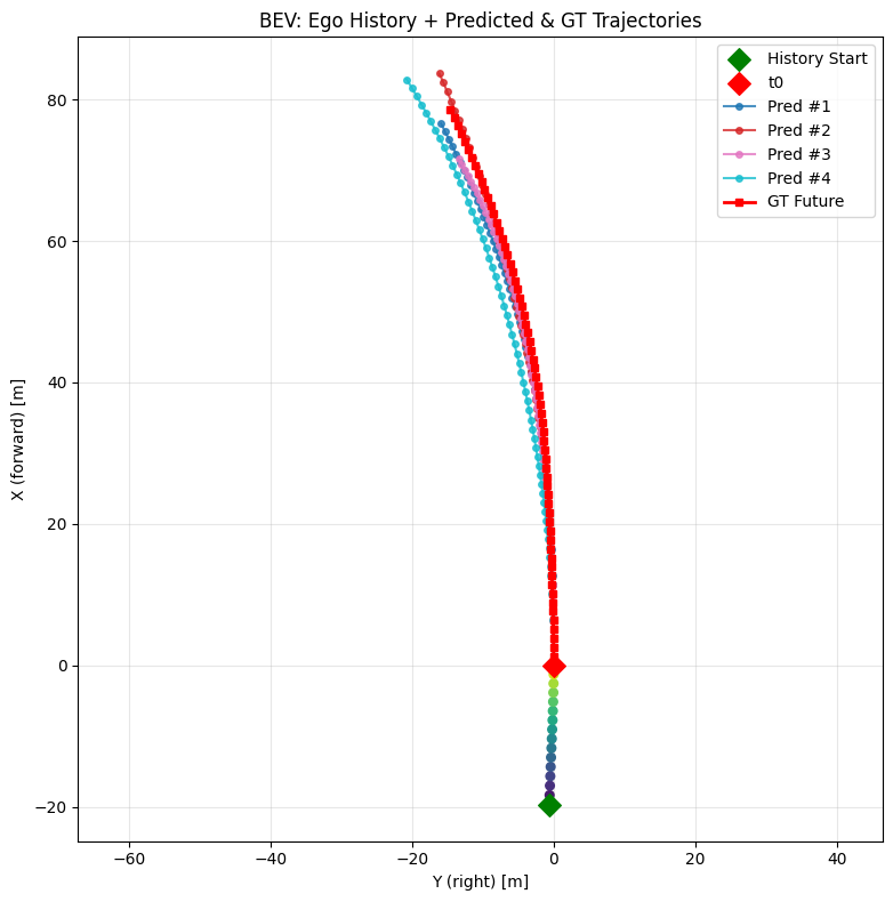
The vehicle is approaching a night-time intersection where staying straight requires an active lane change to avoid a right-turn slip lane. Visibility is low. The model generates four candidate reasoning traces (one per predicted trajectory) all converging on the same safe decision.
مخرجات سلسلة السببية – التي أنتجها Alpamayo 1 خلال اختبارنا:
- “Change to the left lane to stay in the through lane and avoid being forced into the right-turn slip lane at the upcoming intersection, while moderating speed to maintain gap to the lead vehicle and approach the marked crosswalk cautiously.“
- “انتقل إلى المسار الأيسر للبقاء في مسار العبور وتجنب الإجبار على الدخول إلى مسار الانعطاف يمينًا مع الحفاظ على مسافة آمنة من المركبة الأمامية ومنطقة عبور المشاة.“
- “انتقل إلى المسار الأيسر لتجاوز المركبة الأمامية الأبطأ والحفاظ على مسافة أمان أكبر من الرصيف الأيمن بعد ممر المشاة.“
- “غيّر المسار إلى اليسار لتجاوز مركبة أبطأ أمامك في المسار الأيمن والحفاظ على انسيابية الحركة أثناء الاقتراب من منطقة عبور المشاة.“
This scenario is particularly relevant for testing generalisation: the model was not trained on this specific intersection geometry, yet all four predicted trajectories correctly execute the lane change and stay clear of the pedestrian crossing. The reasoning traces are consistent across all four candidates.
السيناريو 3: تكييف السرعة على منحنى الطريق السريع
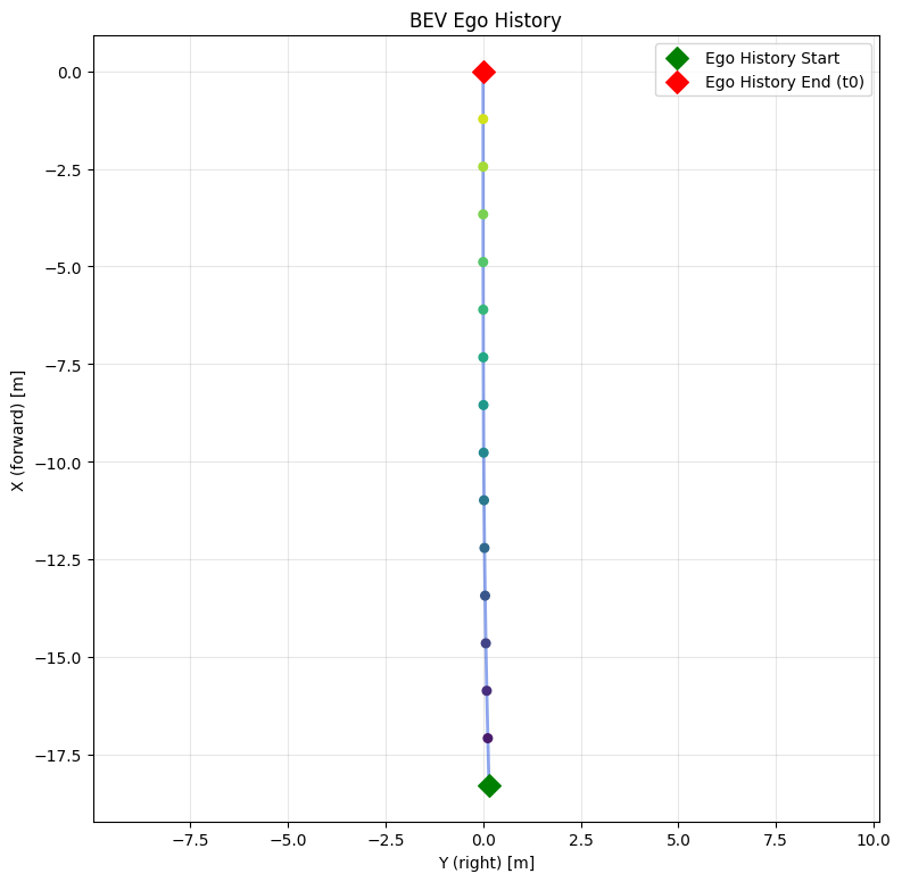
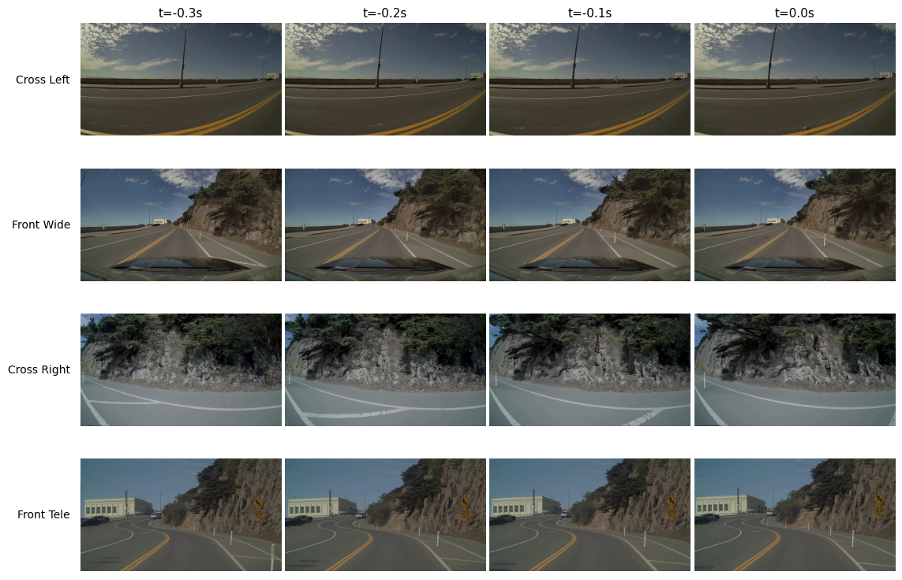
The vehicle is on a winding coastal highway. The road bends ahead. This scenario tests whether the model reasons about geometry, not just reacts to visible lane markings. All four generated reasoning traces say the same thing in slightly different words.
مخرجات سلسلة السببية – التي أنتجها Alpamayo 1 خلال اختبارنا:
- “عدّل السرعة للمنحنى الأيسر المقبل.“
- “عدّل السرعة للمنحنى لأن الطريق ينحني أمامك.“
- “عدّل السرعة للمنحنى الأيسر القادم.“
What matters here is the consistency: the model identifies the same physical constraint from four independently sampled trajectories, which indicates the reasoning is grounded in actual scene understanding rather than pattern-matching on curve geometry.
رؤى من اختباراتنا على DGX Spark: The model’s reasoning traces were immediately readable by non-ML engineers. This matters for safety review processes: you do not need to interpret neural network weights to understand what the system decided and why.
إجابة مباشرة على السؤال التنظيمي
يحل مخرج سلسلة السببية مشكلة أعاقت شهادة المستوى 4 في معظم الأسواق: الصندوق الأسود.
The EU AI Act, emerging NHTSA guidance in the US, and equivalent frameworks across Asia all move toward the same requirement: safety-critical AI systems must be able to explain their decisions. Alpamayo produces that explanation natively, as part of every inference pass. It is built into the architecture.
The practical implications go further than compliance. Fleet operators can use reasoning traces to identify systematic gaps in model behaviour – not through expensive post-incident reconstruction, but by reading the model’s own output at scale. Insurance companies have concrete evidence to assess risk. Passengers in robotaxi deployments can receive plain-language explanations of what the vehicle is doing and why. That last point matters for public acceptance, which remains one of the underestimated barriers to commercial deployment.
رؤية: Organisations that build on Alpamayo’s explainability architecture now will be ahead when mandatory explainability standards are enforced. Building explainability into a system after the fact is technically complex and expensive.
نموذج المعلّم-الطالب: كيف يتوسّع هذا النموذج ليشمل الإنتاج
يعمل نموذج يضم 10 مليارات معامل على وحدة معالجة رسومات في مركز بيانات. وهو لا يعمل داخل المركبة. هذا قيد معروف، وقد صُمم Alpamayo حوله منذ البداية.
Alpamayo 1 is the Teacher: a high-capability reasoning model that runs in cloud or on-premise infrastructure. It generates high-quality, labelled reasoning traces and trajectory outputs. Those outputs become the training data for Student models – smaller, optimised versions with 0.5 to 2 billion parameters that are designed to run on production automotive compute hardware, such as the DRIVE AGX Orin or the DRIVE Thor architecture.
The economic logic is straightforward. You pay the computational cost of full reasoning capability once, at training time, using the Teacher. The Student inherits those capabilities through distillation and runs at a fraction of the cost at inference time – fast enough for real-time driving decisions. This is the bridge between a research model and an in-vehicle deployment.
NVIDIA plans to release official distillation scripts in June 2026. That release is the production gateway for the entire ecosystem. Our own roadmap is built around it: using the distillation tools to compress the 10B teacher to a 0.5B–2B student model, then transitioning off the DGX Spark and deploying onto edge devices to measure memory footprint, power consumption, and inference latency. The target is a stable real-time inference rate – the sub-second response time that reactive autonomous driving requires. The end goal is a live, closed-loop demonstration inside a physical vehicle on DRIVE AGX Orin or Thor hardware, validating that the distilled model can perceive, reason, and drive safely in real-time.
ما تشير إليه خارطة طريق NVIDIA لعام 2026 للصناعة
نشرت NVIDIA خطة إصدار واضحة ومتسلسلة لعام 2026. تعالج كل مرحلة فجوة محددة في المسار من النموذج إلى النشر الإنتاجي.
| مرحلة رئيسية | الإصدار | ما يتم شحنه |
| مارس 2026 | GTC San José | نصوص الضبط الدقيق + دعم لمدخلات التنقل والنصوص التوجيهية |
| يونيو 2026 | Alpamayo 1 Super | نموذج أكبر + نصوص التقطير الرسمية + إطار عمل مفتوح المصدر للتعلّم المعزز ذي الحلقة المغلقة |
| ديسمبر 2026 | Alpamayo 1 Ultra | نموذج أساسي شامل للمركبات ذاتية القيادة على نطاق واسع |
The March 2026 release at GTC San José delivers fine-tuning tooling and expanded prompt support. This signals that the base model is stable enough for organisations to begin adapting it to their own data. The June release is more significant: distillation scripts and a closed-loop reinforcement learning framework address what NVIDIA calls “embodiment misalignment” – the gap between a model that generates correct reasoning and one that executes correct actions. The fact that this is a dedicated June release indicates it remains the hardest open problem. The December Alpamayo Ultra release frames the end state: a universal foundation model for autonomous vehicles, analogous to what a large language model is for text.
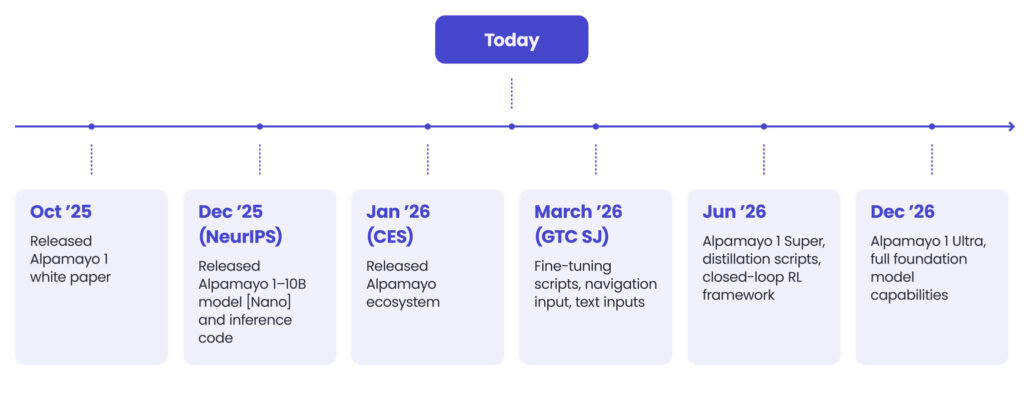
For decision-makers, the roadmap creates a specific action window. The six months between March and June 2026 are the optimal period to build fine-tuning capability and data pipelines on the base model, before the distillation tools ship and the production race begins in earnest.
ثلاثة أسئلة قبل استثمارك التالي في المركبات الذاتية
Alpamayo does not make autonomous vehicle development easy. It changes which problems are hard. Organisations that understand this distinction will allocate resources more effectively. Here is a three-question framework for evaluating your current position:
| سؤال استراتيجي | الاختبار التشغيلي | ما الذي يعنيه ذلك |
| هل تشرح مجموعة أنظمة القيادة الذاتية قراراتها؟ | هل يمكن لفريقك تدقيق ما فعله النظام (ولماذا) بعد وقوع الحدث؟ | ستكون سجلات سلسلة السببية مطلوبة للحصول على الموافقة التنظيمية في معظم الأسواق. ابنِ على هذا الأساس الآن. |
| هل يمكن لأجهزة الحوسبة الطرفية لديك تشغيل الاستدلال في الوقت الفعلي؟ | ما هي ميزانية زمن الاستجابة لديك وهل يمكنك تلبيتها دون إشراك الحوسبة السحابية في العملية؟ | خطط للنماذج المضغوطة (0.5B–2B معامل). لا تبنِ البنية حول نموذج المعلم بحجم 10B. |
| هل تبني من الصفر أم تدمج؟ | هل لديك بيانات كافية للضبط الدقيق، أم ينبغي لك استخدام النظام البيئي المفتوح؟ | تعمل مجموعات بيانات Physical AI من NVIDIA على خفض الحاجز بشكل كبير. استخدمها قبل بناء خطوط أنابيب خاصة. |
أربعة إجراءات يجب اتخاذها الآن:
1. قيّم فجوة القابلية للتفسير لديك
Review your AV stack for its ability to produce readable decision logs. If it cannot, decide whether explainability can be added as a layer or requires architectural changes. That answer determines your integration path.
2. ابدأ البناء على النظام البيئي المفتوح قبل إصدار الأدوات في يونيو
The Physical AI datasets and Alpamayo 1 model weights are available today. Begin building data pipelines and evaluation workflows now – the advantage of an earlier start compounds quickly in machine learning.
3. التصميم للأجهزة الطرفية منذ البداية
يُعد النموذج ذو 10 مليارات معامل أداة تدريب، وليس هدفًا للنشر. حدّد منصة هدفك، وقيود الذاكرة، ومتطلبات زمن الاستجابة قبل البدء في أعمال التخصيص – وليس بعدها.
4. التفاعل الاستباقي مع الجهات التنظيمية
Alpamayo’s reasoning traces give you a readable, auditable log of model decisions. Use this to start conversations with regulatory bodies now. Organisations that help shape explainability standards will be better positioned than those that wait to comply.
استخدم الذكاء الاصطناعي في عمليات السيارات لتقليل وقت الوصول إلى السوق بنسبة تصل إلى 45%
احصل على الكتاب الإلكتروني
الخلاصة
The move from pattern recognition to explicit reasoning addresses two structural problems at the architectural level – the long tail of edge cases and the black-box opacity that blocks certification.
NVIDIA’s team has demonstrated it – and we have verified it ourselves – in closed-loop simulation on real-world scenarios (stopping at red lights, navigating night-time intersections, handling highway curves) producing reasoning traces that are coherent, auditable, and directly tied to physical trajectory outputs. The open-source release means the ecosystem can move now, not after a proprietary licensing negotiation.
The window for strategic positioning is specific and finite. The fine-tuning release in March 2026, the distillation framework in June, and the Alpamayo Ultra foundation model in December define a development arc that will look, in hindsight, like the 18 months when the production landscape for autonomous vehicles was decided.
لقد وصلت طبقة الاستدلال. والسؤال هو: هل مؤسستك مستعدة للبناء عليها؟
وهنا يأتي دور Spyrosoft comes in, helping automotive and mobility organisations integrate NVIDIA’s AI stack. Our engineers have hands-on experience with Alpamayo on DGX Spark hardware and can help you assess your readiness, define your strategy, and get to a working prototype faster. Fill out the form below to learn more.




arrow_circle_rightاتصل بنا
هل تتساءل من أين تبدأ؟ يسعدنا مساعدتك في تقييم خياراتك.

arrow_circle_right مقالاتنا


