من الذكاء الاصطناعي إلى العائد على الاستثمار: وكلاء الذكاء الاصطناعي لأعمالك


Your organisation is facing a choice: continue adding narrow AI tools piecemeal or fundamentally rewire workflows around AI. McKinsey calls this the gen AI paradox: roughly 80% of companies report using generative AI, yet most see little to no impact on their bottom line. The culprit is that AI often remains bolted on: deployed in horizontal pilots or chatbots that generate diffuse benefits, instead of integrated into core processes. To turn AI from a novelty into value, you must embed AI deeply in business operations.
عمليًا، يعني هذا إعادة التفكير في القرارات وسير العمل والتعاون بين الإنسان والذكاء الاصطناعي، مع عمل وكلاء الذكاء الاصطناعي الأذكياء كمحفزات استباقية، وليس مجرد أدوات تفاعلية.
ستوضح لك هذه المقالة كيف يمكنك تنفيذ الذكاء الاصطناعي بفعالية، مع عمل وكلاء الذكاء الاصطناعي كممكّنات عملية لنتائج أعمال قابلة للقياس.
مفارقة الذكاء الاصطناعي التوليدي: تبنٍّ واسع النطاق، تأثير محدود
تكشف الاستطلاعات الحديثة عن تباين صارخ: بينما 70-80% من المؤسسات الكبيرة أطلقت الذكاء الاصطناعي التوليدي، وتفيد نسبة مماثلة بعدم تحقيق مكاسب مالية جوهرية. ويعزو McKinsey ذلك إلى عدم التوازن بين الذكاء الاصطناعي الأفقي وحالات الاستخدام الرأسية.
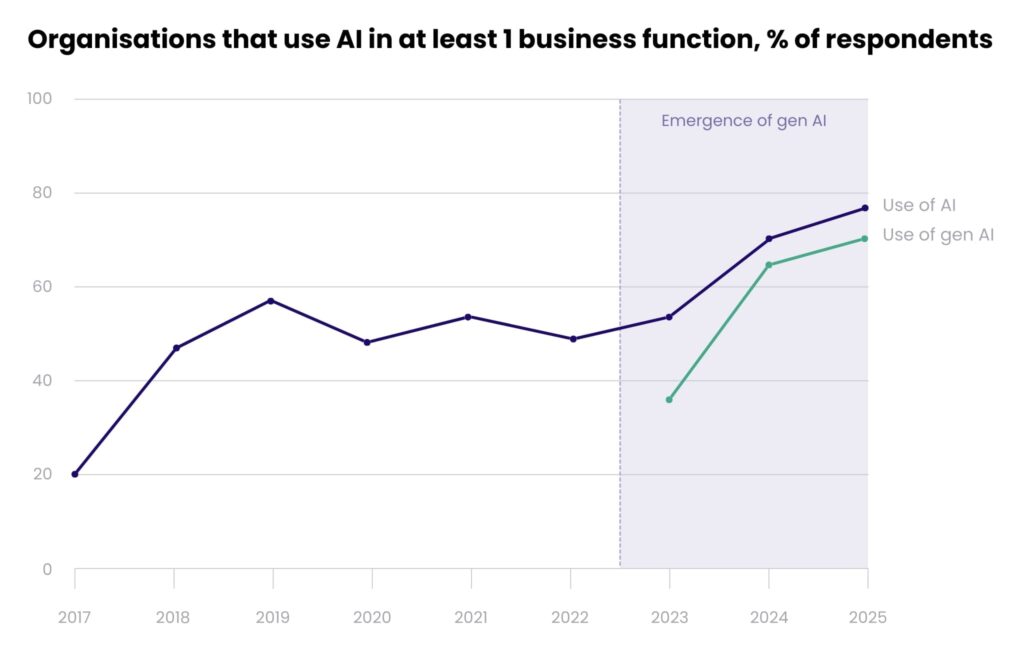
Many companies have adopted horizontal use cases like enterprise copilots and chatbots. Microsoft 365 Copilot is already used by nearly 70% of Fortune 500 companies. These are productivity boosters – they help employees save time on repetitive tasks and synthesise information. But the benefits are spread across the workforce and don’t show up in the top or bottom line.
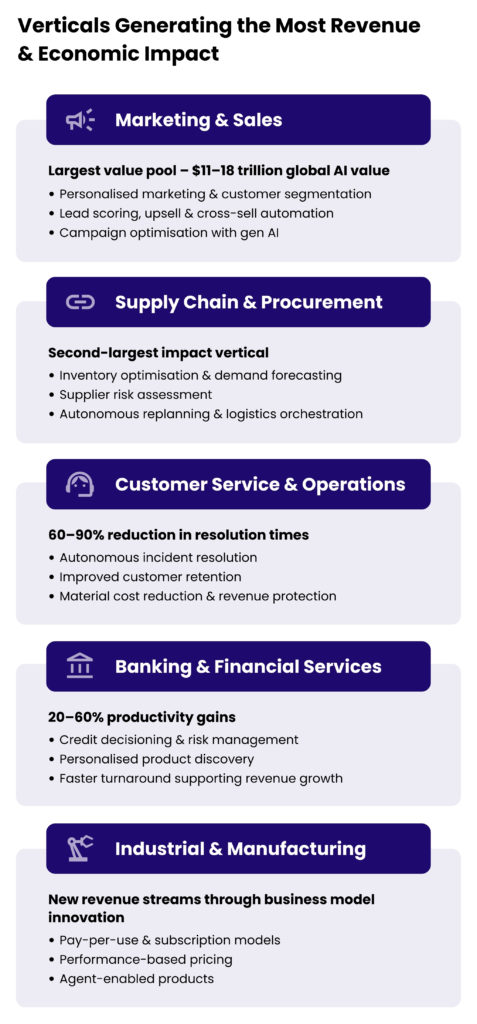
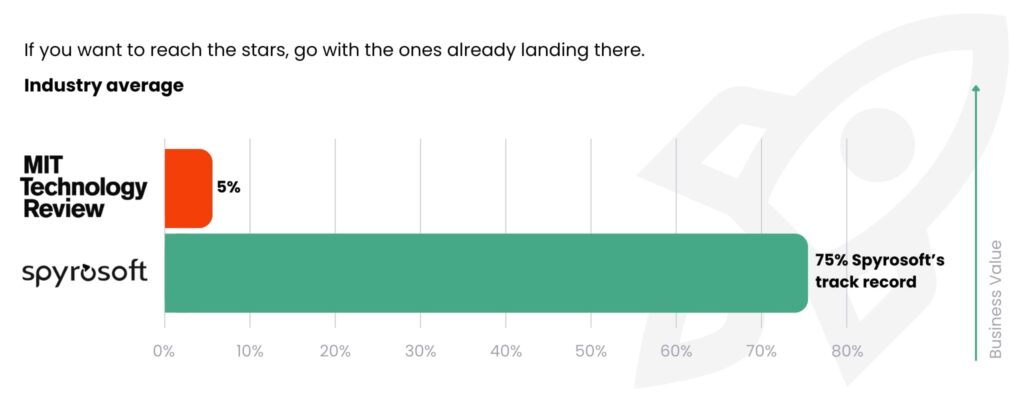
Vertical use cases tell a different story. These are embedded in core business functions and processes and can deliver measurable economic impact. But scaling them has been hard: less than 10% of such initiatives make it past the pilot stage. Even when deployed they often only address a narrow step in a process and require human prompting rather than operating proactively or autonomously. So, their impact on overall business performance is far below what’s possible.
فلماذا يوجد هذا الخلل؟
Both horizontal and vertical AI require deliberate decisions and structured enablement. However, horizontal tools are typically easier to deploy at scale, while vertical use cases demand targeted redesigns of workflows and operating models. As a result, their adoption faces six major barriers:
المبادرات المجزأة
In many organisations, vertical use cases have emerged from a bottom-up approach within individual functions. Because fewer than one-third of CEOs actively sponsor their company’s AI agenda, this often results in a patchwork of disconnected micro-initiatives and dispersed investments. Without strong enterprise-level coordination, efforts remain fragmented and fail to generate transformative impact.
محدودية توفر الحلول الجاهزة
Unlike horizontal applications such as copilots, which can be deployed largely off the shelf, vertical use cases often require deeper customisation and closer alignment with domain-specific workflows. Teams often need to stitch together multiple components and customise them heavily, effectively doing near-from-scratch development. While many organisations have data scientists capable of building models, what is often missing are the roles that bridge business requirements with technical execution – AI consultants, analytics translators, or AI product managers.
These specialists play a crucial part in connecting frontline workers, project sponsors, and AI engineers, ensuring that solutions are not only technically sound but also directly embedded in the realities of daily operations. Without this connective layer, even the best models risk remaining isolated experiments rather than becoming scalable business solutions.
اطّلع على كيفية تبسيط عملياتك من خلال حلول الذكاء الاصطناعي
القيود التقنية للنماذج اللغوية الكبيرة المبكرة
Despite their remarkable capabilities, first-generation large language models (LLMs) carried limitations that restricted enterprise deployment. They could produce inaccurate outputs, undermining trust in precision-critical environments. They were also fundamentally passive: unable to act independently, drive workflows, or make decisions without prompts. Handling complex, multi-step workflows with branching logic proved difficult, as did maintaining context across extended interactions due to limited memory.
من الجوانب الأضعف الأخرى في النماذج اللغوية الكبيرة المبكرة كان الأمان.
Sensitive data entered external systems could easily be exposed or misused, raising concerns around confidentiality, compliance, and regulatory risk. Moreover, the models themselves were vulnerable to prompt injection, data poisoning, or adversarial manipulation, creating potential vectors for misinformation or malicious outputs. Without robust access controls, auditability, and mechanisms to ensure data governance, organizations struggled to trust early LLMs in security-critical environments such as financial services, healthcare, or industrial operations.
أوضح هذا الافتقار إلى الأمان المدمج أن نشر النماذج اللغوية الكبيرة على نطاق واسع سيتطلب بنى جديدة، وضوابط أقوى، ومبادئ تصميم تركز على المؤسسات.
فرق الذكاء الاصطناعي المعزولة
تعاني العديد من المؤسسات في مبادرات الذكاء الاصطناعي لأنها تُطوَّر بمعزل عن غيرها.
Too often, a central AI or R&D team spends months building a solution, only to present it to business users at the end with a “now use it” expectation. On production lines in automotive, for example, innovations are handed over from R&D but turn out to be disconnected from the realities of day-to-day operations, simply because frontline workers were never engaged in the design process.
The same pattern repeats across industries: models built without input from IT, data, or business teams may work in a controlled prototype but prove brittle, over-engineered, or misaligned once tested in live environments.
إمكانية الوصول إلى البيانات
Structured data is often scattered across multiple systems without consistent governance, while unstructured information, such as documents, emails, logs, and media, remains largely uncatalogued and underutilised.
The result is not only inefficiency, with teams spending time searching for usable inputs, but also a missed opportunity to turn data into a real business asset. The challenge is less about achieving real-time freshness everywhere and more about identifying and prioritising the data sources that truly fuel business value. In the past, companies often embarked on multi-year “big bang” initiatives, building vast data lakes first and hoping relevant use cases would follow.
Many of those efforts consumed significant resources but failed to deliver tangible results. Today, the approach has shifted: data platforms are built incrementally, with the focus on bringing in the data required for the most impactful use cases first, proving value, and then adding new sources over time.
Organisations that strategically define which data assets underpin their critical use cases, assign clear ownership, and invest in improving their quality build a foundation that scales. When sequenced well, early AI projects can improve the data assets that later use cases also depend on: accelerating deployment, reducing duplication of effort, and amplifying long-term impact.
إذا كنت بحاجة إلى مساعدة في هذا الأمر، فتأكد من الاطلاع على خدماتنا في مجال البيانات وذكاء الأعمال.
المقاومة الثقافية والجمود التنظيمي
حتى عندما تكون التقنية ناضجة، لا يزال بإمكان الأشخاص إبطاء التقدم. ومع ذلك، يمكنك تجنب ذلك من خلال النهج الصحيح.
Many AI deployments encounter quiet resistance from business teams and middle management, driven by concerns about disruption, uncertainty around job impact, or limited familiarity with the technology. This hesitation can delay adoption and make integration into daily operations more difficult, but it is not a dead end.
Anticipating these barriers early and recognising that organisational culture must evolve alongside technology is essential. The key is not only to ask how do we add AI? but also how should processes adapt when intelligent software can act?, a mindset shift that lays the groundwork for moving beyond prototypes toward scaled, meaningful impact.
Think of the shift that happened when spreadsheets arrived for accountants. Before, calculations were done manually on paper or with a calculator. Accurate but painfully slow. Spreadsheets didn’t just make the same work faster, they expanded what was possible: complex models, instant recalculations, and entirely new ways of analysing data.
If we treat it as just another tool to make existing processes a bit more efficient, we miss the point. The real opportunity lies in reimagining workflows, decisions, and roles around intelligent software, unlocking value that simply wasn’t possible before.
وكلاء الذكاء الاصطناعي للأعمال: من أدوات تفاعلية إلى متعاونين مستقلين
Turning organisational processes upside-down can harm your organisation. Therefore, the adoption of AI should be balanced. One way to make it sustainable and profitable is to consider implementing AI agents, which are key concept in scaling AI.
وكيل AI هو كيان برمجي يجمع بين التعلم والذاكرة واتخاذ القرارات لتنفيذ المهام من البداية إلى النهاية.
Unlike a simple chatbot or analytic model, an AI agent can plan, act autonomously across systems, and continuously improve. As IBM notes, unlike traditional or generative AI, AI agents possess the ability to make complex decisions autonomously, plan, and interact dynamically across systems.
In business, agents can literally change the world by automating multi-step processes and serving as proactive collaborators. They are enablers that transform AI into a goal-driven virtual collaborator.
في McKinsey وOpenAI وMicrosoft وAnthropic والتعريفات الأكاديمية، الميزات الأساسية هي:
- الاستقلالية (القدرة على اتخاذ إجراءات دون حثّ بشري في كل خطوة)
- التخطيط (القدرة على تسلسل الإجراءات نحو هدف)
- الذاكرة/الحالة
- تكامل الأدوات والأنظمة
- اتخاذ القرار
By combining these, AI agents shift work from reactive responses to proactive assistance. For example, instead of a support agent waiting for a user’s query, an agent might automatically resolve recurring customer issues, alert teams to anomalies, or suggest strategic business moves. In short, agents become decision support engines that work with humans.
كيف يُستخدم الذكاء الاصطناعي في الأعمال
تُظهر القصص التالية ما يمكن القيام به وكيف تطبق الشركات المختلفة وكلاء الذكاء الاصطناعي في مؤسساتها. فيما يلي أمثلة على حالات الاستخدام التي نفذتها شركات أخرى ونحن، Spyrosoft.
دراسة حالة 1: تحويل خدمة العملاء باستخدام وكيل ذكاء اصطناعي
المشكلة: Our client, a global leader in the paints and coatings industry, needed a customer support solution that could scale across markets. Their HubSpot-based chatbot struggled to support multiple languages and websites, offered limited knowledge base automation and proved inefficient in handling growing customer query volumes.
الحل: We delivered an AI-driven chatbot designed for multilingual, multi-platform customer support. The solution scales smoothly across regions, automatically builds and updates the knowledge base, reduces manual effort and integrates with internal systems to ensure reliable data flow. By using advanced AI, the chatbot provides personalised, context-aware interactions that help customers find answers faster and support teams focus on higher-value tasks.
النتيجة:
- +150%
- زيادة في الأتمتة مقارنةً بالروبوت المحادثي السابق من HubSpot
- تصعيدات أقل بمقدار 2×
- إلى وكلاء بشريين
- انخفاض بمقدار 3 أضعاف في الحالات غير المحلولة
- تحسين معدل الحل من أول تواصل
إذا كانت أتمتة دعم العملاء أمرًا تفكر فيه، فتأكد من قراءة رأينا حولالدعم الفني بالذكاء الاصطناعي.
دراسة حالة 2: الاكتتاب في التأمين على نطاق واسع
المشكلة: كان مكتتبو التأمين في Compensa غارقين في استفسارات الوسطاء ومعالجة العروض اليدوية وأوقات الاستجابة البطيئة، مما حد من الإنتاجية والاستجابة للعملاء.
الحل: Spyrosoft, in cooperation with Compensa, created an AI underwriting solution to support underwriting by responding to broker requests, processing offers, and providing faster, more accurate responses. By embedding domain knowledge into the agents, the system replicated underwriter expertise across the team.
النتيجة:
- زيادة بمقدار 2× في كفاءة الاكتتاب
- أوقات استجابة أسرع 5× عبر سير عمل الاكتتاب
- معالجة ضعف عدد العروض ضمن نفس الطاقة التشغيلية
- مُعترف به ضمن أفضل ثلاث ابتكارات عالمية داخل المؤسسة
- مساهمة مباشرة في نمو الإيرادات
دراسة حالة 3: إعادة تصور مذكرات مخاطر الائتمان في القطاع المصرفي
المشكلة: Retail bank relationship managers were spending weeks drafting credit-risk memos to support lending decisions. Each memo required manually pulling data from at least ten different sources and weaving together complex reasoning across interdependent sections such as loans, revenue, and cash flow, slowing decision-making and frustrating both staff and customers.
الحل: The bank collaborated with credit-risk experts to build a proof of concept powered by AI agents. These agents extracted data, drafted memo sections, assigned confidence scores to highlight areas for review, and suggested follow-up questions. Instead of manually compiling documents, relationship managers shifted into roles of strategic oversight and exception handling.
النتيجة:
- زيادة في الإنتاجية بنسبة 20–60% عبر سير عمل الموافقة على الائتمان
- انخفاض بنحو 30% في زمن دورة الموافقة
- قرارات أسرع وأكثر دقة مع أخطاء يدوية أقل
- تركيز أكبر على الحكم البشري ذي القيمة المضافة
دراسة حالة 4: الارتقاء بجودة البيانات في أبحاث السوق
المشكلة: A market intelligence firm employed over 500 analysts to clean, structure, and codify massive amounts of data. Despite this investment, errors persisted – 80 percent of mistakes were still being spotted by clients. The process was costly, resource-intensive, and left little time for analysts to focus on generating deeper insights.
الحل: The company piloted a multi-agent system designed to autonomously detect anomalies, explain shifts in sales or market share, and identify drivers of change. The agents cross-referenced internal data such as taxonomy updates with external signals like product recalls or weather events. They then synthesised and ranked the most influential factors, providing ready-to-use insights for decision-makers.
النتيجة:
- تحديد إمكانية تحقيق مكسب إنتاجي يتجاوز 60%
- أكثر من 3 ملايين دولار من التوفيرات السنوية المتوقعة
- إعادة توجيه المحللين نحو أعمال استراتيجية ذات قيمة أعلى
- تحسين الدقة والعمق في معالجة البيانات من خلال وكلاء الذكاء الاصطناعي
دراسة حالة 5: أتمتة العمليات الخلفية في الخدمات المالية
المشكلة: Global banks face mounting costs and inefficiencies in their back-office operations, from underwriting to compliance checks. Manual processes are slow, prone to error, and consume significant resources.
الحل: تعاونت إحدى شركات التأمين الكبرى، AIG، مع Palantir لنشر 78 وكيل ذكاء اصطناعي مخصص للاكتتاب.
النتيجة: اعرف المزيد.
- تقليص زمن العملية من يومين إلى ثلاث ساعات
- اتخاذ قرارات أسرع وأكثر دقة
- وكلاء الذكاء الاصطناعي يمكّنون نماذج تشغيلية جديدة وقابلة للتوسع تتجاوز خفض التكاليف
دراسة حالة 7: إعادة ابتكار عمليات اللوجستيات وسلاسل التوريد
المشكلة: كانت شركة شحن أمريكية تغرق في الأعمال الورقية. كانت أوامر الاستلام وبوالص الشحن وتحديثات الشحنات تُعالج يدويًا، مما أدى إلى أخطاء وتأخيرات وشحنات مفقودة.
الحل: AI agents were introduced to digitise orders, process bills of lading, and update shipment statuses automatically. By removing the human bottleneck, the system created an always-on, error-free process for document handling.
النتيجة:
- تحقيق دقة تتراوح بين 98–99% في معالجة الطلبات
- أوقات استجابة أقصر بشكل ملحوظ
- القضاء شبه الكامل على الطلبات الفائتة
- الانتقال من العمل الورقي اليدوي إلى نظام قابل للتوسع يعمل على مدار الساعة
- تحرير الموظفين للتركيز على الحالات الاستثنائية وخدمة العملاء
دراسة حالة 8: تحديث الأنظمة المصرفية القديمة
المشكلة: A global bank faced the daunting task of modernising its legacy core platform, made up of more than 400 separate applications. The project carried a $600 million budget and was slowed by siloed teams working through repetitive, manual tasks. Documentation was slow, error-prone, and difficult to coordinate, leaving the transformation effort stuck in complexity.
الحل: The bank adopted an agentic approach, where squads of AI agents collaborated under human supervision. Each agent was responsible for a defined stage, documenting existing applications, generating and reviewg code, integrating features, and testing outputs. Human experts guided the process, ensuring quality and strategic alignment while offloading repetitive coding and documentation tasks to the AI.
النتيجة:
- أكثر من 50% انخفاض في وقت وجهد التطوير للفرق المتبنية المبكرة
- أتمتة العمل اليدوي، مع انتقال الأفراد إلى أدوار إشرافية
- دورات تحديث أسرع وتسليم للميزات مع دورات تطوير أقل
بناء خارطة طريق لتبني الذكاء الاصطناعي
يمكن أن يكون تكرار هذه النجاحات أسهل مع خارطة طريق واضحة. إن تبني الذكاء الاصطناعي على نطاق واسع ليس مجرد ترقية تقنية. إنه تحول في الأعمال.
استنادًا إلى أفضل الممارسات في القطاع، ينبغي أن تفكروا في خطوات مثل ما يلي:
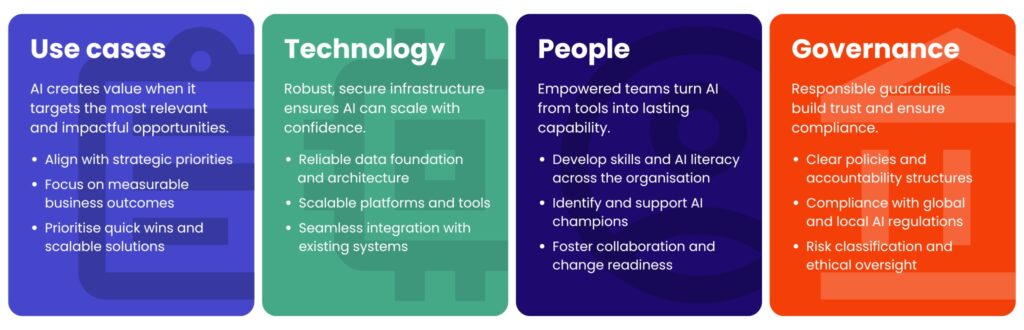
1. التركيز على حالات الاستخدام عالية القيمة
AI only delivers lasting impact when it is tied to real business outcomes. Start by aligning initiatives with strategic priorities and measurable goals, whether that’s reducing call resolution times, improving throughput, or cutting error rates. Prioritise quick wins that demonstrate value early, while designing solutions with scalability in mind.
2. بناء أسس تكنولوجية قابلة للتوسع وآمنة
A strong data and technology backbone is critical for adoption at scale. Invest in a modular, extensible architecture, a shared ecosystem where reusable AI agents can plug into common platforms, APIs, and governance layers. Ensure seamless integration with existing systems, supported by reliable data pipelines and secure, observable infrastructure that users can trust.
3. تمكين الأفراد والثقافة
Technology succeeds only when people adopt it. Promote AI literacy across the organisation, equip teams with the skills to work effectively with AI agents, and create cross-functional squads that blend IT, operations, and business expertise. Involve end users early, identify AI champions, and openly communicate goals to build trust and readiness for change.
4. تأسيس حوكمة مسؤولة وتطور مستمر
Trust and accountability must be built in from the start. Define clear policies, ethical guardrails, and oversight mechanisms for how AI agents operate, make decisions, and use data. Set up monitoring to track agent performance, collect feedback, and adapt over time. Treat every deployment as a learning lab, refining workflows, retraining models, and scaling what works.
تحويل إمكانات الذكاء الاصطناعي إلى واقع
The era of AI has arrived at boardroom agendas, but the winners will be those who go beyond plugging in the latest tools. Leading organisations are not just adding AI as a sidekick but also redesigning themselves around it. The era of agentic enterprises is here.
يجب عليك التفكير في تغيير عملياتك في بيئة يمكن للبرمجيات أن تتخذ فيها إجراءات. يتطلب ذلك إعادة تصور سير العمل من الأساس، وجعل وكلاء الذكاء الاصطناعي محوريين في كيفية خلق القيمة.
In practical terms, success depends on strong intent: define clear outcomes, embed AI (and AI agents for business) deeply into core processes, and realign teams and metrics accordingly. When done right, the payoff can be dramatic. For example, X-genie lets underwriters process twice more offers and deliver them five times faster. Similarly, firms that built centralised AI platforms achieved faster adoption and lower costs per use case.
The path forward is one of both ambition and rigor. Invest in modular platforms and cross-functional teams, set up governance and skills programs, and use AI agents as instruments of business change, not just nice-to-have features.
By thoughtfully integrating AI, and especially by leveraging AI agents within core processes, you can move from isolated pilots to enterprise-wide impact. In doing so, you will turn the promise of AI into a competitive advantage, transforming not just tasks but entire business models.
تنفيذ الذكاء الاصطناعي مع Spyrosoft
At Spyrosoft, we’re working on AI strategies and solutions for industries daily. We can advise you on AI strategy that will supercharge your operations, shaping roadmaps and defining way forward.
Whether you’re developing AI agents, modernising core applications, or integrating advanced analytics into your operations, our team delivers end-to-end solutions, from strategy and prototype to deployment and scaling.
إذا كنت ترغب في أن تصبح مؤسسة قائمة على الوكلاء، فسيسعدنا مساعدتك.
الأسئلة الشائعة
يشير الذكاء الاصطناعي في الدعم الفني إلى استخدام تقنيات الذكاء الاصطناعي وتعلّم الآلة لأتمتة عمليات خدمة العملاء والدعم الفني أو تعزيزها. ويشمل ذلك استخدام أدوات مثل روبوتات المحادثة، والمساعدين الافتراضيين، وقواعد المعرفة، والتحليلات التنبؤية، ووكلاء الذكاء الاصطناعي والمساعدين الأذكياء.
يُستخدم الذكاء الاصطناعي لأتمتة الردود، وتصنيف التذاكر وترتيب أولوياتها، ومساعدة الوكلاء البشريين، وتوفير الدعم على مدار الساعة طوال أيام الأسبوع، وتحليل سلوك العملاء لتحسين تقديم الدعم. فهو يساعد في إدارة استفسارات العملاء، وتقديم ردود فورية، وعرض توصيات مخصصة، وحتى التنبؤ بالمشكلات المستقبلية بناءً على البيانات التاريخية – مما يحسن بشكل كبير أوقات الاستجابة وتجربة العملاء الإجمالية.
تشمل الفوائد الرئيسية لاستخدام الذكاء الاصطناعي في الدعم الفني أوقات استجابة أسرع، وتوافراً على مدار الساعة طوال أيام الأسبوع، والقدرة على التعامل مع كميات كبيرة من الاستفسارات المتكررة دون إرهاق بشري. يمكن للأنظمة المدعومة بالذكاء الاصطناعي أيضاً تقليل عبء العمل التشغيلي من خلال أتمتة المهام الروتينية وتحسين دقة حل المشكلات من خلال الرؤى المستندة إلى البيانات. يؤدي هذا إلى تجربة عملاء أكثر اتساقاً وقابلية للتوسع مع تحرير الوكلاء البشريين للتركيز على مشكلات أكثر تعقيداً وأهمية استراتيجية.
يمكن للذكاء الاصطناعي تعزيز جميع مستويات الدعم الفني من خلال أتمتة وتحسين المهام المختلفة بناءً على درجة التعقيد. في دعم المستوى الأول L1، يمكن للروبوتات المحادثة المدعومة بالذكاء الاصطناعي والمساعدين الافتراضيين التعامل مع الاستفسارات الشائعة وإعادة تعيين كلمات المرور وتقديم استكشاف الأخطاء الأساسي. بالنسبة للمستوى الثاني L2، يمكن لأدوات الذكاء الاصطناعي مساعدة الوكلاء البشريين من خلال تحليل السجلات واقتراح الحلول وأتمتة التشخيص. في دعم المستوى الثالث L3، يمكن للذكاء الاصطناعي دعم المهندسين من خلال تحديد الأنماط في مجموعات البيانات الكبيرة، وتسريع تحليل السبب الجذري، وحتى التنبؤ بمشكلات النظام المتكررة قبل أن تتفاقم.




لنناقش كيف يمكننا دعم مشاريعك في مجال الذكاء الاصطناعي

Tomasz Smolarczyk
مدير الذكاء الاصطناعي