מסירה יעילה של פרויקטים: 5 תרחישים וטיפים למעבר חלק


Project handovers are an inevitable part of every project’s lifecycle. They arise from team turnover, supplier changes or shifts in organisational strategy. Despite their frequency, however, handovers are often not given the attention they deserve, which can result in miscommunication, the loss of vital information, unnecessary delays and even the compromise of long-term value.
A smooth transition is currently a key factor in maintaining momentum and achieving lasting results. Knowledge, responsibility and ownership must be transferred effectively when a project shifts from development to ongoing support, changes hands between external partners or is restructured internally. This is integral to future performance.
This article explores five key scenarios in which effective handovers are crucial. We will examine the distinctive challenges at play in each case and share actionable guidance to help you safeguard continuity, uphold quality standards and pave the way for sustained project success.
The significance of a successful project handover
A project handover is a critical phase that directly affects a project’s ability to continue, evolve and be maintained sustainably by new owners. If not managed carefully, the handover point is inherently vulnerable to miscommunication, delays and inefficiency, whether the transition involves internal teams, external partners or handover to ongoing operations. A well-managed handover, on the other hand, brings several key benefits.
מבטיח המשכיות וממזער שיבושים
It keeps the project on track with minimal downtime. Clear documentation and actionable insights enable the incoming team to continue work seamlessly without delays or redundant efforts.
Captures & transfers critical tacit knowledge
Effective handovers capture informal knowledge such as decisions, workarounds and lessons learned, which is not included in formal documentation. This information transfer prevents mistakes from being repeated and accelerates the ramp-up of the new team.
בונה ומשמר את אמון בעלי העניין.
Transparent and organised transitions demonstrate professionalism and instil trust among clients, partners and the leadership team. Despite personnel changes, stakeholders can be confident that project goals will be met.
מפחית סיכונים באופן פרואקטיבי
Clear responsibility assignments and comprehensive information sharing reduce the risk of missed deadlines or overlooked tasks. Anticipating potential gaps during transition phases prevents costly setbacks and ensures the project remains aligned with strategic objectives.
A report by the Association for Project Management (APM) מצא כי85% of study participants believe that clearly defined and expressed project benefits are essential for successful handover and75% of respondents highlighted the importance of involving end-user reps throughout the project lifecycle.
קבלו את רשימת התיוג המלאה למסירת הפרויקט שלכם!
הורידו את הספר האלקטרוני החינמי שלנו!
What are the circumstances of the project handover?
Project handovers typically occur in response to change, which is sometimes anticipated and sometimes unexpected. Regardless of the cause, careful planning is required for each transition in order to avoid disruption and protect the value already created.
סיבה נפוצה אחת להעברה היא הבלתי נמנע של שינוי. As projects evolve, the people or organisations involved often change. Team members may leave, companies may be acquired, or outsourcing agreements may come to an end. While these changes are often beyond our control, they emphasise the importance of managing handover processes thoughtfully and efficiently.
Another key moment for handover arises during התאמות אסטרטגיות מחדש. As businesses grow, pivot or reorganise, responsibilities are often transferred between teams or departments. For instance, a project may be transferred from an internal team to an external partner, or vice versa, as part of a broader business strategy. Clear and well-managed transitions in these situations are essential to maintain momentum and ensure continued alignment.
תרחיש נפוץ שלישי מתרחש ב סוף מחזור החיים של פרויקט. When active development slows and the system or product moves into a steady operational phase, ownership typically passes to a maintenance or support team. This handover is critical for long-term success, as it ensures the new team has all the necessary context, tools and guidance to manage ongoing maintenance effectively.
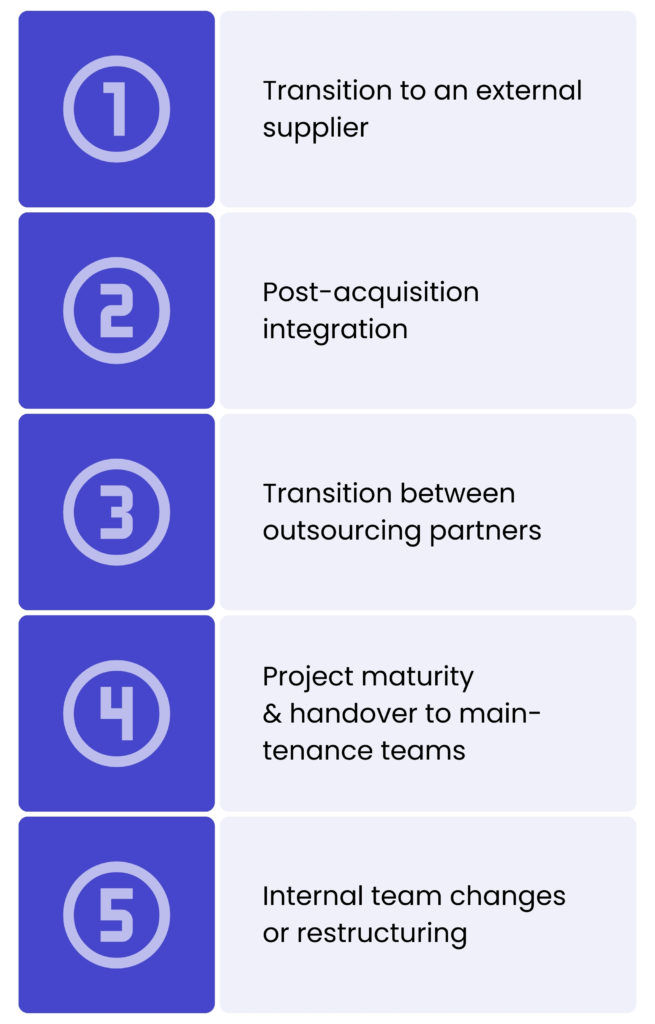
There are five possible project handover scenarios:
מעבר לספק חיצוני
This scenario involves transferring project responsibilities to an external supplier or third party. Careful coordination is required to ensure that the vendor receives a comprehensive briefing on the project details, technical specifications and deliverables. Clear communication, detailed documentation and well-established support and onboarding procedures are essential for a successful transition, preserving continuity and preventing any disruptions to service or quality.
טיפים:
- Prepare detailed documentation early on, including system architecture and the business context.
- Clearly define the scope, responsibilities and timelines in the contract.
- Organise joint workshops or shadowing sessions to ensure a smooth knowledge transfer.
- Temporarily retain key internal experts to support and oversee the transition.
אינטגרציה לאחר רכישה
Project handovers become crucial for successfully integrating teams, systems, and processes when a company acquires another or merges with a partner. In this scenario, it is essential to align strategies, technologies and organisational cultures to ensure that projects can continue seamlessly. Successful integration relies on transparent communication, shared objectives and structured knowledge transfer between teams.
טיפים:
- Develop a structured integration plan that aligns processes, tools and objectives.
- Appoint dedicated integration leads from both sides.
- Conduct knowledge audits to identify gaps and overlaps.
- Maintain open communication to overcome differences in team culture and workflows.
מעבר בין שותפי מיקור חוץ
When a company decides to change outsourcing partners, it is essential to implement a structured handover process. This involves transferring knowledge, workflows and resources from the outgoing provider to the incoming one. Key challenges may include aligning operational procedures, managing stakeholder expectations and minimising the risk of disruption to project continuity. Thorough documentation and clear guidelines for the new partner are required to ensure a smooth transition.
TIPS:
- Use cooperation clauses to enforce sufficient knowledge transfer with the outgoing vendor.
- Adopt a phased approach in which the old and new partners work together temporarily.
- Standardise documentation and tooling to ensure consistency.
- Conduct a neutral technical or project audit to validate completeness.
Project maturity & handover to maintenance teams
As a project enters its mature phase, responsibility for ongoing support and optimisation is transferred to a maintenance team. This handover involves conveying all relevant project knowledge and documentation, as well as any outstanding tasks or updates. Ensuring a smooth transition for the maintenance team is crucial for maintaining system stability and performance, and for minimising downtime and post-handover issues.
טיפים:
- Involve the maintenance team before the development process is complete.
- Provide practical documentation such as runbooks and escalation paths.
- Capture and share hidden knowledge, such as information on known issues and design decisions.
שינויים בצוות הפנימי או ארגון מחדש
When project responsibilities shift within an organisation due to team restructuring or role changes, effective internal handover processes become essential. This process usually involves sharing knowledge to ensure incoming team members are prepared to manage ongoing tasks. Maintaining consistent quality of work and minimising productivity gaps throughout the transition are key challenges.
טיפים:
- הפיכת התיעוד להרגל מתמשך.
- Use mentoring to share knowledge informally.
- Hold focused handover meetings to review the current status and next steps.
- Ensure that leadership supports and monitors the transition.
Want to make your next project handover smooth and risk-free?
Download our comprehensive, free guide outlining the 11 essential items for a successful handover checklist! It’s a practical resource that will help your team plan, communicate and execute seamless transitions in any situation.
Got questions? Our experts are here to help! Simply fill out the form below to get in touch.
An effective handover ensures continuity, captures critical knowledge, builds stakeholder confidence and minimises risk. Without effective management, projects are vulnerable to miscommunication, delays and a potential loss of value.
The five main scenarios include: transition to an external supplier, post-acquisition integration, transition between outsourcing partners, handover to maintenance teams, and internal team changes or restructuring.
Key steps include creating detailed documentation, clearly defining the scope and responsibilities of contracts, organising workshops and ensuring the involvement of internal experts during the transition phase.
Post-acquisition handover requires the alignment of strategies, systems and cultures. The success of this process depends on structured integration plans, effective communication and knowledge audits to bridge the gap between teams.
Maintaining productivity and ensuring a smooth transition when teams or roles change internally requires continuous documentation, mentoring, focused handover meetings and leadership involvement.


arrow_circle_rightצרו קשר
התמקדו בליבה העסקית שלכם, בזמן שאנחנו מנהלים את תחזוקת תשתית ה-IT שלכם

Filip Rozanski
ראש שירותים מנוהלים
arrow_circle_right מאמרים מומלצים


