Réalité augmentée 101 : cas d'usage et prédictions futures


Le potentiel de la réalité augmentée s'étend à divers secteurs, du commerce de détail et de la fabrication jusqu'aux soins de santé. À mesure que la technologie AR est constamment améliorée, son application s'étend bien au-delà des jeux et du divertissement virtuel.
In this article, we’ll look at how augmented reality works to understand better what it can be used for. Then, we’ll also describe some current and evolving augmented reality use cases in business as well as discuss how AR will be developing in the future.
Qu'est-ce que la réalité augmentée en termes simples ?
La réalité augmentée (RA) est un moyen de présenter des données supplémentaires par le biais d'éléments visuels numériques, de sons ou de stimuli sensoriels dans un environnement réel. La RA superpose généralement des objets virtuels à des objets réels, mais elle peut aussi masquer des objets virtuels derrière des objets réels ou masquer des objets réels, de sorte qu'ils ne soient pas visibles à l'écran.L'évolution des technologies AR a considérablement transformé divers secteurs en améliorant l'engagement et l'expérience client.
Bref historique et évolution de la RA
Augmented reality has a fascinating history that dates back several decades. The concept of AR was first introduced in the 1960s, but it wasn’t until the 1990s that the first practical AR applications began to emerge. These early applications were primarily focused on education, training, and gaming, laying the groundwork for the technology we know today.
The 2000s marked a significant turning point for AR technology, driven by the rapid development of smartphones and tablets. This era saw the creation of AR apps that could be used on mobile devices, bringing AR into the mainstream. Popular apps like Pokémon Go and Snapchat showcased the potential of AR for entertainment and social interaction, capturing the imagination of millions worldwide.
Today, AR technology is being harnessed across a wide range of industries, from education and healthcare to marketing and retail. Businesses are leveraging AR to enhance customer experiences, improve training and education, and foster greater engagement and interaction. The journey of AR from a conceptual idea to a transformative technology is a testament to its incredible potential and versatility.
Comment fonctionne la réalité augmentée ?
The way augmented reality works depends on the complexity of the system. In general, AR uses computer vision, GPS data about user localisation, mapping and depth tracking to show extra data layered on the real-world context. The cameras and sensors collect, send and process the gathered data to show virtual content layered on what the user is looking at in real time. As the user moves, the AR visuals automatically adjust to the changed context.
The hardware components required for augmented reality include: a processor, display (optical projection systems, monitors, wearable display devices, eyeglasses or goggles), sensors and input devices. Smartphones and mobile tablets are commonly used for AR as they are very often equipped with sensors, like accelerometer, GPS or compass that allow motion tracking. However, the more complex the AR, the more computing power the processor should have, as the latency requirements are extreme. In mobile devices, insufficient computing power is often compensated by offloading data processing to a remote machine in the cloud.
À quoi ressemble la fusion de la réalité avec un monde numérique ?
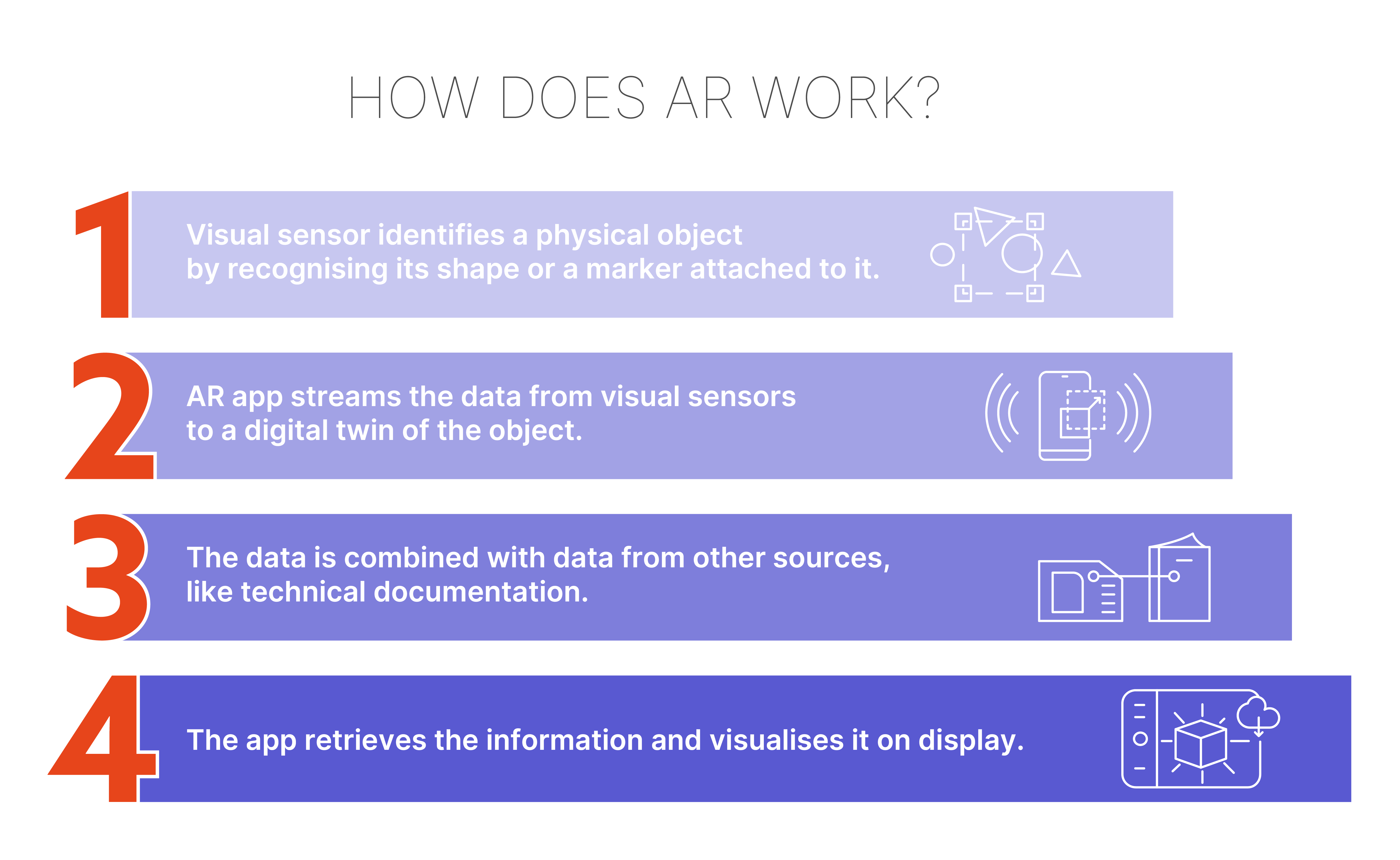
Illustrons le fonctionnement de la RA dans unfabrication industrielle context. Let’s imagine a situation, in which AR enables workers to get trained by substituting paper manuals with digital instructions presented directly in their field of view, for example, through AR goggles, leaving their hands free and reducing mental effort required to operate a machine.
The AR-enabled device uses a visual sensor to identify a physical object by recognising its shape or a marker attached to it. Then, the AR application connects with a digital twin (a 3D copy) of the object – in our example, one of the machines used on the production line. The data from visual sensors is then streamed to a digital twin and is combined with data from other sources, like technical documentation. The application retrieves the information and visualises it to the user on display, in some cases allowing the user to interact with the visualisation through touch interaction.
Ce n'est là qu'un exemple parmi d'autres de l'utilisation de la réalité augmentée dans un contexte professionnel. Ces dernières années, la RA s'est répandue dans de nombreux secteurs, du divertissement à la santé. Vous trouverez ci-dessous une présentation de quelques autres applications.
Différences entre la réalité augmentée et la réalité virtuelle
While augmented reality (AR) and virtual reality (VR) are often mentioned in the same breath, they are distinct technologies with unique applications. Virtual reality creates a completely immersive digital environment that replaces the physical world, transporting users to a different reality altogether. In contrast, augmented reality enhances the physical world by overlaying digital information and images onto it, creating a blended experience.
VR is predominantly used for gaming, education, and training, offering users a fully immersive experience. On the other hand, AR is utilised in a broader range of applications, including marketing, retail, and healthcare. One of the key advantages of AR is its accessibility; it can be used on a wide variety of devices, such as smartphones and tablets, making it more readily available to the general public.
Comprendre les différences entre la RA et la RV est essentiel pour apprécier les avantages uniques que chaque technologie offre et la manière dont elles peuvent être appliquées à divers domaines.
Découvrez nos services de conseil et de développement d'interfaces homme-machine
En savoir plus
Quels sont quelques exemples d'utilisation de la réalité augmentée ?
The beginnings of AR technology are grounded in aviation, where it’s still used, for example, in pilot training. AR head-up displays are also used in military aircraft to present flight parameters and machine controls right in the field of a pilot’s view, so they can remain focused on piloting the aircraft.
Les affichages tête haute ont ensuite été transférés versvéhicules automobiles. À l'origine, les affichages tête haute des voitures présentaient des données telles que la vitesse ou une carte routière. Aujourd'hui, grâce à la RA, les données, telles que la navigation, sont affichées sur la vue réelle de la route, plutôt que sur une simple carte.
Another example of an industry where AR is widely used is entertainment. The global AR market reached a value of US$ 6.39 Billion in 2021 and is expected to reach $ 38.03 billion by 2027. Augmented reality is more and more common in sports. During live sports coverage, augmented reality can enrich the play-by-play with extra data. For example, in golf, using special technologies (see our étude de cas TrackMan), il est possible de suivre la trajectoire de vol d'une balle, sa vitesse, le point exact où elle a touché le sol, etc., et d'afficher ces informations à l'écran en temps réel.
La RA a également le potentiel de révolutionner la médecine, bien qu'elle soit actuellement considérée comme une nouveauté. La recherche porte sur l'utilisation possible de la RA pour fournir des données d'imagerie médicale dans la zone opératoire ou pour former les chirurgiens.
Quels sont les avantages de la réalité augmentée ?
La RA réduit la surcharge cognitive
La RA fournit les informations nécessaires exactement au moment où l'utilisateur en a besoin, en déployant stratégiquement des fonctionnalités de réalité augmentée. Nul besoin de recourir à des ressources supplémentaires.
La RA enrichit la réalité
Les applications de réalité augmentée ajoutent une couche d'informations supplémentaires au monde réel qui nous entoure, enrichissant l'expérience utilisateur et aidant à mieux comprendre le monde environnant.
La RA améliore l'accessibilité et réduit les barrières
Les dispositifs et applications de RA peuvent servir d'outils pédagogiques pour les personnes en situation de handicap accomplissant certaines tâches du monde réel. Haptique et les retours audio permettent aux personnes ayant des déficiences visuelles ou cognitives d'utiliser le toucher et l'ouïe pour comprendre en temps réel les informations sur le monde qui les entoure, le rendant ainsi plus accessible.
La RA permet la visualisation d'idées abstraites dans un environnement réel
It’s one of the most ground-breaking benefits of AR that’s especially valuable in the retail industry. Customers don’t have to rely solely on their imagination to decide which colour or pattern of a sofa best matches their interior design or how a particular model of a watch will look on their wrist.
L'avenir de la réalité augmentée s'annonce prometteur
Augmented reality continues to evolve, with mobile AR taking the market by the storm. Mobile devices are being equipped with new technologies, like LiDAR, that can significantly boost AR capabilities by adding more depth and allowing for occlusion, making the AR experiences feel more natural.
Selon le rapport de Grand View Research, the AR market size, estimated at USD 25.33 billion in 2021, is expected to expand at a compound annual growth rate (CAGR) of 40.9% from 2022 to 2030. The industrial and manufacturing segment is accounted for the largest revenue share and is predicted to continue dominating the market in this decade. Also, the automotive industry is widely adopting AR technology to enhance user experience and its market share is estimated to grow by 43.3%. The use of AR in the healthcare segment is expected to skyrocket in the near future as it’s increasingly being implemented in training and surgical visualisation.
Le moment d'adopter la technologie AR, c'est maintenant. Parlez-nous de vos besoins et de votre idée, et nous vous aiderons à construire une solution AR de pointe.


arrow_circle_rightNOUS CONTACTER
Parlez à notre expert pour permettre un développement HMI continu dans votre entreprise !

Przemyslaw Krzywania
Directeur HMI
arrow_circle_right Nos articles