DICOM : un guide rapide sur la norme et des conseils pratiques de notre expert


The healthcare industry is a constantly changing and growing sector. This is influenced by the continuously progressing fields of science and rapidly developing technologies. For years now, there have been standards introduced to help doctors, manufacturers, and medical units keep up with changing needs and thereby provide the best possible care for patients. One of them is a standard for medical imaging called DICOM.
In this publication, we share with you the DICOM definition, its structure and model architecture. Moreover, thanks to our expert Łukasz Śliwowski, we also dive into the biggest challenges IT companies may find while using the DICOM standard in their projects.
Qu'est-ce que DICOM ?
DICOM stands for Digital Imaging and Communications in Medicine and is a software integration standard used in medical imaging. It can be defined as a protocol and a data format that specifies how to store, transfer, and display medical images. The format is used in imaging systems such as X-ray, CT, ultrasound, and MRI and is used widely in many healthcare facilities.
Originally, DICOM was developed in 1985 by NEMA (National Electrical Manufacturers Association) and ACR (American College of Radiology). Over the years the standard evolved, after some revisions and changes, it was renamed DICOM in 1993 and subsequently became a commonly accepted practice.
DICOM as a file format allows storing the data of image pixels and other sets of data made up of attributes. Sets of attributes, known also as tags, can contain crucial pieces of information such as patient personal and medical data. DICOM offers more than 2000 different attributes that can be placed and shared in a file.
DICOM en tant que norme
DICOM ne désigne pas seulement des fichiers d'images et des ensembles de données, mais également une norme et son protocole. La norme DICOM couvre les procédures et protocoles relatifs à l'imagerie numérique et au formatage des données dans cinq domaines :
Gestion des images – concerne l'échange de fichiers contenant des informations liées aux images, par exemple l'interprétation d'images et la procédure utilisée.
Interprétation d'images – désigne les liens entre les images et les perceptions des utilisateurs exprimées sous forme de texte, d'audio ou de supports contenant des informations connexes.
Gestion des images réseau – utilise des dispositifs qui envoient et reçoivent des images et comprennent la structure des informations échangées. Cela permet l'échange de noms de fichiers et d'images en fonction d'attributs.
Gestion de l'impression – permet aux appareils de partager des imprimantes sur le réseau DICOM et définit les classes SOP qui doivent être déployées pour se conformer aux spécifications d'impression de la norme.
Gestion du stockage hors ligne – permet l'échange de fichiers à l'aide de supports de stockage interchangeables.
De plus, la norme DICOM fournit des services permettant de déterminer la manière appropriée d'échanger, de stocker et d'archiver les données, ainsi que la façon de rechercher des données dans le système d'archivage et de communication d'images (PACS).
Dans sa structure, la norme récemment publiée contient 22 sections indépendantes mais liées :
Partie 1 : Introduction et aperçu (ce document)
Partie 2 : Conformité
Partie 3 : Définitions des objets d'information
Partie 4 : Spécifications des classes de service
Partie 5 : Structures de données et encodage
Partie 6 : Dictionnaire de données
Partie 7 : Échange de messages
Partie 8 : Prise en charge de la communication réseau pour l'échange de messages
Partie 9 : Retraité
Partie 10 : Stockage multimédia et format de fichier pour l'échange de médias
Partie 11 : Profils d'application de stockage multimédia
Partie 12 : Formats et supports physiques
Partie 13 : Retiré
Partie 14 : Grayscale Standard Display Function
Partie 15 : Profils de sécurité et de gestion des systèmes
Partie 16 : Ressource de mappage de contenu
Partie 17 : Informations explicatives
Partie 18 : Services Web
Partie 19 : Hébergement d'applications
Partie 20 : Rapports d'imagerie utilisant l'architecture de document clinique HL7
Partie 21 : Transformations entre DICOM et d'autres représentations
Partie 22 : Communication en temps réel (DICOM-RTV)
Some of these sections can help define activities such as managing imaging procedures, reporting procedure status, encrypting datasets, or organising layouts of images for review. Overall, sections are meant to assist in defining the range of services that machines can perform to accomplish useful tasks.
modèle d'imagerie DICOM
The DICOM data model addresses the medical imaging workflow, which consists of various processes. Some of them can represent the visit and registration of the patient or consist of one or more medical examinations or procedures. Other ones concern the association of each study with one or more series of medical examinations or deal with the compliance of the acquired image.
Les modules du modèle DICOM aident à identifier les attributs de données appropriés. Dans le flux de travail DICOM, ils sont regroupés en catégories, telles que patient, étude, série ou image, puis subdivisés en d'autres sous-catégories plus détaillées.
Le graphique suivant montre un exemple de la structure du modèle DICOM.
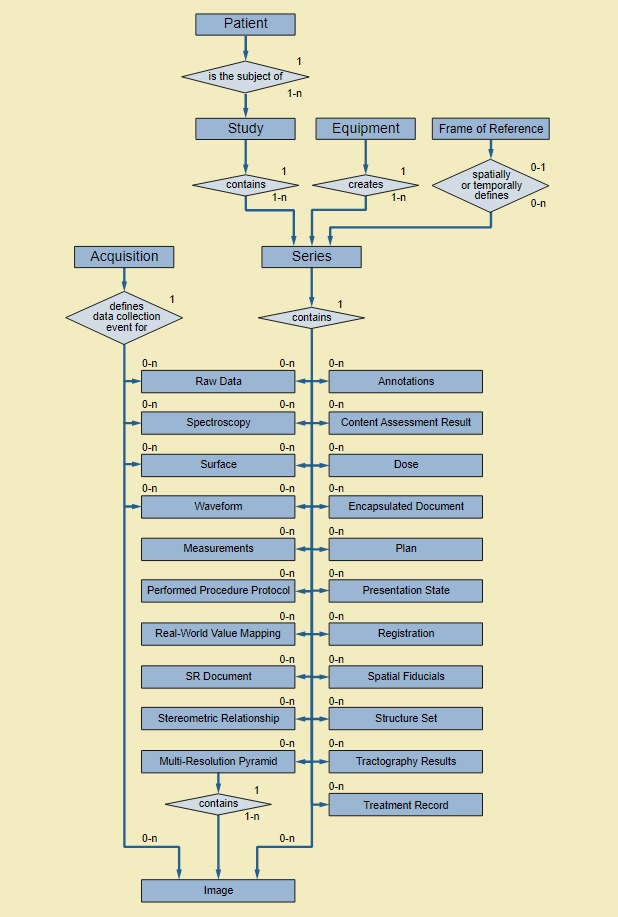
Source : https://dicom.nema.org/medical/dicom/current/output/html/part03
Avantages de l'utilisation des images DICOM
The main advantage of DICOM is the unification of file format and data incorporated in the image. This means that pictures or tests made in one medical facility can be easily seen, read, and interpreted in any other place, hospital, or even at home with the use of adequate software. Standardisation also helps to create various types of automation systems supporting diagnostic processes. Such solutions can be created following the guidelines contained in a standard that is valid worldwide. The appropriate quality of data in DICOM can translate into effective algorithmisation of certain processes, thus supporting the efficiency and reducing the working time of medical workers.
Les autres avantages que DICOM peut offrir sont :
Stockage numérique – the standard enables storing medical images and data in digital systems and therefore allows eliminating the need for physical storage. It also offers improvements in the management and accessibility of medical information held in the hospital database.
Un accès plus facile à l'information – the unification of image format and digital storage makes it possible for doctors all over the world to access the necessary information. This enables remote diagnosis, training, and consultation. All this improves the efficiency of the diagnostic process and thus the quality of patient care.
Services d'imagerie supplémentaires – DICOM standard delivers many additional services. That includes protocols for printing images on a film or digital medium and procedures for reporting and archiving the file. It also offers services like the organisation of picture layouts and encryption of data sets.
Défis liés aux images DICOM
Besides the many benefits, there are some challenges that can be found, especially in the practical use of the DICOM standard for automation processes and utilisation of DICOM data to algorithms. Together with our expert Łukasz Śliwowski, we take a closer look at some of those issues.
One of the biggest challenges is the quality of images or data, which can be affected by different interpretations of the standard by both healthcare facilities and producers of the equipment. Image quality can also depend on the configuration of the machine, e.g., X-ray or CT. Technicians who make the image can adjust the device for different sensors and resolutions, impacting its quality.
From my experience, the quality of medical data is quite a typical challenge. Sometimes, it is happening because different people or institutions have a different understanding of the standard, and sometimes medical standards just leave room for interpretation. There are some new standards like FHIR qui fonctionnent un peu mieux dans ce domaine, mais si l'établissement ne maintient pas la qualité de ses données, aucune norme ne peut aider.
– Łukasz Śliwowski, analyste commercial principal chez Spyrosoft
Another thing that can cause lower quality data for an automation process is the method of filling in the information and tags in the DICOM file. Since the standard leaves some freedom in data entry, certain medical units take advantage of it and skip some details that they do not necessarily need to gain time. To quote our expert:
There are hospitals that strictly follow the standards, but there are also facilities that are not so precise in this regard. Sometimes, they do not fill in all the tags or replace them with different information. This can also create situations where the image is missing some data needed for further processing. In those cases, it turns out that the system configured to work in one hospital, does not work in the other one, and therefore it is more problematic to create simple automation. It also often means that some data must be checked manually, and the whole system needs to be implemented per hospital.
A different class of problems can be seen in the integration and collaboration process with hospitals and their administration workers or technicians. As institutions, healthcare units may have many procedures that are difficult to meet or address by technological companies. Here our expert – Łukasz Śliwowski se remémore son expérience à cet égard :
Most of the time, doctors and researchers from medical facilities are very keen to collaborate with IT companies or start-ups. However, sometimes the issues may start later on when working with people from the administration or hospital IT department starts to be problematic, or the inner procedures make the work difficult and more time-consuming. In some projects, I experienced even situations when the integration process had to be completely abandoned due to constantly piling on problems such as liability for equipment insurance or internal IT security procedures.
A further challenge, connected to administrative and legal issues, can be for instance GDPR compliance. The organisation of the attributes in DICOM gives access to very detailed data on the patient. Some of them contain sensitive data or details that could help to identify the patient unambiguously. In many of these situations, the system or platform owner is legally forbidden to process such data. Revenant sur l'expérience de l'analyste commercial principal de Spyrosoft :
In situations related to GDPR and the processing of patient records, we have to implement an additional solution to anonymise the data. This method must be designed to, on the one hand, erase all sensitive and explicit patient data and, on the other hand, still be able to link the person with the data that are held in the hospital. Of course, such adjustment is possible, but unfortunately, it requires additional time and effort.
Importance du format DICOM
With all the benefits and challenges that DICOM can bring, its importance to the healthcare industry is still undeniable. Since its introduction in the 1980s, the standard has contributed to providing key tools for diagnostics and clinical analysis. It is therefore used in all healthcare fields that use medical imaging, which includes cardiology, oncology, radiotherapy, neurology, ophthalmology, and dentistry.
Bien que les entreprises informatiques puissent rencontrer de nombreux défis lors de l'utilisation des informations DICOM, la qualité appropriée des fichiers et des données peut encore soutenir considérablement les processus d'automatisation.
Si vous souhaitez en savoir plus sur DICOM ou d'autres normes médicales et leur utilisation dans l'intégration des systèmes informatiques, n'hésitez pas à contacter notre Équipe de santé.


arrow_circle_right LECTURES RECOMMANDÉES :





arrow_circle_rightContactez-nous
