Qu'est-ce que la technologie d'intelligence de localisation et comment peut-elle vous aider à développer votre entreprise


For organisations that want to understand how people interact with physical locations, location intelligence is the answer. It takes business analytics to the next level by revealing patterns and trends hidden in location-based data, enabling organisations to gain actionable insights that drive growth, efficiency and innovation.
Dans cet article, nous allons nous pencher sur la technologie de la location intelligence, en examinant son fonctionnement, ses composants essentiels et l'impact transformateur qu'elle peut avoir sur la croissance d'une organisation.
Qu'est-ce que l'intelligence de localisation et comment fonctionne-t-elle ?
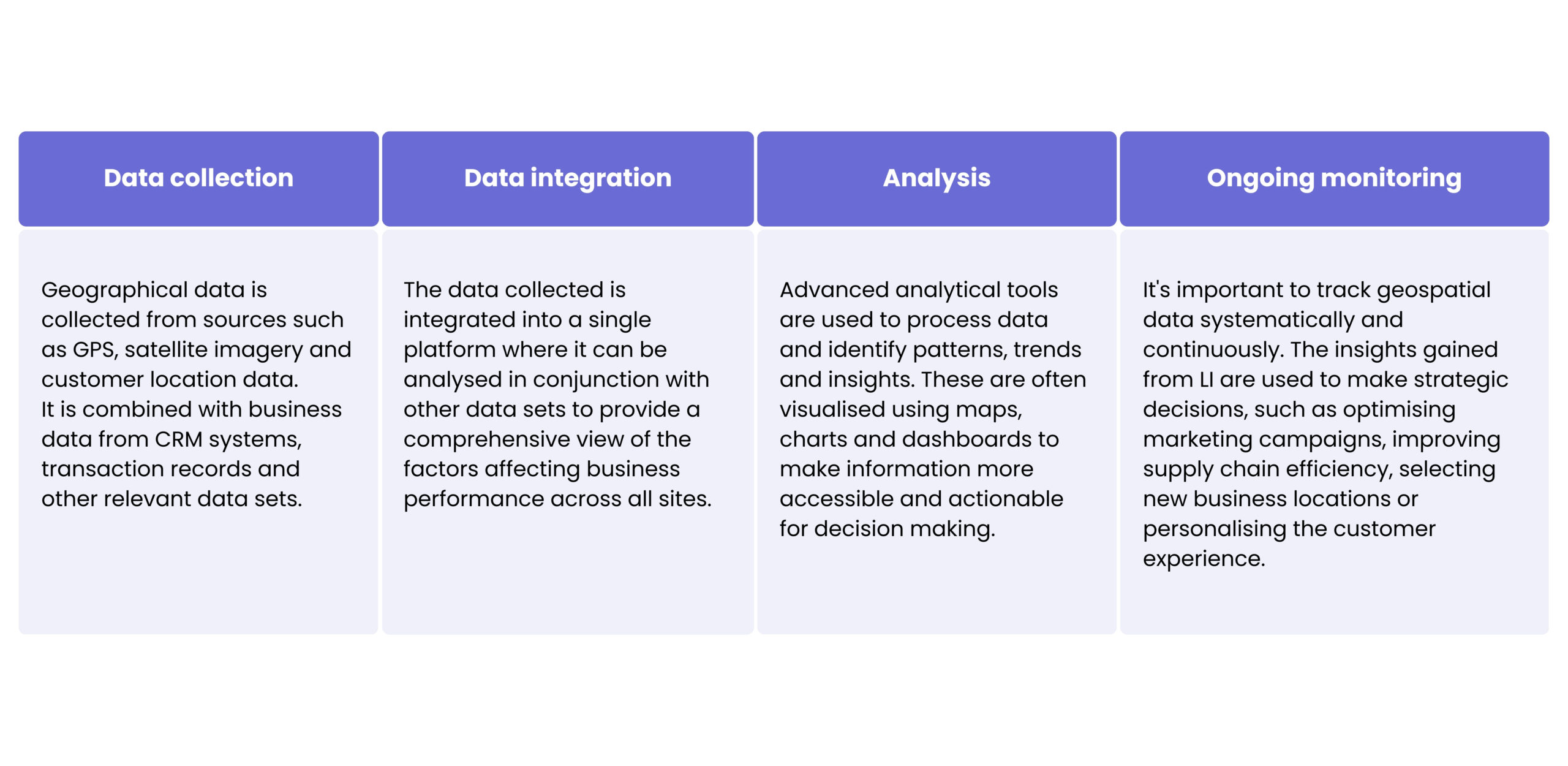
La technologie de location intelligence (LI) est un outil analytique avancé qui intègre des données géographiques avec divers ensembles de données pertinents pour l'entreprise afin d'apporter des insights précieux. Elle va au-delà des méthodes traditionnelles Systèmes d'information géographique (SIG) by combining spatial information with data from multiple sources, such as geographic information, traffic patterns, customer data, social media, and economic statistics. This data is then processed using advanced algorithms and visualisation tools to reveal trends, and correlations that are not immediately apparent.
Le processus comprend généralement plusieurs étapes clés :
Le rôle de la localisation dans la réponse aux défis modernes
The challenges we encounter in business and government are inextricably linked to geography. It provides critical insight into a range of key issues, including infrastructure development, sustainability, climate change, environmental protection and social equity.
- L'importance des données de localisation ne cesse de croître – Les informations de localisation ont toujours été essentielles, mais aujourd'hui, avec des milliards de capteurs et d'appareils intelligents, le volume de données disponibles pour visualisation et l'analyse a considérablement augmenté.
- Il trouve des applications dans tous les secteurs – Du secteur public à l'immobilier et au commerce de détail, l'intelligence géospatiale stimule tout, de l'optimisation de la chaîne d'approvisionnement à la résilience climatique.
- L'intelligence de localisation est essentielle – Sans analyse basée sur la localisation, nous passons à côté des informations et des insights clés nécessaires pour agir de manière plus efficace et éclairée.
“Advanced location intelligence technology, powered by machine learning and big data, allows us to turn raw spatial data into actionable insights at an unprecedented scale. This is accelerating the pace of smart city innovation and improving our ability to proactively respond to challenges such as climate change, infrastructure management and public health crises.”
Jaroslaw Marciniak, Directeur des services géospatiaux
Cas d'usage concrets de l'intelligence de localisation
Transport et urbanisme
Analysing real-time geospatial data can facilitate intelligent transport in urban areas. By using location intelligence, traffic data is used to improve traffic flow, reduce congestion and reduce emissions. In addition, location intelligence supports applications that provide real-time updates on public transport arrivals and notifies users of maintenance disruptions.
Agriculture
Smart agriculture uses location intelligence in many ways. For example, soil moisture data from sensors can be combined with weather forecasts to provide intelligent irrigation recommendations and optimise water use. Location data from sensors attached to livestock can monitor their activity, providing insights into behaviour and land use.
Gestion de la chaîne d'approvisionnement
In this case, LI can be used for routing and workforce optimisation. By using location data, companies can streamline fleet management and improve driver efficiency. In addition, network optimisation and site selection enable retailers to choose warehouse locations closer to customers, thereby reducing delivery times.
Atténuation du changement climatique
Key drivers of climate change such as CO2 emissions, coral reef health, ocean temperatures and sea levels can be monitored and analysed using geospatial information. GIS enables risk visualisation and supports decisions on climate change mitigation. In addition, identifying and predicting weather conditions and climate risks can help select the best locations for renewable infrastructure, such as wind turbines or solar panels.
Découvrez nos offres géospatiales !
En savoir plus
Avantages stratégiques de la technologie LI pour votre entreprise
La technologie de Location Intelligence offre un large éventail d'avantages pour les entreprises, susceptibles d'améliorer considérablement les opérations ou la planification stratégique et de stimuler l'efficacité opérationnelle.
Mieux comprendre le client
Location intelligence technology enables companies to gain a deeper understanding of customer behavior by analysing location-based data. Acquisition of this knowledge helps identify customer preferences, predict trends, and more accurately segment markets, leading to more targeted strategies and improved customer satisfaction.
Logistique et opérations optimisées
By integrating geographic and operational data, LI helps companies streamline logistics and supply chain management. It enables efficient route planning, reduces transportation costs, and improves inventory management, ultimately leading to better resource allocation and operational efficiency.
Nouvelles opportunités d'expansion de marché
LI provides valuable data to select optimal locations for new stores, facilities, or branches. By analysing factors such as demographics, competitor locations, and market demand, companies can make informed decisions about where to expand, maximising their market potential and minimising risk.
Une meilleure prise de décision grâce à l'analytique prédictive
Using historical location-based data, the technology allows companies to predict future trends and behaviours. With its predictive capabilities, businesses are able to make more strategic decisions like anticipating market changes, optimising product offerings, and preparing for potential challenges, outpacing the competition.
Les tendances à venir de la localisation intelligente
As businesses adopt data and advanced analytics, they are increasingly recognising the unique value of physical location, as most data points have a location component. By linking data with geospatial context, businesses can gain deeper insights into customer behaviour, lifestyles or needs. The importance of location intelligence will continue to grow in the coming year, driving new trends and applications across multiple sectors.
Enrichissement des données pour de meilleurs résultats en IA
L'efficacité de Geo AI dépend de données de haute qualité, et l'enrichissement des données avec des jeux de données tiers et des insights spatiaux améliore la précision et l'utilisabilité, ce qui conduit à de meilleurs résultats, des économies de coûts et des insights plus approfondis sur le comportement des consommateurs lorsque les données de localisation sont intégrées.
La Location Intelligence comme facteur de différenciation clé
Le Location Intelligence est essentiel pour réduire les risques, améliorer la satisfaction client et maximiser les ressources, offrant des retours élevés sur des investissements modestes dans des secteurs tels que les télécommunications, les services financiers et l'assurance.
Démocratiser l'intelligence géospatiale
With the widespread availability of LI tools through smartphones, consumers now have real-time tracking, live traffic updates and enhanced navigation at their fingertips, while businesses continue to seek more accessible and user-friendly LI solutions to streamline decision-making.
Garantir l'intégrité des données
Le 2023 Rapport sur les tendances et perspectives en matière d'intégrité des données souligne que des données fiables sont essentielles, avec 77% des professionnels interrogés s'appuient sur les données de localisation pour prendre des décisions importantes. Cependant, seuls 46% évaluent la qualité de leurs données comme élevée et 41% citent la mauvaise qualité des données d'adresse comme un obstacle, soulignant la nécessité de remédier aux problèmes de qualité des données et de mettre en œuvre une gouvernance solide des données afin d'exploiter pleinement les données de localisation pour obtenir un avantage concurrentiel.
À vous de jouer
Integrating location intelligence into business operations is essential for business leaders seeking greater efficiency and optimisation. With the right tools, data and mindset, the possibilities for businesses using location intelligence are limitless.
Si vous souhaitez explorer comment l'intelligence géospatiale peut aider votre entreprise à réussir, contactez nos experts en géospatial directement à l'aide du formulaire ci-dessous !
Location intelligence is an advanced analytical approach that combines geographic data with other business information to provide valuable insights for better decision-making. It processes data from various sources, such as maps, sensors, social media and traffic systems, using algorithms and visualisation tools to reveal hidden patterns, trends and relationships that traditional analytics might overlook.
LI has a wide range of applications in various industries, including transportation, urban planning, agriculture, retail, logistics, government and environmental management. For instance, it can help cities optimise traffic flow, enable farmers to improve irrigation efficiency, assist retailers in selecting new store locations and support climate change monitoring and mitigation efforts.
Analysing location-based data enables organisations to gain a better understanding of customer behaviour, optimise logistics, identify new market opportunities and enhance decision-making with predictive analytics. The result is improved efficiency, cost savings and more targeted strategic planning, giving businesses a competitive advantage.
Emerging trends include the enrichment of data for AI, the democratisation of location intelligence tools, and a stronger focus on data integrity. Businesses are increasingly integrating geospatial data into AI systems to make more accurate predictions, and accessible LI applications are empowering users at all levels. Maximising the value of location insights also requires a critical focus on ensuring high-quality, trustworthy data.
With data volumes growing and almost every data point acquiring a location component, LI has become essential for staying competitive. It enables smarter, faster and more informed decisions in all areas, from improving customer experience to enhancing sustainability and risk management. Investing in LI today helps organisations to become more resilient and innovative, and to achieve long-term growth.


arrow_circle_right Nos articles
Choisissez votre prochaine lecture




arrow_circle_rightnous contacter
