Pourquoi le streaming à faible latence est essentiel pour le sport et les événements en direct


You’re watching the biggest game of the year when your neighbour’s victory scream echoes through the wall – a full 30 seconds before you see the winning goal. Your phone buzzes with comments while you’re still watching the previous play. It’s maddening.
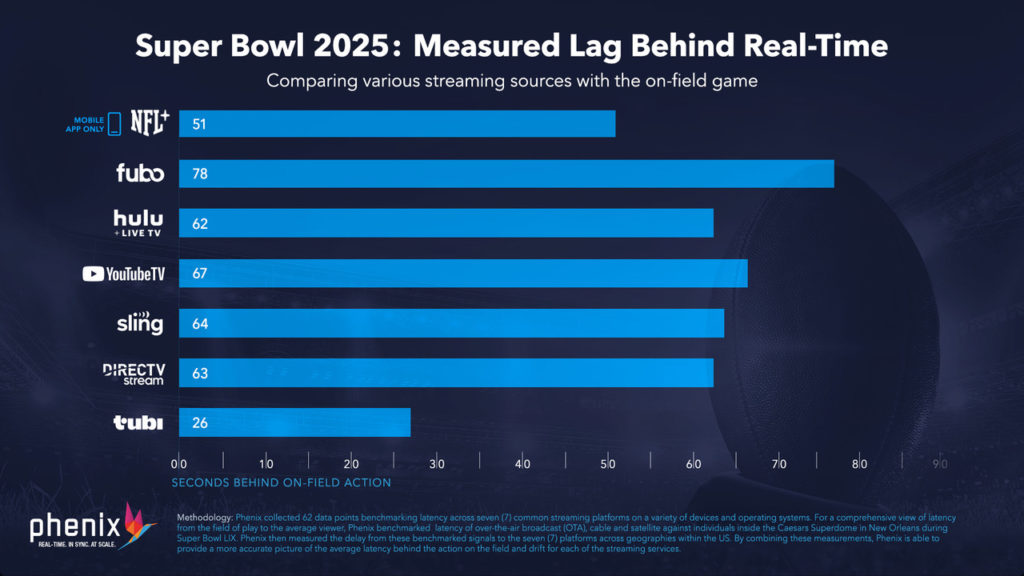
Données du Super Bowl 2025 a parfaitement capté cette frustration. Tubi a obtenu les meilleures performances de streaming, avec un retard de seulement 26 secondes de retard par rapport au temps réel, mais la plupart des plateformes étaient nettement moins performantes, beaucoup faisant patienter les spectateurs plus d'une minute.
Si vous êtes un créateur de contenu, ce problème de latence vous affecte encore plus durement. Imaginez devoir répondre aux messages du chat lorsque il y a un décalage de 30 à 60 secondes entre ce que vous dites et le moment où votre audience le voit. Votre streaming interactif devient péniblement maladroit, et établir de véritables connexions avec les téléspectateurs semble presque impossible lorsque chaque conversation est désynchronisée.
La solution ? Diffusion en continu à faible latence. Dans cet article, nous vous expliquerons comment cette technologie fonctionne et révélerons précisément où elle peut transformer votre expérience de streaming.
Source
Qu'est-ce que la latence dans le streaming vidéo ?
Commençons par les bases. La latence est simplement le délai entre le moment où un événement se produit et celui où il est regardé. Think about shouting across a valley – there’s always that split second before you hear the echo bounce back. In video streaming, the same principle applies: there’s always a delay between when an event occurs in real life and when it appears on your screen.
Every time you watch a live stream, you’re seeing the past. That goal being scored at the World Cup, that last-second three-pointer in the NBA finals, that chat message being read during a live event – it all happened several seconds ago, sometimes even minutes ago. This delay exists because your video needs to travel through multiple steps before reaching your device: it gets captured, processed, sent across the internet, and finally displayed on your screen.
Dans la plupart des scénarios de streaming en direct, cette latence se situe de 20 secondes à deux minutes. For watching a concert or a webinar, this delay doesn’t really matter. Your viewing experience remains smooth and enjoyable. But imagine watching the Super Bowl and receiving goal notifications on your phone before you see the touchdown on your TV, or trying to participate in live voting during a talent show while the results are already being announced. Suddenly, that delay becomes a real problem that breaks the entire experience.
Quelles sont les causes de la latence ?
Latency occurs because it takes time for information, whether digital or not, to travel from one place to another. When you add various stops along the way, that lag can add up, creating larger delays between recording raw data and displaying it on a viewer’s device.
Considérez votre vidéo comme effectuant un voyage complexe avec de multiples points de contrôle. Chaque étape ajoute un léger délai, et ceux-ci s'accumulent rapidement pour former la latence de streaming que les spectateurs ressentent.
Le parcours du streaming vidéo
Your live video must make several crucial stops before reaching its destination. Your camera captures raw data, which then needs to be encoded – a process that compresses and formats media files for transfer over the internet. These files typically go to a streaming server, which transcodes them (i.e., unencodes, alters according to size or resolution, and re-encodes) and transmuxes them (i.e., changes to different protocols for delivery).
À partir de là, votre contenu vidéo transite par un réseau de diffusion de contenu avant d'atteindre les différents appareils. Chacune de ces étapes de traitement – capture, encodage, transmuxage, distribution et décodage – ajoute son léger délai à la latence totale.
Goulots d'étranglement techniques
Much like traffic jams, latency gets affected by bandwidth limitations and physical distance. When data encounters network congestion, it bottlenecks just like cars do when motorway lanes merge. Your network connection quality directly impacts how quickly video data can travel from source to destination.
Streaming à débit adaptatif helps reduce some of these issues by dynamically adjusting video quality based on each viewer’s device capabilities and internet speed. This enables faster startup times and reduced buffering, particularly when working with variable connection speeds or weaker networks.
Diffusez en temps réel sans attendre !
En savoir plus
Distance géographique
The physical distance your data must travel creates unavoidable delays. This is why content delivery networks strategically place servers closer to viewers – reducing the distance data travels directly reduces latency. It’s the difference between shouting across a room versus shouting across a football stadium.
Infrastructure réseau
Every router, switch, and protocol change along the route introduces tiny delays that accumulate into noticeable wait times. As overall internet traffic grows, latency increases for all users as the digital “line” to complete transmissions backs up. These micro-latencies add up quickly, manifesting as high latency that frustrates viewers waiting for content to load.
Qu'est-ce que la diffusion vidéo à faible latence ?
Le streaming vidéo à faible latence est une technologie qui minimise le délai entre le moment où un événement se produit dans la réalité et celui où les téléspectateurs le voient sur leurs écrans. Ces solutions visent à réduire ce délai à quelques secondes seulement, voire à des niveaux de latence inférieurs à la seconde.
The difference might seem small on paper, but it’s transformative for interactive streaming, video chat, live gaming, and any situation where real-time engagement matters. Think about live streaming a football match where viewers can vote for the player of the game in real time, or hosting a live cooking show where the chef can immediately respond to audience questions about ingredients.
When your audience can interact with live content without that awkward delay, everything changes. Comments feel like actual conversations, live polls get immediate responses, and interactive live streaming becomes genuinely interactive rather than a delayed back-and-forth.
Là où le streaming vidéo à faible latence est le plus important
Le streaming à faible latence devient critique dans les scénarios où l'engagement en temps réel fait ou défait l'expérience. Voici où ces secondes de délai supplémentaires peuvent tout vous coûter :
Sports et événements en direct
Picture watching the World Cup final where your neighbour’s cheering spoils the winning goal before you see it happen. Sports streaming demands instant action – viewers expect to see that touchdown, that knockout punch, or that game-winning shot as it happens, not 30 seconds later. Modern sports apps require low-latency video streaming to synchronise with TV broadcasts and maintain perfectly aligned second-screen experiences. When fans are following live content on social media while watching the game, even a few seconds of delay can ruin the entire experience.
Divertissement interactif et jeux
Video game streaming and esports represent the ultimate test of low latency. When a gamer streams live gameplay, viewers want to see their reactions and strategies in real-time. A delay of several seconds makes it impossible for the audience to follow along with fast-paced action or provide meaningful commentary. Professional esports tournaments require sub-second latency to maintain competitive integrity – even a few seconds of delay can reveal strategies before they’re executed.
Commerce électronique et live shopping
Live shopping streams on platforms like Instagram Live or TikTok Shop need low-latency video streaming to create authentic, real-time interaction. When influencers showcase products and answer audience questions instantly, viewers feel like they’re having actual conversations rather than delayed exchanges. High latency kills the spontaneous energy that drives impulse purchases and genuine engagement.
Services financiers et trading
Live streaming financial news, market analysis, and trading education requires ultra-low latency to ensure viewers receive actionable information. When market conditions change rapidly, even a few seconds of delay can make the difference between profit and loss for viewers making investment decisions based on live content.
Éducation et formation
Interactive live streaming in education – from virtual classrooms to professional training sessions – needs low latency to facilitate genuine real-time engagement. When students can ask questions and receive immediate responses, or when trainees need to react to scenarios in real-time, traditional streaming latency disrupts the learning experience.
Émissions de musique live et de compétition
Eurovision, American Idol, or any live event with audience voting illustrates why low latency matters. When viewers can vote for their favourite performers in real time, traditional streaming latency creates unfair advantages – some viewers see performances 30 seconds before others, giving them more time to vote. But it’s not just about voting – imagine watching Eurovision and seeing social media explode with reactions to a performance you haven’t seen yet, or having friends comment on a singer’s outfit while you’re still watching the previous act.
La diffusion vidéo à faible latence garantit que chacun vit l'émission simultanément, rendant la participation du public véritablement équitable et permettant aux téléspectateurs de partager leurs réactions authentiques sur les réseaux sociaux sans gâcher l'expérience des autres.
Exemples de fournisseurs à faible latence
Le marché du streaming à faible latence a explosé, les fournisseurs de technologies rivalisant pour offrir les expériences de streaming en temps réel les plus rapides et les plus fiables. Voici comment les principales plateformes utilisent la faible latence pour résoudre des problèmes spécifiques :
- Zoom – La visioconférence exige une latence ultra-faible car une conversation naturelle devient impossible dès qu'il y a ne serait-ce que quelques secondes de retard. Personne ne veut de ces pauses gênantes où tout le monde parle en même temps.
- Twitch – Les streamers de jeux vidéo ont besoin d'une interaction réactive avec leur audience. Lorsque les téléspectateurs commentent le gameplay, un délai de 30 secondes signifie que le streamer réagit à des conseils concernant des ennemis déjà morts.
- YouTube Live – Les fonctionnalités de streaming interactif comme les sondages en direct et les sessions de questions-réponses deviennent dénuées de sens lorsqu'il existe un délai important entre les questions et les réponses.
Prêt à éliminer la latence du streaming ?
Les chiffres sont clairs : 47 % des consommateurs se désabonnent des services de streaming en raison de problèmes de mise en mémoire tampon, and viewers consider cancelling after just 13.5 seconds of poor performance. When delays of 30-78 seconds (like those measured during the 2025 Super Bowl) become the norm, low-latency streaming isn’t optional – it’s essential for keeping your audience engaged.
Chez Spyrosoft, nous aidons les entreprises de médias à mettre en œuvre des solutions de streaming qui offrent les performances que les audiences modernes exigent. Notre expertise garantit que vos flux atteignent les spectateurs avec un délai minimal et un engagement maximal.
Découvrez comment nous pouvons optimiser votre stratégie de streaming avec des solutions à faible latence éprouvées.
Latency is the delay between something happening at the venue and the viewer seeing it on screen. During the 2025 Super Bowl, some platforms ran over a minute behind broadcast. That means viewers hear the crowd react to a goal before they see it, and anyone on social media already knows the result. For live sports, every second of delay affects the experience.
Video passes through multiple stages before it reaches a viewer: capture, encoding, transcoding, distribution, and decoding. Each step adds time. Network congestion, geographic distance from servers, and infrastructure complexity all compound the problem. Reducing latency means optimising across the entire pipeline, not just one step.
It depends on the use case. For sports, getting under 5 to 10 seconds removes the spoiler problem and keeps streaming in sync with broadcast. For interactive applications like live voting or esports, sub-second latency is the target. There is no single threshold. It is about matching the technical requirement to the viewer experience you are trying to deliver.
Yes. 47% of consumers have unsubscribed from a streaming service due to buffering issues, and viewers start considering cancellation after around 13.5 seconds of poor performance. Latency and reliability are not just technical metrics. They directly affect whether people stay or leave.
Esports and interactive gaming rely on real-time audience engagement. Live shopping depends on spontaneous interaction between hosts and buyers. Competition formats need simultaneous voting to be fair. Financial data platforms require timely delivery to remain actionable. Anywhere the value of content depends on it being genuinely live, latency matters.


arrow_circle_rightContactez-nous
Améliorez votre expérience d'événement en direct grâce à la technologie à faible latence !

Bartlomiej Lozia
CEO Spyrosoft BSG
arrow_circle_right Nos articles


