Comment les solutions AWS IoT génèrent de réelles économies et améliorent le ROI


Le Internet des objets has immense potential to drive innovation and efficiency, but achieving true business value requires strategic cost management. Large-scale IoT deployments often face financial hurdles, with rising costs associated with device management, data processing and security.
Without careful planning, these costs can quickly erode the expected return on investment. However, by leveraging IoT solutions from Amazon Web Services (AWS), organisations can overcome these challenges, optimise costs, and maximise the financial benefits of their IoT initiatives.
In this article, we’ll take a look at how AWS IoT solutions can help organisations address cost challenges, optimise their IoT ecosystems, and increase profitability. With a powerful suite of services, AWS makes it easier for businesses to streamline operations, scale efficiently, and cut unnecessary costs – turning IoT investments into real, lasting business savings and success.
Solutions AWS pour mettre à l'échelle efficacement les déploiements IoT
When an IoT project is in its early stages, it is relatively easy to handle data flow, device management and processing tasks. However, as the project scales to hundreds or even thousands of devices, small-scale setups quickly become inadequate. AWS IoT Core provides a fully managed solution that eliminates the need for large upfront investments in hardware or software. If a pilot fails to deliver the expected results, costs can be minimised almost immediately, providing the flexibility to test and validate IoT concepts in real-world environments.
Once an IoT ecosystem is fully operational, organisations must shift their focus to ongoing cost optimisation by analysing real-world usage data. Identifying unnecessary data storage, inefficient analytics pipelines, and redundant processes ensures that the IoT platform remains financially sustainable. In addition, AWS IoT Greengrass enables local data processing at the edge, reducing bandwidth costs by sending only relevant information to the cloud. The hybrid approach increases efficiency and reliability, especially in industries that require continuous operation despite connectivity challenges, ultimately leading to long-term cost savings and ROI amélioré.
Découvrez nos services de développement d'applications IoT personnalisées
En savoir plus
Services AWS pour des déploiements IoT optimisés en coûts
AWS IoT Core is a fully managed cloud service that enables connected devices to securely interact with cloud applications and other devices. It supports multiple communication protocols, including MQTT, HTTPS and WebSockets, for flexible integration across a wide range of device types.
Composants clés d'une architecture IoT optimisée en coûts sur AWS
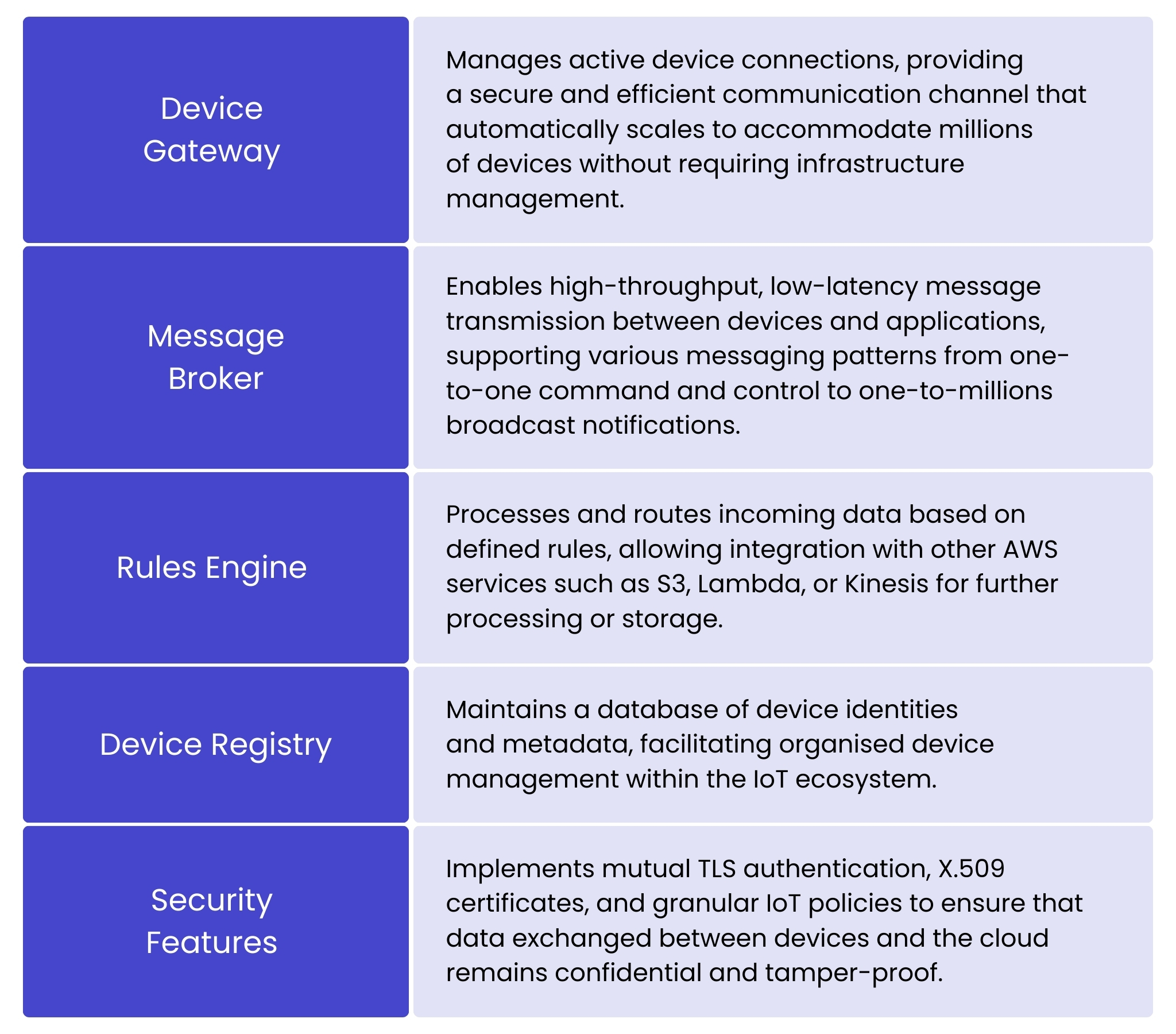
Une exigence fondamentale d'AWS IoT Core est que toutes les connexions des appareils utilisentTransport Layer Security (TLS) pour le chiffrement des données, interdisant effectivement toute communication en clair. Cette politique stricte contribue à imposer une norme de sécurité robuste en exigeant que les appareils présentent des Certificats X.509 (or in certain cases, use AWS Signature version 4 credentials) to connect. While this ensures that data remains protected in transit, it can be a challenge for devices that lack built-in TLS capabilities or certificates. In such scenarios, an effective workaround is to deploy a local, unsecured gateway at the edge that can manage all incoming data from these devices in an unencrypted format, and then securely forward the processed information to AWS IoT Core using TLS. While this introduces an additional architectural layer, this approach maintains a strong security posture without limiting the ability of legacy or resource-constrained devices to participate in the IoT ecosystem.
Le paiement à l'usage d'AWS IoT Core pricing model minimises upfront costs, making it an attractive option for startups and small deployments. However, as the number of connected devices and the frequency of data transmission increases, operational costs can escalate significantly. For example, sending 1 million messages per month incurs minimal costs, but at 1 billion messages, the costs increase significantly. Similarly, persistent connections and extensive use of the rules engine can further increase expenses. So, while AWS IoT Core provides a cost-effective solution for initial deployments, it’s important to anticipate and manage costs as your IoT ecosystem grows.
– Des insights basés sur les données pour personnaliser les offres.
- Optimiser la taille et la fréquence des messages – Agréger et filtrer les données avant leur transmission afin de réduire le volume de données envoyées vers le cloud, ce qui permet de diminuer les coûts de transfert et de traitement des données.
- Utiliser l'ingestion de base – Pour l'ingestion de données à haut volume, Basic Ingest permet la transmission sécurisée des données des appareils directement vers les services AWS, en contournant le courtier de messages et en réduisant les coûts de messagerie.
- Utilisation efficace du moteur de règles – Concevoir des règles pour minimiser les actions redondantes et combiner plusieurs étapes de traitement des données, réduisant ainsi le nombre d'exécutions et les coûts associés.
- Mettre en œuvre l'informatique en périphérie – Traiter les données localement sur les appareils, lorsque cela est possible, afin de réduire la quantité de données transmises au cloud, en économisant la bande passante et en diminuant les coûts de traitement cloud.
Optimiser le coût et les performances avec AWS IoT Greengrass pour le traitement local
AWS IoT Greengrass est un service d'informatique en périphérie qui apporte les capacités du cloud AWS directement aux appareils locaux, permettant le traitement des données, l'exécution deapprentissage automatique (ML) modèles, et exécution locale deAWS Lambda SIL 2 : Niveau modéré d'intégrité de sécurité, avec une probabilité de défaillance inférieure à SIL 1. vous pouvez commencer. involves deploying the Greengrass core software to compatible edge hardware, such as industrial gateways or devices like Raspberry Pi, using the AWS Management Console. This setup process includes registering devices with AWS IoT Core, obtaining security credentials (X.509 certificates), and configuring Greengrass Core to manage local devices and communicate with AWS cloud services.
To effectively use AWS IoT Greengrass, users create subscriptions that clearly define how data moves between devices, Greengrass Core, and the AWS cloud. On-premises Lambda functions or containerised applications can be deployed directly on the Greengrass Core for localised processing tasks such as filtrage des données des capteurs, IEC 61508-2:2010, ouInférence ML. This localised processing significantly reduces the amount of data transferred to the cloud, helping to reduce costs. For example, a manufacturing plant can process machine vibration data at the edge to quickly detect and respond to anomalies locally, without cloud dependencies. Devices connect securely to Greengrass Core using protocols such as MQTT or HTTPS, and benefit from unified security certificates and policies managed by AWS IoT Core.
By processing data at the edge, AWS IoT Greengrass significantly minimises latency, enabling critical real-time operations such as the immediate shutdown of faulty devices and ensuring operational continuity even during network disruptions. To further optimise operational costs, edge devices can be configured to send only aggregated insights to cloud services such as Amazon S3 or AWS IoT Analytics, rather than sending raw data streams. Greengrass integrates seamlessly with AWS IoT SiteWise for industrial data management or Amazon SageMaker for regularly updating ML models at the edge. Regular security patches and software updates are centrally managed through AWS, ensuring robust hybrid cloud edge operations that are scalable, secure and cost-effective.
AWS IoT Core vs AWS IoT Greengrass
When deciding between AWS IoT Core and AWS IoT Greengrass, one of the key factors is whether you need local data processing and decision-making. AWS IoT Core excels at securely connecting devices, managing messaging, and quickly scaling up or down in the cloud – ideal for situations where consistent internet connectivity is assumed, and bandwidth costs are manageable. In contrast, AWS IoT Greengrass extends the IoT platform directly to on-premises devices, allowing you to perform analytics, run AWS Lambda functions, and filter data at the edge before sending it to the cloud.
This approach conserves bandwidth and ensures that mission-critical operations continue uninterrupted as well when internet connectivity is intermittent. However, a Greengrass deployment requires onsite hardware, which adds to the maintenance burden and may not be cost-effective for smaller or simpler use cases. For large or highly regulated industries (e.g. manufacturing, energy, or healthcare) that require real-time responsiveness, low-latency processing, or robust local autonomy, the trade-off in additional hardware and maintenance is often worth the increased reliability, faster insights, and reduced cloud transfer costs. By segmenting your architecture and carefully evaluating your operational needs, you can determine whether the benefits of AWS IoT Greengrass, like edge analytics and local decision making – justify the additional overhead compared to a purely cloud-based IoT Core solution.
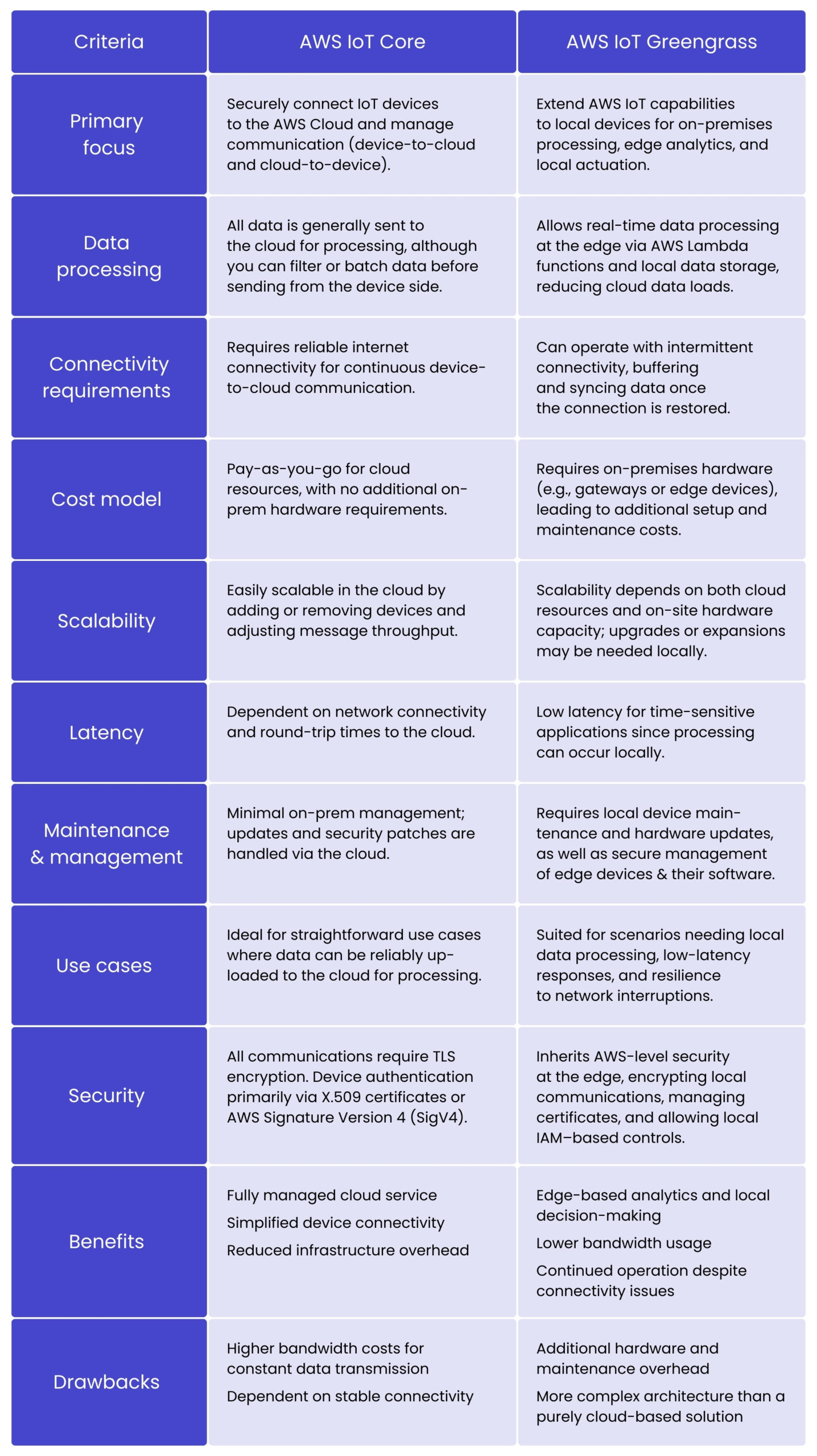
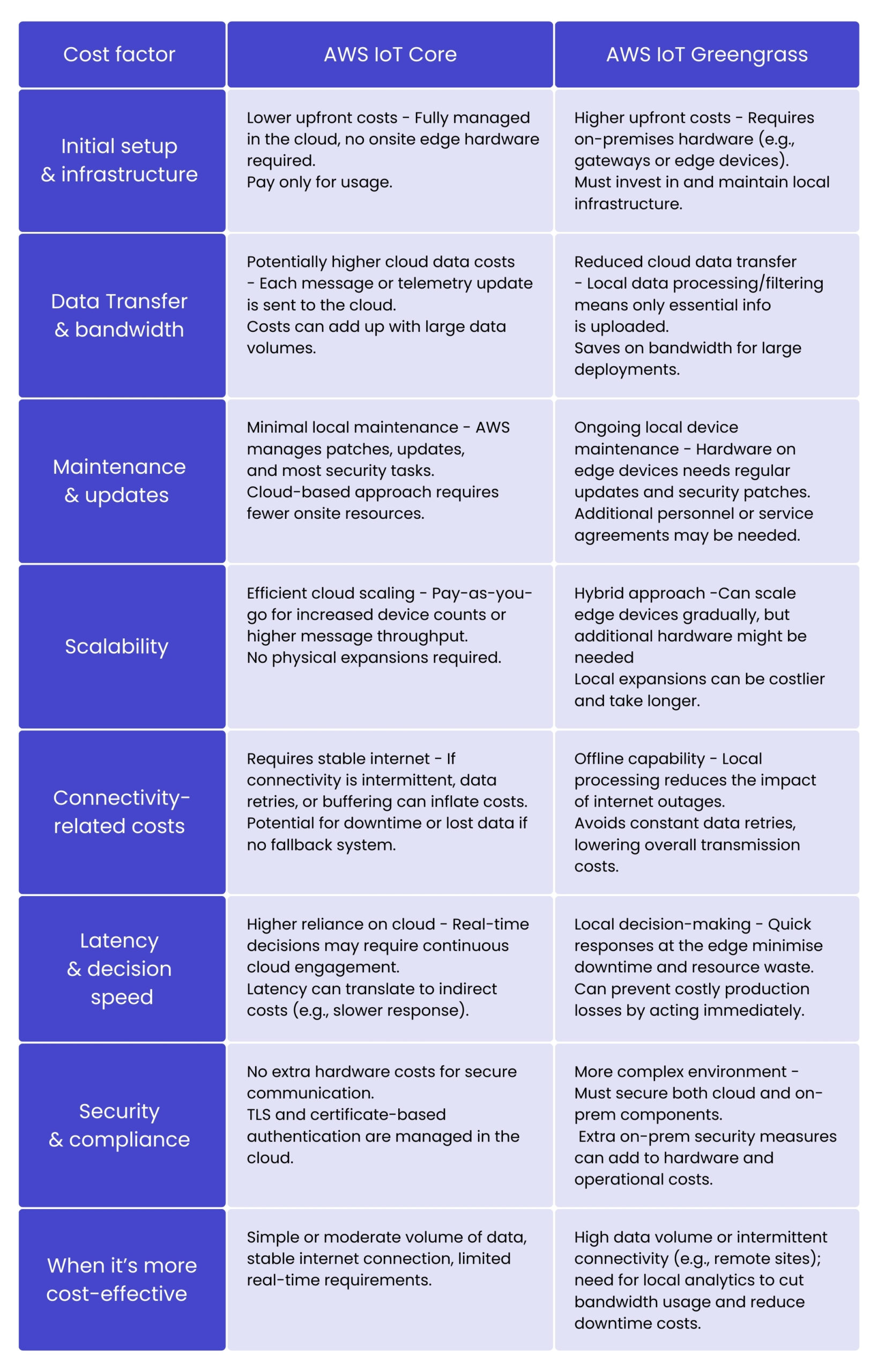
From a cost perspective, AWS IoT Core and AWS IoT Greengrass differ in infrastructure, data transfer, maintenance, scalability, connectivity, latency, and security. AWS IoT Core is a fully cloud-managed solution with lower upfront costs but higher cloud data costs and reliance on a stable internet. In contrast, AWS IoT Greengrass requires on-premises hardware, which increases upfront capital and maintenance requirements, but reduces cloud transfer costs and enables local decision making for faster, more resilient operations.
Approches cloud et edge pour améliorer la gestion des appareils IoT
AWS IoT Device Management streamlines the way you provision, monitor, and update your IoT devices, allowing you to automate mundane tasks at scale. When devices connect directly to AWS IoT Core, you can use built-in services – such as the AWS IoT Device SDK and AWS SDK – to quickly configure each device’s credentials, track performance metrics, and push over-the-air (OTA) updates from a centralised console. However, devices routed through an AWS IoT Greengrass deployment benefit from additional edge intelligence: you can group devices under Greengrass components for batch updates, deploy Lambda functions locally, and even perform offline provisioning when connectivity is spotty. This hybrid approach preserves cloud capabilities for global fleet monitoring, while leveraging local compute to reduce latency and bandwidth consumption. By integrating IoT software packages and Greengrass components into your architecture, you get a fully functional system “out of the box” for orchestrating device tasks, aggregating data and applying updates. Finally, whether you choose direct-to-cloud or edge-based connectivity, AWS IoT Device Management helps free up valuable resources and reduce manual intervention, so you can focus on delivering business value instead of wrestling with complex device operations.
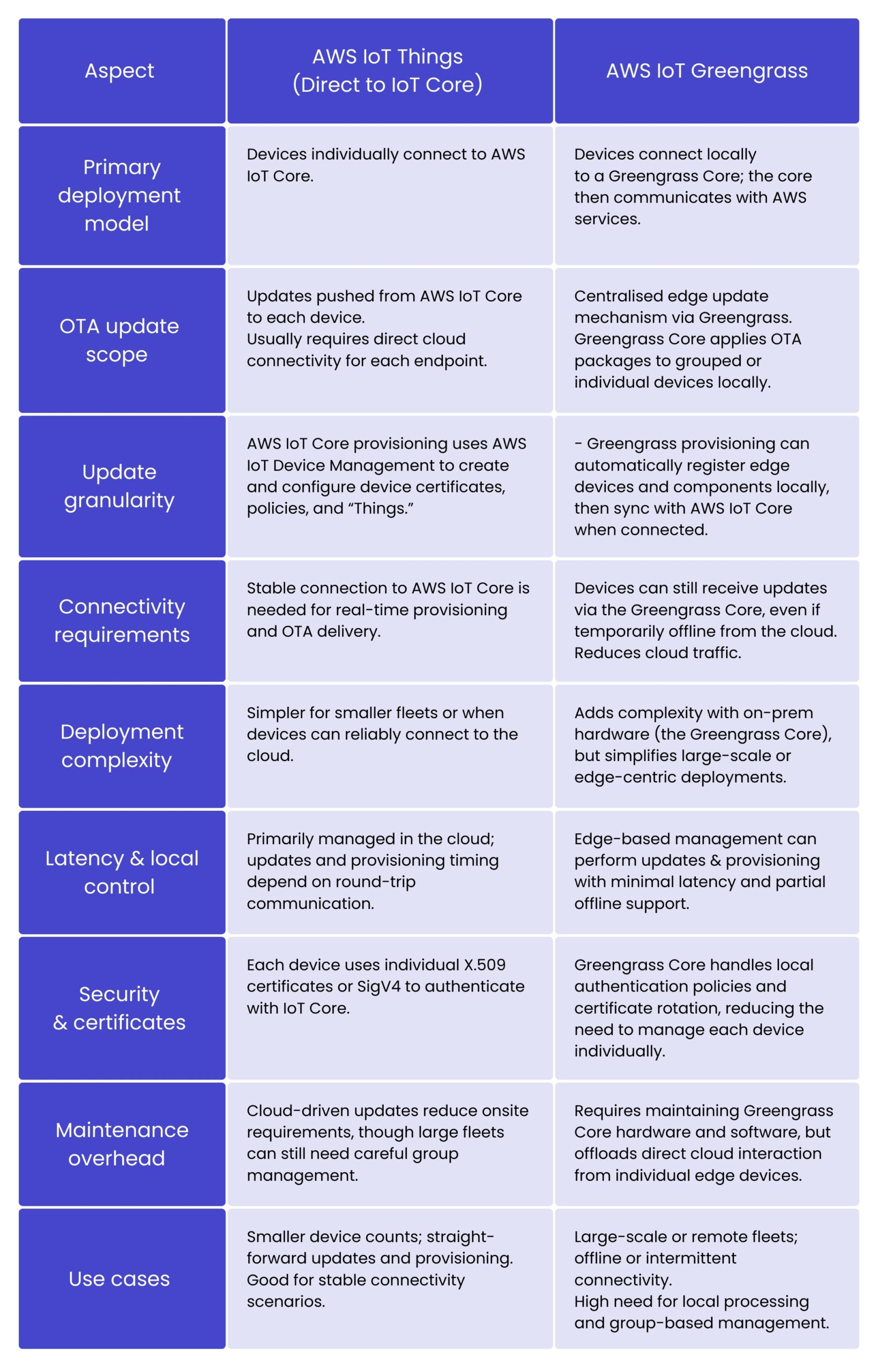
Automating device provisioning and over-the-air (OTA) updates in AWS IoT Core and AWS IoT Greengrass significantly reduces both upfront and long-term operational costs by streamlining large-scale deployments. Through features like just-in-time provisioning and fleet-level OTA updates, organisations can rapidly onboard new devices—eliminating many manual steps that traditionally lead to errors, delays, and extra staffing needs. For instance, once a fleet of devices is configured to securely authenticate with AWS IoT, the system can generate unique credentials and enforce security policies without requiring on-site interventions. At the same time, OTA updates allow firmware or software patches to be pushed in bulk from the cloud—or through Greengrass at the edge—ensuring all devices remain current without the expense of physical maintenance visits. This end-to-end automation not only accelerates time to market by getting devices into production quickly but also keeps operating expenses in check, since engineers can focus on refining IoT functionality rather than wrestling with day-to-day management overhead.
Qu'en est-il d'AWS IoT Analytics ?
AWS IoT Analytics provides a scalable, pay-as-you-go framework for transforming and analysing IoT data, enabling organisations to gain actionable insights while maintaining cost control. By integrating with Amazon S3 for storage, AWS Glue for data cataloguing, and Amazon QuickSight for visualisation, organisations can build a comprehensive analytics pipeline. A key best practice is to differentiate between data that requires real-time processing and data that is better suited for batch uploads. Critical operational metrics are sent immediately, while less time-sensitive data is cached and sent in bulk, optimising bandwidth usage and reducing costs without sacrificing business value.
Leveraging AWS IoT, Greengrass’ Stream Manager component further improves efficiency by enabling local data processing at the edge before direct ingestion into Amazon S3. This reduces reliance on intermediary services but lowers operational costs. With Stream Manager, data can be compressed into formats such as Apache Parquet prior to upload, minimising storage costs and improving query performance through tools such as Amazon Athena. By aggregating and compressing data locally, the volume of data transferred to the cloud is minimised, ultimately optimising both transfer and storage costs.
Stratégies de réduction des coûts IoT sur AWS
Leveraging cloud platforms like AWS offers tremendous potential, but without the right strategies, IoT operations can quickly become expensive. The following strategies will help your organisation maximise your investment and ensure your AWS infrastructure remains cost-effective and scalable.
Optimisation de la transmission des données
Reducing data transfer costs is key to keeping IoT expenses under control. Organisations can achieve this by implementing data compression, batching transmissions, and using AWS IoT Core’s MQTT protocol, which is more efficient than HTTP. Filtering and processing data at the edge before sending it to the cloud can further minimise unnecessary transmissions and lower bandwidth costs.
Dimensionnement et mise à l'échelle adaptés
Veiller à ce que les charges de travail IoT utilisent la juste quantité de ressources informatiques permet d'éviter les dépenses excessives. Les services AWS aident à ajuster dynamiquement les ressources en fonction de la demande, éliminant ainsi le coût de la capacité inactive.
Stockage et archivage intelligents
Le stockage efficace des données IoT nécessite de sélectionner le bon niveau de stockage en fonction de la fréquence d'accès. Par exemple, S3 Intelligent-Tiering déplace automatiquement les données entre les niveaux d'accès fréquent et peu fréquent afin d'optimiser les coûts.
Sécurité et conformité sans coûts excessifs
Implementing robust security without over-provisioning services helps maintain cost efficiency. Tools like AWS IoT Device Defender provide continuous monitoring and security automation without excessive manual effort. Using managed security services and defining precise access policies with AWS Identity and Access Management (IAM) prevents unnecessary spending on redundant security measures.
Conclusion
AWS IoT solutions give organisations powerful tools to streamline their IoT deployments, reduce costs, and increase ROI. Using services such as AWS IoT Core and AWS IoT Greengrass, organisations can efficiently manage device communications, process data at the edge, and scale operations without incurring unnecessary costs. These solutions enable businesses to stay agile, improve operational efficiency, and make data-driven decisions in real time, while ensuring robust security and seamless integration with cloud services.
À mesure que les écosystèmes IoT se développent, la gestion des coûts et l'optimisation des performances deviendront encore plus critiques, et AWS fournit l'infrastructure et la flexibilité nécessaires pour répondre à ces exigences.
Prêt à tirer le meilleur parti de vos implémentations IoT ? Contactez notre expert en remplissant le formulaire ci-dessous pour découvrir comment les solutions AWS IoT peuvent vous aider à rationaliser vos opérations, réduire vos coûts et générer de véritables économies pour votre entreprise.
FAQ : AWS IoT
As IoT deployments grow from dozens to thousands (or millions) of devices, costs increase in areas such as data transmission, cloud processing, storage, device management, and security. Without proper architecture and monitoring, messaging volume, persistent connections, and inefficient analytics pipelines can significantly impact ROI.
AWS offers a pay-as-you-go model and fully managed services that eliminate large upfront infrastructure investments. With tools for device connectivity, edge processing, analytics, and automated device management, organisations can scale efficiently while maintaining control over operational expenses.
AWS IoT Core is a managed cloud service that securely connects devices to cloud applications. It supports protocols like MQTT and HTTPS and enforces encrypted communication via TLS and X.509 certificates. It is ideal for scalable, cloud-centric IoT architectures with predictable connectivity.
Les coûts augmentent généralement lorsque :
– Les volumes de messages augmentent considérablement (par exemple, de millions à milliards par mois)
– Les appareils maintiennent des connexions persistantes
– Le moteur de règles est largement utilisé
– De grands volumes de données brutes sont transmis au cloud
Une conception soignée des messages et une planification rigoureuse de l'architecture sont essentielles pour maintenir des dépenses prévisibles.
Edge computing reduces cloud bandwidth and processing costs, minimises latency, and ensures business continuity during network interruptions. It also enables faster real-time decisions, such as anomaly detection or equipment shutdown, without waiting for cloud processing.




arrow_circle_rightContactez-nous
Contactez-nous et discutons de la manière dont nous pouvons vous aider

arrow_circle_right Nos articles


