Le Web3 signifie des niveaux croissants de transparence – un entretien avec Oliver Snowden


Comment expliqueriez-vous ce qu'est le Web3 à quelqu'un qui n'a jamais entendu ce terme auparavant ?
« Web3 » peut être un terme assez émotionnel et signifie souvent des choses très différentes selon la personne à qui vous parlez.
Pour moi, c'est un terme utilisé pour décrire un ensemble de technologies qui aspirent à être décentralisées et à défendre de nombreux principes de l'inventeur du web, les idées originales de Sir Tim Berners-Lee sur la décentralisation, la non-discrimination, la conception ascendante, l'universalité et le consensus. It is a set of technologies that decentralises our web services, enables wider participation, improves remuneration, lowers costs and automates many tedious processes. Perhaps “tokenisation of everything” is an appropriate phrase – whether digital or a real-world entity, a digital token will determine ownership, who has access and how much.
What might it mean for you? It might mean that you will be working for algorithms, possibly a Decentralised Autonomous Organisation (DAO), where you can supply your services from anywhere with an Internet connection. Want to supply 5G telephony services? Join the Helium community. Want to supply computer storage? Join the Storj, Sia etc. communities. Want to verify the people’s identities? Join identity.com and participate in the Decentralised Identity Verification ecosystem. Want to influence the direction of those communities? Participate in the governance structures via the community token. It is that simple.
Je suis incroyablement enthousiaste à l'idée des possibilités offertes – mes cours universitaires d'il y a 20 ans sur les systèmes autonomes et les systèmes multi-agents deviennent une réalité et ma tête déborde d'idées [Système multi-agents][Nick Jennings]. Les fondations sont dues à la percée en informatique que la personne (ou le groupe) utilisant le pseudonyme Satoshi Nakamoto a publiée dans le Livre blanc du Bitcoin le 31 octobre 2008.
Web2 vs Web3 – quelles sont les principales différences ?
De manière générale, on simplifie le développement du web ainsi :
Web1 : Lecture seule
Web2 : lecture-écriture
Web3 : lire-écrire-posséder
Qu'est-ce que le Web3 Web2 vs Web3
Web2 was largely about efficient, centralised entities (often the FAANGs) developing interactive and collaborative platforms for the masses. Businesses and individuals leveraged those platforms but clearly it gave a handful of tech companies tremendous insight into customer data and an incredible amount of power and influence, which they still hold today. Je pense que nous nous souvenons tous de l'ancien Président Trump contournant les médias traditionnels et utilisant Twitter directement. Beaucoup se souviennent sans doute aussi du jour où il a été «déplateformisé”. Le Web3 consiste à décentraliser et à démocratiser ces services web, en permettant la gouvernance communautaire et une rémunération plus équitable.
Concrètement, je considère cette technologie comme un moyen d'offrir des emplois porteurs de sens à des personnes partout dans le monde, en leur permettant de gagner de l'argent grâce aux écosystèmes numériques et de concurrencer les systèmes Web2.
Take for instance our digital photos – many of us love to store our photos on Google Photos, Flickr, iCloud etc. That convenience comes at a cost and is currently ~$30 for 100GB per year. What happens when normal mobile, PC and games console users are financially rewarded for supplying their free storage space? Surely those users would be happy to earn any amount of money. A slick app that allows them to capitalise on their free storage will push storage prices towards “waste pricing” – the users were using their computers anyway… and receiving any reward is better than nothing. This is what the likes of Storj, Sia, Filecoin and many others are working on. At the time of writing, the equivalent amount of storage on Web3 technology is ~$4 per year but I will be intrigued to know how that changes in time.
Quels sont les principaux secteurs où le Web3 devient de plus en plus prominent actuellement ?
To my mind, Web3 has largely been applied to “low hanging fruit” and by that, I mean impactful, relatively straightforward use cases. We have seen attempts to address the major areas of computing with various levels of success. Decentralised CPU/GPU processing, storage, networking and DNS have seen “solutions” with varying levels of success. We have also seen Web3 applied to actualités, vidéo, réseautage, identité, talent, Audio,et Oracles, pour n'en citer que quelques-uns.
Now you asked about the areas that are most visible and prominent right now. If you have been following the news you will probably already have a good idea, but because these systems are relatively open and decentralised it is pretty easy to see. By looking at, say, Suivi des frais de gaz Ethereum or Eth Gas Station we can see that, at the time of writing, essentially all of the top “gas guzzlers” on Ethereum are either Non-Fungible Token (NFT) or Decentralised finance (DeFi) systems. We can see they are extremely popular given that in the past 30 days the top 10 systems have spent approximately $170 million in fees alone.
Ainsi, les NFT consistent essentiellement à fournir des jetons « uniques en leur genre », stockés sur une technologie de registre distribué (DLT). Ces jetons peuvent être associés à tout élément numérique ou physique, mais ont été largement associés à des images, des vidéos et des fichiers audio.
Why should those tokens have any value? Well, the same reason that the original painting in a museum could have enormous value, but the postcard in the gift store (a copy) only attracts a small amount. People want to record ownership and rights to content, which they can use in digital systems. The token shows that the content is the “original content” and it allows the owner to prove they are the owner. Other digital systems, such as a game, might only permit “original content” to be used (e.g. avatars, in-game characters etc.) and therefore there can be enormous value associated with such tokens. I should point out that whilst this might seem irrelevant to some, NFT Spider-Man ont été la principale raison pour laquelle AMC a enregistré sa deuxième meilleure journée de ventes de billets de toute son histoire.
En ce qui concerne la DeFi, la fondation Ethereum la définit comme suit :
- Une alternative mondiale et ouverte au système financier actuel.
- Des produits qui vous permettent d'emprunter, d'épargner, d'investir, de trader et bien plus encore.
- Basé sur une technologie open source avec laquelle tout le monde peut programmer.
Source :Finance décentralisée (DeFi)
Nous pouvons voir à partir de sources, telles queDeFi Pulse qu'environ 100 milliards de dollars sont actuellement immobilisés.
So given that, I’d say that both the “Arts and Recreation Services” and “Financial and Insurance Services” are dominating Web3 at the moment. Whilst I certainly thought finance would be dominant in this space, I have to admit that I was rather taken back by the digital art NFT craze. That said, Hal Finney was thinking of this en 1993 – selon moi, cela montre à quel point ces personnes étaient en avance sur leur temps.
Quelles sont les principales technologies utilisées dans le domaine du Web3 ?
Il existe des diagrammes vraiment utiles, tels que les Stack Web3 créée par Coinbase , ce qui offre une excellente vue d'ensemble.
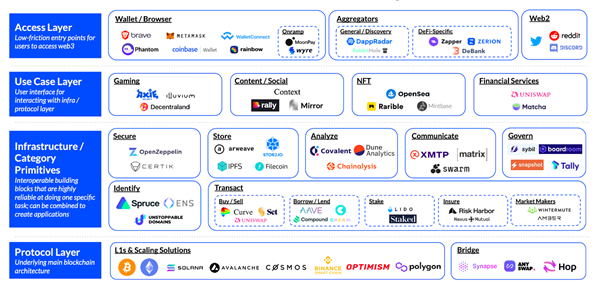
D'un point de vue pratique :
Niveau protocole : Ethereum prend en charge environ 90 % des applications Web3.
Couche d'accès : the Brave web browser, created by Mozilla co-founder and inventor of Javascript, has seen tremendous growth. It natively integrates crypto wallets, supports IPFS, includes decentralised DNS and rewards users using Basic Attention Token (BAT). Brave currently has ~50 million monthly active users and user growth has more than doubled annually each year depuis le lancement du produit.
Accès au portefeuille : Metamask est utilisé par 21 millions d'utilisateurs mensuels pour connecter leur valeur numérique àSites Web3.
Accès NFT : OpenSea is marketed as the “world’s first and largest NFT marketplace” with over 600 thousand users and 80 million NFTs attracting vast sums of money. It is supporting “EIP-721: Non-Fungible Token Standard” and “EIP-1155: Multi Token Standard”, which essentially simplifies the whole process of creating an NFT.
DeFi : the Uniswap protocol is a leading way to swap, earn and build on their crypto trading protocol without intermediaries. It is built on Ethereum’s blockchain technology and consequently much of it was written using Solidity, which is typically accessed via relatively standard web technology. The Uniswap V3 SDK, for instance, is written in TypeScript.
So, whilst the above might give the impression that Web3 technology is “good to go”, I would like to caution that much of Web3 is – in fact – heavily dependent on Web2. This is largely because the vast majority of clients were not written for Web3 but rather Web2. This has resulted in companies such as Infura.io stepping up to “increase developer productivity” by serving Ethereum data over HTTPS and WebSockets. Whilst this solves an immediate need, it adds fuel to the fire with respect to vast sums of money being raised from technology purporting to be decentralised but is practically “decentralised in name only” and is utilising Web2 technology. This is why the likes of Jack Dorsey [former CEO of Twitter and current CEO of Square] are openly hostile to much of the Web3 efforts and why he supports the development of Bitcoin with Spiral.xyz (a rebrand of Square Crypto), which is supporting the development of the Bitcoin Development Kit and the Lightning Development Kit (low-cost payments on top of bitcoin).
Existe-t-il des secteurs susceptibles de ne pas être influencés par le Web3 ? Si oui, pourquoi/pourquoi pas ?
Wow, voilà une sacrée question. Honnêtement, je considère le Web3 comme largement l'évolution du web. Existe-t-il des secteurs qui n'ont pas été influencés par le web ? Peut-être, mais je soupçonne qu'ils sont relativement peu nombreux.
To my mind, we will see Web3 evolve the public web and Internet. Then, much like Web1 and 2, industries associated with defense and critical infrastructure will have to pick and choose carefully how much they adopt such technology. Decentralised data will mean that both “friend and foe” have access to the encrypted data and of course they too can adversely affect performance and governance in decentralised systems. At the very least there will be many “impact assessments” across such organisations.
I suspect things will go in a similar way to intranets vs the Web. Overzealous network administrators often locked down Intranets in the early days but a decade of website blocking, workarounds etc. has widely led towards a more targeted approach to security for all but the most sensitive areas.
How many software engineers are happy writing code without listening to their favourite music streaming service? Do they enjoy downloading their software dependencies when adhering to their security policies? Can they compete against adversaries without such restrictions? Practically, I imagine that Web3 will only add to the mounting pressure for increasingly targeted security measures.
J'espère que le Web3 offrira des niveaux croissants de transparence et de responsabilité, et, je l'espère, un environnement moins hostile et plus équitable.
Selon vous, les entreprises du Web2 peuvent-elles opérer une transition en douceur vers le Web3 ?
Absolutely. Many of the dominant Web2 companies are centres of excellence in their field. Whilst there have been many DLT supporters to date, I hope that more will recognise that DLT has a strong social component. Web3 participants want access to opportunity, to set the rules and be empowered to make a meaningful difference – democratic digital property if you like.
Google and Apple did an incredible job at bringing mobile to the world – they did this by empowering thousands of mobile developers to make a difference and be rewarded via their App Stores. DLT creates an opportunity for more to be rewarded, whether they are developing new functionality, supplying data or given new opportunities to work. I’d love to see the very best technology organisations participate in what has largely been a grassroots effort.
Y a-t-il autre chose que vous souhaitez ajouter ?
It has been great to talk to you about Web3 and I really just wanted to say that regardless of where this technology is now, I think that we are fundamentally talking about something very special. The Internet of Finance, the Tokenisation of Everything, the Ownership of Global Digital Property…whatever we call it, I think many can see this is likely to have a profound impact on the world. À ce jour, nous avons vu les plus grandes entreprises mondiales franchir les premières étapes, aux côtés de particuliers fortunés et même d'un pays, El Salvador.
Whilst some have their concerns, I largely see this technology as being a force for good – honest money, open to all technology and something that streamlines processes. That said, it raises huge questions…many of which I don’t think anyone has great answers for yet. I hope that it will bring much needed conversations about our place in the world, how we add genuine value, how we tax, global inclusion and how countries collaborate and/or compete.
For example, I expect many billing systems to be disrupted. What happens when we can “pay per frame” for video content? Will music artists release limited edition NFTs that people will have to buy to listen to the music legally? Will audio players, video games etc. respect NFT ownership etc.? Will physical stores of value move to digital property? How will tax authorities cope with trillions of transactions happening at the speed of light? Is it reasonable to expect vast amounts of data to be retained for years to comply with existing law? How can laws for the physical world in a local jurisdiction realistically be applied to global digital systems?
Given the above, I hope that solution providers will be able to work with authorities around the world to help them take a more active role in the development of DLT systems with a view to creating fair and reasonable methods of compliance. For example, I’d like to see taxation smart contracts, transparent KYC/AML system interfaces and the like so that 3rd party developers can create innovative systems that respect the law and can be used freely by citizens without an air of suspicion.
Je souhaiterais conclure avec 3 recommandations pour quiconque souhaite approfondir ce sujet :
Enfin, si certains lecteurs sont aussi enthousiastes que moi à propos de cette technologie, je serais ravi d'entendre leurs réflexions et recommandations.
Avertissement financier : Oliver est principalement Senior Big Data Software Engineer chez Spyrosoft et possède une exposition à diverses cryptomonnaies et actifs numériques. Les commentaires formulés ne constituent pas un conseil financier.


arrow_circle_right Nos articles


