Interview avec Przemyslaw Nogaj et Lukasz Ornatek : Spyrosoft Synergy au Qt World Summit 2022


Notre partenariat avec le Qt Company ranges from business to R&D. On the one hand, our specialists support the development process, help Qt clients adopt Qt technology or solve certain architecture challenges. On the other hand, we also regularly cooperate in terms of improving the Qt framework.
Lors du Qt World Summit de cette année, nous souhaitons partager l'une de nos idées. Dans l'interview suivante, Przemysław Nogaj, ingénieur logiciel principal C++, et Łukasz Ornatek, ingénieur logiciel senior C++, de Spyrosoft Synergy, donnent un aperçu de la solution d'amélioration que leur équipe a développée.
Quel était le problème que vous avez rencontré ?
Lukasz Ornatek: While working on our projects, especially for clients in the automotive sector, we’ve observed that their preference is to use Android-based solutions. Qt is a multi-platform framework that works perfectly with Android. Still, quite often, there’s the need to integrate a solution with various APIs offered by Android and this results in a bottleneck caused by a programming language barrier between the business logic and UI layers of an app.
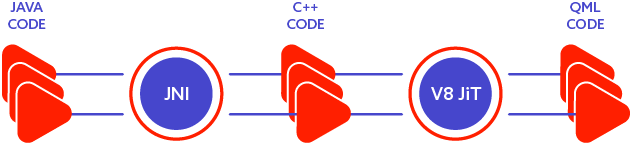
Przemyslaw Nogaj : Un exemple parfait est le cas du téléchargement d'une liste de contacts depuis un téléphone Android et de son affichage dans le système d'infodivertissement d'une voiture développé en Qt, ce qui nécessite de nombreux appels à l'API Android.
LO: That’s a nonoptimal process requiring breaking a few programming language barriers. In Qt, the UI is developed in QML, but to communicate with Android API, which is most often coded in Java, we needed to manually write a C++ code and then code it in Java. Usually, it entailed manually writing the so-called boilerplate code, which consisted of many repetitive elements. That was a very error-prone process, which we wanted to avoid, so we created a solution based on native Android mechanisms and Qt tools that improved the framework.
Comment votre solution résout-elle le problème ?
LO: Our solution, called QtAIDL, automates the process of writing the code, which enables the communication between the business logic and UI layers of an app. QtAIDL also allows the simulation of the Java backend before the final implementation is ready. Thus, the developer who codes the UI is not blocked and can work with the simulation.
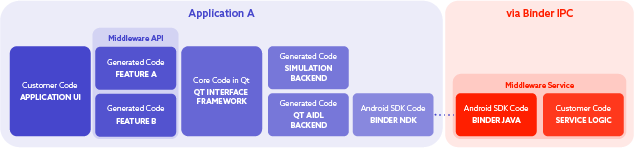
Nous souhaitons désormais partager notre solution avec la communauté Qt lors du Qt World Summit 2022. Nous ne voulons pas qu'il s'agisse d'un code mort, c'est pourquoi nous le partageons sous licence MIT. Chacun peut l'utiliser librement et proposer des améliorations supplémentaires.
PN: Our solution addresses many challenges. Firstly, we got rid of the language barrier. Developers can focus on either the QML or Java code. We can forget about writing the tedious boilerplate code. It allows us to optimise the workflow with regard to developer specialisation. Qt and C++ developers can concentrate on the UI, while Java developers can give their attention entirely to the business logic part of an app.
Il est difficile de trouver des développeurs Android qui codent simultanément en Java, C++ et QML. Grâce à QtAIDL, il est plus facile de séparer les compétences.
Quelles sont vos attentes pour le Qt World Summit 2022 ?
PN : Nous aimerions susciter des discussions sur les framework Qt améliorations, échanger des idées avec d'autres passionnés de Qt et apporter notre contribution à la communauté. Nous aimons Qt parce que c'est un framework open source auquel chacun peut contribuer, et nous souhaitons également le soutenir.
L'année prochaine, nous prévoyons également de participer au Qt Contributors Summit, où nous aimerions présenter certaines de nos idées à la communauté des contributeurs Qt.


arrow_circle_rightContactez-nous
Construisez une solution HMI qui offre une expérience fluide à vos clients

Przemyslaw Krzywania
Directeur HMI
arrow_circle_right Nos articles


