Qu'est-ce que l'analyse de potentiel Automotive SPICE® 2024 et quel sera son impact sur le secteur ?


The automotive world is rapidly transforming, with software taking the driver’s seat in shaping functionality and innovation. In this landscape, the question of whether suppliers can keep pace is more pressing than ever. Automotive SPICE® Potential Analysis (PoA), introduced in 2024 by the VDA QMC — the Quality Management Centre of the German Association of the Automotive Industry —offers a fresh lens for examining technical readiness. As a key organisation shaping quality standards in the automotive sector, the VDA QMC develops frameworks to foster consistency, reliability, and technical excellence. This new approach is quietly but firmly reshaping the dynamics between OEMs and suppliers, laying the groundwork for partnerships built to thrive in a software-led future.
Automotive SPICE Potential Analysis 2024 : un nouveau sujet dans le secteur
En tant que automobile industry pivots towards software-defined vehicles, Automotive SPICE PoA emerges as a timely and innovative tool. It evaluates the capability of collaborations or partnerships in delivering a specific planned product or service. Introduced in 2024, it bridges the gap between traditional evaluations and the need for swift, software-focused assessments. Automotive SPICE PoA is poised to become a game-changer in supplier evaluations.
Obtenez un guide gratuit sur Automotive SPICE
Télécharger maintenant
Le lien avec les normes VDA QMC
Automotive SPICE PoA présente des similitudes avec le Analyse de potentiel VDA 6.3, particularly Module P1, which has long been recognised for risk assessments. Traditionally, VDA 6.3 evaluates risks related to suppliers, technologies, production sites, and products. However, while VDA 6.3 encompasses a broad range of domains, Automotive SPICE PoA takes a more specialised approach.
En se concentrant exclusivement sur les systèmes logiciels, Automotive SPICE PoA constitue un référentiel indépendant Modèle d'évaluation des processus (PAM)/Modèle de référence des processus (PRM). Unlike VDA 6.3, it does not assess hardware or mechanical aspects, offering a targeted evaluation that meets the specific needs of modern Automotive software projects. This specialised approach is built on a standardised method, which is crucial for evaluating the capabilities of potential collaborations for product or service delivery, reducing risks, and facilitating process improvements.
Évaluation versus analyse de potentiel – principales différences d'évaluation
Les PoA Automotive SPICE et les évaluations complètes Automotive SPICE® 4.0 diffèrent considérablement par leur portée, leur objectif et leur application. Ces distinctions sont résumées ci-dessous :
In the case of specific assessments and evaluations, understanding or validating various Automotive SPICE models and guidelines becomes crucial. Automotive SPICE PoA is particularly effective in early project phases or scenarios requiring rapid evaluations, while full Automotive SPICE assessments remain indispensable for comprehensive process analysis.
![Automotive SPICE Potential Analysis vs. Automotive Spice 4.0 Assessment
1. [Criteria] Objective - [Potential Analysis] Quick evaluation of technical capabilities and initial filtering. - [Assessment] In-depth analysis of processes and compliance.
2. [Criteria] Scope - [Potential Analysis] Project level (Level 1 only), reduced content and duration. - [Assessment] Covers project and organisational unit (Levels 1-5).
3. [Criteria] Indicators - [Potential Analysis] Practices and information items. - [Assessment] Practices, information items, and process attributes.
4. [Criteria] Process Attribute Rating - [Potential Analysis] Three-tier scale: Fragmentary, Valid, Satisfactory. - [Assessment] Detailed Capability Levels (CL0-CL5).
5. [Criteria] Purpose - [Potential Analysis] Explore candidates, including small companies and startups, and evaluate risks. - [Assessment] Improve development and management processes across full scope.
6. [Criteria] Result - [Potential Analysis] Independent result, not integrated with Automotive SPICE assessments. - [Assessment] Fully aligned with Automotive SPICE results.
7. [Criteria] Application - [Potential Analysis] Risk evaluation, familiarisation with Automotive SPICE protocols. - [Assessment] Ensures compliance and long-term success in development.](/wp-content/uploads/2024/12/image-automotive-spice-potential-analysis-vs.-automotive-spice-4.0-assessment-895x1024.jpg)
Process Reference Model (PRM) dans Automotive SPICE PoA
Le Modèle de référence de processus (PRM) dans Automotive SPICE, le PoA est dérivé d'Automotive SPICE® 4.0, conservant son fondement méthodologique tout en rationalisant la structure pour des évaluations plus rapides. En se concentrant surNiveau de capacité 1, le PRM évalue les processus techniques critiques tout en excluant les aspects organisationnels non essentiels.
Le support joue un rôle crucial en facilitant les efforts d'amélioration des processus et d'analyse des problèmes dans le cadre du plan d'action Automotive SPICE.
Structure du PRM dans Automotive SPICE PoA :
1. Périmètre BASIC : processus fondamentaux obligatoires, incluant :
- Gestion potentielle de projet (POPM),
- Gestion des versions et de la configuration technique (RTCM),
- Process Quality Assurance (PQAS),
- Résolution de problèmes techniques (TEPR).
2. PLUG-IN : processus optionnels pour étendre l'évaluation dans des domaines tels que :
- Niveau système : Exigences et conception système (SYRD), Intégration et vérification système (SYIV),
- Niveau logiciel : Exigences logicielles, Conception et mise en œuvre (SWDI), Intégration et vérification logicielles (SWIV),
- Élicitation des exigences : Collecte et gestion des exigences des parties prenantes (REEL).
3. Périmètre FLEX :
Processus supplémentaires adaptés à des besoins spécifiques de projet, tels que la gestion des partenaires et de la collaboration (PCOM) ou la gestion des demandes de changement technique (TCRM).
Applications pratiques
Automotive SPICE PoA finds its strength in practical, early-phase applications. For instance, imagine an OEM working on a next-generation ADAS project. By leveraging Automotive SPICE PoA, the OEM can quickly evaluate multiple suppliers’ software development capabilities, ensuring they align with project needs. This evaluation includes assessing potential collaboration to ensure that partnerships are capable of effectively delivering planned products or services.
Similarly, suppliers can use Automotive SPICE PoA to identify gaps in their processes, such as inadequate traceability in testing, before presenting their readiness to OEMs. This proactive approach not only mitigates risks but also fosters stronger collaboration and confidence between stakeholders. It helps realise the capabilities of partners to effectively deliver planned products or services while addressing constraints and improving processes.
Évaluation des attributs de processus dans Automotive SPICE PoA
Automotive SPICE PoA utilise un système de notation simplifié à trois niveaux pour évaluer les résultats des processus :
1. Fragmentaire (gris clair) :
- Reflète des preuves insuffisantes ou une mise en œuvre partielle.
- Niveau d'atteinte : 0–50 %.
2. Valide (gris foncé) :
- Indique que la plupart des résultats sont atteints, bien que des écarts subsistent.
- Niveau d'atteinte : 51–75 %.
3. Satisfaisant (vert) :
- Démontre une réalisation complète, avec des écarts négligeables.
- Niveau de réalisation : 76–100 %.
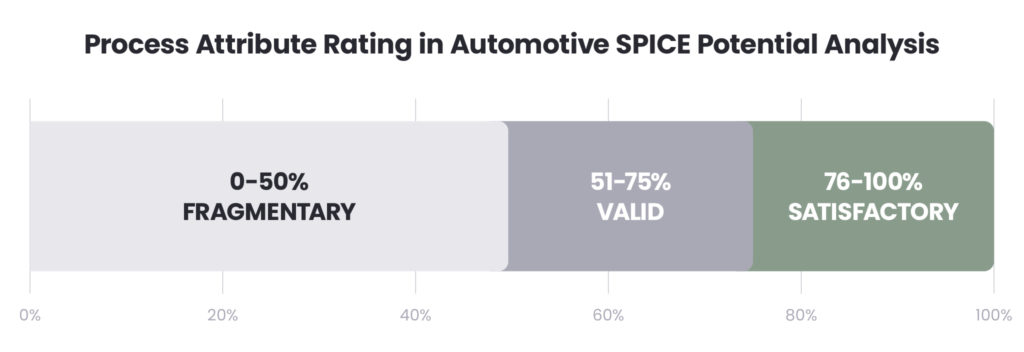
This system simplifies the evaluation process while identifying critical areas for improvement early in the project lifecycle. It is important to confirm user agreement to document license rules, ensuring compliance and understanding of the terms associated with the document.
Impact du plan d'action Automotive SPICE
Automotive SPICE PoA has the potential to reshape the automotive industry by fostering clarity, trust, and precision across all stages of development. For suppliers, it provides a roadmap to align with OEM expectations, highlighting areas for improvement and building readiness for complex projects. Successfully completing an Automotive SPICE PoA assessment enhances confidence and facilitates long-term partnerships with OEMs.
OEMs benefit from reduced risks through early evaluations of suppliers’ technical capabilities. The streamlined approach simplifies supplier selection while ensuring high-quality, innovative solutions. Automotive SPICE PoA also fosters collaboration, enabling OEMs and suppliers to address deficiencies jointly and strengthen their relationships.
For end users, Automotive SPICE PoA contributes to safer, more reliable vehicles. The robust software systems it promotes enable advanced features such as ADAS and connectivity solutions. By emphasising safety and traceability, Automotive SPICE PoA builds confidence in the reliability and innovation of Automotive systems, shaping a future driven by quality and trust.
Résumé et défis
Automotive SPICE® Potential Analysis 2024 is more than a tool; it’s a response to the Automotive industry’s shift toward software-first development. By focusing on evaluating the capabilities of potential partners to execute and deliver planned products or services, ensuring consistency, traceability, and effective process assessment. Automotive SPICE PoA bridges the gap between supplier readiness and OEM expectations. However, as a new methodology, its adoption will require time, training, and a willingness to adapt.
Il est essentiel que les utilisateurs acceptent les règles de licence du document, ce qui souligne l'importance de la conformité et du consentement de l'utilisateur dans les processus.
Alors que l'Automotive SPICE PoA est optimisé pour les évaluations en phase précoce, les organisations doivent équilibrer son efficacité avec les informations plus approfondies offertes par les évaluations Automotive SPICE complètes lorsque cela est nécessaire.
En maîtrisant avec succès ces scénarios, Automotive SPICE PoA pourra s'imposer comme un outil indispensable dans l'évaluation des fournisseurs, façonnant un avenir de systèmes automobiles sûrs, innovants et de haute qualité.
FAQ : Analyse potentielle Automotive SPICE® 2024
While Automotive SPICE 4.0 offers a comprehensive analysis of all process capabilities across an organisation, PoA focuses on early-phase evaluations and is designed for faster, software-centric assessments. It targets Capability Level 1 processes only, helping OEMs and suppliers identify strengths and gaps without the time and resource investment of a full assessment.
Both OEMs and suppliers benefit from PoA. OEMs gain early visibility into a supplier’s software development maturity and can make informed partnership decisions. Suppliers can identify process gaps, improve efficiency, and demonstrate readiness for complex projects, building trust with OEMs.
Les objectifs clés du PoA sont de :
– Évaluer la capacité technique d'un fournisseur et sa préparation à la collaboration.
– Réduire les risques liés au projet et au partenariat dès les premières phases de développement.
– Améliorer la communication et l'alignement entre les OEM et les fournisseurs.
– Fournir une feuille de route claire pour les améliorations de processus avant une mise en œuvre à grande échelle.
Automotive SPICE PoA is inspired by VDA 6.3 Module P1 (Potential Analysis), but it focuses exclusively on software systems rather than mechanical or production-related aspects. It complements VDA 6.3 by providing a specialised, software-driven assessment aligned with the industry’s shift toward software-defined vehicles.
As vehicles become increasingly software-defined, PoA helps OEMs and suppliers align faster, manage risks early, and strengthen cooperation. It supports safer, more reliable, and innovative automotive systems, making it an essential tool for maintaining quality and competitiveness in the evolving automotive landscape.




arrow_circle_rightContactez-nous
Contactez-nous pour découvrir comment nous pouvons soutenir votre projet automobile

arrow_circle_right Nos articles


